Roofing Contractor Serving Ottawa County, Oklahoma
Family-owned roofers based in Miami, the Ottawa County seat. Free inspections, storm damage repair and insurance claim help across northeast Oklahoma.
Ottawa County is 471 square miles of land, and it is not one place. The eastern side is Ozark Plains — rocky, wooded, rolling. The west is Neosho Lowlands: flat prairie and farm ground. Roofs fail differently on either side of that line. Our office is at 111 S Main St in Miami, the county seat.
Two Counties Inside One County Line
Drive east from Miami toward Wyandotte and the ground changes under you. It gets rockier, more wooded, more rolling — that is the Ozark Plains, and it runs across the eastern side of the county to the Spring River and the Grand Lake shoreline. Drive west and it flattens into the Neosho Lowlands: open prairie and farmland toward the Neosho River. Same county. Two different roofing problems.
Trees are what take roofs apart on the east side. A limb doesn't have to punch through the deck to matter — a branch dragging across shingles for two years scrubs the granules off and leaves the asphalt bare to the sun. Leaves pack the valleys — the V-shaped channels where two roof planes meet — and water backs up sideways under the shingles instead of running off. North-facing slopes under shade stay damp long enough to grow moss, and moss holds water against the roof like a sponge. On those homes we spend as much time in the valleys and gutters as on the open field of the roof.
West and central — Miami, Commerce, North Miami, out toward the farm ground — the enemy is wind and moisture, not trees. Open country means nothing slows the wind before it reaches your rakes and eaves, the sloped edge and the lower edge of the roof. Wind gets under an edge, lifts it, and works it looser every season. And in the low neighborhoods near the Neosho, humidity and saturated ground push moisture up into attics and soffits that were never vented well enough to dry out. That's a ventilation problem wearing a roof-leak costume.
The Homes Here Aren't Generic
Ottawa County has 13,701 housing units. About 76.7% are detached single-family homes and 12.2% are mobile or manufactured — roughly one home in eight. That second number matters. A manufactured home is a different roof: shallower pitch, often metal, and the failures show up at seams and fasteners rather than out in the middle of a shingle field. If a contractor walks your manufactured home and prices it like a stick-built ranch, he's guessing.
About 13% of the county's housing sits vacant, and much of that is second homes along the Grand Lake shoreline that nobody sees for months. An empty house doesn't tell you it's leaking. By the time someone opens the door in spring, a small flashing failure has soaked the decking and the insulation. If you own out there, a fall inspection is worth more than a spring one.
Median home value in the county is $123,300; median household income is $49,947. We say that plainly because it explains how we work. We're one family-owned office on Main Street in Miami. There's no fleet to feed and no ad budget to recover inside your quote.
What This Corner of Oklahoma Throws at a Roof
Northeast Oklahoma averages 4 to 5 days a year with hail bigger than three-quarters of an inch. That is the only hail number we'll put in writing, because it's the only one that's actually sourced. Anyone showing you a map with exact dates and stone sizes for your street is selling, not measuring. We'd rather get on the roof and look.
The quieter damage is temperature. Miami sits at 778 feet with 89 nights a year below freezing and 57 days above 90 — five of them over 100, with an August daily high that normals out at 91.5°F. The record high in town is 116°F, set in 1954. Water finds a hairline crack, freezes, expands, and makes the crack bigger; that happens eighty-nine times a winter. Then summer bakes what's left, and with roughly 62% sunshine a year, UV keeps working the south and west slopes even in years when nothing dramatic happens. Roofs here rarely die from one event. They wear out, and then an event finishes them.
The County Underneath the Roofs
Ottawa County was established at statehood in 1907 and named for the Ottawa tribe. Nine federally recognized sovereign nations are located here, five of them headquartered in Miami. Route 66 was commissioned in 1926 and ran through Quapaw, Commerce, Miami and Afton — Miami's Main Street is the historic alignment, and our shop sits on it, down the block from the Coleman Theatre, which opened in 1929. Commerce, about five miles north, was the first Route 66 town in Oklahoma coming west from the Kansas line.
In 1926 this county was the largest source of lead and zinc in the world; the mining began near Peoria in 1891. The legacy is the Tar Creek Superfund site and the chat piles, and we'll say it clearly: a roof has nothing to do with that. It is a ground, water and dust problem, and the EPA and ODEQ are who you ask, not a roofer. This county also contains a town that no longer exists. Picher had 1,640 people in 2000. An EF4 tornado struck it on May 10, 2008, destroying roughly 150 homes and killing six people. The state disincorporated it on September 1, 2009 after a buyout, and it was formally dissolved in 2013. That is county history. It is not a sales hook, and we won't use it as one.
Working a Three-States Corner
Ottawa County borders both Kansas and Missouri. That isn't trivia — it shapes the job. We work across Oklahoma, Kansas, Missouri and Arkansas because the state line is a short drive in two directions, not because we drew a growth map. Each state handles contractor registration its own way, and the rules follow the address of the house, not our truck.
In town, the City of Miami requires a permit for a new roof and for a re-shingle. We pull it. And under the current Oklahoma residential code, the state amended the section covering roof recover — IRC R908.3.1.1 — to require a tear-off instead of laying new shingles over the old ones in defined conditions. That affects your price. If a bid is cheap because it goes over the top of what's already up there, ask whether that's allowed on your roof, and get the answer before you sign.
After a Storm: What We Do and What We Don't
Inspections are free everywhere in the county — Miami, North Miami four miles up the road, Commerce about five north, Quapaw about nine northeast, Wyandotte about twelve, plus Fairland, Afton and the lake. If the roof is open, we can get a tarp on it. Then we photograph the damage, give you a written photo report, and write an estimate for the work we would perform.
Here's the boundary, and it's Oklahoma law, not modesty. We don't file, handle or negotiate your claim — a contractor who represents your interests for pay is acting as a public adjuster, and that takes a licence we don't hold. We can't touch your deductible in any way; advertising deductible help is illegal here. Your insurer decides what's covered. What we can do is document what we see, explain what the process means, and meet your adjuster on the roof if you ask. If you're considering an impact-resistant Class 4 shingle, ask your insurer whether they offer a discount — Oklahoma doesn't require one.
Forty-two neighbors have left us a Google review. We'd rather earn the next one honestly than promise you something we can't do.
Roofing in Ottawa County
Which Ottawa County towns do you actually serve?
Miami, Commerce, North Miami, Quapaw, Fairland, Afton and Wyandotte, plus the Grand Lake area. We are in Miami, the county seat, at 111 S Main St. If your address is not on our list, ask — we would rather tell you honestly than take a job we cannot service.
Why do you keep talking about the east and west sides of the county?
Because they are genuinely different. The eastern part of Ottawa County sits in the Ozark Plains — rockier, wooded, rolling — and roofs there mostly fail because of trees. The western part is the Neosho Lowlands — flat, open farmland — and roofs there mostly fail because of wind, or because moisture gets into an attic that was never ventilated properly. Same county, two different problems, 471 square miles.
You say you're licensed in four states. Is that real?
It is a function of where we are. Ottawa County is the extreme northeast corner of Oklahoma and it borders both Kansas and Missouri — Baxter Springs, Kansas and Joplin, Missouri are closer to our shop than most Tulsa suburbs are to downtown Tulsa. Working across state lines is not an expansion strategy here; it is the geography.
Do you work with the tribal nations in Ottawa County?
Nine federally recognized nations are located in this county and five are headquartered in Miami — that is a fact about where we live and work. Whether we are the right contractor for a specific tribal project is a conversation to have directly, not a claim to make on a website.
What about the Tar Creek Superfund site and the chat piles?
That is a ground, water and dust issue, and it is outside what a roofer can speak to. Ottawa County was the largest source of lead and zinc in the world in 1926 and the region is still living with it — but a roof does not address it, and we are not going to imply otherwise. The EPA and ODEQ are the right sources.
Do you charge for a roof inspection anywhere in Ottawa County?
No. Inspections are free throughout the county.
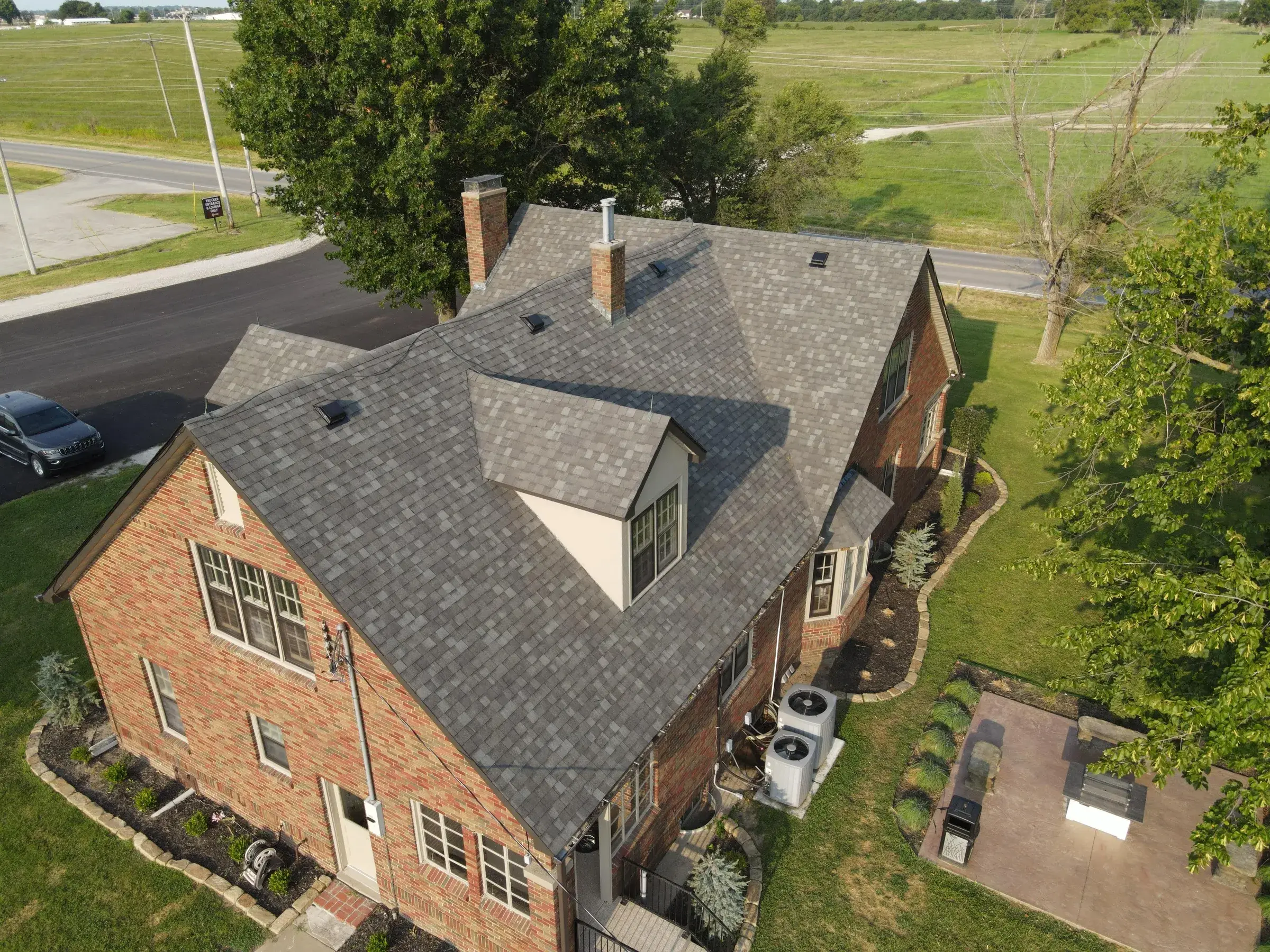
Free roof inspection in Ottawa County
Tell us what you're seeing. We'll arrange an inspection, explain the findings, and provide clear next steps without pressure.
- • A real look at the roof, not a sales visit
- • Photos of whatever we find, and what it means
- • A written quote if you want one — and an honest “you don’t need us yet” if that’s the answer