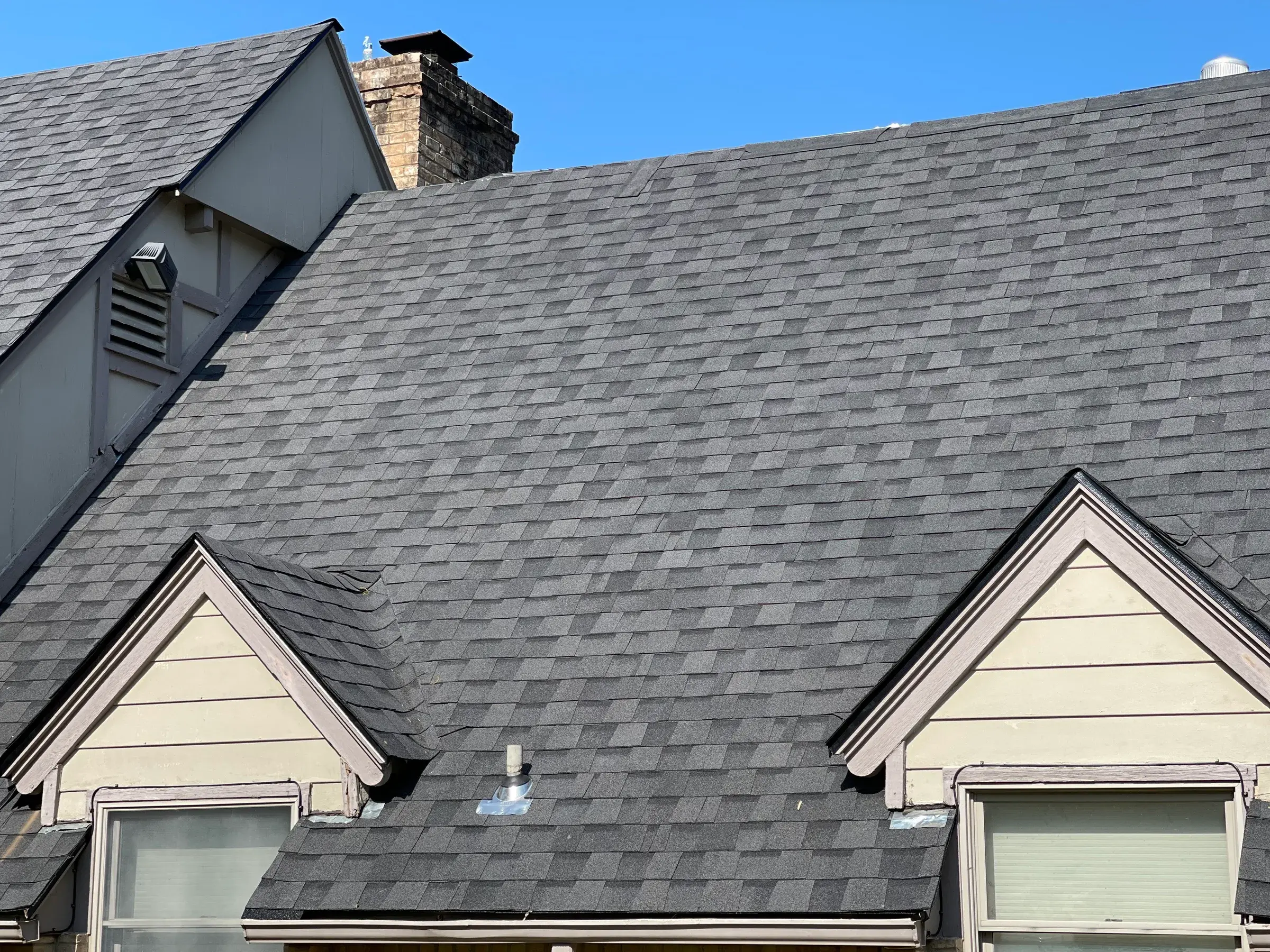
Roof Replacement in Miami, Oklahoma
A replacement is the one time your whole roof system is open — decking, ventilation, flashing, underlayment, all of it. We use that window to fix what the last roof got wrong instead of covering it up, and we put every layer on the estimate so you can compare our bid against anyone else's honestly.
If you're comparing roof replacement bids in Miami, Oklahoma, this page is built to help you read them. A replacement is the only time your whole roof system is open — decking, ventilation, flashing, underlayment. Below is what we look for, what goes on our estimate line by line, and exactly where cheap bids hide the money.
When a Miami, OK Roof Is Genuinely Done
Most roofs don't fail all at once. They fail in a pattern, and the pattern here is driven by heat and cold rather than one dramatic storm. Miami sees about 57 days a year above 90 degrees and five days above 100. It also sees roughly 89 nights a year below freezing. That combination — expand, contract, expand, contract — is what finally cooks the asphalt out of a shingle and leaves the mat brittle.
A roof is a replacement candidate, not a repair candidate, when the failures are no longer in one place:
- Granules in the gutters and downspout splash blocks year after year, not just after one hail day. The granules are the shingle's sunscreen — 62% annual sunshine here means once they're gone the asphalt goes fast.
- Shingle corners curling or cupping across whole slopes, especially the south and west faces that take the afternoon load.
- Shingles that crack when you flex them. A healthy shingle bends. A finished one snaps.
- Nail heads showing through, or shingles sliding out of course — the mat has lost its grip on the fastener.
- Three or four repairs in three or four different areas in the last couple of years.
- Any sag you can see from the driveway. That's decking or framing, not shingles, and it doesn't get better.
Hail complicates the picture. Ottawa County averages four to five days a year with hail larger than three-quarters of an inch. Hail doesn't always punch holes — it more often bruises, knocking granules loose and fracturing the mat under them, and that damage shows up as accelerated aging one or two summers later. If a roof was already brittle from age, a hail day is often just the last push.
Tear-Off vs. Overlay: Why We Almost Always Tear Off
An overlay — sometimes called a re-cover or a shingle-over — means new shingles nailed straight over the old ones. It's faster, it's cheaper, and it's the single biggest reason one bid comes in far under another.
Here's what you buy with the savings. Nobody looks at your decking, because the decking is buried. You add a full layer of weight to a structure nobody inspected. The doubled asphalt runs hotter under a Miami August, where the normal daily high is 91.5 degrees, which shortens the new shingles' life. The new shingles telegraph every ripple and lifted corner underneath. And when this roof is done, the next crew has two layers to remove instead of one, and you pay for that.
There's a code dimension too. Oklahoma amended the residential code — IRC section R908.3.1.1 — to require tear-off rather than shingle-over in defined conditions, which is stronger than the national baseline. It's the clearest signal in the state's own code that recovering an old roof is not treated as equivalent work. The City of Miami requires a permit for new roofs and re-shingles. We pull it.
What We Find Under Old Roofs in Ottawa County
Tear-off is the only time anyone sees the deck. What turns up follows the geography. East Ottawa County sits in the Ozark Plains — rockier, wooded, rolling — so those roofs carry more shade, more leaf litter in the valleys, and more debris damming water behind it. West of town it flattens into the Neosho Lowlands, open prairie and farmland, where roofs get more wind and more sun and less tree cover.
The recurring finds:
- Soft or delaminated decking along the eaves, almost always on homes where the soffit intake vents are painted over or buried under blown insulation. The moisture had nowhere to go and condensed on the underside of the deck all winter.
- Rot in the valleys and around chimneys, where debris held water against the deck and the old flashing was face-nailed instead of woven in.
- OSB panels swollen at the edges — the tell is a ridged, wavy line every four feet across the roof, which telegraphs right through the new shingles if you don't replace the sheet.
- No drip edge at all. Older roofs around here frequently have none, and the deck edge has been wicking water for decades.
- Reused pipe boots with the rubber collar cracked open. UV kills that collar long before the shingle around it fails.
Decking gets priced per sheet, and that unit price goes on your estimate before we start — so if a sheet has to come off, it's a number you already agreed to, not one invented on the roof.
The Layers on Your Estimate, Explained
A roof isn't shingles. It's roughly eight things stacked in order, and a bid that only names the shingle is hiding seven of them.
- Decking — the plywood or OSB sheathing. Look for a per-sheet unit price.
- Drip edge — the metal L that runs the eaves and rakes and pushes water into the gutter instead of behind it.
- Underlayment — the layer over the deck. Synthetic lays flatter, tears less under foot, and doesn't wrinkle the way felt does when it gets damp before dry-in. Felt in place of synthetic is a quiet downgrade on a bid.
- Ice and water membrane — a self-adhering peel-and-stick used in valleys and around penetrations. Oklahoma does not require it by code, so if you want it, it has to be a named line item or it won't be there.
- Starter strip — a purpose-made strip with the adhesive positioned at the eave edge. Some crews cut up field shingles to fake it, which puts the sealant strip in the wrong place and leaves your most wind-exposed edge unsealed. Ask for factory starter by name.
- Field shingles — including the nailing. Nails placed above the manufacturer's nail line, or overdriven by a gun set too hot, will not hold, and it's invisible from the ground the day it's done.
- Flashing — step flashing at sidewalls, counter flashing at the chimney, new pipe boots. New, not reused.
- Ridge cap and ventilation — see below. Cut-up three-tabs used as ridge cap crack early.
Ventilation Correction Happens During Replacement or It Doesn't Happen
Attic ventilation is a balance between intake at the soffits and exhaust at the ridge. Air enters low, rises, leaves high. When intake is blocked, exhaust vents pull air out of your living space instead of your attic, and your attic stays hot and damp. That's what rots decking from underneath and what makes a new roof age like an old one.
Once the field is stripped, we can actually see it: whether soffit vents are open or painted shut, whether insulation has been blown over the intake, whether the deck has staining, and whether previous owners mixed vent types. Mixed exhaust is the common one — a ridge vent plus open gable vents, or a powered fan next to a ridge vent, so the high vent pulls air from the other high vent instead of from the soffits. It short-circuits, and the far corners of the attic get no airflow at all.
Correcting it after the shingles are on means opening the new roof back up. That's why we treat it as part of the replacement, not an upsell after.
How to Compare Three Roofing Bids Without Getting Fooled
Get three bids. We mean that. But compare them properly, because the low number is usually low for a reason that's written down — just not in a place people look.
- Check the scope: tear-off to the deck, or overlay? Settle this first. Everything else is noise until you do.
- Find the decking allowance. Is there a per-sheet unit price, or does the bid go quiet about what happens if the deck is bad? Silence there is a change order waiting.
- Read the flashing line. 'Reuse existing flashing' or no flashing line at all means the new roof gets the old roof's weak points back.
- Check the underlayment: synthetic or felt? Named product, or just 'underlayment'?
- Check the starter and ridge cap. Factory starter and factory ridge cap, or cut field shingles?
- Look for ventilation. If it isn't on the estimate, it isn't happening.
- Confirm the permit is being pulled, and by whom.
- Ask each bidder for their Oklahoma roofing contractor registration number. Oklahoma registers roofing contractors — it does not license them, and no state in our service area requires a surety bond, so 'licensed and bonded' on a yard sign tells you nothing. A registration number you can check tells you something.
Your Property During a Replacement: Access, Debris, Landscaping, Pets
Tear-off is a demolition day. Being honest about that is more useful than promising it'll be tidy.
- Driveway: we need it. Move vehicles out the night before — for the dump trailer, and because that's where debris and fasteners land.
- Debris: old shingles come off in sheets and nails come with them. We tarp landscaping and run a rolling magnet over drives and lawns before we leave. Walk it with us.
- Landscaping: tell us about anything fragile — a bed, a fence panel, a satellite dish, an irrigation head near the drip line. It's easier to protect than replace.
- Pets: indoors, away from the perimeter. The noise is genuinely loud and the debris drop is constant, no matter how careful the crew is.
- Inside: hang a bed sheet over anything stored in the attic. Tear-off shakes decades of dust loose through the framing. Take pictures off the wall if you like them where they are.
- You don't need to be home. Most people would rather not be.
Replacement Timeline for a Typical Miami Home
Miami's housing is mostly detached single-family homes, and most of them are a one- to two-day tear-off and install once the crew is on site. Size, pitch, how many layers come off, and how much decking has to be replaced move that. Weather moves it more.
- Free inspection. We get on the roof, into the attic if we can, and photograph what we find.
- Written estimate, layer by layer, including the per-sheet decking unit price and the ventilation plan. Free, and yours to compare against anyone else's.
- Permit. The City of Miami requires one for new roofs and re-shingles. We pull it.
- Material delivery and staging, usually a day ahead.
- Tear-off — down to the deck, one section at a time. We don't strip more roof than we can dry in the same day.
- Deck inspection and repair, with you seeing what came off.
- Dry-in: drip edge, underlayment, membrane where it's specified.
- Install: starter, field, flashing, ventilation, ridge cap.
- Cleanup, magnet sweep, and a walkthrough.
One rule we don't bend: we don't open more roof in a day than we can close. In a county that averages four to five hail days a year and where a storm can be over you before the trailer's loaded, an open deck overnight is not a risk worth taking with your house.
We're a family-owned outfit on Main Street in Miami — the historic Route 66 alignment — with roots up the road in Commerce. We work across Oklahoma, Kansas, Missouri and Arkansas, and we treat every homeowner the way we'd want ours treated. The inspection and the estimate cost nothing. Call (209) 758-8550.
Roof Replacement questions
Can you just go over my existing shingles?
Physically often yes, and we almost always advise against it. An overlay hides the decking so nobody can see rot or delamination, adds weight, runs hotter, and shortens the new shingles' life. It also makes the next tear-off more expensive. If someone bids you an overlay against our tear-off, that's most of the price difference right there.
What happens if you find bad decking after tear-off?
We show you. Decking replacement is priced per sheet and we put that unit price on the estimate before we start, so there's no surprise number invented on the roof. In Ottawa County we most often find soft decking around chimneys, in valleys, and along the eaves of homes with blocked soffit ventilation.
How long does a roof replacement take?
Most single-family homes in Miami are a one- to two-day tear-off and install once the crew is on site, depending on size, pitch, layers and how much decking has to come off. Weather moves that. We don't tear off more roof than we can dry in the same day.
Do I have to be home during the replacement?
No, though you'll want to move vehicles out of the driveway and plan for noise. If you have pets, indoor is safer — tear-off drops debris and fasteners regardless of how carefully a crew works. We run a magnet over drives and lawns at the end.
What does a roof replacement cost in Miami, OK?
It comes down to squares, pitch, layers to remove, decking condition, and material choice — an impact-resistant shingle or a metal panel is a different number than a builder-grade three-tab. We won't quote a range sight unseen, because a number pulled out of the air is how homeowners get change-ordered later. The inspection and the written estimate are free.
Do you replace the flashing or reuse it?
New. Reusing old step flashing and pipe boots on a new roof is one of the most common shortcuts in this trade, and it's why new roofs leak at chimneys and sidewalls. If a bid doesn't say new flashing, ask why.
Will you correct my ventilation during the replacement?
That's the right time to do it. Once the field is stripped we can see whether intake and exhaust are balanced, whether soffit vents are painted or insulated shut, and whether previous vents were mixed in ways that short-circuit airflow. Fixing it later means opening the new roof back up.
Protect Your Property with a Free Roof Inspection
Tell us what you're seeing. We'll arrange an inspection, explain the findings, and provide clear next steps without pressure.
- • A real look at the roof, not a sales visit
- • Photos of whatever we find, and what it means
- • A written quote if you want one — and an honest “you don’t need us yet” if that’s the answer