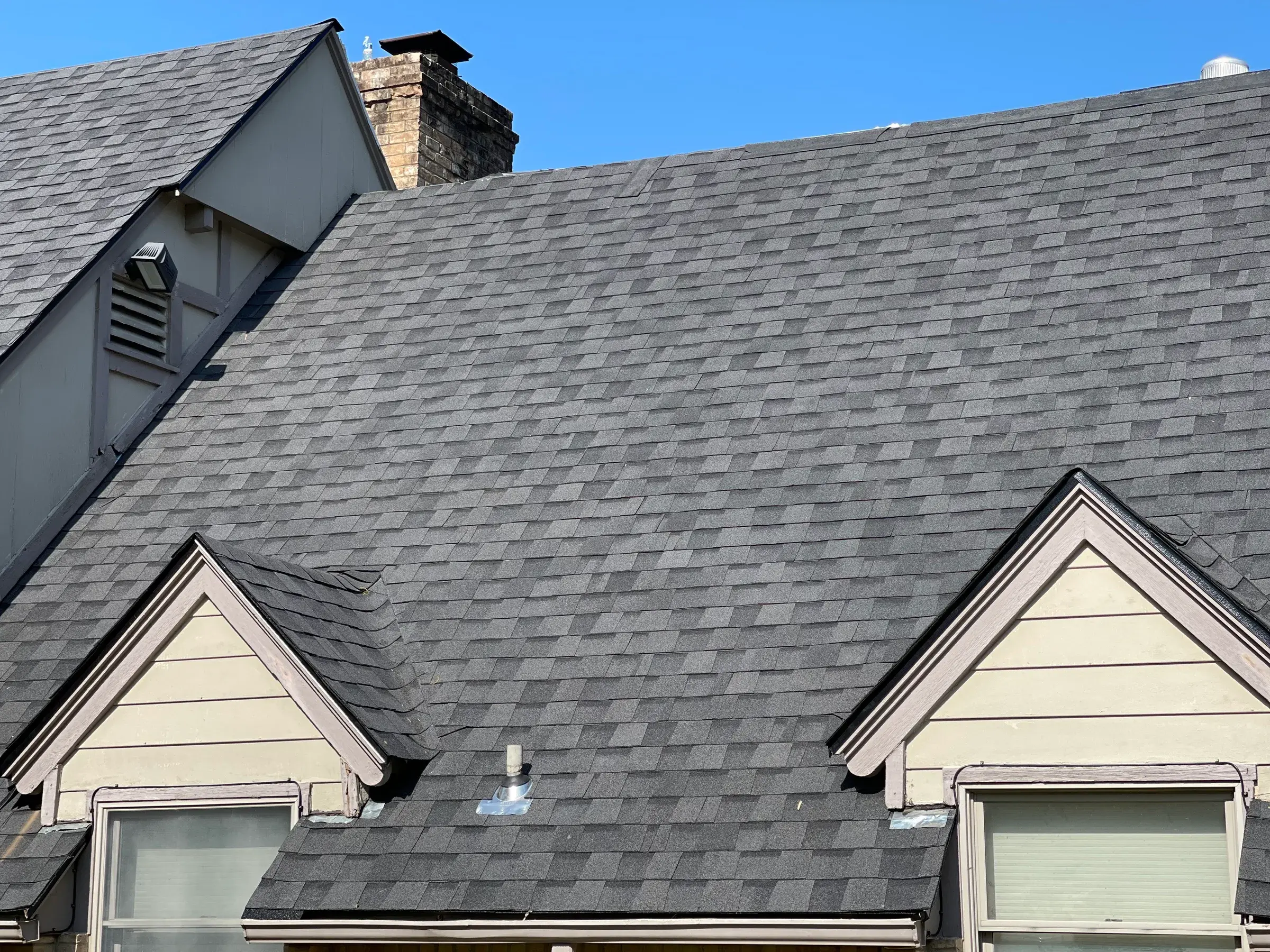
Skylight Repair & Installation in Miami, OK
A skylight is a hole in your roof with glass in it. Done right, it's watertight for decades. Done wrong — or done twenty-five years ago and never touched since — it becomes the most reliable leak on the house. We repair, replace and install skylights on Miami homes, and we're candid about which of those you need.
Two very different people land on this page. One has water on the drywall right now and wants it stopped. The other is thinking about daylight in a dark hallway. This covers both — how to tell a leaking skylight from a condensing one, why the flashing kit matters more than the brand name, and why an old skylight under a new roof is a callback waiting to happen.
Skylights are the most misunderstood thing on a roof. They get blamed for water they had nothing to do with, they get "fixed" with caulk that fails in a season, and they get left in place under brand-new roofs for reasons nobody can defend once you run the numbers. Here is how we actually think about them on Miami and Ottawa County homes.
Why Skylights Get Blamed for Leaks They Didn't Cause
Water doesn't drip where it gets in. It gets in somewhere upslope, runs down the underside of the decking or along a rafter, and exits at the first interruption it finds. On a lot of roofs, that interruption is the skylight.
So a failed vent boot, a nail that backed out, or bad step flashing — the L-shaped metal that ties the roof into a wall — twenty feet up the slope shows up as a stain on the skylight shaft. The homeowner replaces the skylight. The leak comes back.
There's a second reason skylights collect trouble: the head flashing at the top of the unit is a dam. Everything shedding down that slope stacks up against it. On the eastern side of Ottawa County — the rockier, wooded Ozark Plains half — leaf litter and twigs build a compost pack on the upslope side of a curb and hold water in the one spot the roof was designed to shed it fastest.
How we actually find it
- Look inside first. Where the stain sits on the shaft tells you a lot — water at the head of the skylight usually came from above it; water at the bottom corners more often came from the unit itself.
- Get on the roof and clear the upslope side. Half the time the debris pack tells the story before anything else does.
- Hose test from the bottom up, in zones. Start well below the skylight, run water for several minutes, wait, then move up one zone. Someone stays inside watching. Wetting the whole roof at once proves nothing.
- Check the glass or dome itself before touching the flashing. A fogged or crazed unit is a different problem with a different answer.
Curb-Mounted vs. Deck-Mounted: The Distinction That Decides Everything
A curb-mounted skylight sits on a built-up wooden frame — the curb — that stands proud of the roof plane, usually around four inches. The unit drops onto the curb. A deck-mounted skylight has an integral frame that sits down on the decking itself, so it sits lower and reads cleaner from the yard.
Curb-mount is more forgiving. That extra height is free clearance from debris, from snowmelt sitting behind the unit, and from water that's moving slowly because the slope is shallow. It's also easier to retrofit onto an existing opening. Deck-mount looks better and, flashed correctly, performs very well.
The part that matters more than either: they are not interchangeable, and the flashing systems are not interchangeable either. A curb-mount unit set on a deck-mount opening — or a new unit dropped onto a twenty-five-year-old curb that's out of square and soft at the corners — is where improvisation starts. Improvisation is where leaks start.
Flashing Kits: Why the Manufacturer's Kit Is Not Optional
Every skylight manufacturer supplies a flashing system built for that specific unit and that specific roof covering — one kit for shingles, a different profile for metal. It's a real system: an apron at the sill, individual step or soaker pieces working up both sides, a head flashing at the top, and usually a self-adhered skirt underneath the whole assembly.
The number one cause of a skylight leaking within a year of being installed is that somebody skipped the kit and built their own out of generic step flashing and a tube of sealant. It works. For a while. Then it doesn't, and by then it's invisible under the shingles, which is exactly why it keeps happening.
Sealant is not a flashing system. It's the last line of defense, and in Northeast Oklahoma it lives a hard life: 89 nights a year below freezing, 57 days above 90°F, and roughly 62% annual sunshine beating on it. That's a full cycle of expansion and contraction on the same bead of caulk, twice a day, for years. Metal laps handle that. Caulk eventually doesn't.
Condensation vs. Leak: The Skylight Diagnosis Everybody Gets Wrong
Here's the one worth reading twice. A large share of the "leaking skylights" we're called out to look at in January are not leaking. They're condensing.
Warm, moist air rises to the highest point in a room. The highest point in that room is a piece of glass with an Oklahoma winter night on the other side of it — and we get 89 nights a year below 32°F. The glass drops below the room's dew point, moisture in the air condenses on it, and runs down onto the frame and the drywall shaft. From your couch it looks exactly like a leak. It is not a roofing problem.
The tell is timing, and you can do this diagnosis yourself before you call anyone.
- Condensation shows up on cold, clear nights — often when it hasn't rained in a week.
- It gets worse after long showers, cooking, laundry, or a house full of people over the holidays.
- The water is clean and clear, and it forms on the glass surface itself, running down fairly evenly.
- A real leak shows up during or shortly after rain, usually enters at one point rather than everywhere, and the water is often dirty or rust-tinted from dust and fasteners.
- If it drips when it's dry outside, it is not the roof.
The fixes are ventilation and humidity, not roofing: bath and kitchen exhaust fans that actually terminate outside rather than dumping into the attic, indoor humidity kept moderate in winter, and a properly insulated and air-sealed shaft so the skylight isn't cold-soaked from the attic side. Attic ventilation matters here too — a cold, wet attic makes everything downstream of it worse.
One exception, and it's important. If the moisture is between the panes — a permanent haze or fog you can't wipe off from either side — that's a failed seal in the glass unit. No amount of ventilation touches it, and it cannot be repaired. That unit is done.
Old Acrylic Bubbles on Miami Homes: Crazing, Yellowing and Brittleness
Plenty of houses around Miami still carry the original acrylic dome on a wooden curb. Acrylic ages three ways, all of them visible from the ground if you know what to look for: it yellows, it goes milky, and it crazes — a fine spiderweb of surface fractures that catches the light. Under roughly 62% annual sunshine, 57 days a year above 90°F, and five days above 100°F, that dome is getting cooked on a schedule.
Then the real test arrives. Ottawa County averages 4 to 5 days a year with hail larger than three quarters of an inch. A new acrylic dome flexes and takes that. A crazed twenty-five-year-old dome doesn't flex — it shatters, or it splits along a craze line you couldn't see from inside.
Two other things worth checking on old dome units. First, the retainer frame that clamps the dome down usually has small weep holes designed to drain the channel. Painted over, caulked over, or packed with debris, that channel fills and pushes water inward — a leak that has nothing to do with the flashing. Second, look at the curb itself where it meets the roof. If the wood is soft at the corners, the unit is the least of it.
We'll photograph what we find and show it to you. You should be able to see the crazing yourself rather than take our word for it.
Replace the Skylight When You Replace the Roof
This is the money argument, and it's the one nobody in this market bothers to make.
Skylight flashing goes under the shingles. It has to — that's how the system sheds water. Which means the only way to replace a skylight is to open the roof around it. Do that during a re-roof and the roof is already open; the flashing is already off; the deck is already exposed. Do it three years later and you are cutting into a roof you just paid for, and the shingles you weave back in will never quite match the ones around them.
Oklahoma's situation helps here. The state amended IRC section R908.3.1.1 to require a tear-off rather than a shingle-over in defined conditions — so on many Miami re-roofs the deck around that skylight is fully exposed anyway. The unit is sitting there accessible, kit off, curb visible. The marginal cost of swapping it right then is a fraction of the cost of a dedicated return trip later.
Run the arithmetic on the alternative: a 20-year-old skylight left under a fresh 25-year roof is not a saving. It's a scheduled callback with a demolition bill attached.
- Tear off the field around the opening and get eyes on the curb, the deck edges, and the sheathing.
- Repair or rebuild any rot found — this is the moment it's cheap, and it's usually the corners.
- Set the new unit and install the manufacturer's flashing kit for that unit and that roof covering, in order, from the sill up.
- Shingle back over the flashing so the laps run the way water runs.
- Inspect the shaft from inside for the insulation and air-sealing that keeps the glass from cold-soaking come January.
One administrative note: the City of Miami requires a permit for new roofs and re-shingles. We pull it. That's not an upsell, it's just how the job is supposed to go.
Adding a Skylight or Sun Tunnel: What's Realistic
Whether we can put light into a dark room is decided by what's holding your roof up, not by what you'd like.
Conventional rafters can often be cut and headed off to make an opening. But that is a structural decision, not a roofing decision, and if it needs an engineer's eyes it gets an engineer's eyes. Engineered trusses are a different story: every member in a truss is doing a specific job in tension or compression, and you don't cut them. That isn't a negotiable opinion or a matter of nerve. If a truss is where you want the hole, the answer is no.
That's where a sun tunnel — sometimes called a tubular skylight — earns its keep. It's a small dome on the roof feeding a reflective tube that threads down between the framing without touching it, ending in a diffuser in the ceiling. Less structure, less shaft, no truss surgery. It won't give you a view of the sky. It will give you a hallway or a bathroom you don't need the switch for.
Where it goes matters as much as whether it goes
Orientation is a real design decision here. A north-facing skylight gives even, cool light all day. A west-facing one over a west-facing room in an August with a 91.5°F daily normal is a heat lamp aimed at your furniture. And a shaft that runs through an attic is a long insulated box you have to build correctly — get it wrong and you've built a chimney that delivers humid house air straight onto cold glass, which puts you right back in the condensation section above.
Skylights on Low-Slope and Commercial Roofs
Low-slope roofs change the physics. Water isn't running past a skylight — it's moving slowly, or sitting, and looking for the lowest place to get in. Debris doesn't wash off; it accumulates against the curb.
So curb height stops being a detail and becomes the whole thing. The curb has to stand high enough above the finished roof surface that ponded water and slush never reach the top of it. On a membrane roof, the flashing isn't a metal kit at all — the membrane itself wraps the curb, gets terminated mechanically at the top, and is counter-flashed. Different trade, different sequence, same principle: laps run with the water, sealant is not the plan.
Skylight manufacturers publish a minimum slope for their units. Below it, that unit doesn't go on that roof, whatever anyone tells you.
One safety point that gets overlooked on commercial buildings: an old, sun-brittled skylight in a walkable low-slope roof is a genuine fall hazard for anybody up there servicing rooftop equipment. It reads as solid and it isn't. Worth knowing before you send an HVAC tech up in July.
If You're Not Sure Which Problem You Have
That's fine — that's most calls. Bring us the timing (does it drip when it rains, or when it's cold and dry?), and we'll come look. Inspections and quotes are free, and if the honest answer is that your skylight is fine and your bath fan is venting into the attic, that's what we'll tell you. We'd rather be the roofer you call for twenty years than the one who sold you a skylight you didn't need.
Skylight Services questions
Water is dripping from my skylight. Is it leaking?
Maybe not. On a cold night, warm moist air from the house condenses on the inside of the glass and runs down onto the frame and drywall — it looks identical to a leak from below. The tell is timing: condensation appears on cold, clear nights and gets worse when you shower or cook, while a leak appears when it rains. If it drips when it's dry outside, it's condensation, and the answer is ventilation and humidity, not roofing.
Can a leaking skylight be repaired, or does it need replacing?
It depends where the water gets in. Failed flashing can be redone. A failed seal between the glass panes, a cracked acrylic dome, or a rotted frame means the unit is done — you can't repair a seal failure, and patching around a brittle 25-year-old dome is throwing money at it.
Should I replace my skylights when I replace my roof?
If they're old, yes — and this is a genuine money argument, not a sales pitch. Skylight flashing sits under the shingles. Doing it during a replacement is a fraction of the cost of coming back later and opening a new roof to get at it. A 20-year-old skylight under a brand-new 25-year roof is a scheduled callback.
What's the difference between curb-mounted and deck-mounted?
A curb-mounted skylight sits on a built-up frame that stands above the roof plane; a deck-mounted one sits down on the deck itself for a lower profile. Curb-mount is more forgiving on lower slopes and easier to retrofit; deck-mount looks cleaner and, with the manufacturer's flashing kit, performs very well. What matters more than which one is whether the right flashing kit was used at all.
Can you add a skylight where there isn't one?
Often, yes, but the framing decides it. Rafters can sometimes be cut and headed off; engineered trusses generally cannot be cut, and that's not a negotiable opinion. If a truss roof is in the way, a sun tunnel — a small reflective tube threaded between the framing — often gets you the light without the structural problem.
Why did my skylight leak right after it was installed?
Almost always because it wasn't flashed with the kit made for it. Skylight manufacturers supply a specific flashing system for their unit and their roof type, and improvising with step flashing and sealant instead is the number one cause of a new skylight leaking. It's also invisible once the shingles are on, which is why it keeps happening.
Protect Your Property with a Free Roof Inspection
Tell us what you're seeing. We'll arrange an inspection, explain the findings, and provide clear next steps without pressure.
- • A real look at the roof, not a sales visit
- • Photos of whatever we find, and what it means
- • A written quote if you want one — and an honest “you don’t need us yet” if that’s the answer