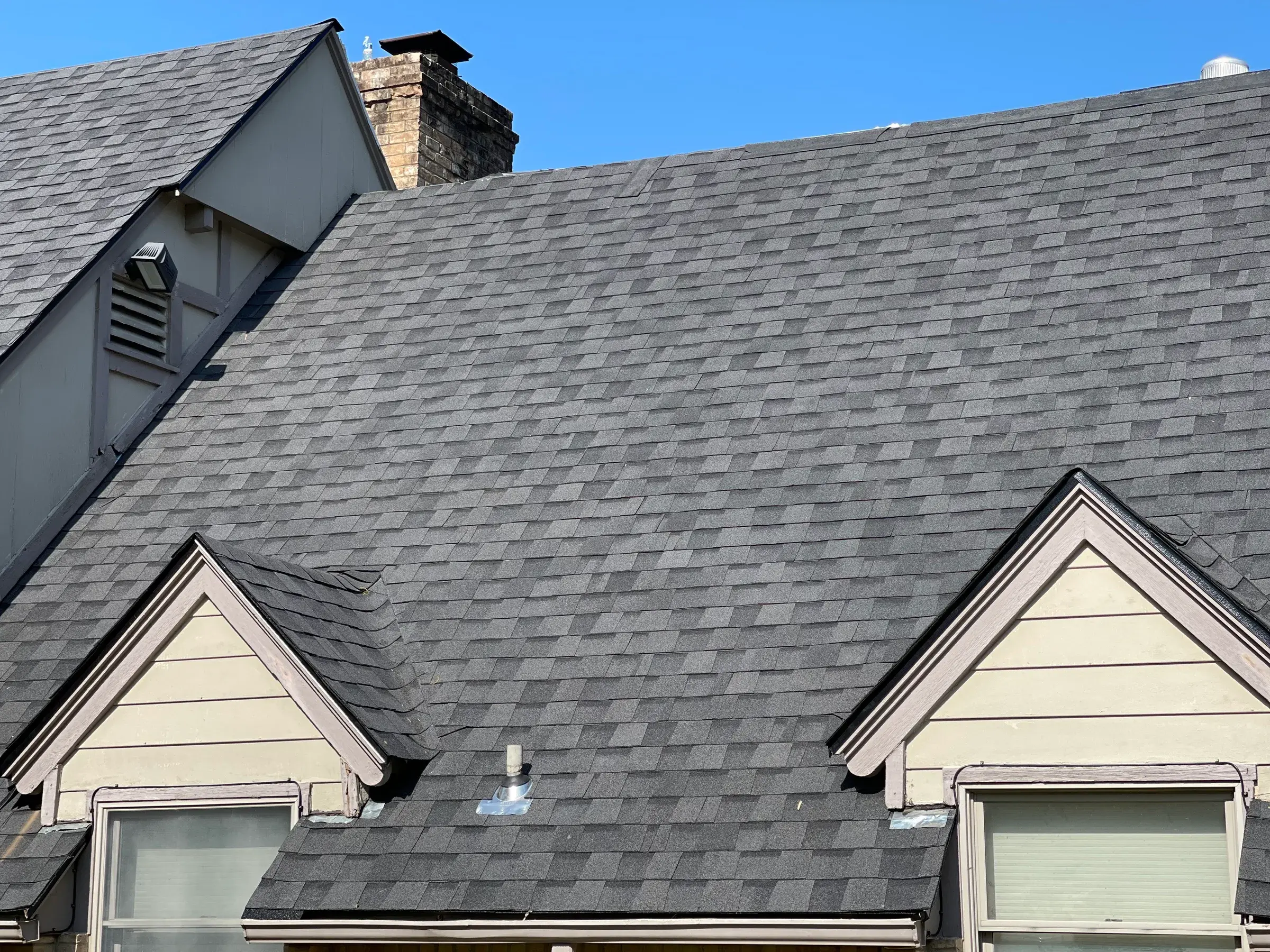
Gutter Cleaning in Miami, Oklahoma
A clogged gutter isn't a gutter problem — it's a fascia problem, a soffit problem, and in January an ice problem. Water that can't leave your roof edge goes backwards under the shingles instead. We clear gutters and downspouts on homes and buildings across Miami and Ottawa County.
Gutter cleaning is a small job that quietly protects an expensive one. The eave — where the roof edge, fascia, soffit and gutter all meet — is the most vulnerable part of your house, and it fails from water that couldn't leave. We clear gutters and downspouts on homes and buildings across Miami and Ottawa County, and we tell you what we saw while we were up there.
What Actually Happens When a Gutter Clogs
A gutter is a trough with one job: catch the water coming off several hundred square feet of roof and hand it to a downspout. It's hung with a slight pitch so water runs toward that downspout. Which means debris runs toward it too. The clog almost always forms exactly where the water is trying to leave.
Once the outlet is plugged, the trough becomes a bathtub. Water rises until it finds the lowest edge, and that's the outside lip — so it sheets over the front and lands where your gutters were installed to stop it landing. But the water going over the front is the harmless half. The half that matters goes backwards, over the inside lip, behind the gutter, onto the wood.
Debris doesn't stay fluffy here, either. We get 57 days a year above 90°F and roughly 62% annual sunshine. A gutter full of wet leaves in June is a gutter full of a dense, felted, half-composted mat by September — baked down into something a leaf blower will not touch. That's why the job gets harder the longer it waits, and why "I'll do it in the fall" often means doing last spring's work first.
Signs they're already full
- Water sheeting over the front edge during rain instead of running to a downspout
- Vertical dirt streaks down the outside face of the gutter
- A downspout that stays silent in a downpour — no water sound means no water moving
- Anything growing in the trough. A seedling means soil, and soil means it's been full for a year or more
- A dark line, blistered paint or soft spots on the fascia board behind the gutter
- Splash marks on the siding or an erosion trench in the dirt directly below the eave
Fascia Rot, Soffit Saturation and Backed-Up Eaves
Two words worth knowing. The fascia is the flat board running along the roof edge — it's what your gutter is screwed into. The soffit is the panel underneath, between the wall and the roof edge, usually with vents in it.
Here's the part people don't see coming. Fascia board is typically painted on the face you can see and left raw on the back, where it meets the gutter. So when overflow runs behind the gutter, it lands on the unpainted side of the board and rot starts on the hidden face. By the time the front is soft or the paint is lifting, the damage has been going for a while. The gutter is still hanging straight. The house still looks fine from the driveway.
Then it goes downhill in order. Soft fascia stops holding fasteners, so hangers and spikes work loose and the gutter begins to sag — which ruins the pitch, which makes it hold more water, which makes it heavier. Water working down past the fascia gets into the soffit. And a wet, sagging or blocked soffit means your attic's intake vents are compromised, because the soffit is where a roof breathes in. Attic airflow dies, moisture collects, and now a clogged gutter is a decking conversation. That whole chain starts with a handful of leaves at a downspout outlet.
Winter: Why a Full Gutter Becomes an Ice Problem
Miami averages 89 nights a year below freezing. That's not deep-north winter — it's something arguably worse for a roof edge: repeated freeze-thaw. Water gets in, freezes, expands, thaws, gets in further. Nearly ninety times a year.
A gutter full of saturated debris can't drain, so it holds that water right against the roof edge and the drip edge — the metal flashing that runs along the eave and directs water off the deck and into the trough. When it freezes, you get a solid plug of ice sitting exactly where meltwater needs to exit. Meltwater coming down the slope hits that plug, backs up, and starts working uphill under the shingles. Shingles shed water; they don't seal against it moving the wrong way. Water gets under a course and into the house.
That leak has nothing to do with a hole in your roof. It's also worth knowing that Oklahoma's residential code doesn't mandate an ice-barrier membrane at the eave the way northern states do — so on plenty of roofs here, there's no dedicated membrane under those first courses. And ice is heavy. A frozen trough on tired fascia is how gutters end up in the flowerbed in January.
The Ozark Tree Line: Why East-Side Properties Clog Faster
Ottawa County is genuinely two places, and it changes how often your gutters need attention. East of Miami you're into the Ozark Plains — rockier, wooded, rolling, oak and pine over the roofline. West of town it flattens into the Neosho Lowlands: open prairie and farm ground, far fewer trees.
On the east side, the enemy isn't autumn. It's spring. Oak catkins — the stringy flower tassels that drop in April and May — mat into the trough and pack a downspout outlet tighter than fall leaves ever do. Oak leaves themselves are leathery and slow to break down, so they don't rinse through; they layer. Pine needles are the worst of the lot because they weave together into a mesh that then catches everything else. A wooded lot east of town realistically needs more than two visits a year, and one of them should be after the catkins finish.
Out west on the open ground, homeowners assume no trees means no clogs. Then the downspout backs up anyway. What accumulates there is field dust, windblown seed and shingle granules — and granules are the constant everywhere. Sun and heat age a shingle surface, and every rain rinses some of that mineral surfacing into the gutter, where it settles at the low end as a dense sludge. It's not a leaf pile. You can look into the trough from a ladder, see almost nothing, and still have a plugged outlet. That's a real failure mode and we find it regularly.
One more local wrinkle: roughly 13% of housing in the county sits vacant at any time, a lot of it second homes around Grand Lake. Those gutters overflow for an entire season with nobody standing in the yard to see it happen. The fascia damage on lake properties is often years old before anyone notices.
Downspouts, Underground Drains and Where the Water Goes
Scooping the trough is the easy part. The blockage usually lives in the downspout — most often at the top elbow, where the water changes direction and debris doesn't, or at a crimped joint partway down where the pipe narrows slightly by design.
So we don't consider it clean because it looks clean. We confirm flow — water in at the top, water out at the bottom. If it surges back out of the top elbow seam instead, the blockage is below that point and we keep working. A trough that drains into a plugged downspout is a trough that fills from the bottom up the next time it rains, and you'd never know we'd been there.
Plenty of homes around Miami route downspouts into buried drain lines running out to daylight or the street. Those silt up with granule sludge over the years and can take root intrusion, and there's nothing to see from the ground. If your downspout is full to the elbow and the trough is clean, the problem is underground. We'll tell you that plainly rather than clearing the same gutter twice. Where the water lands at the end matters too — a downspout discharging straight against the foundation is just moving your problem from the roof to the slab.
Gutter Cleaning vs. Gutter Guards: An Honest Comparison
Guards are a real product that get sold with unreal claims. What's true: they handle big leaf litter well. A steep two-story with maples over it and a hard fall drop is a fair candidate, because the access itself is the expensive part.
What's also true, and rarely mentioned in the ad: pine needles thread straight into mesh and stay there. Shingle granules are fine enough to pack a fine mesh or slip through a coarse one. Fine organic grit off a wooded lot composts on top of the guard and turns into a shallow bed of soil — which then grows things. Surface-tension and reverse-curve designs can overshoot in a heavy downpour, sending water past the opening and over the front while the gutter underneath stays bone dry. And some guards fasten under the first course of shingles, which puts fasteners into an area whose entire job is shedding water.
The honest summary: guards move maintenance, they don't remove it. They also make the eventual cleaning slower, because everything has to come off and go back on. If someone tells you a guard means you'll never clean your gutters again, that's the sentence to distrust — not the product.
What We Look At While We're Up There
The eave is where roof problems announce themselves first, and we're already at eye level with it. Here's how a visit runs.
- Clear the trough by hand into a bucket and bag it — not blow it onto the roof, where it relocates into the valleys and starts the same problem somewhere less visible.
- Work the downspout from the top elbow down, including any crimped joints, until it's actually open.
- Flush the system with water and confirm it discharges at the bottom.
- Watch while the water is moving: seams, end caps and miters leak under flow and look perfectly fine when dry.
- Check that the trough drains empty. Standing water after a flush means a pitch problem or a sagging hanger, not a debris problem.
- Check the fascia and the hangers — whether the wood is still holding fasteners.
- Look at the drip edge, the first courses of shingles, and whether the soffit vents are open.
- Take the debris with us.
Things we flag if we see them: fascia that's soft behind the gutter, hangers pulling out, a drip edge that's missing or too short to reach into the trough, soffit vents painted over or blocked with insulation from inside, and unusual granule loading in the trough. That last one is worth a note — we get 4 to 5 days a year with hail larger than three quarters of an inch, and a sudden heavy load of granules after a storm is a reason to look at the roof itself rather than assume the gutter is the whole story. If it warrants a closer look, we'll document what we find with photos and put a written estimate in your hands for the work we'd perform. No pressure attached to it.
The Ladder Problem: Why This Job Sends People to the ER
Worth being direct about. A gutter is aluminum. It is designed to be full of water and nothing else — it is not a structural part of the house, and it is not a handhold. Leaning a ladder against it dents the trough, and a dented trough holds water where it used to move it.
Worse: you're setting that ladder against a board whose condition is the exact thing you can't see from the ground. If the fascia is soft — which is the whole reason clogged gutters matter — then you are bracing your weight against rotten wood. Add the classic mechanics of a fall: standing too high on the rungs, reaching sideways so your center of gravity crosses outside the rails rather than climbing down and moving the ladder, wet leaves underfoot on the roof edge, and soft ground after rain that lets one foot settle mid-climb.
None of that means you can't do it. Single story, level ground, a ladder you trust and a helper at the base — that's a reasonable Saturday. Two stories, a slope in the yard, or any doubt about the fascia, and it stops being a chore and becomes a risk with a bad payoff. This is one of the cheaper things there is to hand to somebody else.
Getting It Done
We're a family business at 111 S Main Street in Miami, and we work across northeast Oklahoma and into Kansas, Missouri and Arkansas. Inspections and quotes are free, and a gutter call is often how we meet people long before there's anything wrong with their roof. That suits us — it's easier to catch a soft fascia board than to replace one.
Call (209) 758-8550 and tell us where the house sits: wooded east side, open ground west of town, or somewhere out toward the lake. It genuinely changes what we expect to find in the trough.
Gutter Cleaning questions
How often should gutters be cleaned in Miami, OK?
Twice a year is a fair default — after autumn leaf drop and again in spring. If you're on the wooded east side toward the Ozark foothills, or you have oaks or pines over the roof, it's realistically more. Properties out on the open lowlands west of town clog more slowly but collect grit and seed.
What happens if I just leave them?
Water overflows at the eave, and the eave is the most vulnerable part of your house. It soaks the fascia until it rots, runs down into the soffit, and can back up under the first course of shingles. Standing water in a gutter also holds weight, and a full gutter pulling on old fascia will eventually take the gutter off the house.
Do gutters have anything to do with roof leaks?
More than people think. A gutter full of wet debris holds water against the shingle edge and the drip edge; in winter that water freezes, and ice at an eave forces water backwards up the slope, under the shingles, and into the house. That leak has nothing to do with a hole in your roof.
Are gutter guards worth it?
Sometimes, and they're not the end of cleaning. Guards handle big leaf litter well; they do poorly with pine needles, shingle granules and the fine organic grit that comes off a wooded lot, all of which pack into the mesh or slip through. They also make the eventual cleaning harder because everything now has to come off first. Worth considering, not worth believing the ad.
Do you check anything else while you're up there?
Yes — the drip edge, the fascia condition, the first courses of shingles, and whether the soffit vents are open. The eave is where a lot of roof problems announce themselves early, and we're already at eye level with it.
Should I just do it myself?
You can, but ladder falls at the gutter line are one of the most common serious home-maintenance injuries there is, and a ladder against a gutter you can't see the condition of is not a stable ladder. If the house is single-story, the ground is level and you're comfortable, fine. Otherwise it's a cheap job to hand off.

Protect Your Property with a Free Roof Inspection
Tell us what you're seeing. We'll arrange an inspection, explain the findings, and provide clear next steps without pressure.
- • A real look at the roof, not a sales visit
- • Photos of whatever we find, and what it means
- • A written quote if you want one — and an honest “you don’t need us yet” if that’s the answer