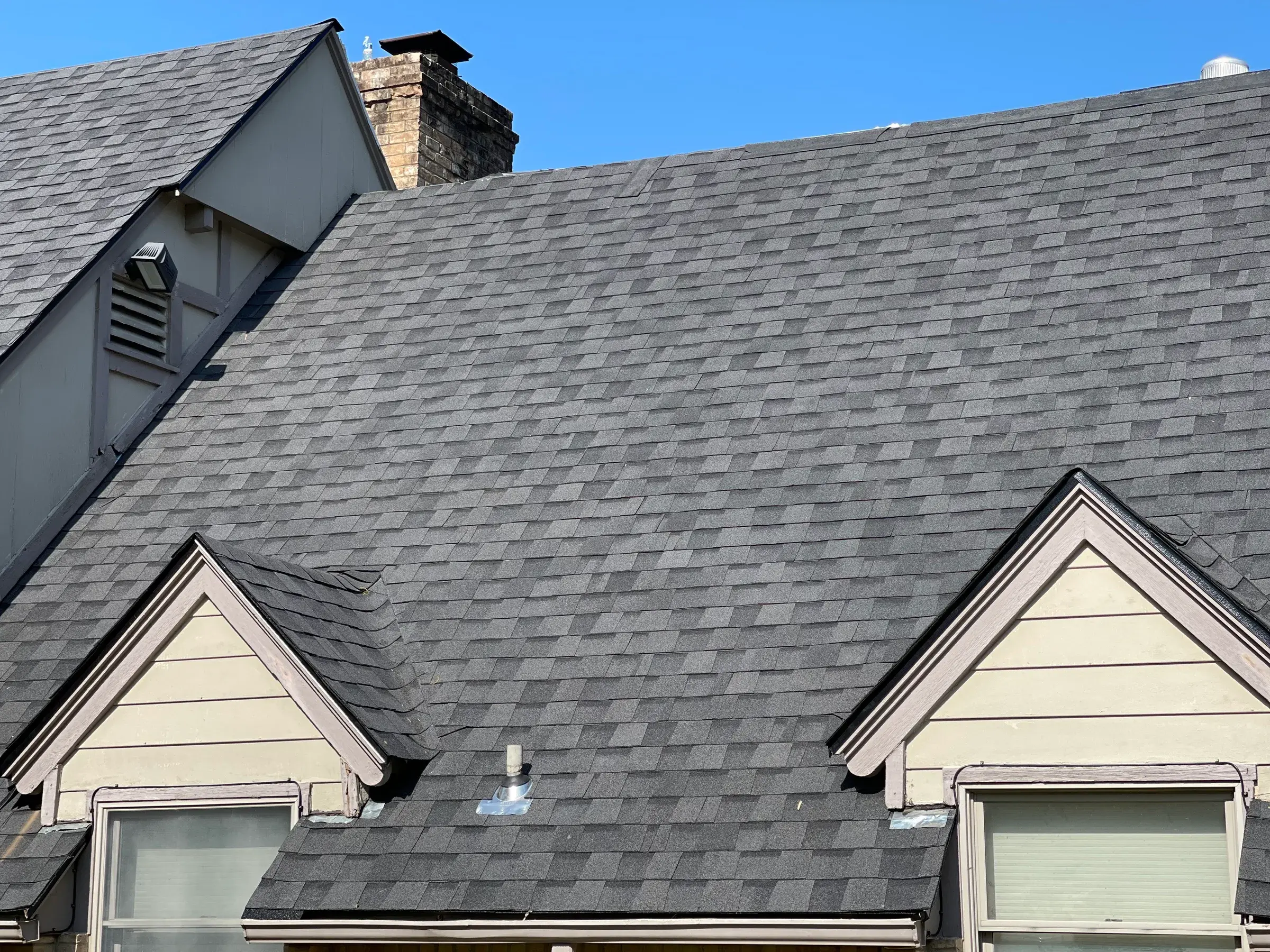
Gutter Repair & Installation in Miami, OK
Most failed gutters in Miami didn't fail — they were installed wrong, or they're simply too small for the roof above them. Pitch, hanger spacing, downspout count and outlet size all have to match the roof, or you get a channel that overflows every real Oklahoma downpour no matter how clean it is.
Clean gutters that still overflow aren't dirty. They're too small, hung wrong, or draining through an outlet that chokes before the trough ever fills. A gutter is hydraulic equipment sized to the roof above it. We repair sagging, separated and undersized runs, and install new ones as part of the eave rather than as an accessory bolted on afterward.
Why Gutters Fail: Pitch, Hangers, Sizing, Fasteners
A gutter has four things to get right, and three of them are settled the day it goes up. Cleaning fixes none of them.
Pitch first. A gutter is not level. It needs a consistent fall toward the outlet — about a quarter inch of drop every ten feet is the usual target. Too little and water stands in the low spot. Standing water is weight, and weight bends aluminum, which makes the low spot lower. On long runs hung by eye, we regularly find sections that actually fall away from the downspout.
Then hangers. Hidden hangers screw into the fascia roughly every two to three feet, tighter at corners and near outlets where load concentrates. Most of the failed gutter in this area is still hanging on the older system: a spike-and-ferrule, which is a long smooth nail driven through the front lip into the fascia board. Here is why that system fails specifically on Northeast Oklahoma houses. We get 57 days a year above 90°F and 89 nights below freezing. Aluminum expands and contracts through every one of those cycles, and a smooth nail has nothing to grip with. Each cycle backs it out a fraction. Eventually you get the classic sight from the driveway: a nail head standing proud of the gutter face and a run sagging in the middle.
From the ground, a gutter that's already failing usually shows you at least one of these.
- Nail or spike heads pushed out past the front face of the gutter
- A visible sag or belly in the middle of a long run
- A gap opening between the back of the gutter and the fascia board
- Staining or paint failure on the fascia and the siding directly below
- A trench line in the mulch or a stripe of erosion under one section
- Shingle granules piled in the trough — that's the roof telling you something separate
Undersized Gutters and Oklahoma Downpours
The number that matters here isn't how much rain falls in a year. It's how much arrives in ten minutes. Storm rain in this part of Oklahoma comes in a burst, and a gutter that handles a gentle drizzle can be flatly overwhelmed by a thunderstorm cell while being perfectly clean.
A gutter carries whatever the roof plane above it hands down. Two things push that number up: the size of the plane, and its steepness. A steep plane sheds faster and also catches more wind-driven rain on its face, so it delivers more water per minute than its footprint suggests. Put a 40-foot run with a single small downspout under a large, steep plane and you have a choke point that no amount of cleaning touches.
The choke is usually the outlet, not the trough. A 2x3 downspout is six square inches of cross-section. A 3x4 is twelve. That's double the drain for one size step. And we regularly find the hole cut in the gutter bottom is smaller than the downspout hanging under it — a 2x3-sized outlet feeding a 3x4 pipe. The pipe looks generous from the yard. The water is being throttled two inches after it leaves the gutter.
Where it spills tells you what's wrong
This is the diagnostic worth doing yourself. Next real downpour, stand under the eave and watch. Where the water leaves the gutter names the fault.
- Over the front lip in the middle of a run: pitch is off, or the run is holding standing water it can't move.
- Over the front near the downspout end: the outlet or the drop is restricted — that one may genuinely be debris.
- Behind the gutter and down the fascia: the roof edge metal is wrong or missing, not the gutter.
- Only in hard rain, never in light rain, and the trough is clean: that's capacity. Cleaning it again will not change it.
Repair or Replace: When a Gutter Is Worth Saving
Plenty of gutter is worth saving, and we'll say so. Re-pitching a run, pulling failed spikes and re-hanging on hidden hangers, resealing a separated seam or end cap, replacing a crushed downspout or elbow, cutting in an additional outlet — those are repairs, and they're often the honest answer.
What isn't worth repairing is metal that's creased or buckled along its length, a sectional run where every joint has already opened, a gutter hanging on fascia that's already soft, or a gutter that is simply too small for the roof. That last one is the trap. You can repair an undersized gutter to a perfect standard and it will still overflow, because you fixed the condition and not the cause.
Seamless vs. Sectional Gutters
Sectional gutter is assembled from short pieces lapped together and sealed at each joint. Seamless gutter is roll-formed on site from a coil, so each side of the house comes off the machine as one continuous length. The difference isn't cosmetic. Every lap joint in a sectional run is a sealant joint, and sealant is the component that ages first — it's being stretched and compressed through 89 freezes and 57 days over 90°F every single year. Joints open. That's where sectional runs start leaking, usually long before the metal itself is done.
Two honest caveats. Seamless isn't actually seamless: there are still joints at inside and outside corners, at end caps, and at outlets. It reduces the seam count, it doesn't eliminate it. And fewer seams doesn't fix capacity. A seamless run that's undersized for the plane above it overflows exactly like the sectional one it replaced.
Downspouts: Count, Placement, and Where the Water Goes
Count is where most installs get cheap. The working rule we use is an outlet at least every 30 to 40 feet of run, and more than that on a large or steep plane. Two drops beat one long one, because each outlet only has to carry its share instead of the whole roof.
Placement follows from that. If a long run drains to a single corner, every gallon the roof sheds has to travel the length of the house before it can leave — and the section nearest that corner is carrying all of it at once. Split the run, drop both ends, and you've halved the peak load without touching the gutter size.
Then there's the part nobody plans: where the water actually ends up. Ottawa County splits in two, and it matters here. West of Miami you're in the Neosho Lowlands — flat prairie and farmland. Flat is the problem, because a downspout extension has nowhere downhill to go, so the water pools where you set it down and works back toward the footing. East of town you're on the Ozark Plains, rolling and rockier, where you usually have grade to work with but shallow rock can dictate how and where an underground line gets routed. Same house, same gutters, two different drainage answers depending on which side of the county you're on.
Fascia First: You Can't Hang a Gutter on Rotten Wood
The hangers screw into the fascia — the flat board running along the roof edge behind the gutter. That board holds the gutter and everything in it. Water weighs roughly eight pounds a gallon, so a full run is hundreds of pounds hanging off one line of screws in one piece of wood.
Rot almost always starts on the back of that board, not the face. Water tracks down behind the gutter, sits against wood where nothing dries it, and eats it from the hidden side. The face can look painted and sound while the back is spongy. So the check isn't visual. We press it — at the screw holes, at the seams, at the low end of a run that's been sagging. Sound wood is hard. Rot gives. Paint blistering in a line, hangers pulled to an angle, and a gutter separating from the board at its top edge all point the same direction.
Sometimes it doesn't stop at the fascia. Water that's been running behind a gutter for years often has the rafter tails and the edge of the roof decking too, and at that point it's a decking repair conversation before it's a gutter conversation. We'd rather tell you that on the driveway than discover it with the new gutter already on the truck.
Gutters and Roofing Are One Job at the Eave
There's a strip about three inches wide along the bottom of your roof where the underlayment, the first shingle course, the edge metal, the fascia and the gutter all meet. Every one of those parts depends on the others being right. Detailing them separately, months apart, by different crews, is how the eave ends up as the weakest part of an otherwise good roof.
There's a code reason the timing lines up too. Oklahoma amended the residential code at R908.3.1.1 to require tear-off rather than shingling over in defined conditions, which means a reroof here generally opens the eave completely — edge metal off, first courses off, fascia exposed and visible for the only time in twenty years. That's the moment to check the wood, correct the edge metal, and size the gutter to the roof. It's also the moment existing gutters are sitting directly in the tear-off debris path. The City of Miami requires a permit for new roofs and re-shingles, and we pull it.
Gutters on Older Homes and Metal-Roofed Buildings
Miami was platted in 1891 as a planned town, and a good share of the housing stock reflects that. Older houses around here frequently have no drip edge at all, fascia in dimensions no modern board matches, or a gutter hung off a decorative frieze detail rather than a flat board. They also tend to carry steeper roofs than newer construction, which puts you right back at the capacity question — a steep old plane hands down more water than its footprint suggests.
Older homes raise a materials question too. Aluminum in direct contact with copper corrodes at the contact point in wet conditions, and so do bare steel fasteners driven into aluminum. If your house has copper flashing, or an old galvanized gutter someone proposes to tie into, that's a metal compatibility decision, not a style preference. Ask about it before anyone starts.
Metal roofs change the geometry. Water leaves a metal panel fast and doesn't slow down at the eave — it launches. A gutter set at the right depth for shingles can be overshot entirely by a steep metal plane in a hard rain, which looks exactly like a clogged gutter from the yard and isn't. And when ice does form across our 89 freezing nights, it releases off metal in a slab rather than melting in place, so hanger strength and gutter position both get decided differently on a metal roof than a shingle one.
One more local reality: manufactured homes are 12.2% of Ottawa County's housing units. They don't have a conventional fascia board to screw a hanger into, and attachment there is its own problem. If that's your house, ask how the gutter is being mounted before anyone turns up with standard hangers and a drill.
If your gutters overflow, sag, or you're just not sure whether they're worth keeping, we'll come look and tell you straight — including when the answer is a repair rather than a replacement. Inspections and quotes are free. Call (209) 758-8550.
Gutter Repair & Installation questions
My gutters overflow even when they're clean. Why?
Almost always capacity or pitch. Oklahoma rain doesn't fall gently — a large, steep roof plane can deliver more water per minute than a 5-inch gutter with a single downspout can carry, and it goes over the front lip. Adding downspouts, upsizing the gutter, or correcting the pitch fixes what cleaning never will.
Can my gutters be repaired instead of replaced?
Often, yes. Separated seams, sagging runs, pulled hangers and damaged downspouts are repairs. What isn't worth repairing is a gutter that's fundamentally too small for the roof, or one hanging on fascia that's already rotted — you'd be re-hanging good metal on bad wood.
What are seamless gutters?
Gutter formed in one continuous run for each side of the house rather than assembled from short sections joined together. Fewer seams means fewer places to leak and separate, which matters in a climate that expands and contracts everything through a hard freeze cycle. There are still seams at corners and outlets.
Do I need new fascia before new gutters?
If the fascia is rotted, yes. Gutter hangers screw into the fascia board — that board is what holds the gutter and the weight of the water in it. Hanging new gutter on soft wood puts you back where you started within a couple of seasons, and it's the most common corner cut on a cheap gutter bid.
Should gutters be done at the same time as the roof?
It's the efficient order. The drip edge, the first shingle course, the fascia and the gutter all meet at the same few inches of your house, and doing them together means those parts get detailed as one system. It also means the gutters aren't damaged by tear-off debris after you just paid for them.
Where should the water go once it's in the downspout?
Away from the foundation, which is the part everyone forgets. A downspout that discharges at the corner of the house is just relocating your roof's water to your foundation. Extensions or underground drains are cheap compared to what chronic foundation saturation costs.
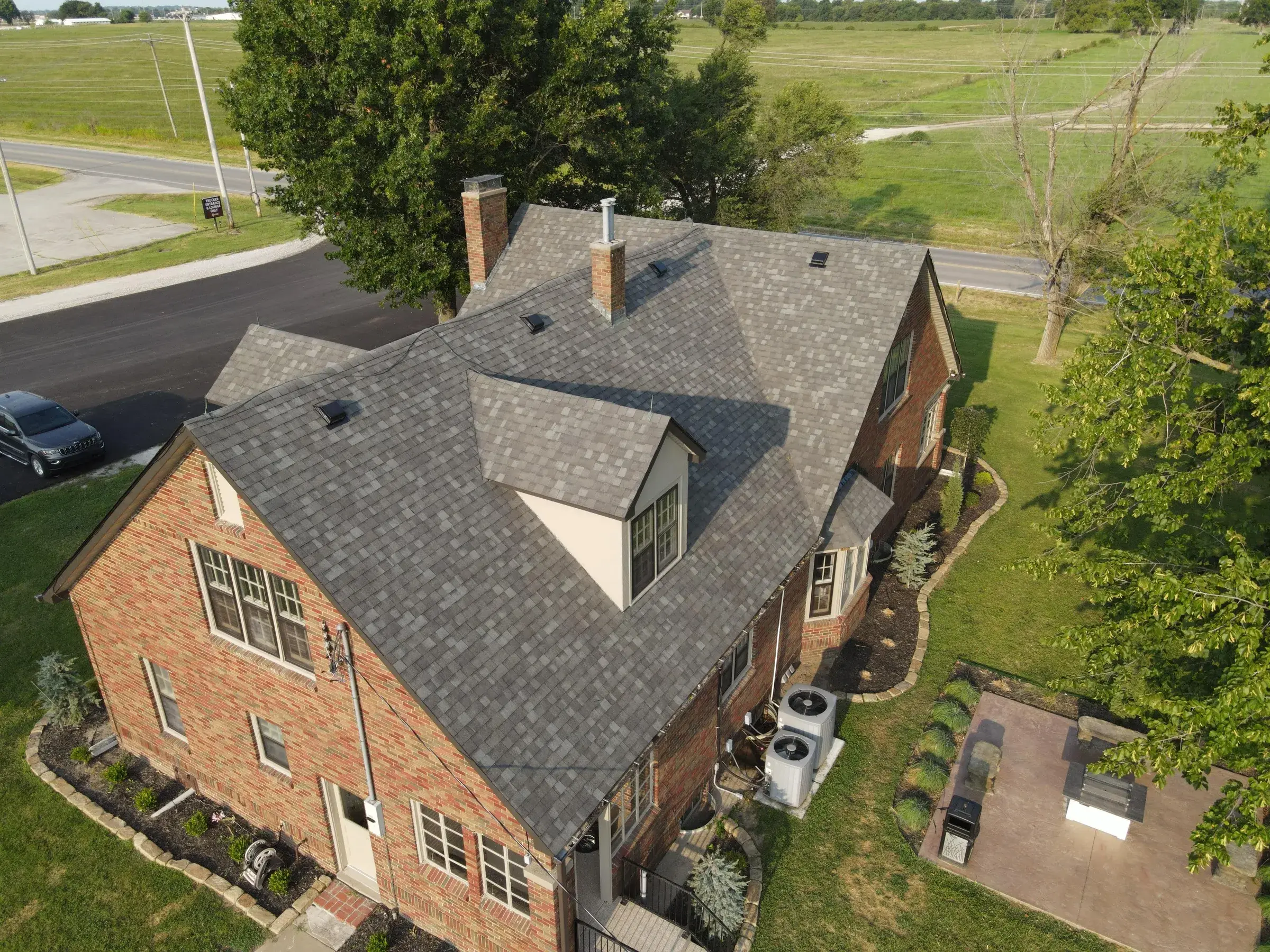
Protect Your Property with a Free Roof Inspection
Tell us what you're seeing. We'll arrange an inspection, explain the findings, and provide clear next steps without pressure.
- • A real look at the roof, not a sales visit
- • Photos of whatever we find, and what it means
- • A written quote if you want one — and an honest “you don’t need us yet” if that’s the answer