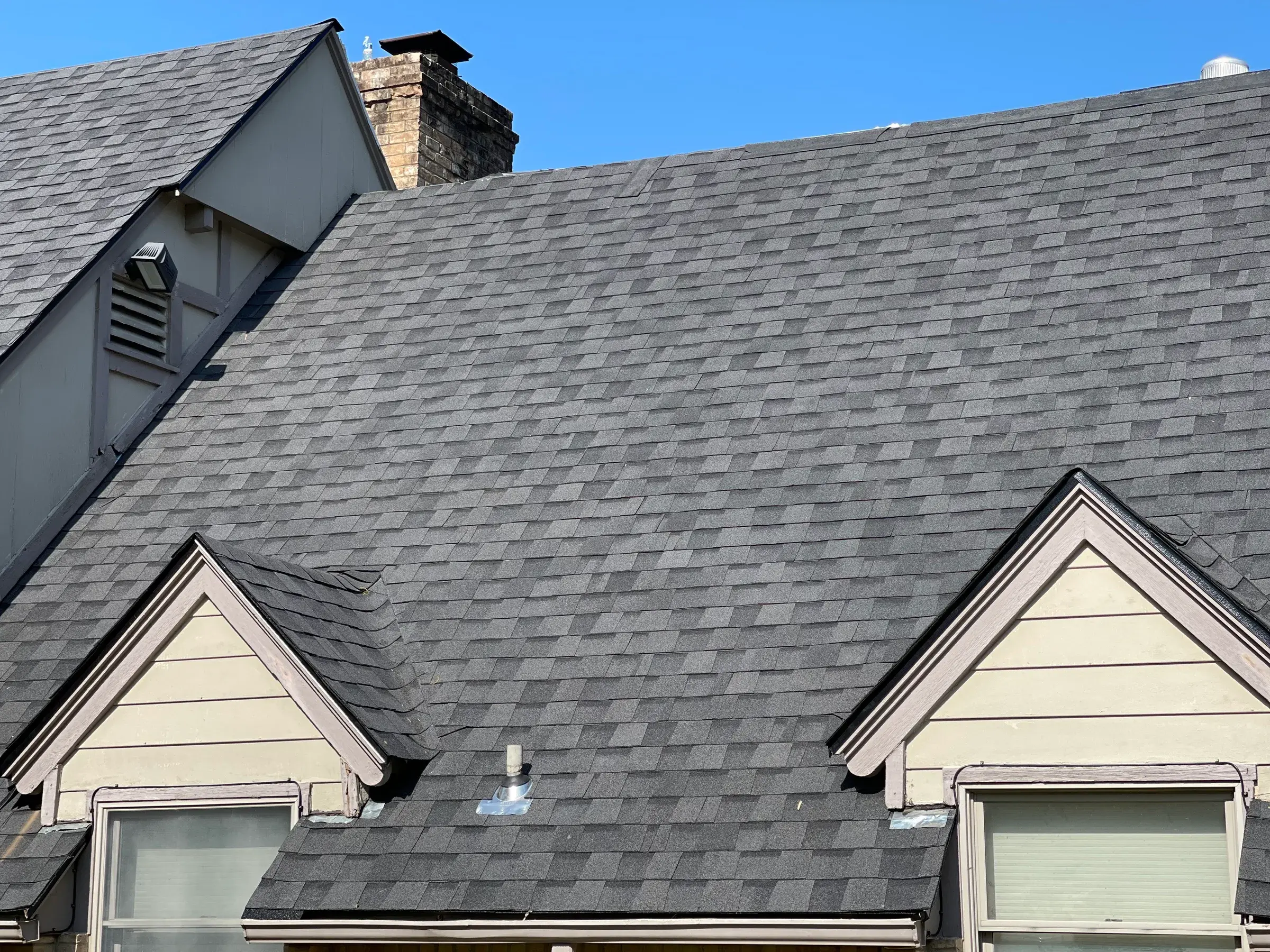
Roof Insurance Claim Assistance in Miami, OK
We document damage, we meet your adjuster on the roof, and we scope and price the repair. We do not negotiate your claim, interpret your policy, or promise approvals — because in Oklahoma a roofing contractor legally cannot. This page explains the line, the law, and exactly what help looks like inside it.
Hail hit, and someone is already at your door promising to handle everything. This page is about what a roofing contractor in Oklahoma is actually permitted to do for you on a storm claim — and what the law reserves for a licensed public adjuster. The line is real, it's written down, and knowing where it sits protects you. Here's the line, and what genuine help looks like on our side of it.
What We Can Do, and What We Legally Cannot
Start with the useful part, because there is real help here and it isn't small.
- Inspect the roof and tell you straight what we find — including "this doesn't look like a claim" when that's the honest answer.
- Photograph the damage slope by slope, along with the soft metals and any interior staining, and put it in a written report you can hand to your carrier.
- Write a scope — the actual line items of work — and a price for the repair or replacement we would perform.
- Meet your adjuster on the roof, if you ask us to be there, and show them what we documented.
- Tarp an open roof so the damage stops growing while the paperwork moves.
- Pull the City of Miami permit — the city requires one for new roofs and re-shingles — and build to current Oklahoma residential code.
- Explain the process so the vocabulary stops being scary.
Now the other side of the line. These are things we will not do, and it is not modesty. Oklahoma law puts them somewhere else.
- We don't negotiate with your carrier or your adjuster.
- We don't read your policy back to you and tell you what's covered. Your insurer decides coverage.
- We don't promise approval, and we don't quote approval rates.
- We don't touch your deductible in any form.
- We don't bill your insurance directly. Oklahoma voids assignment of benefits under 36 O.S. § 1230 — the claim stays yours, and the payment goes to you (and usually your mortgage company, if you have one).
If that list reads as a shorter menu than the roofer who knocked on your door last week, it is. He was describing a job that requires a license he almost certainly doesn't hold.
Contractor vs. Public Adjuster: The Line in Oklahoma Law
Oklahoma defines a public adjuster at 36 O.S. § 6202(4): broadly, someone who, for compensation, acts on behalf of an insured in negotiating or settling a claim. That is a licensed occupation in this state. A roofing contractor registration is not that license, and § 6220(E) draws the boundary directly at contractors — a roofer who crosses into representing your interests in the claim is doing unlicensed public adjusting, which is a misdemeanor.
There's a practical reason the line exists, and it's worth understanding rather than just obeying. A public adjuster is paid a percentage of your settlement and owes you a duty. A roofing contractor is paid to build a roof. When the same company both determines what your loss is worth and profits from the size of that number, the incentive bends. Oklahoma decided not to let that happen.
What a signed "authorization to represent" actually does
It does not fix the problem. This is the part homeowners get wrong most often. A contractor cannot hand you a form, have you sign away your authority to speak for yourself, and thereby become legal. Your signature does not cure unlicensed adjusting — the conduct is what the statute reaches, not the paperwork around it. If a roofer asks you to sign something that makes him your voice with the insurance company, read it twice and then don't sign it.
The Deductible: What Oklahoma Law Says (59 O.S. § 1151.30)
This one is unusually blunt for a statute. Under 59 O.S. § 1151.30, it is unlawful for a roofing contractor to advertise or promise to pay, directly or indirectly, any part of an insured's deductible. It was added in 2022 and amended effective November 1, 2025. The same section bars offering an insured anything of value in exchange for a service — which is why you will never see us offer a gift card for a review, a payment for a yard sign, or a referral bonus. Those are the same prohibition wearing a different hat.
"Indirectly" is doing heavy lifting in that sentence. A "storm discount" that happens to equal your deductible is indirect payment. A free upgrade thrown in to offset it is indirect payment. Writing a bigger scope than the roof needs so the carrier's check covers the deductible is indirect payment, and it is also fraud against your insurer, filed under your name and your policy number.
So budget for it. Your deductible is your share of the loss — that's the deal you bought. Knowing the number before you file is half the reason to get inspected first.
Your Contract Rights: Disclosures and Cancellation Under 59 O.S. § 1151.21
Oklahoma builds protections into any residential roofing contract that will be paid from an insurance claim, and most homeowners never learn they exist. Section 1151.21 requires a pre-contract statement, a specific legend printed in 12-point boldface, and a Notice of Cancellation supplied in duplicate in 10-point boldface. Those formatting requirements are not decoration — they're how you spot a contract that was drafted for Oklahoma versus one a crew brought in from three states away.
The cancellation right itself is commonly described wrong, including by roofers. It is not a generic 72-hour cooling-off period that starts when you sign. Under § 1151.21, the 72 hours run from the point you learn your carrier has denied all or part of the claim. That's the scenario the legislature was protecting you from: you sign, the claim gets denied, and suddenly you're personally on the hook for a full roof you only agreed to because you thought insurance was paying.
There is a second, separate right that people merge with the first one. Section 1151.5(I) says a contractor whose registration standing changes must stop soliciting and disclose the change, gets 30 days to cure it, and you may cancel. That one has no 72-hour clock attached to it at all. Two different protections, two different triggers.
Alongside those, § 1151.7(12) requires roofing work to be performed under a valid written contract, and § 1151.22(A) requires the contract to state that everyone working on the job is covered by workers' compensation. Before you sign anything, with us or anyone:
- Ask for the Oklahoma roofing contractor registration number and check it yourself.
- Ask for proof of liability insurance and workers' compensation.
- Confirm the contract carries the statutory disclosures and the duplicate Notice of Cancellation.
- Confirm there is a written scope with photographs attached — not a one-line "replace roof" and a total.
- Make sure the permit is addressed in writing, and that it's the contractor pulling it, not you.
How a Roof Claim Actually Proceeds, Step by Step
- Get the roof looked at first. Our inspection is free. If the damage is under your deductible, you'll know that before a claim goes on your record.
- If it's open to the weather, we tarp it. Most policies expect you to prevent further damage — an unaddressed hole becomes an argument later.
- We document: slope-by-slope photographs, soft-metal evidence, measurements, and a written scope and price for the work we'd perform.
- You file the claim with your carrier. You file it — it's your policy and your loss.
- Your carrier assigns an adjuster and schedules an inspection. Ask us to be there if you'd like us there.
- We walk the roof with the adjuster and show what we found. The determination is theirs.
- Your carrier issues a decision and, if it's a covered loss, an initial payment based on your policy's terms. Learn two words here: ACV (actual cash value, depreciated) and RCV (replacement cost value). Which one you have is in your policy — ask your carrier to point at it.
- We build the roof to the approved scope and to current Oklahoma code, under the City of Miami permit.
Documenting Damage So Your Adjuster Sees What We Saw
Ottawa County averages four to five days a year with hail larger than three-quarters of an inch. That's not exotic — it's Tuesday around here. Which is exactly why adjusters are careful: on a roof that's been through fifteen years of that, distinguishing this storm from every prior storm and from ordinary aging is the whole job.
Bruise or blister — the distinction the whole inspection turns on
A hail bruise on an asphalt shingle is a spot where the impact knocked the granules loose and fractured the fiberglass mat underneath — the woven layer that gives the shingle its strength. Press it with a thumb and it gives, soft, like a bruise on fruit. A blister is a manufacturing artifact: gas trapped in the asphalt pops out and leaves a small round crater with granules missing but the mat firm and intact underneath. They look alike from a ladder. They're nothing alike under a thumb, and one is a covered loss while the other isn't.
So we look for the things that separate storm from wear. Hail arrives on a wind vector — if the west and south slopes are peppered and the north slope is clean, that's a storm signature, not aging. Soft metals corroborate it: dents in your gutters, downspouts, roof vents, turbine caps, metal fascia wrap, and the fins of your AC condenser size the stone and tie it to an event. Adjusters commonly chalk a ten-by-ten-foot test square on each slope and count hits inside it; carriers set their own thresholds. We photograph the same squares so there's a shared record instead of two memories. Wind damage has its own tell: a shingle lifted and folded back leaves a horizontal crease across the tab, and the mat is broken even after it lays flat again. Missing shingles are obvious. Creased ones are the ones that get missed — and 57 days a year above 90°F soften the sealant strip that's supposed to hold those tabs down.
Timing matters more here than most places. A fractured mat in July is a leak in February, because we get 89 nights a year below freezing: water wicks into the fracture, freezes, expands, and opens it wider every cycle. "The roof isn't leaking yet" is not a test for anything. And if this is a lake place you're only at seasonally — roughly one in eight homes in this county sits vacant much of the year — the damage may have happened months before you found it, and most policies want prompt notice. Call when you find it, not when you're next in town.
Meeting the Adjuster on the Roof
This is genuinely useful and completely legal, and it's the single most valuable thing we do on a claim. We're there presenting findings, not arguing a position. We show the test squares, the soft-metal evidence, the creases, the flashing, and the underside if there's attic access. The adjuster measures, evaluates, and decides. That's their role and we don't try to occupy it.
Where our presence tends to actually change something is scope accuracy rather than persuasion. A scope written for a shingle-over layover may not match what Oklahoma requires: the state amended IRC section R908.3.1.1 to require tear-off rather than recovering an existing roof in defined conditions. If your roof is in one of those conditions, the scope needs to say tear-off, because that's what the permit and the code will require regardless of what the estimate assumed. Same with vents, drip edge, and pipe boots — items that are easy to omit from an estimate written on a tablet and impossible to omit from a roof that has to pass.
If the adjuster's findings and ours don't line up, that's a conversation between you and your carrier. Every policy has a process for it. We'll give you our documentation to use however you choose, and we'll tell you plainly whether we think the roof needs the work — but the claim is yours, and we won't pretend otherwise to win a job.
Storm-Chaser Tactics This Law Was Written to Stop
Every one of these statutes exists because someone did the thing it prohibits, repeatedly, in Oklahoma neighborhoods, after storms. Here's the field guide:
- "We'll cover your deductible" / "no out-of-pocket" / "free roof." Directly prohibited by 59 O.S. § 1151.30. This is the loudest one and the easiest to spot.
- "Sign here so we can deal with the insurance company for you." That's unlicensed public adjusting territory, and your signature doesn't legalize it.
- "We'll get it approved — we know how these companies work." Nobody can promise that. Approval depends on your policy, your deductible, the cause and extent of the loss, and your carrier's own inspection.
- A hundred dollars for a yard sign, or a gift card for a review. Anything of value offered to an insured for a service runs at § 1151.30 from the other direction.
- Urgency with no roof behind it. "We're only in the area this week" is a scheduling problem for them, not a reason for you.
- No Oklahoma registration number on the truck, the card, or the contract — and a phone number from somewhere else.
- A contract with no statutory disclosures, no Notice of Cancellation in duplicate, and no workers' comp statement. That contract wasn't written for this state.
We're a family business at 111 S Main St in Miami — on the old Route 66 alignment, which is the kind of address you can drive to in March when your roof is a problem and the crews that swept through in October are two states away. We'll be here. That's most of what the paperwork above is trying to guarantee, and we'd rather just be the thing than promise it.
We are roofing contractors, not public adjusters or insurance attorneys. Coverage decisions are made by your insurer under your policy.
Insurance Claim Assistance questions
Will you handle my insurance claim for me?
No, and be careful with anyone who says they will. In Oklahoma, negotiating or adjusting a claim on a policyholder's behalf is the work of a licensed public adjuster, not a roofing contractor. What we do is inspect, photograph, and provide a written scope and price for the repair — real, useful help that stays on the right side of the line.
Can you pay or cover my deductible?
No. Oklahoma law is explicit: 59 O.S. 1151.30 makes it unlawful for a roofing contractor to advertise or promise to pay, waive, absorb, or rebate any part of an insured's deductible. If a contractor offers this, they are telling you they'll break the law for you — which tells you what they'll do to you.
Can I cancel a contract I signed with a roofer after a storm?
Oklahoma builds cancellation rights into insurance-related roofing contracts. Under 59 O.S. 1151.21, a residential contract for work to be paid from an insurance claim must carry specific disclosures and a Notice of Cancellation, and the homeowner may cancel within 72 hours of learning the carrier has denied all or part of the claim. There is also a separate right to cancel if the contractor's registration standing changes. Read your paperwork before you sign it.
Do you meet with insurance adjusters?
Yes, when you'd like us there. It's a genuinely useful thing: we can walk the roof with the adjuster, show what we documented, and make sure the scope reflects what's actually on the roof. We're presenting findings — the adjuster's determination is still the adjuster's.
Will my claim be approved?
We can't tell you that and nobody legitimate will. Approval depends on your policy, your deductible, the cause and extent of damage, and your carrier's own inspection. Any roofer promising approval is either guessing or selling.
Should I get a repair estimate before or after I file?
Getting the roof inspected first is usually the smarter order. If the damage is under your deductible, you'll know before you put a claim on your record. If it isn't, you'll go into the claim with photographs and a scope instead of a hunch.
What paperwork should I insist on from any roofer after a storm?
Their Oklahoma roofing contractor registration number, proof of liability insurance and workers' comp, a written contract containing the statutory disclosures, and a written scope with photos. Oklahoma requires all roofing work to be performed under a valid written contract, and requires the contract to state that everyone working on it is covered by workers' compensation.
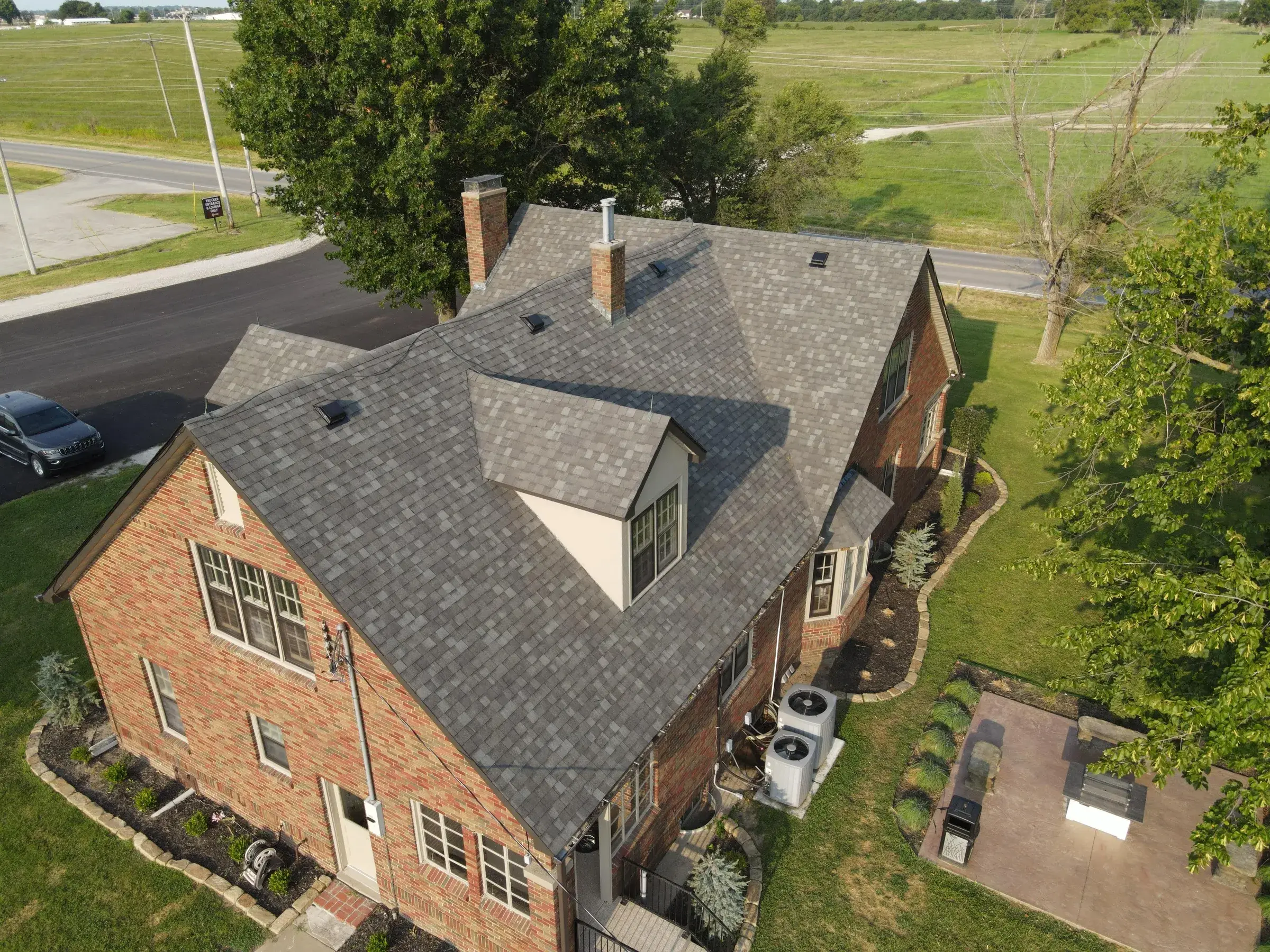
Protect Your Property with a Free Roof Inspection
Tell us what you're seeing. We'll arrange an inspection, explain the findings, and provide clear next steps without pressure.
- • A real look at the roof, not a sales visit
- • Photos of whatever we find, and what it means
- • A written quote if you want one — and an honest “you don’t need us yet” if that’s the answer