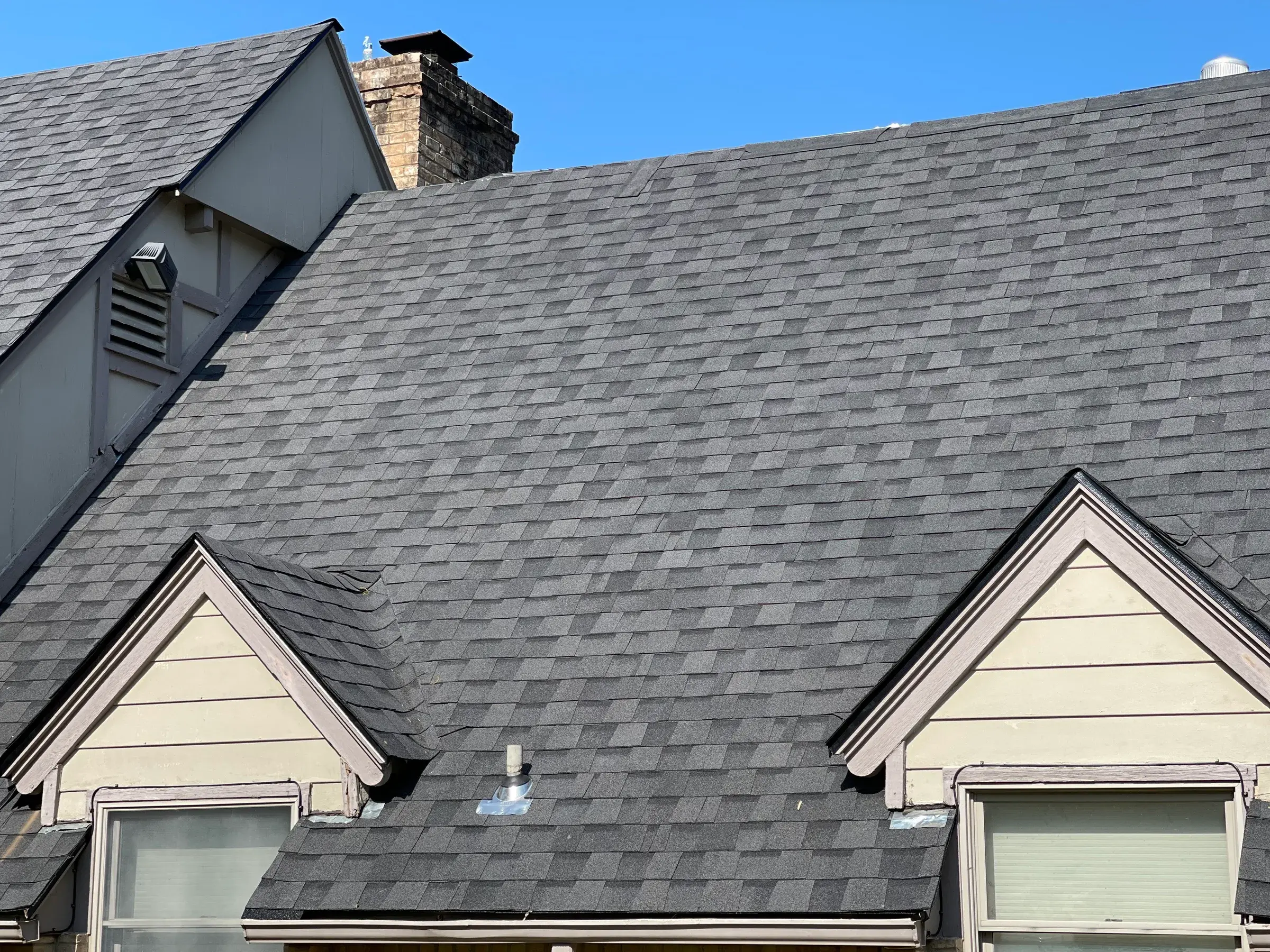
Wind Damage Roof Repair in Miami, OK
Wind doesn't have to remove a shingle to ruin it. A gust that lifts a tab and folds it back breaks the seal and creases the mat, and the shingle lies back down looking untouched. That's why wind damage is under-called on Miami roofs, and why we inspect the whole windward slope, not just the bare spots.
Wind damage on a Miami roof rarely looks the way people expect. Sometimes it's a bare patch of felt you can see from the driveway. More often it's a slope full of shingles that got lifted, broken loose from their seal, and set back down looking normal. Both are damage. Only one of them is obvious. Here's how we tell them apart.
Straight-Line Wind, Gust Fronts and Why This Corner Gets Hit
Tornadoes get the attention. Straight-line wind does most of the work. The same thunderstorms that give Ottawa County its four to five hail days a year push out gust fronts — a mass of cold air that hits the ground and spreads outward ahead of the storm, often before a drop of rain falls. It arrives from one direction, hard. That's why wind damage here is usually concentrated on one or two slopes rather than scattered evenly over a roof.
Which slope depends on where you live. West of Miami, out in the Neosho Lowlands, the ground is flat open prairie and there is nothing between your roof and the wind. East, on the Ozark Plains side, the rolling ground and tree cover break the wind up — but broken-up wind is turbulent wind, and a house sitting in a gap in the tree line can catch worse gusting than one standing in the open. Corner lots, houses on a rise, and homes that recently lost a windbreak tree all behave differently from the neighbors.
The Difference Between a Blow-Off and a Broken Seal
Asphalt shingles don't rely on nails alone to stay flat. Each one carries a strip of factory-applied adhesive — the sealant strip — across its face. Sun heat softens it, and the shingle above bonds down onto it. Once that bond forms, the roof behaves like one continuous surface instead of a stack of loose flaps. The bond, not the nail, is what keeps wind from getting underneath.
So wind attacks the bond first. A gust lifts the bottom edge of a tab, peels the adhesive apart like a stubborn sticker, and lets go. The shingle drops back down. Nothing is missing. Nothing is torn. But the seal is broken, and it does not re-form on its own — exposed adhesive picks up dust and grit within days and loses its tack for good. What you have now is a shingle held on by nails only, hinged at the top, waiting for the next gust front.
- A tab you can lift by hand with no resistance and no tearing — a sealed shingle fights back and usually tears before it releases
- Shingle edges standing slightly proud of the course below instead of lying tight to it
- A line of tabs fluttering in an ordinary breeze while the rest of the slope sits still
- An adhesive strip that looks clean and glossy instead of bonded and dirty
- Blow-offs clustered near a rake or eave with apparently untouched shingles in between — the untouched ones are the ones to check
Creased Shingles: The Damage That Lies Back Down
A crease is what happens when the lift goes further. The tab folds back on itself — sometimes for a fraction of a second — and the fiberglass mat inside the shingle fractures along the fold. Then the wind stops and the shingle lies back down. From the driveway it looks identical to every other shingle on the roof.
It isn't. The mat is the shingle's backbone; the asphalt and granules are weatherproofing wrapped around it. Once the mat is broken across a line, that line is a hinge. Our 57 days a year above 90°F and 89 nights below freezing work that hinge open and shut, and within a season or two the crease cracks through, sheds granules in a stripe, and leaks. The leak shows up months after the storm that caused it — which is exactly why most homeowners never connect the two.
Where Wind Starts: Rakes, Eaves, Ridges and Any Loose Edge
Wind doesn't attack the middle of a roof. It attacks edges, because an edge is the only place it can get underneath. Every piece of perimeter detailing on a shingle roof exists to deny it that.
The starter course does more than people think
Along the eave and up the rake, a proper roof gets a starter strip: a purpose-made course whose adhesive line sits right at the very edge, bonding the first row of shingles down at their most vulnerable point. The old shortcut was cutting up three-tab shingles and flipping them over. That puts the adhesive in the wrong place — several inches up from the edge — and leaves the bottom of the first course unbonded. It's one of the most common reasons a roof starts unzipping from the eave and doesn't stop.
- Rake edges — the sloped sides of the roof. Wind gets under an unbonded rake and peels the slope back like a page
- Eaves — the bottom edge, which needs starter adhesive at the edge and drip edge metal underneath it
- Ridges and hips — cap shingles are single tabs with a small nail zone. Nails placed outside it, or caps left to seal on sunshine alone, come off first
- Wall lines, where step flashing — the L-shaped metal that ties the roof into a wall — can be lifted or its counter-flashing pulled loose
- Old spot repairs, where shingles feathered into an aged field often never bonded to the ones around them
Why Older Roofs Blow Off at Lower Wind Speeds
The rating printed on a shingle wrapper comes from a lab. It describes a new shingle, nailed to spec, fully sealed, under controlled conditions. That number belongs to the manufacturer, it's conditional on the installation, and nobody — us included — can promise your roof will perform to it. A twenty-year-old Ottawa County roof is a different set of conditions entirely.
Two things age a seal here. Sun is the first: roughly 62% of possible sunshine in a year, plus the heat load of 57 days over 90°F, keeps cooking the asphalt long after it has finished curing. It hardens, turns brittle, and the sealant strip goes from tacky to glassy. Movement is the second: 89 freeze-thaw nights a year expand and contract the deck and the shingles at different rates, and every cycle works at a bond that's already stiffening. An old roof isn't weaker because it's tired. It's weaker because the glue quit.
There's a seasonal version of this. Shingles installed in late fall or winter may not see enough sun to activate their sealant strips before the first strong wind of the season. The roof is new, correctly installed, and still vulnerable until spring warms it. That's a real effect, and it's why cold-weather work should include hand-sealing rather than an assumption that the sun will get around to it.
Nailing Patterns and High-Nailing: The Install Defect Wind Finds
Every shingle has a nail zone — a narrow band, usually marked right on the shingle, where the fastener has to land. It's there for a specific reason. A nail in that band passes through the shingle being fastened and catches the top edge of the shingle in the course below, so each nail holds two shingles at once. That double-hold is most of a roof's mechanical wind resistance.
High-nailing is when the nails land above the band. It happens fast — a crew moving quickly, or working up a steep pitch, drifts the gun upward an inch or two. Now each nail holds one shingle, and the course beneath it is fastened by nothing but its sealant strip. You cannot see high-nailing from the ground and you cannot see it from the attic. You find it by lifting a shingle and looking, which is why it usually gets discovered after the wind has already found it.
We look for the related failures on the same lift: overdriven nails, where gun pressure was too high and the head has cut through the mat instead of clamping it; underdriven nails standing proud, holding the shingle above off its sealant strip; and simply too few nails per shingle, which is the cheapest corner there is to cut and the hardest one for a homeowner to catch.
Repair Sequence After a Blow-Off
A blow-off repair isn't just putting shingles back. Here's the order the work actually goes in.
- Stop the water. If the deck is open and more weather is coming, tarping the exposed area buys room to do the rest properly instead of in a rush. That's its own job and it comes before the repair.
- Walk the whole windward slope — not the bare patch. We lift tabs by hand across the field, sight across the surface at a low angle for creases, and check every rake, eave, ridge and flashing line on that side.
- Photograph everything in place, before anything moves. You get a written photo report of what we found and where. If you take it to your insurer, that report is what the conversation is built on. Your carrier makes the coverage decision, and we can meet your adjuster on the roof if you'd like us there.
- Check the deck. Once shingles are off, we look at the sheathing and underlayment. A blow-off that took the felt with it may have soaked the deck, and wet OSB needs finding now, not in two years.
- Match, or say we can't. Shingle lines get discontinued and colors weather. On a roof young enough for current stock, a proper weave-in is nearly invisible. On an older roof we'll tell you rather than pretend.
- Replace with full nailing and hand-seal. Fasteners in the nail zone, correct count, and hand-applied sealant under the tabs around the repair perimeter so the new work isn't waiting on the weather to bond.
- Re-bond the field where it makes sense. Shingles around the repair that lost their seal but aren't creased can often be hand-sealed instead of replaced.
- Written estimate before anything starts. Where the work is a re-shingle rather than a spot repair, the City of Miami requires a permit — we pull it.
One code point worth knowing if the repair conversation turns into a replacement conversation: Oklahoma amended the residential code (IRC R908.3.1.1) to require tear-off rather than shingling over the existing roof under defined conditions. So "just go over it" isn't automatically on the table here, and a bid that assumes it is deserves a question. We work to the current Oklahoma residential code.
Wind-Driven Rain: Water Where There's No Hole
This is the call we get most after a storm, and the one that confuses people most. Water came in. There's no hole.
A roof isn't waterproof — it's water-shedding. Every layer overlaps the one below it so gravity carries water down and out. The whole system assumes water falls downward. Sustained wind breaks that assumption. It drives rain sideways and even upward, and pushes it into the gaps the design counts on staying dry.
- Under the bottom edge of shingles, especially where the seal is broken — the unsealed tab we've been talking about is also a scoop
- Through ridge vent louvers with no external baffle — the small deflector that makes wind ride over the vent instead of into it
- Through gable and soffit vents, which are openings on purpose
- Behind step flashing and counter-flashing at walls and chimneys, where water travels up under the metal instead of down over it
- Around pipe boots and skylights, whose seals are built for downward water
- Behind siding above a roof-to-wall junction, then out below the flashing — which is why the ceiling stain rarely lands under the actual entry point
The tell is timing. If the leak only appears in storms with wind behind them, and a heavy straight-down rain does nothing at all, you're almost certainly looking at wind-driven rain rather than a hole. The fix is usually detailing — a baffled ridge vent, reworked flashing, a proper boot — not a new field of shingles. It's real damage even though nothing is missing, and it's worth chasing down, because water sitting in a wall cavity or a deck doesn't dry itself out before the next front comes through.
We are roofing contractors, not public adjusters or insurance attorneys. Coverage decisions are made by your insurer under your policy.
Wind Damage Roof Repair questions
Only a few shingles blew off. Is the rest of the roof okay?
Not necessarily. Wind that removes shingles in one spot has usually broken the adhesive seal on many more around it, and an unsealed shingle is a shingle waiting for the next gust. We check the whole windward slope by hand rather than counting the bare patches.
What is a creased shingle?
It's a shingle that got folded back by wind and laid back down. The fold fractures the mat along a line, and the crease will crack open and leak later even though the shingle is still on the roof and looks fine from the ground. Creasing is the most commonly missed wind damage there is.
How much wind does it take to lift shingles?
Less than the shingle's rating, often. Ratings are lab numbers on new, properly nailed, fully sealed shingles. A 20-year-old roof with dried sealant strips, a roof with high-nailed shingles, or a roof missing its starter course can lose shingles in wind far below the number on the wrapper.
Water came in during a storm but I can't find a hole. What happened?
Probably wind-driven rain. Sustained wind pushes water sideways under shingle edges, up through vent louvers, and behind siding and flashing — paths that shed water fine when it falls straight down. It's real damage even though nothing is missing, and it's usually a detailing fix rather than a field fix.
Can you replace just the shingles that blew off?
Often yes, if the roof is young enough that the shingles are still available and the surrounding field is still pliable. On an older roof, walking and lifting brittle shingles to weave in new ones creates as much damage as it repairs, and that's the point where we'd talk about the slope rather than the spot.
Should I file a claim for missing shingles?
It depends on how many, your deductible and your policy. A handful of shingles is often below the deductible and not worth a claim; a stripped slope is a different conversation. We'll document what we find — the decision is yours and the coverage call is your carrier's.
Protect Your Property with a Free Roof Inspection
Tell us what you're seeing. We'll arrange an inspection, explain the findings, and provide clear next steps without pressure.
- • A real look at the roof, not a sales visit
- • Photos of whatever we find, and what it means
- • A written quote if you want one — and an honest “you don’t need us yet” if that’s the answer