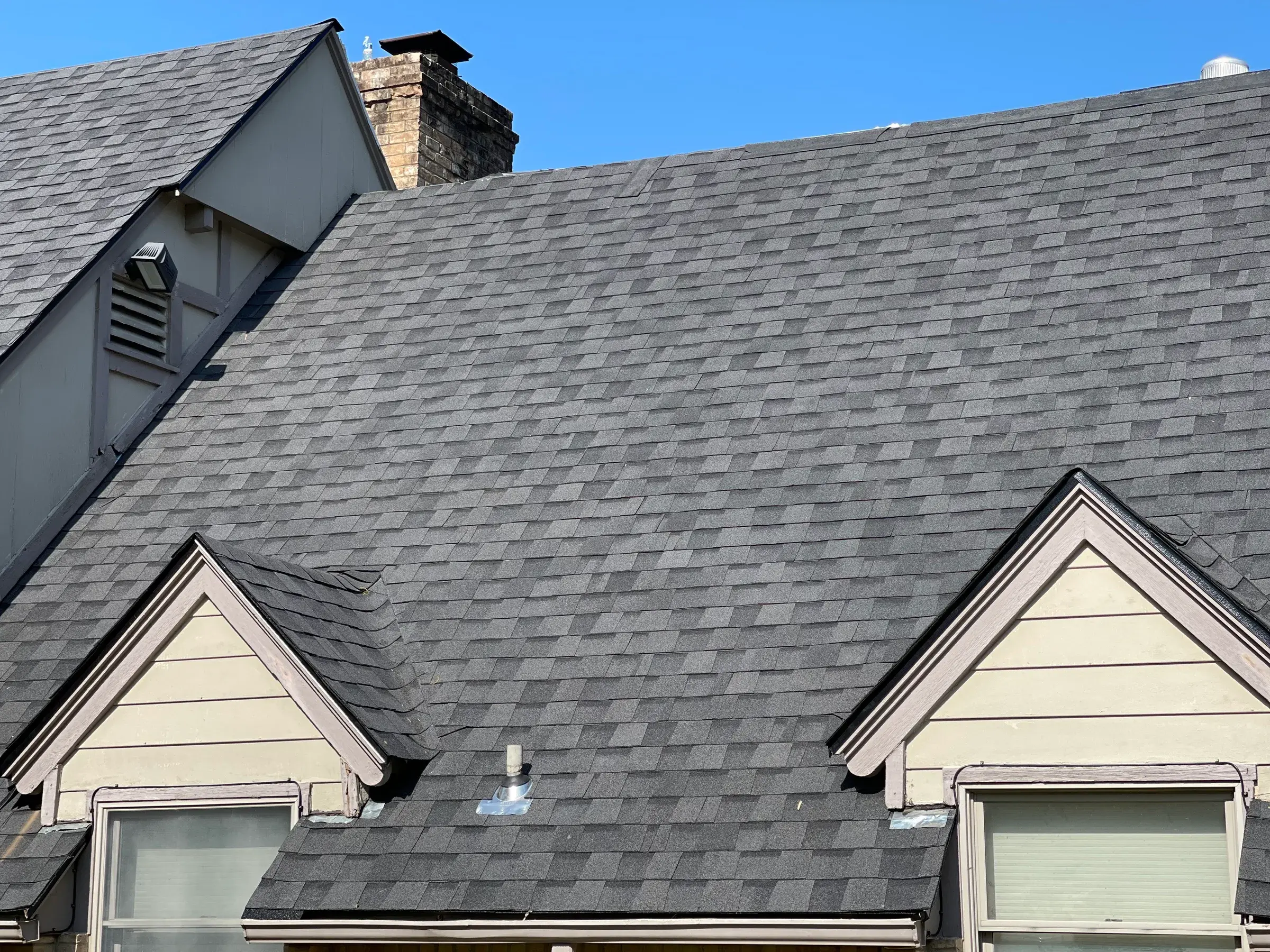
Roof Flashing Repair in Miami, Oklahoma
Roofs almost never leak in the middle. They leak where the roof stops — at a wall, a valley, a chimney, a vent, a skylight — and that's where flashing lives. It's the least glamorous metal on your house and it's responsible for more water in more ceilings than every worn-out shingle in Ottawa County combined.
If the stain on your ceiling sits under a wall, a chimney, a valley, or a skylight, your shingles probably aren't the problem. The metal is. This page walks through every flashing type on a Northeast Oklahoma house, what each one does, how each one fails here, and the two questions that tell you whether a bidder intends to do it right.
Why Flashing, Not Shingles, Is Where Roofs Leak
A field of shingles is a simple machine. Water lands, water runs downhill, and each course overlaps the one below it. Nothing interrupts the path. That part of your roof is rarely what fails.
Leaks happen where the slope stops. Every place the shingle field is interrupted is a place a roofer had to build a water path out of bent metal:
- Where a roof slope runs into a vertical wall — dormers, second-story walls, porch roofs
- Valleys, where two slopes meet and dump their water into one trough
- Chimneys, which are a wall on all four sides
- Plumbing vents, furnace flues, and bath fans poking through the deck
- Skylights
- The perimeter — eaves and rakes, where water has to make the jump into the gutter
Those are the joints. Flashing is the hardware that carries water across them. It is the least glamorous metal on your house and it is doing the hardest work. This page is about the component and the craft — if you're still trying to find where the water is getting in, start with our roof leak repair page instead.
The Flashing Types on Your House and What Each One Does
Most homeowners have one word — flashing — for about eight different parts. Knowing which is which is the whole game, because a bid that says "flashing as needed" is telling you nothing.
- Step flashing — small L-shaped pieces, one woven in per shingle course, where a slope runs up alongside a wall.
- Apron or headwall flashing — a single bent piece where a slope ends and dies into a wall face.
- Kickout flashing — the last piece at the bottom of a wall run, bent to throw water out into the gutter.
- Valley flashing — metal in the trough where two slopes meet, often with a raised center rib.
- Base flashing — metal turned up onto masonry at a chimney.
- Counter flashing — the cap set into the masonry that covers the top of the base flashing.
- Cricket or saddle — a small peaked structure on the uphill side of a wide chimney that splits water around it.
- Pipe boots and vent flashing — a flanged base with a collar that seals to the pipe.
- Drip edge — the perimeter metal that stops water curling back under the deck.
The piece most houses are missing
Kickout flashing. Water runs down the step flashing at a wall, reaches the bottom of the run, and has to be thrown clear. A kickout is a single piece of metal bent out at an angle to do that. Without one, the water arrives at the bottom of the wall and goes straight behind the siding. Nothing on the roof looks wrong. The rot is in the wall sheathing, and the stain shows up on an interior wall, sometimes in a room you wouldn't connect to the roof at all. Walk your driveway and look at the bottom of every place a roof runs into a wall. If you don't see a small tab of metal aimed into the gutter, that's a finding.
Step Flashing: The Detail Cheap Roofers Skip
Step flashing — the L-shaped metal that ties the roof into a wall — works because it's a stack, not a strip. Each piece sits on a shingle course, gets covered by the course above, and laps over the piece below it. Water that gets behind the siding hits a piece of metal, gets carried out onto the shingle below, and rejoins the roof. It is redundant by design. There is no single joint that has to hold forever.
The shortcut is one long piece of L-metal run up the wall and sealed at the top. It's faster and it uses less labor and it works — right up until the sealant lets go. Then there's nothing behind it. One joint, no redundancy.
The other tell is face-nailing: nails driven through the exposed face of the metal to hold it to the wall. Every one of those is a hole punched in the middle of the water path, and every one is a place freeze-thaw can start working. Step flashing gets fastened high, where the course above will cover it.
Valleys: Open, Closed, and Woven
A valley carries more water than any other square foot of your roof — two slopes' worth, concentrated into one line. There are three ways to build one.
- Open valley — metal stays exposed down the center, usually with a raised rib in the middle to keep water from crossing under the shingles on the other side.
- Closed-cut valley — shingles from one slope are run across and the other slope's shingles are cut back to a line above center.
- Woven valley — courses from both slopes are laced over each other.
All three work when they're built right. What matters here is your lot. The east side of Ottawa County is Ozark plains — rocky, rolling, wooded. Under trees, an open metal valley sheds leaves and needles that a closed-cut valley will hold. Debris in a valley isn't dirt; it's a dam. It backs water sideways under the shingle edge, and then it stays wet against the deck long after the rain quits. Out west in the Neosho lowlands, on open prairie lots, that matters much less.
The classic valley failure is a nail. A fastener driven too close to the center line sits in the fastest-moving water on the roof. It's a small hole in a big river.
Counter Flashing and Reglets on Masonry
Chimney flashing is two systems, not one. The base flashing turns up onto the brick. The counter flashing is a separate piece cut into a mortar joint — the cut is called a reglet — and bent down over the top of the base. Water running down the brick face hits the counter flashing and gets shed onto the base, which sheds it onto the roof. The entry point is inside the wall, above the top of the base metal. There's nowhere for water to sneak.
The shortcut is counter flashing laid flat against the brick face and sealed at the top with a bead. That bead is now the only thing standing between the weather and your chimney chase. Here's the diagnostic: get a look at the top edge of the metal. A real reglet is a saw-cut groove in the mortar joint, and the metal disappears into it. A shortcut is a smear of sealant sitting on the face of the brick. You can usually tell from the ground with binoculars.
If the mortar itself is crumbling, the metal has nothing to key into. That's masonry work, and it needs to be sound before we set flashing back in. We'll tell you plainly what we see. There's more on the whole chimney assembly — crickets, base, counter — on our chimney flashing repair page.
Caulk Is Not Flashing (And Never Was)
Sealant is a consumable. Metal is a system. Confusing the two is the single most expensive mistake in roof repair.
Consider what a bead of caulk lives through in Miami. Roughly 62% annual sunshine loading it with UV. Fifty-seven days a year above 90°F, with an August daily max normal of 91.5°F — and a dark roof surface running far hotter than the air. It expands, it contracts, it shrinks, it crazes, it pulls back from one edge. Then winter arrives and pries at the hairline it just opened.
Roof cement troweled over a valley or a step run is the same mistake with more theater. It hides the gap instead of closing it, holds moisture against the metal, and has to be scraped off before anyone can do the real repair — which makes that repair bigger and costlier than it needed to be.
Freeze-Thaw: How Oklahoma Winters Open Flashing Joints
This is the mechanism that makes Northeast Oklahoma flashing different from flashing in a mild climate, and almost nobody explains it to homeowners.
Miami averages 89 nights a year below 32°F. Here's what one of those nights does. During the day, water finds a hairline gap — a caulk joint that shrank, a lap in a piece of metal, an old nail hole — and capillary action wicks it in. That night it freezes and expands about nine percent. It has nowhere to go, so it pushes. The gap opens a hair. The next thaw lets a little more water in than last time. The freeze after that pushes a little harder.
That's 89 chances a year for the cycle to run. It's why a joint that was watertight in November is a functioning leak by March, and why so many flashing calls come in during spring rain — the rain didn't cause the failure, it just found it. Winter did the work quietly, with nobody watching.
Hail compounds it. We get four to five days a year with hail larger than three-quarters of an inch. Hail doesn't just bruise shingles — it dents and creases metal. A crease across a valley or a bent step piece breaks the plane the water was supposed to run down and creates a spot that holds water instead of moving it. That's a freeze-thaw site the next winter. When we inspect after a storm, we photograph the flashing details separately from the shingle field and put them in a written photo report, because that's exactly where a fast look misses things.
Reused Flashing on a New Roof: The Shortcut That Guarantees a Callback
A brand-new roof that leaks in its first year is usually leaking through old metal.
Here's how it happens. The crew tears off the shingles. The flashing is bent, has a decade of old nail holes, has caulk residue on it, and maybe was face-nailed by whoever did it last. Pulling it and installing new metal costs a few hundred dollars in material and an hour or two of labor. Leaving it costs nothing today. New shingles go over it and the roof looks perfect from the street.
Oklahoma is unusual here in a way that works in your favor. The state amended IRC section R908.3.1.1 to require tear-off rather than shingling over an existing roof in defined conditions. When the old shingles come off, every piece of flashing on the house is sitting there exposed and accessible. That is the one moment in twenty years when replacing it is cheap. A tear-off that does all the hard work and then leaves fifteen-year-old step flashing in place has skipped the easy part and kept the weakest link.
The City of Miami requires a permit for new roofs and re-shingles. We pull it.
We're family-owned, we work out of one office on Main Street in Miami — the old Route 66 alignment — and we do this across Northeast Oklahoma and into Kansas, Missouri, and Arkansas. Inspections and quotes are free, and we'll show you the photos of your own flashing whether or not you hire us. Call (209) 758-8550 and we'll come look.
Roof Flashing Repair questions
What is flashing, in plain terms?
It's the metal that carries water across the places where your roof meets something else — a wall, a chimney, a valley, a pipe, a skylight. Shingles shed water down a slope; flashing handles every place that slope is interrupted. It's the transition hardware of a roof.
What is step flashing and why does it matter?
Where a roof slope runs into a vertical wall, water has to be carried out onto the shingles at every course. Step flashing is a series of individual bent pieces, one woven in per shingle course, that does exactly that. The cheap alternative is one long piece of metal caulked to the wall, which works for a while and then doesn't. If you have a leak where a roof meets a wall, this is usually why.
Can flashing just be sealed with caulk?
Not as a fix. Caulk is a supporting player at the top edge of counter flashing, not a water barrier by itself. It shrinks, it crazes in UV, and here it gets wedged apart by freeze-thaw. Any repair whose entire plan is a tube of sealant is a repair with an expiration date on it.
Why does my roof leak at the chimney?
Chimneys are the hardest flashing on a house — they need base and apron flashing, step flashing up both sides, a cricket or saddle on the uphill side of a wide chimney to divert water around it, and counter flashing cut into the masonry above all of it. Missing crickets and surface-caulked counter flashing account for most chimney leaks we find.
Should flashing be replaced when I get a new roof?
Yes. Reusing old, bent, and previously nailed flashing under new shingles is one of the most common ways a brand-new roof leaks in its first year. It saves the contractor a few hundred dollars in metal and labor, and it costs you the whole point of the new roof.
Why do flashing leaks show up in spring here?
Freeze-thaw. Water gets into a hairline gap at a lap or a caulk joint, freezes, expands, and opens the gap slightly. Do that fifty times over a northeast Oklahoma winter and a joint that was watertight in November is a path in March — right when the spring rains arrive to test it.
Protect Your Property with a Free Roof Inspection
Tell us what you're seeing. We'll arrange an inspection, explain the findings, and provide clear next steps without pressure.
- • A real look at the roof, not a sales visit
- • Photos of whatever we find, and what it means
- • A written quote if you want one — and an honest “you don’t need us yet” if that’s the answer