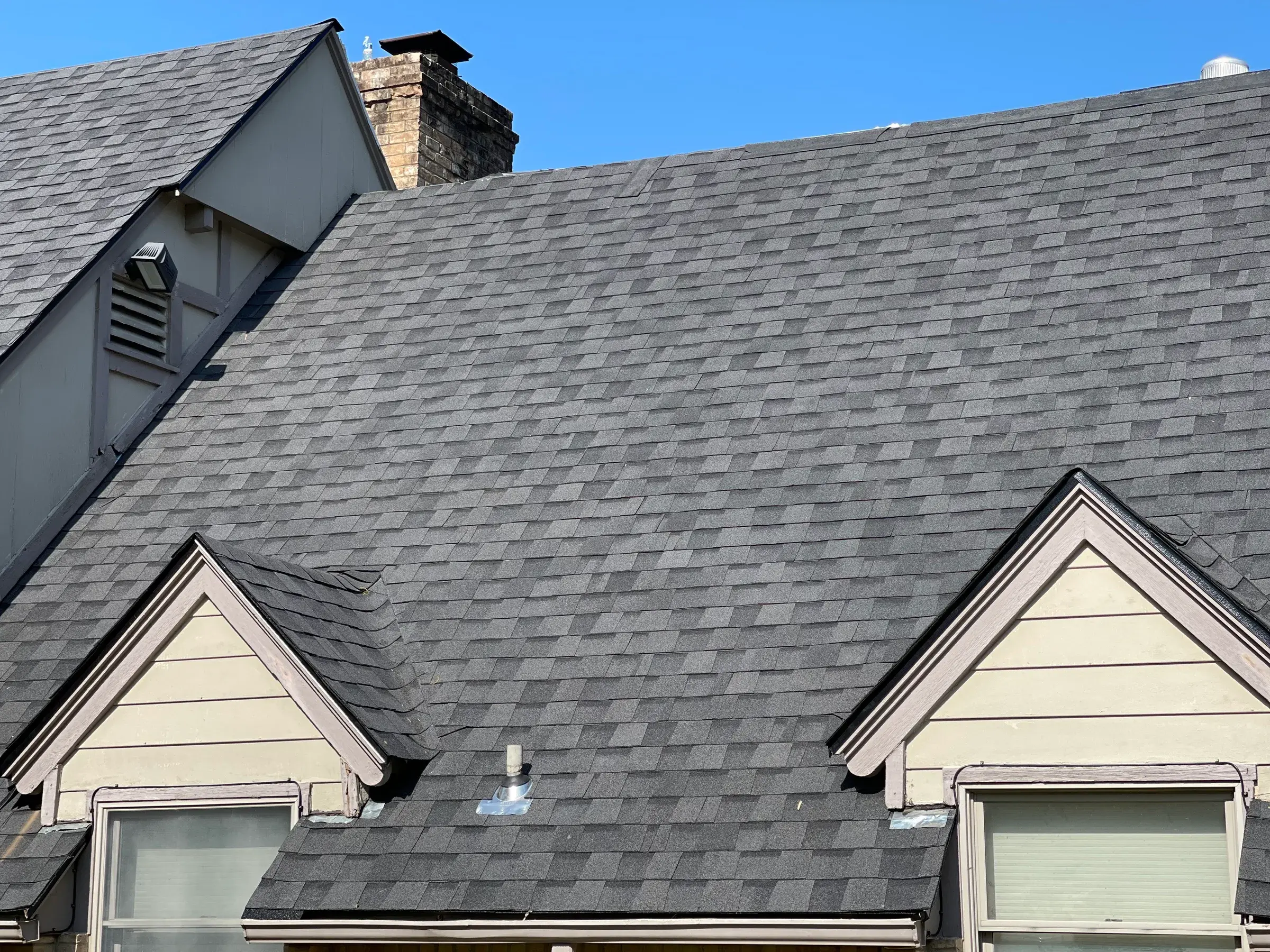
Roof & Attic Ventilation Repair in Miami, OK
Your attic has to breathe, and in Miami most of them don't. Blocked soffits, mixed vent types fighting each other, insulation shoved into the eaves — the result is decking that rots in winter, shingles that cook in summer, and a house that's hot upstairs no matter what the thermostat says.
A hot upstairs bedroom the thermostat can't touch. Damp insulation in a house with no leak. A roof that wore out in fifteen years instead of twenty-five. Those are attic ventilation symptoms, and in Miami they usually trace to one of two things: intake blocked at the soffits, or two kinds of exhaust quietly fighting each other on the same roof.
What Attic Ventilation Is Supposed to Do
Attic ventilation isn't really about the attic. It's about the wood deck above it and the ceiling below it. Air is supposed to enter low at the eaves, warm up, rise, and leave high at the ridge. No power, no moving parts. Just a path.
That moving air does two completely different jobs in two different seasons. In summer it pulls heat off the underside of the roof deck before that heat can cook the shingles from below. In winter it carries water vapor out of the attic before it condenses on cold wood.
Northeast Oklahoma hands us both problems in the same twelve months. Miami sits down in the Neosho River valley. We get 57 days a year above 90 degrees and five above 100, with an August daily high that normals out at 91.5. Then we turn around and get 89 nights a year below freezing. Your attic spends August fighting heat and January fighting moisture. A vent setup that only solves one of those isn't a system — it's half of one.
Intake and Exhaust: The Balance Almost Nobody Has
The residential code Oklahoma uses handles this as a ratio, not a vent count: roughly one square foot of open vent area for every 300 square feet of attic floor, and only when that opening is split about evenly between low intake and high exhaust. Split it wrong and the ratio tightens.
The phrase that matters is net free area — the actual open hole left after the perforations, louvers, and insect screen. This is where homeowners get fooled. A 16-by-8-inch soffit vent is not 128 square inches of airflow. The screen and the punched holes might leave you a third of that. Manufacturers publish the net free area for each piece, and the honest way to assess a roof is to add up what's actually open on each side and compare it to the attic's square footage.
Here's what we find over and over: exhaust wins and intake loses. A ridge vent runs the full length of the ridge — that's a lot of opening — while intake is four little rectangles in the soffit, half of them blocked. Air is not optional. When exhaust outruns intake, the attic pulls make-up air from wherever it can get it: back down through the ridge vent itself, or up out of your house through recessed light housings, the bath fan cutout, and the gaps around the attic hatch.
That last one is the quiet disaster. Instead of venting the attic, the roof is now sucking warm, humid indoor air up into it. In January, that's the moisture that shows up as frost on your nails. You didn't build a ventilation system. You built a chimney.
Blocked Soffits: Insulation, Paint and Bird Blocking
Intake is where ventilation dies, and it almost always dies at the eave. The soffit is the underside of the roof overhang — the flat panel you see when you stand next to the house and look up. Five ways we find it choked:
- Insulation shoved into the eaves. Blown-in insulation with no baffles migrates out to the edge and sits right on top of the intake vents. It's the single most common failure on this list.
- Paint. Perforated aluminum soffit panels get repainted, and the holes are small enough that two or three coats close them. The vent is still there. It just doesn't pass air anymore.
- Debris and nests. Out on the east side of Ottawa County — the Ozark Plains side, rockier and heavily wooded — leaf litter, wasp nests, and mud daubers pack an open soffit vent solid in a couple of seasons.
- Solid panel. Somebody wrapped the soffit and fascia in new aluminum and ran solid panel across an eave that used to be vented. It looks sharp from the driveway. The attic is now sealed.
- Baffles crushed or never installed. A baffle is a stiff channel stapled between the rafters at the eave to hold an air path open above the insulation. Without one, nothing keeps the insulation off the vent.
You can check most of this yourself in ten minutes. Pick a bright day, go up in the attic, turn your light off, and look toward the eaves. If you can see daylight at the edges, you have an intake path. If it's black all the way around, you don't — and every dollar spent on exhaust above it is wasted.
Mixing Vent Types: How Two Exhausts Short-Circuit Each Other
Air takes the easiest route available. That one sentence explains most of the bad ventilation in this county.
Say a house has gable vents — the louvered triangles up in the ends of the attic — and somebody puts a ridge vent on during a re-roof and leaves the gables open. The ridge vent is now pulling from the gable vents, because they're big, close, and up high, instead of from the soffits thirty feet away and twenty feet down. The upper attic gets a nice little breeze between two openings. The bottom third of the attic, where the deck meets the eave, never moves air at all. Same story with a whirlybird turbine left on a roof that just got a ridge vent, and same story with a powered fan.
The failure mode nobody sees: a ridge vent with no slot
A ridge vent is not a vent. It's a cap over a hole. The hole is a slot cut clean through the roof decking, roughly an inch to each side of the ridge board, running most of the ridge but stopping short of the ends. The vent is the weather cover over that slot.
Crews in a hurry nail the ridge vent down over solid decking and never cut the slot. Or they cut it forty percent of the length and call it done. Or the slot is there but the ridge board on a stick-framed roof still blocks it. From your driveway the roof looks perfectly ventilated. Up close it's a plastic hat. We find this several times a year, and the homeowner has always been told they have a ridge vent — which is true, and irrelevant.
One more thing worth a look: we get four to five days a year with hail bigger than three-quarters of an inch. Ridge vent baffles crack, turbine housings dent, and a turbine that's stopped spinning is just a hole in your roof with a lid on it. When we're up there after a storm, the vents get checked along with the shingles.
Summer in Oklahoma: Attic Heat and Shingles Cooked From Below
We run about 62 percent annual sunshine, and dark asphalt shingles sitting in it get far hotter than the air temperature ever does. Miami's record high is 116, set back in 1954, but you don't need a record day for this to bite. The industry figure for an under-ventilated attic on a hot afternoon is well over 130 degrees. That's a general number, not a measurement we took on your house — but it's the right order of magnitude, and it explains a lot.
Shingles are cooled from below as much as from above. Asphalt shingles are a mat saturated with asphalt and volatile oils, and sustained heat drives those oils out. The mat gets brittle. Granules let go. Edges curl and cup. Down on the deck, repeated heat cycling works nails loose and can leave OSB sheathing swollen at the seams. None of that is storm damage. It's just a roof aging from the inside out, and it's why a roof that had 25 years in it gives you 15.
This is worth knowing before you buy your next roof: most shingle manufacturers' warranty terms address attic ventilation. We're not going to characterize what yours says — pull the paperwork and read it, or ask the supplier. But it is not an obscure clause, and it is one of the few things about a roof that you control from inside the house.
Winter: Condensation, Frost on the Nails, and Rot With No Leak
Eighty-nine nights a year below freezing means the underside of your roof deck spends a lot of the winter at 25 or 30 degrees. Meanwhile your family is making water vapor all day — showers, cooking, laundry, dishwasher, breathing. That vapor rises. If the attic can't flush it, it finds the coldest surface up there and turns back into liquid.
It hits the nails first. Steel conducts heat better than wood, so the shanks of the roofing nails poking through the deck are the coldest thing in the attic. Frost forms on them, then on the deck itself, in a fuzzy layer that looks a lot like snow got inside. We take photos of it constantly.
Then we get a mild afternoon — and around here we always do. The frost melts. It drips onto the insulation and stains the bedroom ceiling. The homeowner sees a brown ring in February and calls about a leak. There is no leak. The roof is bone dry. That's why this page exists: a lot of what gets diagnosed as a leak in this town is condensation, and the two are fixed completely differently.
Run that cycle every week from December to March and the deck never fully dries out. OSB delaminates and goes dark and soft. Plywood loses its grip on the nails. That's decking rot with no leak above it — one of the few ways a roof can fail from the inside while the shingles still look fine from the street.
Ventilation and Ice at the Eave
The overhang past your exterior wall is the coldest part of the roof, and it always will be. There's no house under it — it's outside air above and below. So when snow sits on the roof and the attic underneath is warm, the snow on the upper slope melts, the water runs down, and at the overhang it crosses onto cold decking and refreezes. That ridge of ice then dams the water behind it and pushes it back up under the shingles, where shingles were never designed to hold it out.
You cannot roof your way out of a warm attic. The materials help, but the mechanism is temperature. A cold attic doesn't melt the snow in the first place, and a roof that doesn't melt doesn't dam. That's an intake-and-exhaust problem plus an insulation and air-sealing problem — and the insulation side is a different trade. If that's what your house needs, we'll say so plainly instead of selling you vents.
Fixing Ventilation: What's Possible Without Re-Roofing
Ventilation is one of the few roofing problems that's diagnosed from the inside. Here's how we work it:
- Go up in the attic first, on a bright day, and turn the light off. Daylight at the eaves — or the absence of it — tells us more than anything visible from the roof.
- Read the evidence up there: rust on the nail shanks, dark staining or delamination on the deck, matted or discolored insulation, insulation packed into the eaves.
- Count what's actually open. Add up the net free area of the existing intake and the existing exhaust, compare both to the attic's square footage, and find out which side is starving.
- Get on the roof and check the exhaust for real — is there a slot cut under that ridge vent, and how far does it run? Are there gable vents or turbines short-circuiting it?
- Track down the moisture sources: bath fans, dryer duct, attic hatch, open recessed lights.
- Hand you a photo report of what we found and a written estimate for the work we would perform.
Plenty of this gets fixed without ever opening up the roof:
- Clearing blocked or painted-over soffit vents, and pulling insulation back out of the eaves.
- Installing baffles in the rafter bays so the intake channel stays open for good.
- Cutting in additional soffit vents, or swapping solid soffit panel for vented panel.
- Closing off gable vents that are short-circuiting a ridge vent.
- Replacing hail-damaged or seized turbines and cracked vent housings.
- Terminating a bath fan through a proper roof or gable cap instead of into open attic.
What does require opening the roof is adding or correcting ridge exhaust, because cutting the slot means pulling cap shingles off the ridge. That's why we push so hard on getting ventilation right during a replacement rather than after. Oklahoma amended the residential code to require a full tear-off rather than shingling over the old roof in defined conditions — and when that deck is bare and open, that is the cheapest hour you will ever get to cut the slot correctly and confirm the intake underneath it. The City of Miami requires a permit for new roofs and re-shingles, and we pull it.
If your upstairs never cools, or you found frost where frost shouldn't be, let us come look at it. The inspection is free and so is the written quote. And if what your house actually needs is insulation work rather than roofing, we'll tell you that and you won't owe us anything for hearing it. Call (209) 758-8550.
Roof Ventilation Repair questions
How do I know if my attic ventilation is bad?
Symptoms first: an upstairs that never cools, frost or damp on the underside of the decking in winter, rusted nail shanks in the attic, matted or discolored insulation, or a roof that wore out years earlier than it should have. Then look at the soffits — if you can't see daylight or open vents from inside the attic at the eaves, your intake is blocked and nothing else matters.
Isn't more vents better?
No, and this is the most expensive misunderstanding here. Ventilation works as a system — cool air in at the soffits, hot air out at the ridge. If you add a second type of exhaust, say a powered fan on a roof that already has a ridge vent, the fan pulls its air from the nearest opening it can find, which is the ridge vent, instead of from the soffits. The attic barely ventilates and you paid for the privilege.
Can bad ventilation really ruin my shingles?
Yes. Shingles are cooled from below as much as from above. An attic running at 150 degrees on an August afternoon bakes the asphalt from underneath, drives out volatiles, and ages the roof from the inside out. A roof that should have gone 25 years goes 15, and the manufacturer's warranty language usually excludes damage from inadequate ventilation.
My insulation was upgraded and now my attic is damp. Why?
Because the insulation was probably pushed out into the eaves and it's sitting on top of the soffit vents. It's the single most common ventilation failure we see, and it's usually done by a well-meaning contractor who blew in insulation without installing baffles to keep the intake path open. Ironically, the energy upgrade cost you your roof's airflow.
Do I have to re-roof to fix ventilation?
No, though replacement is the cheapest time to do it. Intake work at the soffits, adding baffles, and clearing blocked vents happen from below and outside the roof entirely. Adding or correcting exhaust means opening the roof, which is why we push hard on getting it right during a replacement rather than after.
Does ventilation affect ice at the eave?
Directly. A warm attic melts snow on the upper slope; the water runs down to the cold overhang, where there's no house heat beneath it, and refreezes. That ice ridge then dams the water behind it and forces it under the shingles. The fix is keeping the attic cold — which is a ventilation and insulation problem, not a roofing one.
Protect Your Property with a Free Roof Inspection
Tell us what you're seeing. We'll arrange an inspection, explain the findings, and provide clear next steps without pressure.
- • A real look at the roof, not a sales visit
- • Photos of whatever we find, and what it means
- • A written quote if you want one — and an honest “you don’t need us yet” if that’s the answer