Roofing Contractor in Wyandotte, Oklahoma
Roofers serving Wyandotte, Oklahoma from our Miami office twelve miles northwest. Free roof inspections, repair, replacement and storm damage assistance.
Wyandotte sits twelve miles southeast of our office at 111 S Main St in Miami, in the wooded eastern half of Ottawa County. Out here the trees and the lake decide what goes wrong with a roof, and they decide it differently than they do in town. We inspect for free, and we will tell you when a roof still has years left in it.
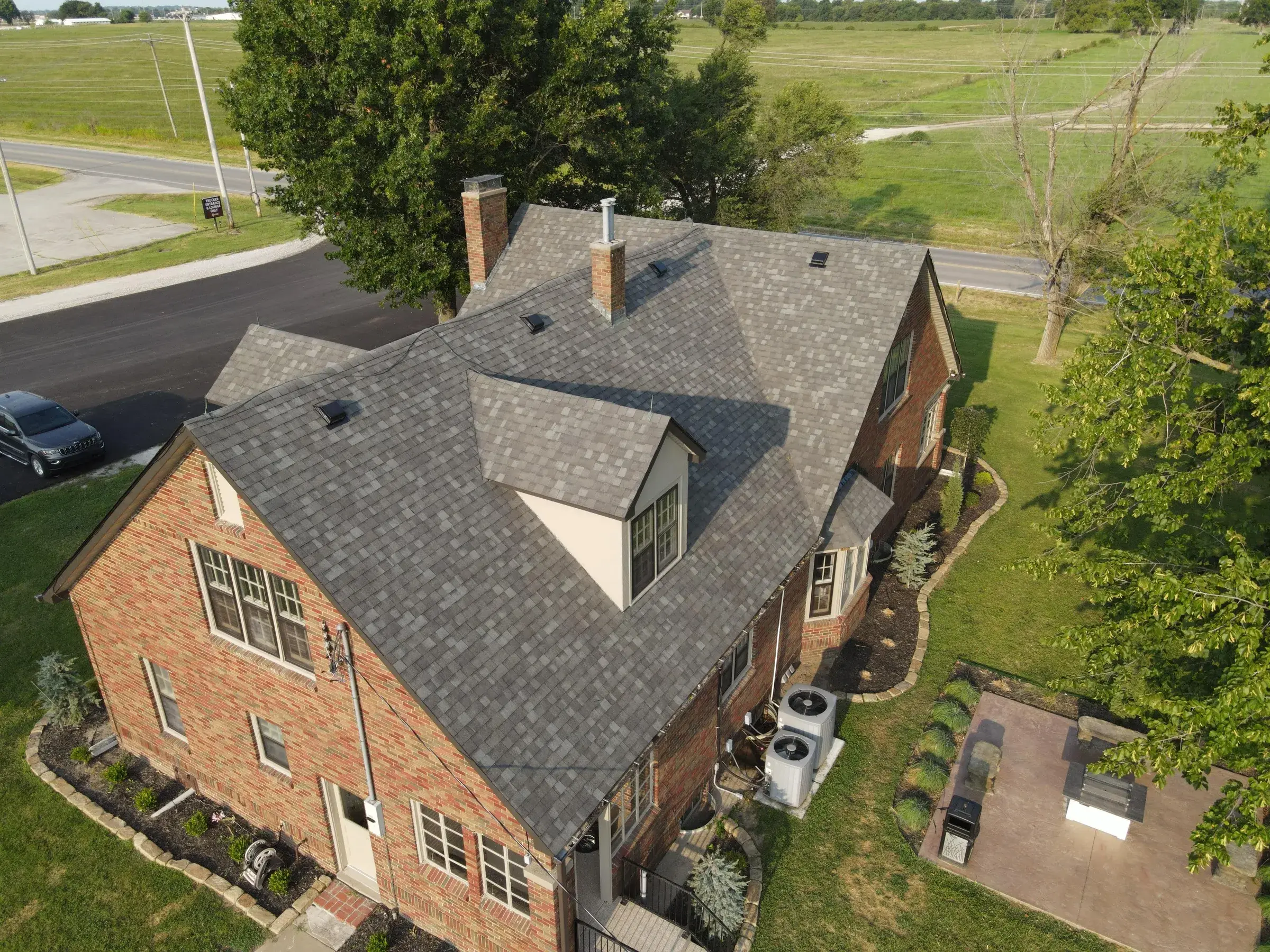
Out here, the trees are the roof's biggest problem
Ottawa County is split down the middle. The western side is Neosho Lowlands — flat prairie and farmland, open sky, nothing over the house. The eastern side is Ozark Plains: rockier, rolling, and wooded. Wyandotte sits on the eastern side. That single geographic fact drives most of what we find on roofs here.
Tree overhang does three things to a roof, and none of them are dramatic enough to notice until they've been happening for years. It drops leaves and small limbs into the valleys — the V-shaped channels where two roof planes meet and water is moving fastest. Wet debris packs in there, dams the water, and holds it against the shingles instead of letting it run to the gutter. It shades the north slope, so that slope never fully dries after a rain and starts growing moss and algae while the south slope looks fine. And in a windstorm, it puts solid wood in motion directly above your decking.
An open lot in Miami dries out within a few hours of a rain. A shaded Wyandotte lot under mature oak may not dry all day. Same shingle, same age, same weather — different outcome. When we inspect a roof here, the first thing we look at is usually not the roof. It's what's hanging over it.
The lake built this town, and you can read it in the housing
When the Pensacola Dam went in during the late 1930s and Grand Lake o' the Cherokees filled behind it, it took away part of Wyandotte's land. What it gave back was tourism and residential development, and that trade is still visible in the housing stock. Wyandotte is the one town in this county that is genuinely growing — 333 people in 2010, 488 at the 2020 census. Miami itself peaked in 1980 and has drifted down ever since. Wyandotte went the other direction.
Growth means the roofs here skew a little newer than what we see in Commerce or Quapaw. It does not mean they're fine. Roughly 13% of housing units in Ottawa County sit vacant, and a good share of that is lake-adjacent second homes — houses nobody is standing in when the ceiling stain appears. A leak that a full-time owner catches in a week can run for a season in a weekend place. If you own a lake house out this way, the honest advice is to have someone put eyes on it after a hard storm rather than waiting for the next visit.
Where metal earns its cost, and where it doesn't
We talk about metal more in Wyandotte than we do in town, and there's a reason that isn't a sales reason. A standing-seam metal roof — flat panels joined by raised, folded seams instead of overlapping tabs — has far fewer places for wet leaf litter to lodge, and debris tends to slide rather than sit. On a heavily shaded, wooded lot where the north slope stays damp and the valleys fill every autumn, that's a real advantage over a shingle that spends half the year under mulch.
It is also more expensive up front, and on an open lot with nothing overhanging it, that advantage mostly disappears. Plenty of Wyandotte houses should get another asphalt roof. We'll say so on your driveway rather than talk you into panels you don't need.
There's a second reason metal comes up here more often. This is a small tribal headquarters town — Wyandotte is the seat of the Wyandotte Nation, which relocated to this area in 1867 — with a genuine light-commercial and outbuilding component alongside the houses, plus a 740-acre private paintball venue east of town that draws thousands of visitors every June. Shops, pole barns, and equipment buildings are a normal part of what we're asked to roof out here, and metal is frequently the right answer on those.
Hail, heat, and the freeze-thaw cycle under a canopy
Northeast Oklahoma sees hail larger than three-quarters of an inch on 4 to 5 days in a typical year. That's the only hail number we'll quote you, because it's the only one that's actually sourced. Hail doesn't skip the wooded side of the county — but tree cover makes damage harder to spot from the ground, and it means limbs come down with the stones. After a hail event here, we're checking for bruised shingles and for impact from wood, which look nothing alike.
Heat and cold do the slower damage. We get about 57 days a year above 90°F and roughly 62% annual sunshine, which cooks the oils out of asphalt over time. Then we get about 89 nights below freezing — every one of those is a freeze-thaw cycle, water working into a gap, expanding, and opening it a little wider. On a shaded slope that thaws late and stays wet longer, those cycles get more to work with. If you're weighing impact-resistant shingles, ask your insurer directly whether they offer any discount for them. Oklahoma doesn't require one, and we're not going to imply a number we can't back.
Storm damage and what we can honestly do about insurance
If a storm opens your roof, we can tarp it. After that, here is exactly what we do and don't do. We document what we find with a photo report you keep. We write an estimate for the work we would perform. If you ask us to, we'll meet your adjuster on the roof and walk them through what we saw. We'll help you understand how the process works. Your insurer decides what's covered — not us.
What we won't do is file, fight, or negotiate your claim, promise approval, or touch your deductible in any form. Oklahoma law is specific on all of that, and a roofer who offers otherwise is telling you something about how they run their business.
Twelve miles from our shop, and no branch out here
We don't have an office in Wyandotte and we won't pretend we do. Ours is at 111 S Main St in Miami, twelve miles northwest — Main Street being the old Route 66 alignment, which is where this family's roots in this corner of the state started, a few miles up in Commerce. We work across Oklahoma, Kansas, Missouri, and Arkansas, but Wyandotte is home county. Small jobs included; twelve miles is not a reason to say no.
Wyandotte has never been a town that keeps quiet about how things are done — in the mid-1920s it elected an all-female city government, and Mamie Foster served over five years as Oklahoma's first female mayor. Word still travels fast in a town of 488. That suits us. We have 42 Google reviews and a name that's easy to find, and we'd rather tell a homeowner their roof has five good years left than sell them one they don't need. Call (209) 758-8550 and we'll come look at it.
Nearby communities
Roofing in Wyandotte
Do you have an office in Wyandotte?
No. Our only office is at 111 S Main St in Miami, twelve miles northwest.
Why do you push metal roofs out here more than in town?
We do not push them anywhere. But Wyandotte sits in the wooded, rolling eastern side of Ottawa County near Grand Lake, and on shaded lots with real tree overhang, metal earns its cost more often than it does on an open lot in Miami. On some Wyandotte houses it still is not the right answer. We will say so.
Tree limbs are over my roof. Is that actually a problem?
Yes, and it is the most common one out here. Overhang means debris in the valleys and gutters, moisture held on shaded north slopes, and limb strikes in wind. Most of what we find on Wyandotte roofs traces back to trees, not to the roof itself.
Do you work with the Wyandotte Nation?
Ask us about your specific project. Wyandotte is the Wyandotte Nation's headquarters and we are a Miami-based roofer working throughout Ottawa County — but we are not going to claim a relationship on a web page that we have not earned on paper.
Wyandotte is small. Do you take small jobs here?
Yes. It is twelve miles from our shop.
Do you do free inspections in Wyandotte?
Yes.
Free roof inspection in Wyandotte
Tell us what you're seeing. We'll arrange an inspection, explain the findings, and provide clear next steps without pressure.
- • A real look at the roof, not a sales visit
- • Photos of whatever we find, and what it means
- • A written quote if you want one — and an honest “you don’t need us yet” if that’s the answer