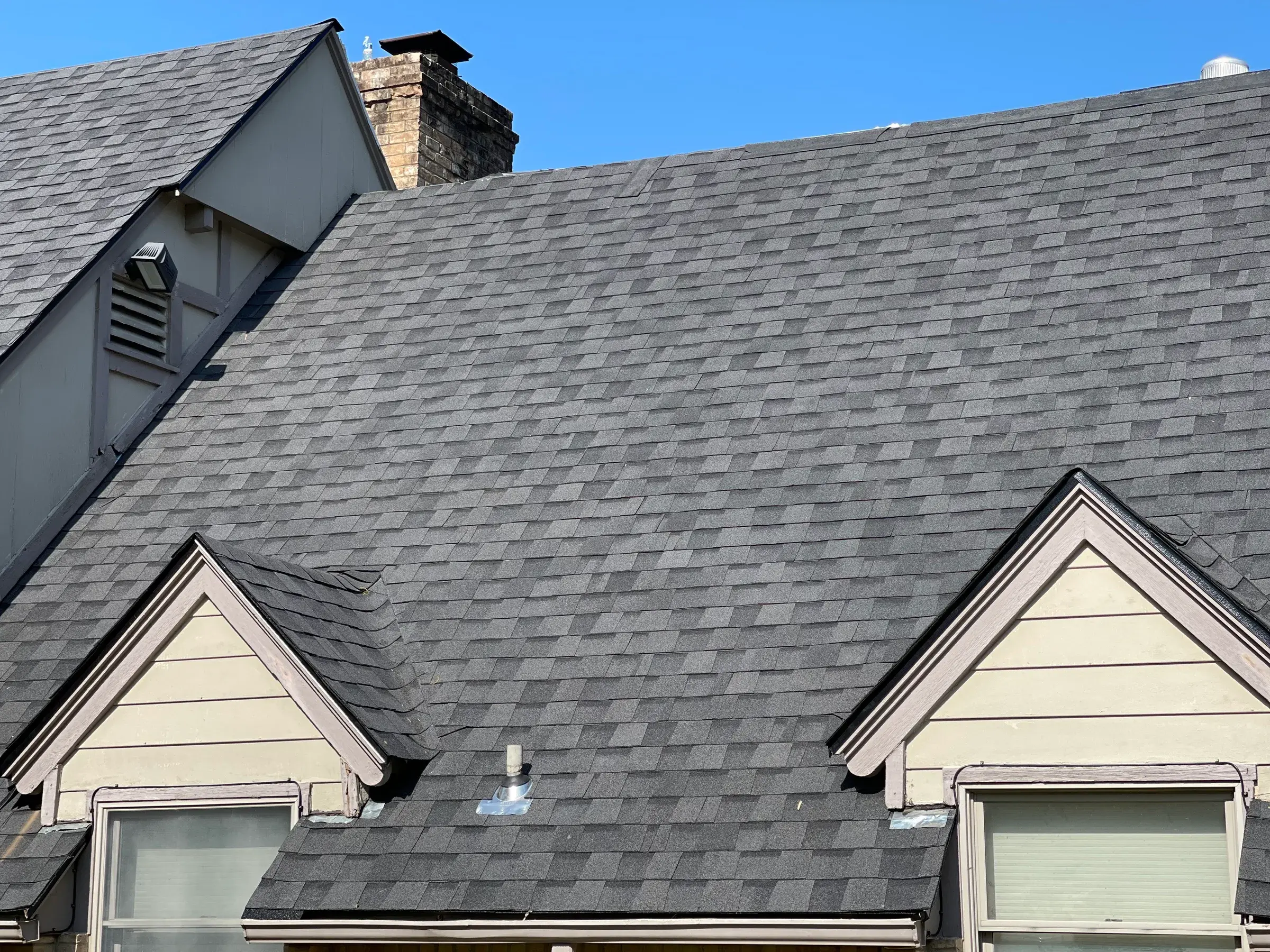
Homes in Miami's low-lying neighborhoods near the Neosho River deal with persistent humidity, and it shows up in attics as damp insulation, rusted nail tips, musty odors, and dark staining on decking. A roof does not stop ground flooding — but ventilation, sealed attic bypasses, and dry soffits are what keep that humidity from rotting the structure.
First, the honest boundary: a roof is not flood protection
Let's settle this before anything else, because it saves people money.
Miami sits on the Neosho River, and the river floods. The U.S. Geological Survey maintains flood-inundation mapping for the Neosho River near Miami, Oklahoma — it is public, it is free, and it will tell you far more about your lot's water risk than any roofer can. Water that comes up from the ground into a crawlspace, a garage, or across a yard is a drainage and elevation problem. No roof, no gutter, no shingle, and no vent solves it. Anyone who tells you otherwise is selling something.
What a roof actually controls is narrower than most homeowners assume. It controls water arriving from above. And it controls the air exchange in the space directly beneath it — the attic. That second job is the one almost nobody thinks about, and it's the one that causes the damp insulation, the rusted nail tips, and the musty smell you came here to figure out.
So the useful question isn't "is my roof keeping the river out." It's "is my attic dealing with the humidity that already lives here." In a lot of Miami homes, the answer is no — and the fix has nothing to do with shingles.
Miami's geography: the Neosho River, elevation, and which areas sit low
Miami sits at roughly 778 feet of elevation on the Neosho — also called the Grand — in Ottawa County. That figure comes from standard geographic records for the city, and it matters less as a number than as a description of the terrain: this is a river town on a low, flat river plain.
Ottawa County is split down the middle in a way that shows up on roofs. The eastern side runs into the Ozark Plains — rockier, wooded, rolling, shaded. The western side is Neosho Lowlands: flat prairie and farmland with open sky and open wind fetch. If you live on the wooded east side, your soffit vents are collecting leaf litter and your north slope stays shaded and damp long into the morning. If you're out west on open ground, your roof dries faster and gets hit harder by wind.
Why "low-lying" changes the attic, not just the yard
Low, flat, river-adjacent ground holds humid air. Cool air settles into it overnight. Shaded lots dry slowly. Crawlspaces over damp soil push moist air up into the house, and that moist air ends up where all warm air ends up — at the top, in the attic.
Then the temperature swings do the rest. The Oklahoma Climatological Survey's 1991–2020 normals put Miami at about 89 nights a year below freezing, alongside roughly 57 days above 90°F. Those 89 cold nights are the ones that matter here. A cold night chills the underside of your roof deck to below the dew point of the air in the attic. Warm, humid air from your living space reaches that cold surface and gives up its water. That's it. That's the whole mechanism. It doesn't need a hole in the roof and it doesn't need rain.
For the underlying humidity and precipitation climatology of northeast Oklahoma, NOAA's National Weather Service office in Tulsa is the authority — worth a look if you want the regional picture rather than a roofer's summary of it.
How humidity gets into an attic — from below, more often than through the roof
Here's the part that surprises people. In a typical Miami house with a moisture problem, most of the water in the attic came out of the kitchen, the bathrooms, and the laundry room. It went up.
The U.S. Department of Energy's Building America program has spent years documenting this, and the finding is consistent: air leakage moves vastly more moisture into an attic than vapor diffusion through drywall does. Meaning the water isn't seeping through your ceiling — it's riding a draft through the gaps in it. Building America's guidance is equally consistent about the order of operations: seal the air leaks first, then insulate. Insulation laid over an unsealed ceiling is a filter, not a barrier. The air goes right through it and drops its moisture on the cold deck above.
Those gaps have a name: attic bypasses. They're the holes in the top of your house that connect conditioned space to the attic.
- Warm, humid air is generated inside — showers, cooking, laundry, dishwashers, houseplants, and simply breathing.
- Warm air rises. The pressure difference between a heated house and a cold attic is called the stack effect, and it pushes air upward all winter.
- That air finds the bypasses: gaps where interior walls meet the ceiling (the top plate), recessed can light housings, the bath fan housing, plumbing vent pipe penetrations, wiring holes, the attic hatch, duct chases, and the gap around a chimney or flue.
- The air enters the attic carrying its moisture with it.
- It reaches the underside of the roof deck, which on a cold Oklahoma night is far colder than the air.
- The air cools below its dew point and the moisture condenses out onto the wood, the nails, and the framing.
- In the morning it warms up, the frost melts, and the water drips down onto the insulation — or soaks straight into the decking.
- Repeat across 89 freezing nights a year, for years.
That last line is the whole story of attic rot in this town. No single dramatic event. Just a slow, repeated, invisible cycle.
The symptoms homeowners misread as a roof leak
Almost every one of these gets phoned in as a roof leak. Some are. Most aren't.
| Symptom | Likely source | What actually fixes it | Whose job it is |
|---|---|---|---|
| Musty odor when you open the attic hatch | Humid air trapped in an attic with poor air exchange; insulation holding moisture | Seal the bypasses feeding it, then restore intake and exhaust airflow | Roofer for the vents; insulation contractor or a handy homeowner for the sealing |
| Insulation matted flat and damp above a bathroom | Bath fan exhausting into the attic, or a disconnected/leaking duct | Duct it to a proper exterior termination, insulate the duct, add a backdraft damper | Roofer sets the roof or gable termination; HVAC or electrician handles the fan |
| Rusted or frosted nail tips poking through the deck | Condensation on a cold deck from indoor air | Air seal the ceiling plane, then balance intake and exhaust ventilation | Roofer plus insulation contractor — usually both |
| Dark gray or black staining across the decking, worst on the north slope | Chronic, repeated condensation over multiple winters | Fix the source first; the stained wood gets evaluated at tear-off | Roofer, with a remediation professional if growth is present |
| Insulation packed tight against the roof edge, no daylight at the eaves | Blown insulation pushed over the soffit vents; no baffles installed | Install rafter baffles and pull the insulation back off the vents | Roofer or insulation contractor |
| Soffit panels sagging, fascia paint peeling in sheets | Chronic wetting from inside the eave, or gutters overflowing into it | Fix the moisture source, then replace the rotted material | Roofer |
| Deck feels spongy underfoot from the attic side | Long-term condensation delaminating OSB or plywood | Replacement of the affected sheathing, typically at reroof | Roofer |
| Lint drifting on top of the insulation | Clothes dryer venting into the attic | Terminate the dryer duct outdoors — this is a code requirement, not a preference | HVAC or appliance installer; roofer if it needs a roof termination |
| Water shows up only in hard, wind-driven rain from one direction | Wall flashing, a sidewall, or a penetration — not the roof field | Targeted flashing repair | Roofer |
Notice how many of those say "roofer plus somebody else." That's honest. Attic moisture is rarely a single-trade problem, and a roofer who tells you a new roof fixes all of it is guessing or hoping.
Condensation vs. leak: how to tell the difference without guessing
You can usually sort this out yourself with a flashlight and some attention to timing. Condensation and leaks behave differently, and the differences are consistent.
| What you see | Pattern and location | Timing | What it usually means |
|---|---|---|---|
| Frost or beads of water on nail tips | Spread evenly across the whole underside of the deck; worst on the shaded north slope | Cold mornings; gone by afternoon | Condensation. Indoor air is reaching a cold deck. |
| Damp insulation in a defined circle | Directly beneath one penetration, a valley, or a fastener | During rain or within hours of it | Leak. Follow the water up to the penetration above it. |
| Damp insulation in wide, vague patches | Along the perimeter where the ceiling meets the outside walls | All winter; no rain required | Air leakage at the top plate. Warm indoor air is condensing where the attic is coldest. |
| Dark staining spread across an entire slope | Uniform, not localized; usually the north or shaded side | Builds over years, not events | Chronic condensation. The roof isn't the source — the house is. |
| Round ceiling stain with a sharp edge | Same spot every single time | Within hours of rain or snowmelt | Leak. Flashing, a backed-out fastener, or ice damming at the eave. |
| Ceiling stain that appears with no rain at all | Near a bath fan housing, a can light, or the attic hatch | Cold snaps and the day after a thaw | Condensation. It's dripping off a duct or the deck and landing on your ceiling. |
| Rust rings around fasteners; corroded truss plates | General, often worst near the ridge | Standing evidence, no timing | The attic has run humid for a long time. |
The single fastest test: go up on a genuinely cold morning, before the sun works on the roof. If the whole deck glitters, that's condensation, and no amount of shingle work will change it. If one spot is wet and everything around it is bone dry, follow it up — that's a leak, and that's a roof repair.
Bath fans, dryer vents, and kitchen exhaust dumped into the attic
This is the most common single cause of attic moisture we find, and it is fixable in an afternoon.
The residential mechanical code Oklahoma builds on is unambiguous about this. Exhaust ducts — dryer exhaust under section M1502, general exhaust systems under M1501 — must terminate outside the building. Not in the attic. Not into a soffit cavity. Not "pointed toward the gable vent." Outdoors, through a termination fitting with a backdraft damper.
Yet in older housing stock it's everywhere. A bath fan that vents into open attic space. A flex duct that came loose from its boot in 1998 and has been steaming the insulation ever since. A dryer run that stops six inches short. Every shower and every load of laundry then pumps a measured dose of water vapor directly into a cold attic. A single family running two showers a day is putting a real volume of water up there over a winter, and every ounce of it condenses on the deck.
How a bath fan should actually be done
- Rigid or insulated flex duct, as short and straight as the framing allows — every extra foot and every sag costs you airflow
- The duct insulated along its full run, so the moist air inside doesn't condense within the duct and run back down into the fan housing
- A consistent upward slope to the termination, with no low spot where water can pool
- A dedicated exterior termination — a roof jack or a proper wall or gable cap — never a soffit vent, because a soffit vent is an intake and you'd be feeding the humid air straight back into the attic
- A working backdraft damper so cold outside air isn't pouring in when the fan is off
- The fan housing itself air-sealed and caulked to the drywall, because the housing is a bypass in its own right
That soffit-vent point deserves emphasis. Terminating a bath fan into a soffit vent is one of the most common well-intentioned mistakes in this housing stock. The soffit is where your attic breathes in. Exhausting into it is like venting a car's tailpipe into its own air intake.
Why blocked soffit intake turns a humid attic into a rotting attic
An attic doesn't ventilate because it has vents. It ventilates because air can get in at the bottom and out at the top. Block the bottom and the top does almost nothing.
Section R806 of the residential code sets the target: net free ventilating area of at least 1/150 of the attic floor area, reduced to 1/300 when the intake and exhaust are properly balanced — roughly half the ventilation low at the eaves, half high near the ridge. The number people fixate on is the ratio. The word that matters is balanced.
Here's what actually goes wrong in Miami attics, in rough order of frequency. Blown insulation gets pushed out over the soffit vents during an energy upgrade and seals the intake shut — no baffles installed, so nothing held it back. Soffit vents get painted over, sometimes twice. On the wooded east side of the county, screens pack solid with leaf litter, seed pods, and wasp nests. And homes get a ridge vent added on reroof day without anyone opening a single intake to feed it — so the ridge vent, having nowhere else to draw from, pulls conditioned air up out of the house through those same bypasses. That configuration makes the moisture problem measurably worse while looking, from the driveway, like an upgrade.
Mixing exhaust types causes its own trouble. A ridge vent plus open gable vents plus a powered attic fan will short-circuit: the fan and the ridge pull their air from the nearest gable rather than from the eaves, and the low corners of the attic — where the damp collects — never move at all. Pick one exhaust strategy and feed it properly. This is the core of what roof ventilation repair work is: not adding more vents, but making the ones you have work as a system. It's the same principle that governs summer attic heat, just running in the opposite direction — the physics don't change between July and January, only the direction the moisture and heat are traveling.
There's a winter overlap worth knowing too. The same warm air leaking into an attic that condenses on the deck also warms the deck unevenly, which is precisely the setup for ice damming at the eaves during a freeze-thaw cycle. Air sealing and balanced ventilation are the shared fix for both problems, which is a rare piece of good news.
Decking, fascia, and soffit rot — the slow damage nobody sees until reroof day
Chronic attic condensation doesn't announce itself. It bills you later, all at once.
Roof decking in most homes here is OSB or plywood. Wet it repeatedly and OSB delaminates — the strand layers separate, the panel swells at the edges, and it loses its grip on the nails. Shingle fasteners lose holding power. The deck starts to feel soft between the rafters. From the street, the roof looks fine. From inside the attic, it's failing.
Fascia and soffit rot the same way, often from the inside out. Peeling paint on a fascia board is frequently the last symptom, not the first — the back of the board has been wet for years by the time the front lets go.
You find all of it on tear-off day. That's not a scare tactic; that's just when the shingles come off and the deck is visible for the first time. And it's worth knowing that Oklahoma amended the residential code's section R908.3.1.1 to require tear-off rather than shingle-over in defined conditions — which means in this state you're more likely to actually see your deck when you reroof, instead of burying a soft one under a second layer. That's a genuinely good amendment for houses in a humid river town.
Practical consequence: if you're getting quotes for a new roof installation and a moisture history is in play, ask every bidder to put their deck replacement price per sheet in writing up front. Some of them will be counting on that being a change order. A roof inspection that includes the attic side — not just a walk on the shingles — is what tells you whether to expect one sheet or twenty.
What to fix in what order, and when it's a roofer's job
Order matters enormously here, because doing step four before step one wastes the money you spent on step four.
Attic moisture: the fix order
- Stop the sources. Get every bath fan, dryer, and range hood terminating outdoors, per code. Nothing else you do matters while a duct is steaming the insulation.
- Air seal the ceiling plane. Top plates, can lights, plumbing penetrations, wiring holes, chases, and the attic hatch. This is the step Building America puts first, and the step most often skipped.
- Then insulate — or re-insulate. Insulation is a thermal fix, not an air fix. It only performs once the air leaks are closed.
- Open the intake. Clear or replace soffit vents, install rafter baffles so insulation can never block them again.
- Balance the exhaust. One coherent exhaust strategy sized to the intake — not three competing ones.
- Repair the damage. Rotted decking, fascia, and soffit get replaced once — and only once — the source is dead.
- Reassess the roof covering last. A roof installed over an unfixed moisture problem is a new roof on a rotting deck.
On whose job each of those is: steps 1, 4, 5, 6, and 7 are roofing work, and the ventilation and flashing pieces are core roof repair. Step 2 is air sealing — some roofers do it, many don't, and an insulation contractor or a careful homeowner with a foam gun and a weekend can handle a lot of it. Step 3 is an insulation contractor. If a can light or a bath fan is involved, an electrician should be in the conversation. If there's visible growth, a remediation professional handles that scope before anyone rebuilds over it.
We'd rather tell you that up front than take a check for a roof that doesn't solve your problem. If we look at your attic and the answer is "your bath fan is the culprit and this is a two-hour job for an HVAC tech," that's what we'll say.
Documenting a moisture problem before it becomes a structural one
Attic moisture is a documentation problem as much as a repair problem, because it accumulates. What you can prove about its progression shapes every conversation that follows — with a contractor, a buyer, or an insurer.
- Photograph the attic now, dated, even if nothing is obviously wrong. A clean baseline is worth more than you'd think.
- Photograph on a cold morning specifically. Frost on nail tips is the clearest evidence condensation gives you, and it's gone by noon.
- Put a cheap hygrometer in the attic and a second one in the living space. Two readings tell you which direction the moisture is moving.
- Photograph the eave from the ground, and from the attic looking out. If you can't see daylight at the soffit from inside, your intake is blocked — that photo is your proof.
- Keep receipts and dates for every fan, duct, insulation, and vent change. Sequence matters when someone later asks when the damage started.
- Re-check after the first hard freeze each winter. That's when the mechanism is running.
On insurance, an honest word. Homeowner's policies generally treat gradual condensation, long-term humidity, and the rot that follows very differently from sudden accidental damage — and the distinction usually decides the outcome. We're not going to tell you what your policy covers, because we don't get to decide that and neither does any contractor. Your insurer decides coverage under your policy. What we can do is document the damage with a photo report, give you a written estimate for the work we would perform, and meet your adjuster on site if you ask us to. If you want an independent read on the claims process itself, the Oklahoma Insurance Department is the neutral party to call.
One last framing. If you live on a low lot near the Neosho, humidity is not a defect in your house. It's the address. The homes here that stay dry in the attic aren't the ones with the fanciest shingles — they're the ones where the exhaust goes outside, the ceiling is sealed, and the soffits can breathe. That's an unglamorous list, and it's cheaper than a deck replacement.
If you want a second set of eyes in your attic before winter, we're at 111 S Main St in Miami and inspections are free — call (209) 758-8550 and we'll tell you what we find, including if the answer is that you don't need us.
Questions people ask about this
My attic smells musty but I can't find any leak. Is my roof bad?
Probably not. A musty attic with no traceable water entry point is far more often condensation than a leak — warm, humid indoor air rising through gaps in your ceiling and giving up its moisture on cold roof decking. The tell is the pattern: leaks make one wet spot surrounded by dry material, while condensation dampens broadly and evenly, worst on the shaded north slope. Check on a cold morning before the sun hits the roof; if the whole deck is beaded or frosted, a new roof won't fix it.
Does Miami's flooding cause attic moisture?
Not directly, and it's worth keeping the two separate. River flooding is a ground-level issue and no roofing work addresses it — the USGS maintains flood-inundation mapping for the Neosho River near Miami if you want to understand your lot's exposure. What low, flat, river-adjacent ground does contribute is persistent ambient humidity and damp crawlspaces, and that moisture can migrate up into the house and then the attic. So geography raises the difficulty; the actual attic fix is still air sealing, proper exhaust termination, and balanced ventilation.
Will adding a powered attic fan solve my damp attic?
Usually not, and it can make things worse. If your soffit intake is blocked — by blown insulation, paint, or leaf litter — a powered fan can't pull air from the eaves, so it pulls it from the easiest available source: conditioned air out of your house through gaps in the ceiling. That drags more humidity into the attic, not less, and runs up your utility bill doing it. Open the intake and balance the system first; that's what section R806 of the residential code is really getting at with its emphasis on balanced ventilation.
My bath fan vents into the attic. Is that actually a problem?
Yes, and it's the single most common attic moisture source we find. The residential mechanical code Oklahoma builds on requires exhaust ducts to terminate outside the building — section M1502 covers dryer exhaust, M1501 covers general exhaust — precisely because dumping shower or laundry humidity into a cold attic condenses it onto the decking. Terminating into a soffit vent doesn't count either, since the soffit is an intake and the moist air gets drawn straight back in. It needs a dedicated roof, wall, or gable termination with a backdraft damper.
Will homeowner's insurance cover rotted decking from attic condensation?
That's your insurer's call under your specific policy, and no contractor gets to promise you an answer. Generally, policies distinguish sudden accidental damage from gradual deterioration, and long-term condensation tends to land on the gradual side — but the language varies and your policy governs. What we can do is document the condition with a dated photo report, provide a written estimate for the work we would perform, and meet your adjuster on site if you ask. For a neutral read on the claims process itself, the Oklahoma Insurance Department is the place to call.