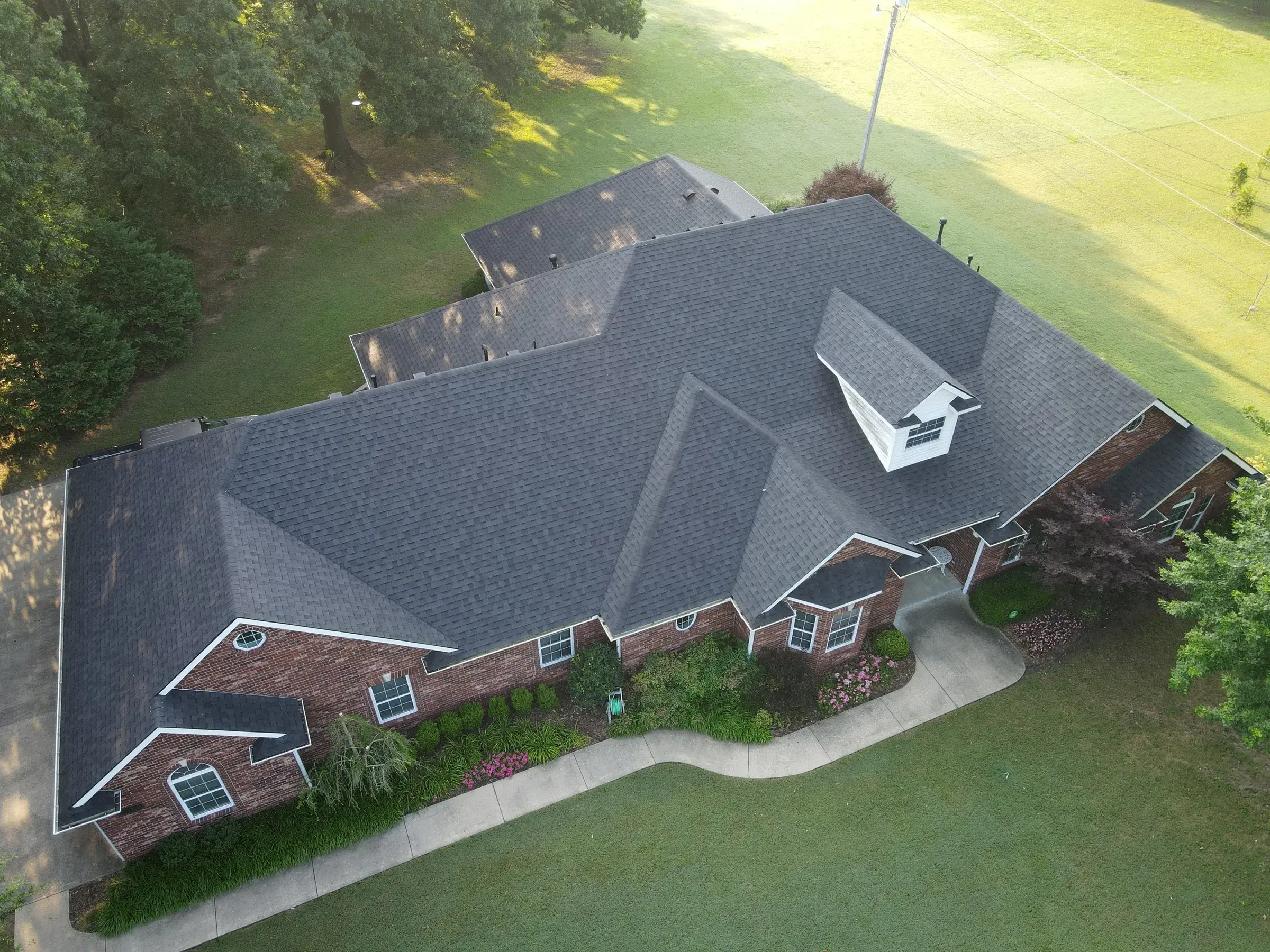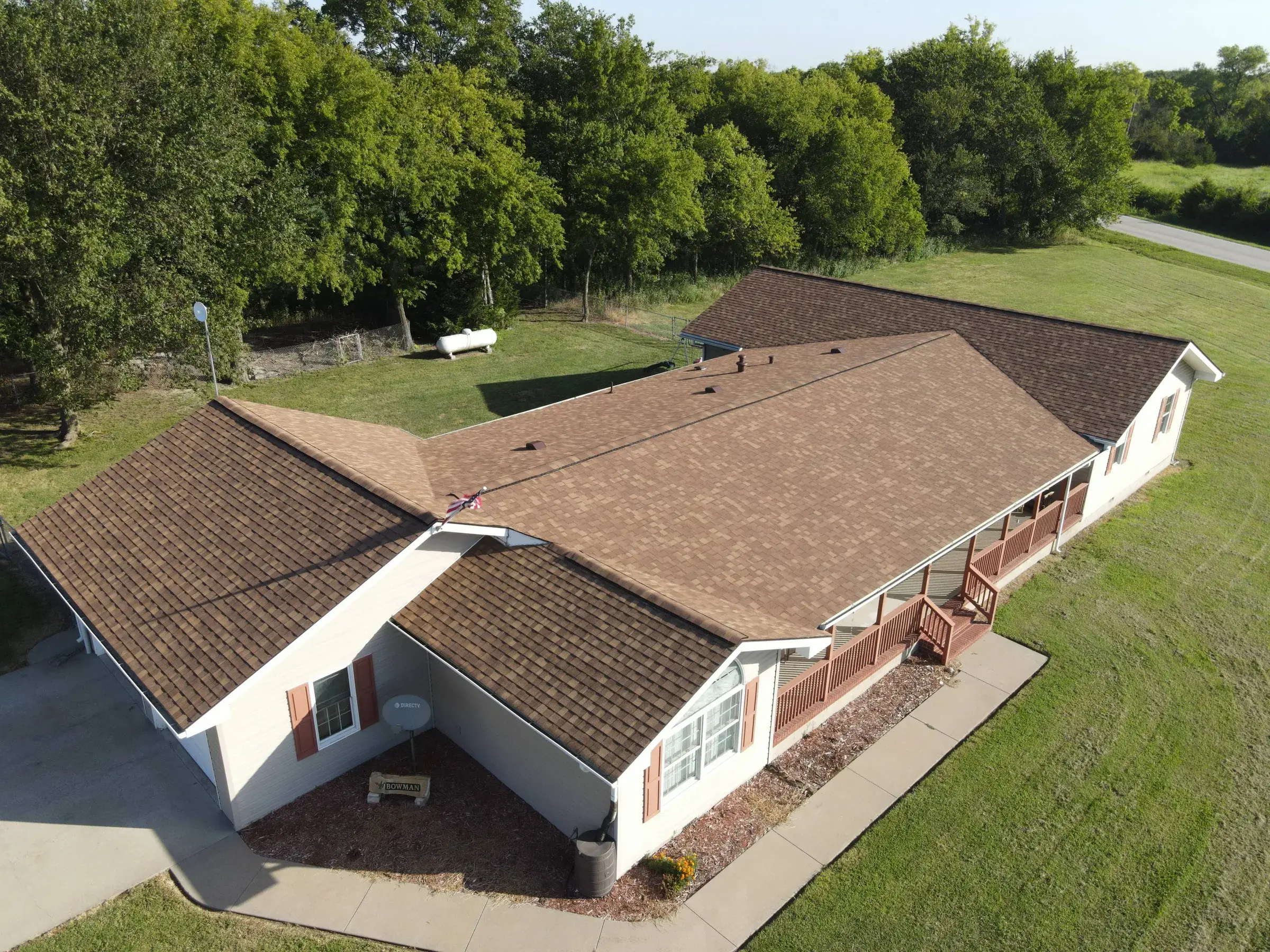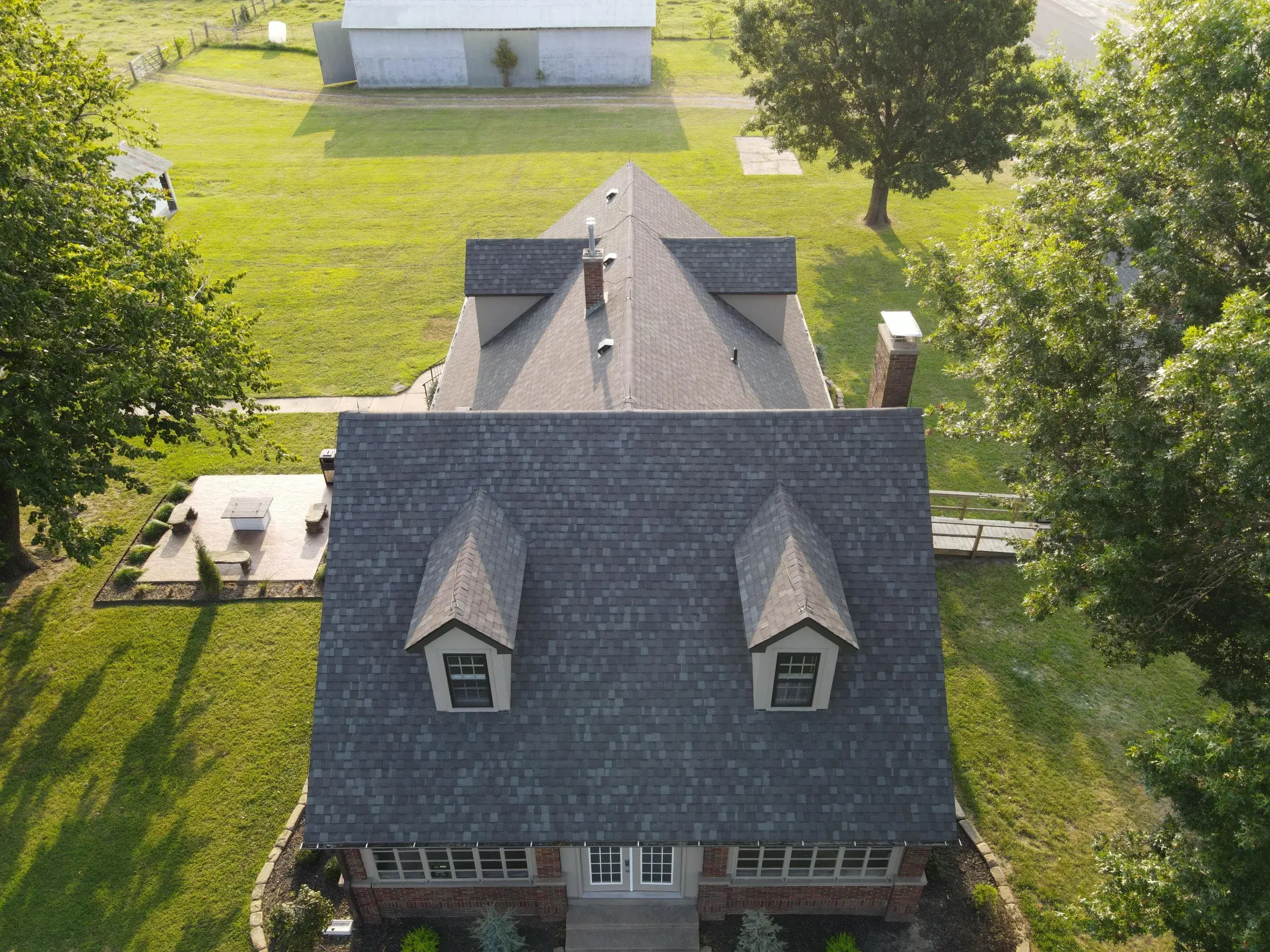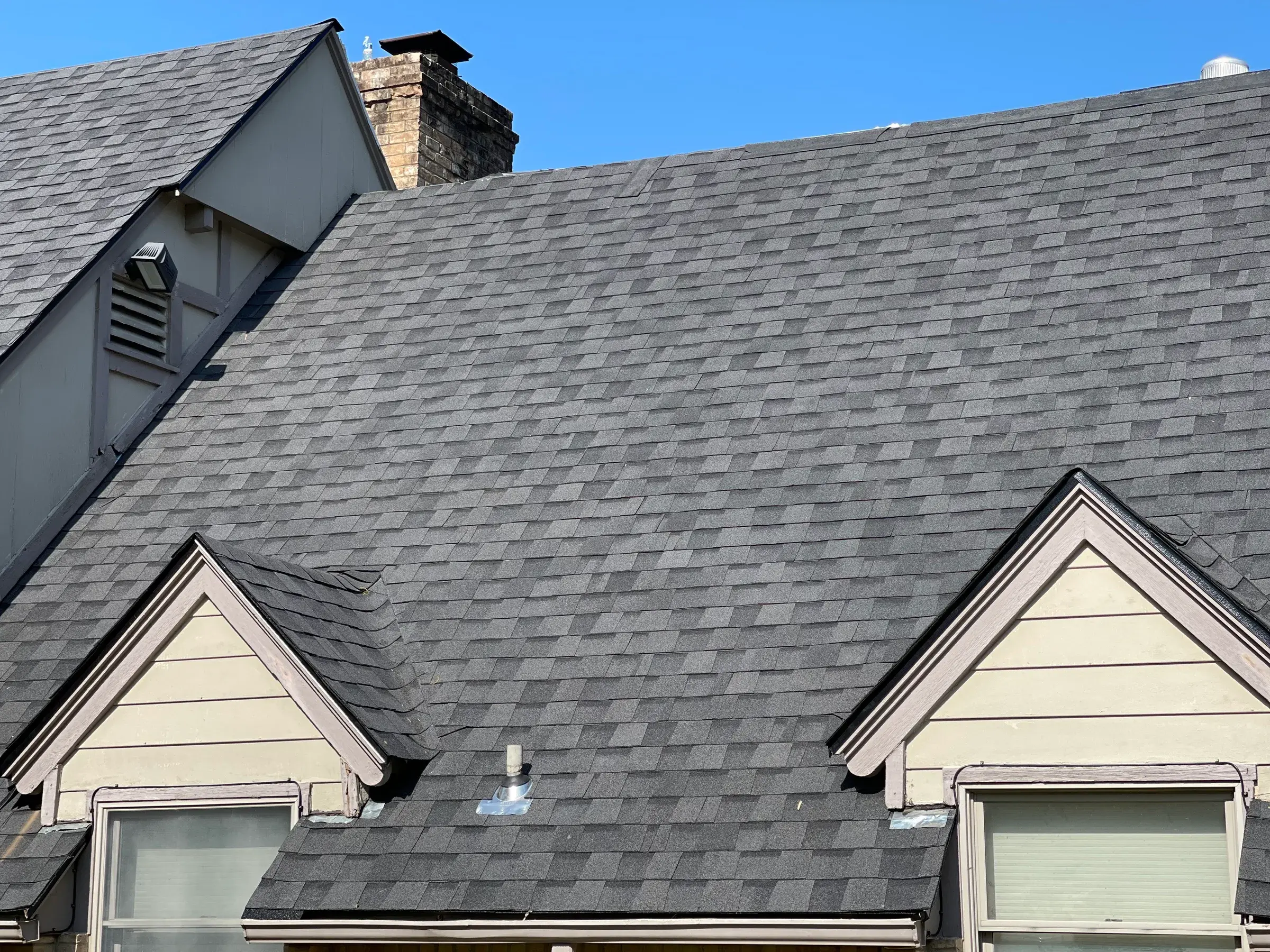
Spring roof maintenance in northeast Oklahoma comes down to six checks: clear winter debris from gutters and valleys, look for lifted or missing shingles, check flashing and sealant at penetrations, inspect the attic for daylight or damp insulation, trim limbs back from the roof, and photograph everything from the ground before storm season starts.
Why spring is the checkpoint that matters most in Ottawa County
Winter rarely breaks a roof outright. It works on the weak spots and leaves them for you to find.
The Oklahoma Climatological Survey's 1991–2020 normals put Miami at 89 nights a year below 32°F. That single number explains most of what a northeast Oklahoma winter does to a roof. Water finds a hairline gap in a sealant bead or around a nail head, freezes, expands, opens the gap a little wider, thaws, and goes deeper. Eighty-nine times. Nothing about that is dramatic on any one night. By March, a bead of caulk that was fine in October has a split running through it.
Spring is the checkpoint because it sits between the damage and the test. Severe weather season here ramps up in spring, and the same OCS normals record 4 to 5 days a year with hail larger than three-quarters of an inch. A roof that enters that season with a lifted shingle tab and a cracked pipe boot is a different roof from one that doesn't.
There is a second reason, and it is the one most homeowners miss. If you never looked at your roof before a storm, you have no way to say what the storm actually changed — not to an adjuster, and not to yourself.
Ottawa County makes this local in a specific way. The east side of the county sits in the Ozark Plains: rockier, wooded, rolling, shaded. Those roofs deal with limb contact, leaf load packed into the valleys, and algae on the north slope. The west side is Neosho Lowlands — flat prairie and farmland, open fetch, nothing to slow the wind before it reaches your ridge. Same county, two different spring checklists. Read yours for where you actually live.
Step 1: Clear the gutters and confirm the downspouts actually discharge away
Start here, for two reasons. Everything else on this list is easier to see once the gutters are clear. And a blocked gutter is the cheapest roof problem to fix and one of the more expensive ones to ignore.
Winter packs them full: last fall's leaves compressed by ice, shingle granules, twigs, and — on the wooded east side of the county — a surprising volume of oak and hickory litter. Get the debris out first, then look at four things.
Standing water after the trough is empty means the gutter isn't pitched to drain. Separated seams and loose hangers mean ice load pulled the gutter away from the fascia over the winter. Rust or dark staining on the fascia board behind the gutter means water is running behind the gutter instead of into it. And granules — a scattering of sandy grit at the downspout outlet is normal for an aging roof shedding its surface; a sudden heap of it after a hail day is a question worth asking someone.
Then test the downspouts with a hose. The test is not whether the gutter fills. It's whether the water leaves, and where it goes once it does. Walk to the discharge point and watch. An extension that dumps two feet from the wall is doing nothing at all. Get the water out past the drip line and confirm it isn't pooling against the foundation — on the flat lots west of Miami, the ground will not do that work for you.
This is a roof issue, not a landscaping issue. Water that can't leave backs up under the shingle edge at the eave, soaks into the deck, and rots the first few inches of sheathing in a place you will never see until a roofer is standing on it. If ladders aren't your thing, this is a routine [gutter cleaning](/services/gutter-cleaning) visit and it takes an hour.
Step 2: Ground-level shingle scan — what lifted, curled, or missing looks like
Get binoculars. Walk the full perimeter and look at all four elevations. Do it in early morning or late afternoon, when low sun rakes across the slope and every lifted edge throws a shadow. Midday light flattens the roof and hides exactly what you're hunting for.
The Asphalt Roofing Manufacturers Association — ARMA, the trade body for shingle manufacturers — publishes homeowner inspection guidance, and its consistent theme is that most of what matters can be identified without setting foot on the roof. Here's the translation table.
| What you see from the ground | What it usually means | Urgency |
|---|---|---|
| A dark rectangle where a shingle used to be | The tab blew off and the underlayment or deck is exposed | Now — that's an open path for water |
| Shingle tabs lifted or standing proud at the edges | The self-seal strip released; wind or age. The next gust can fold it back | Weeks, not months |
| Corners curled up or clawed down | Heat and UV aging the mat. Often a roof in the back half of its life | Note it and plan |
| Shiny black or bare spots scattered across a slope | Granule loss — wear, or impact from hail | Get it looked at |
| Heavy granule accumulation at the downspout outlet | The surface layer is coming off faster than normal | Get it looked at |
| Cracked, chalky, or split collar around a plumbing pipe | The rubber pipe boot has failed under UV | Weeks, not months |
| Rusted, lifted, or caulk-smeared metal at a wall or chimney | Flashing is failing and someone has been chasing the leak | Weeks, not months |
| A dip or wave in the ridge line or the field of the roof | Deck or framing problem underneath | Now — and stay off the roof |
| Green or black streaking on a shaded slope | Algae or moss holding moisture. Common on wooded east-county lots | Watch it |
One thing this table can't do for you: hail. Hail damage on an asphalt shingle is usually not a hole. It's a bruise — a soft, granule-stripped dimple where the impact fractured the fibreglass mat underneath. You can press it with a thumb and feel it give, like a spot on an apple. You will almost never see it from the driveway. So a roof can take real hail damage and look completely fine from the ground. That's not a reason to panic after every storm; it's the reason a ground scan and a [roof inspection](/services/roof-inspections) are two different things.
Step 3: Flashing, pipe boots, and the transitions where leaks actually start
Roofs rarely leak in the open middle of a slope. They leak where the roof stops being a roof: walls, chimneys, valleys, vents, skylights, plumbing stacks. Everything on this step is a transition.
The parts, in plain English
Step flashing is the L-shaped metal that ties a roof into a wall — individual pieces, woven in with each shingle course, so water stepping down the wall keeps getting kicked back onto the roof. Counter flashing is the metal let into a chimney's mortar joint that caps the step flashing behind it. A pipe boot is the rubber collar sealing around a plumbing vent pipe. Kickout flashing is the small diverter at the bottom of a roof-to-wall run that throws water into the gutter instead of behind the siding.
Pipe boots are the ones to check hardest in spring, and the reason is our sunshine. The OCS puts this area near 62% of possible annual sunshine, and UV is what kills rubber. The collar goes chalky, then splits in a ring around the pipe. It is one of the most common sources of a small brown ceiling stain and one of the cheapest components on a roof to replace.
Look at valleys next — where two slopes meet and half the roof's water funnels through. Leaves dam up there over winter, water backs sideways under the shingle edges, and the deck below rots quietly. Clear them. Then look for roof cement smeared over a flashing joint. Sealant is not flashing. Black goop on a metal joint is a symptom: somebody was chasing a leak and didn't fix the geometry. It buys a season. Missing kickout flashing is the sneakiest of the group — nothing shows on the roof at all, and the damage turns up years later as rotted wall sheathing behind the siding. If any of this describes your roof, it's [roof repair](/services/roof-repair) work, not caulk-gun work.
Step 4: The attic check most homeowners skip (and what it reveals)
Pick a bright, dry day. Take a flashlight up — then turn it off and stand still for a minute while your eyes adjust. You are looking for daylight, and daylight only shows in the dark.
Attic inspection mini-checklist
- Daylight visible through the roof deck, or around any pipe, vent, or chimney penetration
- Insulation that is damp, matted, or discoloured — trace straight up from it to find the source
- Rusted nail tips poking through the deck (this is condensation, not a leak — it's a ventilation problem)
- Dark staining or water tracks on rafters, trusses, or the underside of the decking
- Soffit vents blocked by blown insulation pushed over the eaves
- A bathroom or dryer vent that terminates in the attic instead of through the roof or wall
- A musty smell, or any spot of mould on the sheathing
Rusted nail tips deserve a word. Warm moist air from inside the house rises into a cold attic, hits the underside of the deck, condenses on the coldest metal it can find, and rusts the nails. Homeowners find it, assume the roof is leaking, and buy a repair they don't need. The fix is airflow.
The International Residential Code's attic ventilation section — R806, adopted through Oklahoma's current residential code — sets the benchmark: one square foot of net free vent area for every 150 square feet of attic floor, or one for every 300 when the vents are balanced, with at least 40% and no more than 50% of the vent area in the upper part of the attic and the rest down at the eaves. That balance is the part that gets broken in the real world. Insulation blown over the soffit vents chokes the intake; the exhaust vents then pull their air from inside your house instead. Ventilation problems show up as high summer bills, ice at the eaves in January, and shingles cooking from underneath — and 57 days a year above 90°F gives an unventilated attic plenty to work with. If the checklist above turns up rust or blocked soffits, that's [roof ventilation repair](/services/roof-ventilation-repair) territory.
One local note. Roughly 13% of Ottawa County's 13,701 housing units sit vacant a good part of the year — a lot of that is lake property around Grand Lake o' the Cherokees. An attic nobody has entered since October is exactly where a pinhole leak turns into a framing repair. If you own a second place out here, this is the step not to skip.
Step 5: Trees, limbs, and debris load before the wind arrives
This step is mostly for the east half of the county, where the Ozark Plains bring the trees right up to the house. West of Miami, in the Neosho Lowlands, you generally have the opposite problem: nothing standing between your roof and the wind.
The Insurance Institute for Business & Home Safety — IBHS, the research body funded by insurers to test buildings against wind and hail — is consistent in its resilience guidance: limbs that touch or overhang a roof should come back. Four separate reasons stack up. A limb resting on shingles sands the granules off a little more in every breeze. Overhanging branches drop the debris that dams your valleys. Shade keeps a slope damp, which is how you get moss and algae holding water against the shingle. And in a spring storm, the limb itself becomes the problem.
How far back? Far enough that a limb loaded with ice, or shoved by a gust, still can't reach the roof plane. That is further than it looks from the ground. Anything substantial over the house belongs to an arborist with a rope, not to you and a pole saw on a ladder.
While you're at it, sweep the debris that's already collected — behind chimneys, in the valleys, on any low-slope section, and in the dead corner where a dormer meets the main roof. And if you find moss: do not pressure wash it. ARMA is explicit that pressure washing is not an approved cleaning method for asphalt shingles. It strips the granules — which are the roof's sunscreen — and turns a cosmetic problem into a real one in about ten minutes.
Step 6: Document condition now so you have a baseline later
This step takes fifteen minutes and it's the one people thank themselves for later.
Photograph the roof from the ground, every elevation, wide shots first. Then zoom shots of anything the symptom table flagged. Photograph the gutters, the pipe boots, the wall and chimney flashing, and the attic. Make sure the images carry a date — your phone does this automatically — and get them off the phone and into cloud storage or email, because the phone is the thing that goes missing.
Here is why it matters. After a storm, the only question that counts is what changed. An adjuster is seeing your roof for the first time, on the worst day of its life, with no idea whether that curled shingle happened last Tuesday or in 2019. A dated set of before photos answers that in seconds. It doesn't decide anything — your insurer decides coverage under your policy — but it removes an argument.
File the paperwork with the photos while you're at it: prior repair invoices, and your permit records. The City of Miami requires a permit for new roofs and re-shingles, and we pull it on the work we do. That record is part of your roof's history, and it's worth keeping where you can find it.
What to DIY and what to leave to a roofer
Every step above is designed to be done from the ground, from a ladder at the eave, or from inside the attic. Nothing on it requires walking the slope. That's deliberate.
| Task | How often | DIY or pro | Why it matters |
|---|---|---|---|
| Clear gutters, valleys, and downspouts; test discharge with a hose | Spring and fall; again after heavy leaf drop | DIY from a ladder at the eave, or pro | Backed-up water gets under the shingle edge and rots the deck at the eave where you can't see it |
| Ground-level shingle scan, all four elevations, low sun, binoculars | Spring and fall; after any hail or high wind | DIY | Lifted and missing tabs are the foothold wind uses in the next storm |
| Check flashing, pipe boots, valleys, and every penetration | Spring | DIY to spot it; pro to repair it | Almost every leak starts at a transition, not in the open field of the roof |
| Attic inspection for daylight, damp, rust, staining, blocked soffits | Spring, on a bright dry day | DIY | Shows leaks and ventilation faults months before the ceiling does |
| Trim limbs back clear of the roof plane | Yearly; large limbs on an arborist's schedule | Pro for anything over the house | Abrasion, debris load, shade, and the limb itself when it comes down |
| Photograph the roof and file the images with a date | Yearly, before severe weather season | DIY | A dated before-set is the only thing that proves what a storm actually changed |
The line between DIY and pro is not about skill. It's about the fall. The U.S. Consumer Product Safety Commission tracks ladder injuries year after year through its national emergency-room injury data, and falls from ladders sit among the most reported home-project injuries in the country. A roof compounds it: pitch, loose granules that roll underfoot like ball bearings, and a landing surface with no give. Add that Ottawa County has a high share of manufactured housing — 12.2% of its units — and those roofs are typically low-slope metal or membrane, where walking can puncture the very surface you're trying to protect.
Simple rules. Don't get on a wet or dewy roof. Don't get on a two-storey roof. Don't get on a roof steeper than you'd comfortably walk down a hill. Don't get on a roof alone. If you want the longer version, we wrote one on [when to stay off the roof entirely](/blog/roof-safety-for-homeowners-when-to-stay-off-the-roof).
When a spring check should turn into a professional inspection
Some of what you find is a Saturday job. Some of it is a phone call. Here's the dividing line.
Call a roofer if your spring check turns up any of these
- Anything in the 'now' column of the symptom table — a missing shingle, or a dip in the roof line
- Any interior stain, damp insulation, or daylight through the deck
- Rusted nail tips or soffit vents you can't clear yourself
- Hail of any size at your address, even if the roof looks fine from the ground
- A wind event that took down limbs or blew debris across the yard
- Flashing with roof cement smeared on it, or no kickout flashing where a roof meets a wall
- You don't know how old the roof is, or you're buying or selling the house
Our inspections are free, and you get a photo report of what we find whether or not there's work to do. We work across northeast Oklahoma from our office at [111 S Main St in Miami](/locations/miami-ok), and into Kansas, Missouri, and Arkansas.
One more thing worth knowing before you let anyone on your roof, especially after a hail day when out-of-state trucks start appearing in driveways. Oklahoma registers roofing contractors through the Construction Industries Board, and the CIB runs a free public search at verifyroofing.cib.ok.gov. Registration requires liability insurance of at least $500,000 for residential work. Two minutes, no account needed. Be aware of the vocabulary too: Oklahoma issues a registration, not a licence, and neither Oklahoma nor Kansas nor Arkansas requires a surety bond for roofing — Missouri has no state roofing licence at all. Anyone telling you they're 'licensed and bonded' in this market is describing something that doesn't exist here.
This checklist has a twin. Spring is about finding what winter did and getting ahead of what storm season will test. [Fall maintenance](/blog/fall-roof-maintenance-checklist-northeast-oklahoma) is about the other end — getting the roof ready for those 89 freezing nights. Do both, keep the photos, and you'll spend the next decade making small decisions about your roof instead of one large one.
If your spring walk-around turned up something you'd like a second opinion on, we'll come look at it. Inspections are free, and you'll get the photos either way. Call (209) 758-8550.
Questions people ask about this
When should I do spring roof maintenance in northeast Oklahoma?
As early in spring as the weather lets you work outside safely — the point is to finish before severe weather season is underway, not after the first storm. Rather than working from a fixed date, check the severe weather climatology the National Weather Service office in Tulsa publishes for northeast Oklahoma, which shows hail, wind, and tornado frequency by month. The Oklahoma Climatological Survey records 4 to 5 days a year here with hail larger than three-quarters of an inch, so there is no season worth gambling on.
Can I tell whether my roof has hail damage from the ground?
Usually not. Hail damage on an asphalt shingle is typically a bruise rather than a hole — a soft, granule-stripped dimple where the impact fractured the mat underneath, which you can feel by hand but rarely see from a driveway. What you can spot from the ground is blown-off tabs and a sudden heap of granules at the downspout. A roof can take real hail damage and look perfectly normal from below, which is why a ground scan and an actual inspection are two different things.
Do I need a permit to replace a roof in Miami, Oklahoma?
Yes — the City of Miami requires a permit for new roofs and re-shingles, and we pull it on the work we do. It's also worth knowing that Oklahoma amended IRC section R908.3.1.1 to require a tear-off rather than shingling over the existing roof in defined conditions. If a contractor proposes a layover, ask them how it meets that amendment.
How do I check that a roofing contractor is legitimate in Oklahoma?
Use the Construction Industries Board's free public search at verifyroofing.cib.ok.gov. Oklahoma registers roofing contractors, and registration requires liability insurance of at least $500,000 for residential work. Note the wording: Oklahoma issues a registration, not a licence, and no state in this region requires a surety bond for roofing — Missouri has no state roofing licence at all. A company advertising itself as 'licensed and bonded' here is describing something that doesn't exist.
Should I pressure wash moss or algae off my shingles?
No. The Asphalt Roofing Manufacturers Association is explicit that pressure washing is not an approved cleaning method for asphalt shingles — the pressure strips the granules, which are the shingle's protection against UV. That turns a cosmetic problem into a real one. Algae streaking on a shaded north slope is common on wooded lots in the east of Ottawa County and is mostly an appearance issue; if it bothers you, ask about cleaning methods the manufacturer actually approves.