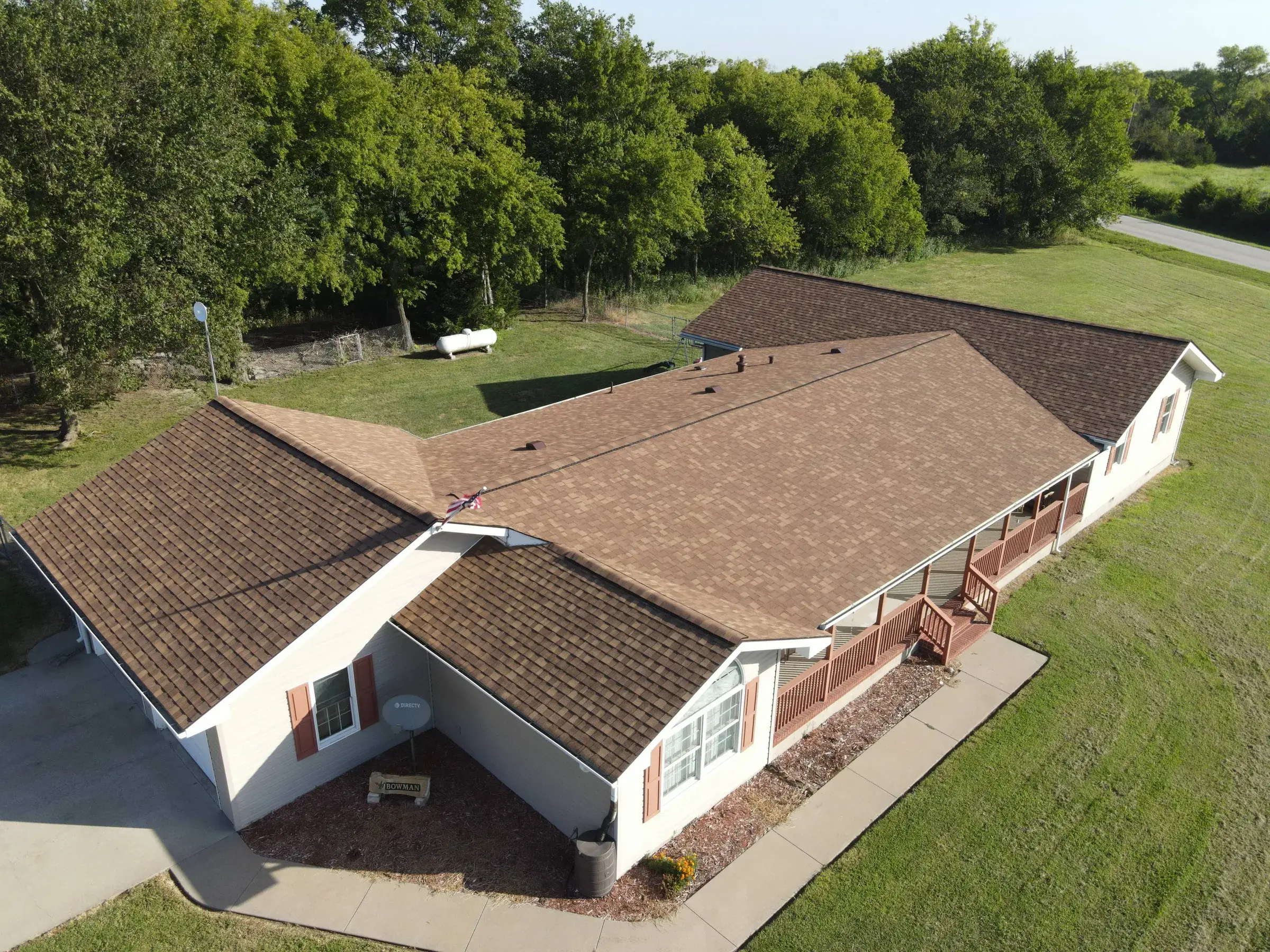
In northeast Oklahoma, twice a year is the baseline — late spring after seed and blossom drop, and late fall after the oaks and maples finish. Add a third cleaning if your roof sits under overhanging trees or you have pine nearby. Overflowing gutters damage fascia, soffits, and foundations far faster than they damage the roof itself.
The baseline answer: two cleanings, and when
Two cleanings a year covers most houses in and around Miami. The timing is what people get wrong — specifically the fall one.
The spring visit belongs in late May or early June. By then the oaks have finished dropping catkins (the stringy, caterpillar-looking tassels that pile up on your driveway in April), and the maples and elms are done throwing seed.
The fall visit is the one that gets rushed. A lot of homeowners clean in mid-October because that is when the calendar says fall. In Ottawa County that is too early. Oak is the dominant hardwood across the eastern half of the county, and oaks let go late — some hold brown leaves into December. Clean in October and you either do it twice or the gutter goes into winter packed.
Aim for the stretch after the oaks are bare. That is often late November into the first part of December. You are also racing the cold: the Oklahoma Climatological Survey's 1991–2020 normals put this area at roughly 89 nights a year below 32°F, so freezing nights start arriving while leaves are still falling. Pick a dry, mild day inside that window and get it done.
If the fall cleaning is part of a bigger walk-around, our [fall roof maintenance checklist for northeast Oklahoma](/blog/fall-roof-maintenance-checklist-northeast-oklahoma) covers what else deserves a look on the same trip.
Why late spring counts too — seed pods, blossoms, and shingle grit
Spring is the cleaning people skip, and the reasoning is backwards. Spring debris is smaller than fall leaves, so it seems less serious. Small is worse.
A wet oak leaf is broad and flat. It tends to lie in the trough or wash toward the outlet in one piece. Catkins, elm seed, maple samaras, cottonwood fluff and blossom drop do something different — they mat. They knit together into a wet felt that packs into the downspout outlet, which is the narrowest opening in the entire system. A gutter can look almost clean from the ground and still be plugged at the one hole that matters.
Spring runoff also carries grit off the roof. Some of that is dust and pollen. Some of it is shingle granules — the colored ceramic coating that shields the asphalt underneath from ultraviolet light. Northeast Oklahoma gets about 62% of possible sunshine in a year, so that coating is doing real work, and what shows up in your gutter tells you something about it.
Tree cover is the variable: how species around Ottawa County change your schedule
Ottawa County is split down the middle, and the split is not decorative. The eastern side sits in the Ozark Plains — rockier, rolling, wooded. OSU Extension and Oklahoma Forestry Services describe that country as oak-hickory: post oak, blackjack oak, hickory, with shade and leaf litter to match. The western side is the Neosho Lowlands — flat prairie and farmland, open sky, trees mostly in fencerows and along the river bottoms. Elm, hackberry, cottonwood, sycamore.
Two houses ten miles apart in this county can honestly need a different schedule. A place east of town under a hickory canopy is a three-visit house. A place on open ground west of the Neosho may genuinely get by on one.
Species matter more than tree count. A single silver maple overhanging the roof will out-clog five trees standing off in the yard, because maples drop twice — seed in spring, leaves in fall. Eastern redcedar is the one people overlook. OSU Extension and Oklahoma Forestry Services have documented its spread across Oklahoma for decades, and it is thick here. Cedar drops fine, waxy needles in every season, and those needles pack down tight and rot slowly. A house with cedar close to it does not have a seasonal gutter problem. It has a year-round one.
Overhanging limbs are the other multiplier, and they bring more than leaves. Our piece on [trees, limbs, and roof debris in northeast Oklahoma](/blog/trees-limbs-and-roof-debris-in-northeast-oklahoma) gets into what a branch does to shingles when the wind comes up.
Frequency decision table
| Tree cover around the house | Roof pitch | Gutter size | Cleanings per year |
|---|---|---|---|
| No trees within about 30 feet (open lots, west-county farmland) | Any | 5-inch K-style, 2x3 downspouts | 1 — late fall |
| Trees in the yard, nothing over the roof | 4/12 to 6/12 (typical) | 5-inch K-style, 2x3 downspouts | 2 — late spring and late fall |
| Trees in the yard, nothing over the roof | 8/12 or steeper | 5-inch K-style, 2x3 downspouts | 2 — steep roofs sluice debris straight into the trough |
| Branches overhang part of the roof | 4/12 to 6/12 | 5-inch K-style, 2x3 downspouts | 3 — late spring, late summer, late fall |
| Full oak/hickory canopy over the house (east Ottawa County) | Any | 5-inch K-style, 2x3 downspouts | 3 to 4 |
| Full canopy over the house | Any | 6-inch, 3x4 downspouts | 3 — the bigger outlet buys back one visit |
| Eastern redcedar or planted pine within about 30 feet | Any | Any | 3 to 4, spread through the year — needles drop in every season |
| Low slope with trees nearby | Below 4/12 | Any | 2 — but check the roof surface and valleys more often; debris parks there instead of reaching the gutter |
Pitch is written as rise over run: a 6/12 roof climbs 6 inches for every 12 inches across. Steep roofs deliver debris to the gutter fast and efficiently, which is why a steep, wooded lot fills quickly. Low-slope roofs hold debris on the shingles and in the valleys instead, so the gutter looks fine while the roof itself is holding wet leaf litter against the surface. Different problem, same tree.
How to tell your gutters are overdue without climbing a ladder
You can read most of this from the yard during or right after a rain. Walk the perimeter of the house with an umbrella. Every one of these is visible from the ground.
Ground-level signs your gutters are overdue
- A dark vertical streak running down the fascia board, usually worst near a corner or an end cap
- Anything green growing out of the top of the gutter — maple seedlings and moss are the usual two
- Water pouring over a corner or an end cap during rain instead of leaving through the downspout
- A run that sags in the middle, or a visible gap between the back of the gutter and the fascia
- A downspout that stays dry or only trickles while it is raining hard
- Mud and grit splashed a foot or more up the siding under the eave
- A washed-out trench in the mulch or soil directly beneath a gutter line
- A fan of shingle granules on the ground at the bottom of a downspout
- Wasps, birds, or squirrels working the gutter line
- Icicles hanging from one section only after a cold snap
- Paint peeling on the underside of the soffit, or a soffit panel starting to droop
Two of those deserve extra weight. A downspout that will not run in a downpour means the outlet is plugged, and the gutter above it is a trough of standing water. And water coming over the back of the gutter — the fascia side rather than the front lip — is the expensive one, because that water never touches the ground. It goes into the house's edge.
What clogged gutters actually damage: fascia, soffit, siding, foundation
Here is the part most people have backwards. A clogged gutter is not primarily a roof problem. Your shingles shed water by design and mostly do not care. The damage lands on the wood trim the gutter is bolted to, and on the dirt around your footings.
| What the water does | What it damages | What you would see | Typical remedy |
|---|---|---|---|
| Overflows the back edge of the gutter | Fascia — the board the gutter hangs from | Dark vertical streaks, peeling paint, wood that dents under a thumbnail | Cut out and replace the soft fascia, re-hang the gutter, add a gutter apron |
| Runs back under the eave | Soffit panels and the edge of the roof deck | Stained or sagging soffit; birds and wasps getting in behind it | Replace soffit, check the deck edge for rot before any new shingles go on |
| Sheets down the wall | Siding, window trim, wall sheathing | Streaked siding, swollen trim, paint failing in one vertical column | Repair trim and siding — but fix the gutter first or it repeats |
| Dumps straight down at the eave | Grade, foundation soil, crawlspace | A trench cut in the mulch, mud splashed up the siding, a damp crawlspace | Clear the gutter, then extend downspouts well away from the wall |
| Sits as standing water and wet debris | The gutter, its hangers, and the fascia they screw into | Sagging runs, a gap behind the gutter, spikes backing out | Re-hang on hidden hangers with screws and re-pitch the run |
| Backs up onto the roof edge | First course of shingles, drip edge, deck edge | Shingles at the eave staying wet long after rain; dark deck edge visible from below | Clear it — and if the deck edge has gone soft, that is a repair, not a cleaning |
| Freezes solid inside the plug | Gutter seams, hangers, the eave itself | An ice mass at the eave; icicles from one spot only | Nothing safe to do mid-winter. This one is prevented in November, not fixed in January |
Fascia and soffit are the ones that quietly get expensive, because the rot spreads sideways along the board before anyone notices the paint. By the time a soffit droops, the deck edge above it has usually been wet for a while.
The ice connection: full gutters and NE Oklahoma freeze-thaw cycles
About 89 nights a year below freezing, per the Oklahoma Climatological Survey's 1991–2020 normals — but almost none of them stay below freezing. That is the important part. This is not a place that freezes in December and thaws in March. It freezes overnight and thaws by afternoon, over and over.
A packed gutter turns that cycle into a machine. Wet leaf mat holds water instead of letting it leave. The water freezes at night and expands. It thaws, seeps deeper into the seams and behind the hangers, and freezes again the next night. Repeat that a few dozen times and you get split seams, loosened hangers, and a gutter that has slowly pried itself off the fascia.
Ice also weighs a lot. A run of gutter loaded with frozen debris and ice pulls hard on fasteners driven into a fascia board that may already be soft from a summer of overflow. That is how gutters end up in the flowerbed after a cold snap.
One honest correction while we are here: ice forming at your eave is not automatically the gutter's fault. When warm air escapes into the attic, it melts snow on the upper roof, the meltwater runs down and refreezes at the cold overhang, and ice builds regardless of how clean the gutter is. That is an insulation and ventilation issue. A plugged gutter makes it worse and gives the ice something to grab, but clearing gutters will not fix an attic. NWS Tulsa is the National Weather Service office that forecasts for Ottawa County, and its winter headlines are worth watching when you are picking a day for the fall cleaning — you want that job behind you before the first hard freeze, not after.
Gutter cleaning vs. gutter repair — when clogging is a symptom of a pitch or sizing problem
If you are cleaning four times a year and one corner still overflows, stop buying cleanings. Something is wrong with the system, and cleaning it is just paying rent on the defect.
Pitch
Gutters are supposed to slope toward the downspout. The trade rule of thumb is roughly a quarter inch of fall for every 10 feet of run. Too flat and water stands, sediment settles, and the standing water becomes the glue that holds every leaf that lands after it. A gutter that is dead level does not drain — it collects. If one section always grows moss and the rest does not, you have found your low spot.
Sizing
Most houses here were built with 5-inch K-style gutters and 2x3 downspouts because that is the builder default, not because anyone sized it to the roof. The 2x3 outlet is the choke point. Moving to 6-inch gutter with 3x4 downspouts widens the hole debris has to pass through, and on a wooded lot that single change does more for clogging than any amount of scheduling. It also handles the volume of a hard Oklahoma downpour better, which is the other reason corners overflow.
Missing gutter apron
If water runs behind the gutter and down the fascia even when the gutter is clean and flowing, the problem is usually a missing gutter apron — the bent metal flashing that carries water off the deck edge and into the trough instead of letting it wick backward. That is a repair, not a cleaning, and it is a common find on older re-roofs.
Guards come up in every one of these conversations. They change the job; they do not delete it. We took that apart separately in [do gutter guards eliminate gutter cleaning?](/blog/do-gutter-guards-eliminate-gutter-cleaning) — the short version is that guards handle leaves better than they handle cedar needles, catkins, and shingle grit, which are exactly what northeast Oklahoma serves up.
DIY vs. hiring it out: the honest safety math
Plenty of people clean their own gutters, and there is nothing wrong with that. The decision is not about skill. It is about height, pitch, and whether you are alone.
Ladder falls are a permanent fixture in the U.S. Consumer Product Safety Commission's home-injury data — they are the reason ladder safety guidance exists at all. And the falls that hurt people are rarely dramatic. A single-story eave is roughly ten feet up. Ten feet onto a sidewalk, landing wrong, is a wrist or a hip. You do not need a two-story house to get hurt.
Hire it out if the house is two stories, if the pitch is 8/12 or steeper, if the ground under the ladder is soft or sloped, or if nobody is home to foot the ladder. Also hire it out if you would be doing it in December, which — given the oak timing — is exactly when it needs doing.
There is a side benefit worth naming. Somebody at the eave with a clear view is looking straight at the drip edge, the first course of shingles, the fascia, and the soffit. That is where roof problems announce themselves first. A cleaning visit is the cheapest roof inspection anyone gets.
Whatever you decide, get the scope in writing before work starts. A written estimate that says what is being done, on which parts of the house, is standard practice and something you should expect to receive without asking twice.
The short version
Twice a year, late spring and late fall, is the Ottawa County baseline. Three if limbs hang over the roof. Four if there is cedar close to the house. And do the fall one in late November or early December, after the oaks quit — not in October when it feels like fall.
If you would rather not be on a ladder in December, [gutter cleaning](/services/gutter-cleaning) is something we handle around [Miami and the rest of Ottawa County](/locations/miami-ok), and we will tell you what the eave looks like while we are up there. [Get in touch](/contact) for a free inspection and a written estimate.
Questions people ask about this
Is twice a year really enough for a house in Miami, Oklahoma?
For a house with trees in the yard but nothing hanging over the roof, yes — late spring and late fall covers it. Add a third cleaning if branches overhang the roof, and plan on three or four if there is eastern redcedar or planted pine within about 30 feet, since needles drop in every season rather than in one window. Houses on open ground west of the Neosho can often get by on one fall cleaning.
When exactly should the fall cleaning happen?
After the oaks are bare and before the first hard freeze — usually late November into the first part of December in Ottawa County. Mid-October is the common mistake here, because oak is the dominant hardwood on the east side of the county and oaks hold their leaves late, sometimes into December. The window is tight: the Oklahoma Climatological Survey's normals put this area at about 89 nights a year below 32°F, so freezing nights start arriving while leaves are still coming down.
Do gutter guards mean I never have to clean again?
No. Guards change the work rather than eliminating it — most of them keep whole leaves out reasonably well, and most of them do far less against the small stuff northeast Oklahoma actually produces: cedar needles, oak catkins, elm seed, and shingle grit. Fine debris either passes through the guard or mats on top of it. Guards can stretch your interval; they do not end it.
There are granules in my gutter. Is my roof failing?
Not necessarily. ARMA notes that a new roof sheds loose granules in its first rains and that any roof sheds slowly as it ages, so some grit is normal wear. What matters is change: a sudden pile at the downspout on an older roof, granules coming off one slope only, or bare black asphalt or small dark circles visible on the shingles. Given that this area sees four to five days a year with hail larger than 0.75 inch, a sudden change after a storm is worth having someone look at.
Can I just blow the gutters out with a leaf blower from the roof?
It's a worse trade than it looks. You end up standing at the roof edge — the exact place a fall starts — and cold shingles are brittle while wet ones are slick. Blowing from above also drives debris across the roof surface and into the valleys, where it holds moisture against the shingles. If the ladder is the problem, the answer is a better ladder setup or a different person, not the roof.