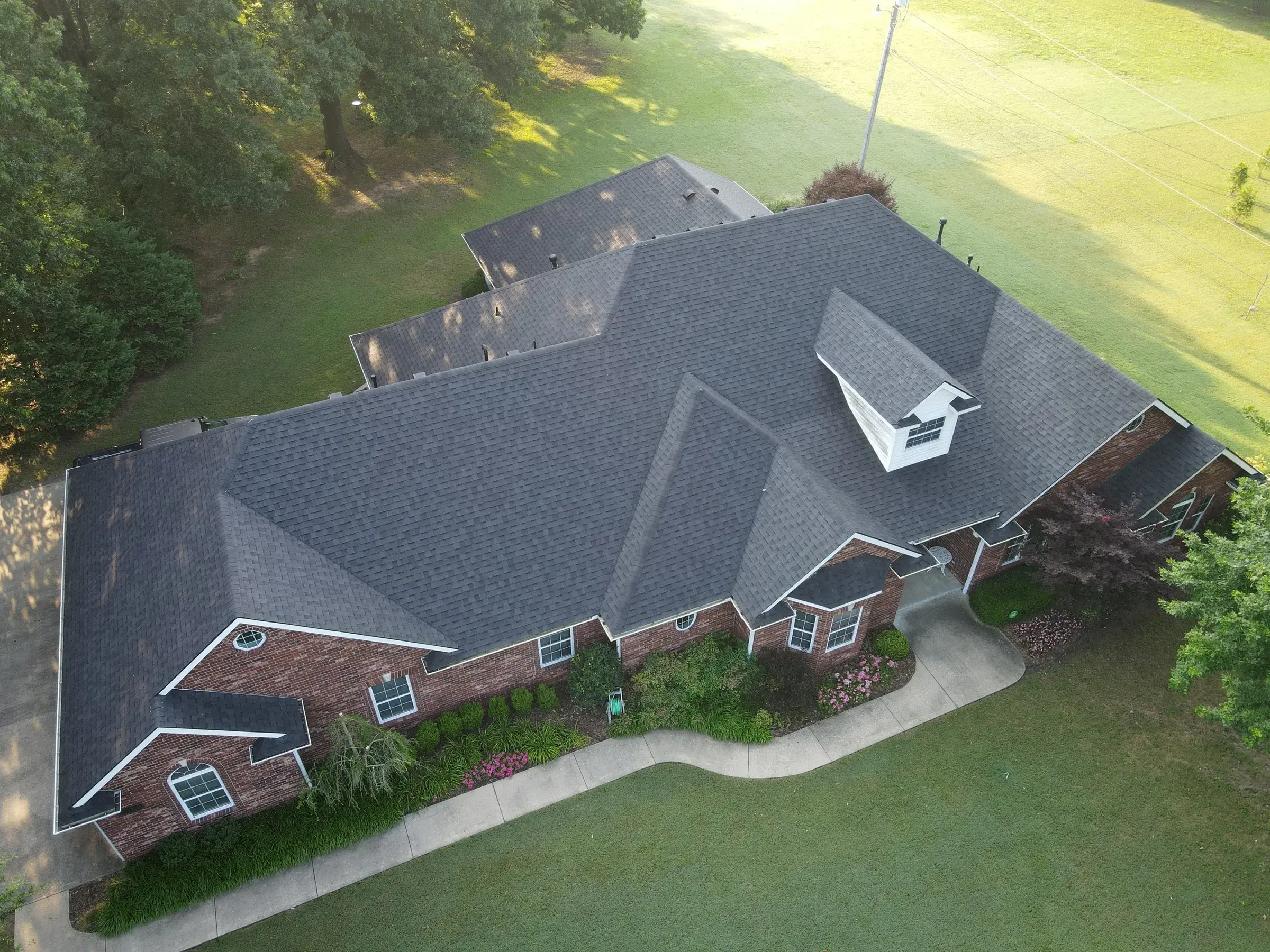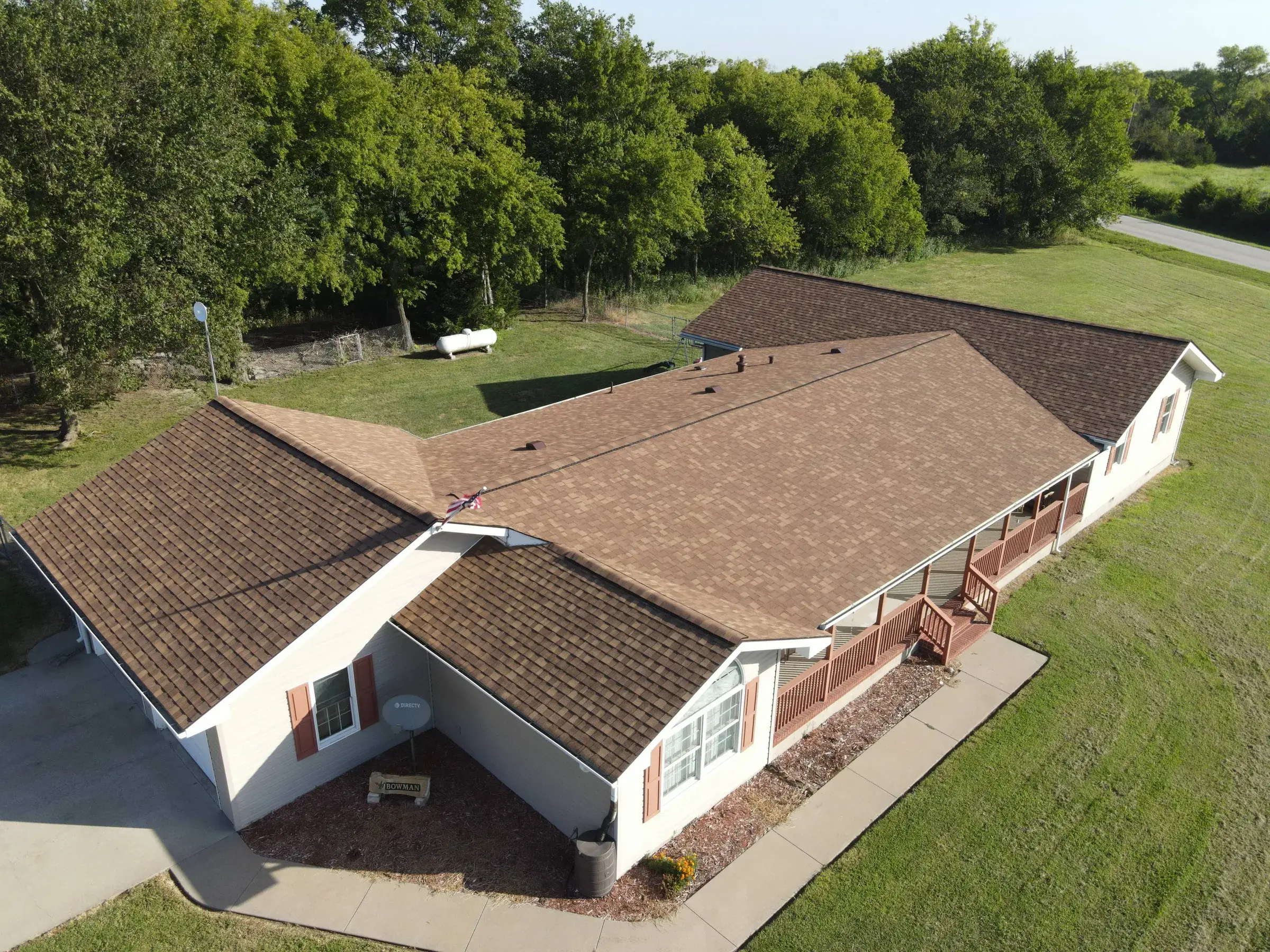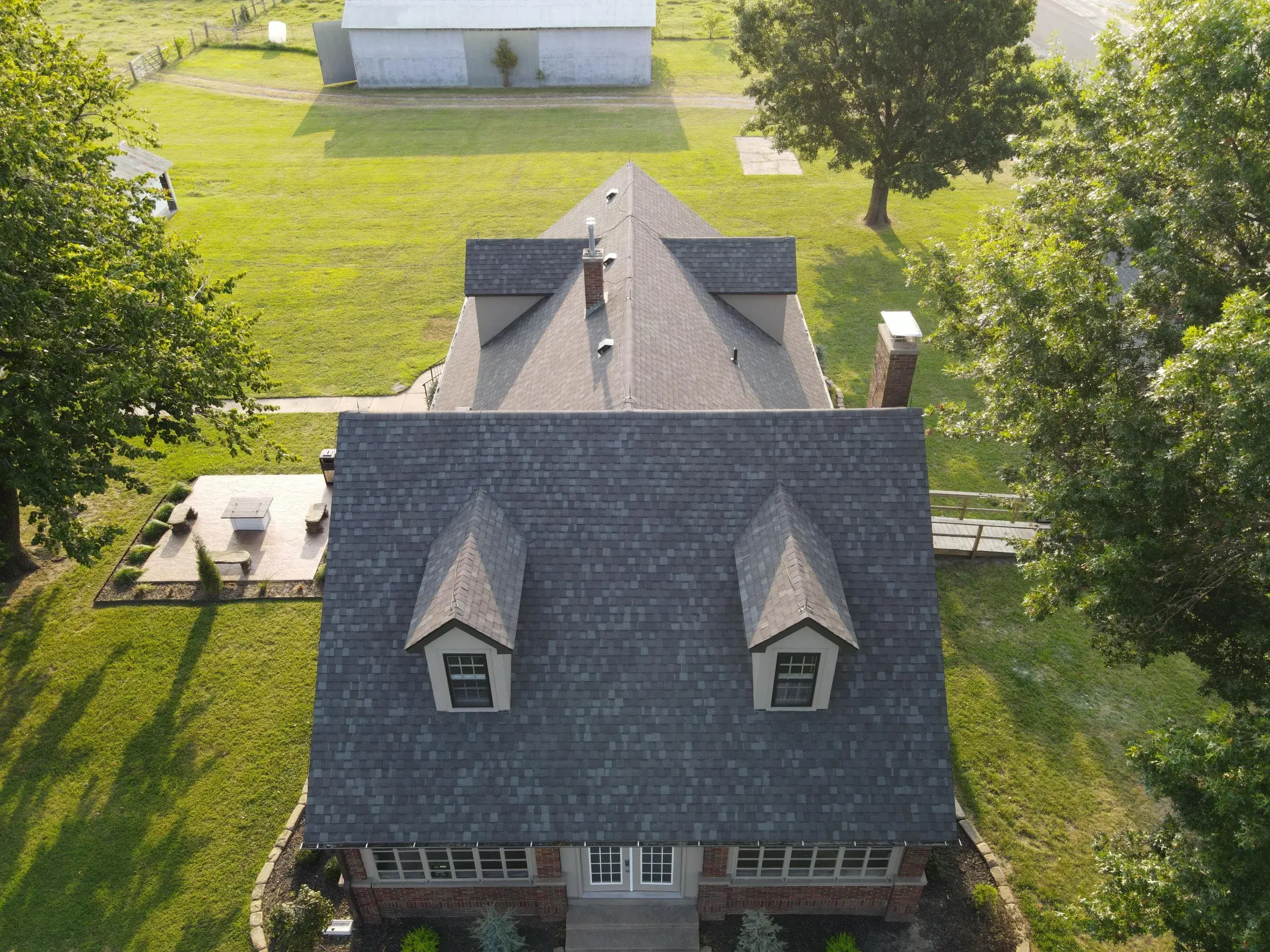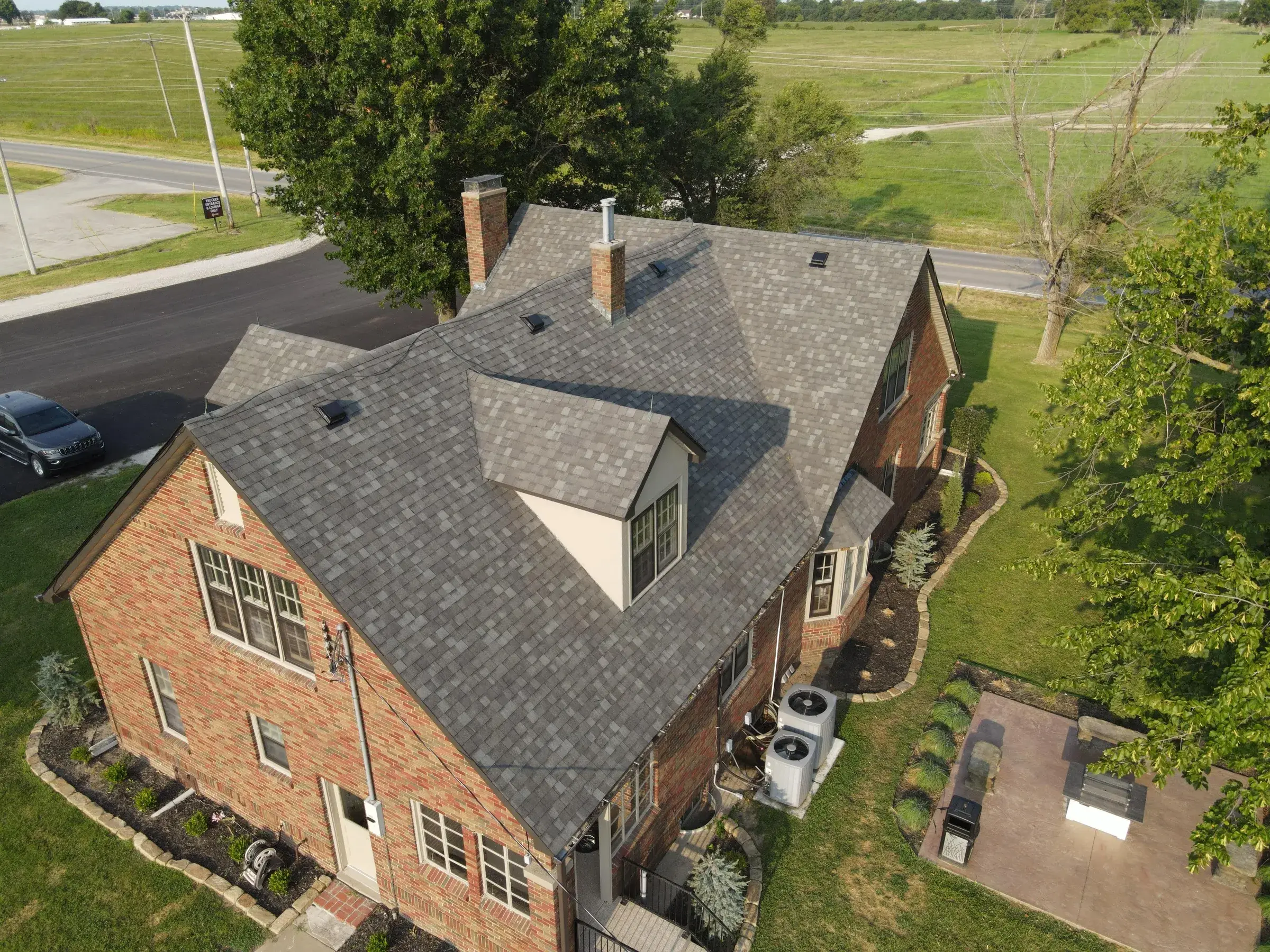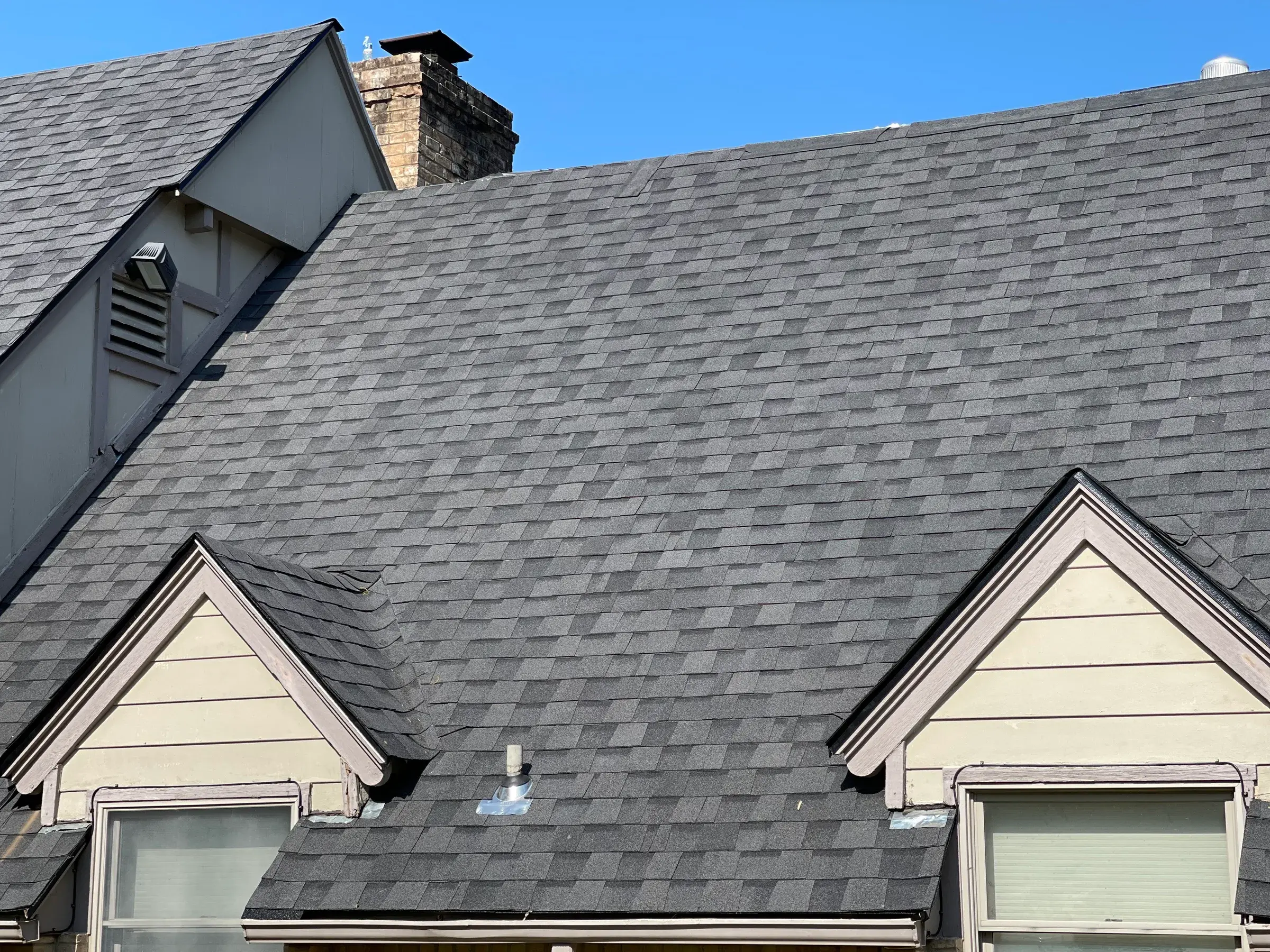
Roofs around Grand Lake face open-water wind exposure, heavy tree cover, and long stretches with nobody home. That combination favors wind-rated installation, careful flashing on additions and dormers, gutter maintenance under oaks, and a scheduled off-season inspection — because a lake-house leak in February can run for weeks before anyone opens the door.
What makes a lake roof different from an in-town roof
Grand Lake o' the Cherokees is not a natural lake. It is the Neosho River backed up behind Pensacola Dam, finished in March 1940 — 51 arches, 5,145 feet across, still described as the longest multiple-arch dam in the world. The Oklahoma Historical Society's record of the lake is the useful part for a homeowner: a reservoir that flooded a river valley and every creek that fed it.
That is why lake roofs vary so much from one lot to the next. The lake covers roughly 41,779 surface acres but carries about 1,366 miles of shoreline. Hold those two numbers next to each other and the shape becomes obvious. This is not a bowl of water with a rim around it. It is a branched, fingered shoreline of coves, points, and creek arms spread across four counties — Delaware, Ottawa, Mayes, and Craig.
So a house on a point takes wind across a mile of open water. A house four hundred yards away, tucked into a cove behind a wooded ridge, barely feels the same front. Both are lakefront. They do not need the same roof, and they do not fail the same way.
What is consistent around Grand Lake is a stack of three conditions that rarely appear together in town: open-water wind exposure on one side, mature Ozark canopy on the other, and long stretches where nobody is inside the house. Each one is manageable. Stacked, they change what a roof needs.
Wind off open water: fetch, exposure, and why edges and ridges fail first
Fetch is the word for the distance wind travels over open, unobstructed surface before it reaches you. Over a wheat field, friction slows the lowest layer of air. Over water, there is almost nothing to slow it. The same front that arrives at an in-town Grove house already broken up by trees and neighboring roofs arrives at a point lot still organized and still moving.
You do not have to take a roofer's word for it. Grand Lake draws sailboaters from around the country specifically because its winds are consistent and predictable. That is the local reputation, and it is not a compliment a roof enjoys. For the actual wind climatology of northeast Oklahoma — prevailing directions, gust records, and severe wind products — the NOAA National Weather Service office in Tulsa is the one that covers this ground, and their climate pages are public. We are not going to attach a number to your lot that we cannot source.
Uplift is an edge problem, not a middle problem
Wind does not press down on a roof. It flows over it, accelerates at the corners, and pulls up. The suction is strongest along the eave, up the rake (the sloped edge at the gable end), across the ridge, and at the corners where two edges meet. That is why a wind-damaged roof almost never opens in the middle of a slope. It peels from an edge, and once the first course lifts, the wind has a handle.
What the IBHS guidance actually asks for
The Insurance Institute for Business & Home Safety publishes the FORTIFIED Roof standard, and the reason it is worth reading is that almost every requirement in it is about installation rather than product. Sealing the roof deck seams so that water cannot enter even if the covering comes off. Ring-shank nails, which resist withdrawal in a way that smooth-shank nails do not. Enhanced edge metal — thicker drip edge, better fastened. Starter strip at the rakes as well as the eaves, which is the single most commonly skipped detail in this business.
None of that shows up in a brochure. All of it shows up in a windstorm. If you are pricing a [new roof installation](/services/new-roof-installation) on an exposed lot, the questions worth asking are about the deck, the nails, the edge metal, and the starter — not about the color.
What a shingle wind rating means, and what it assumes
Asphalt shingles are classified for wind resistance under ASTM D7158, which sorts them into Class D, Class G, and Class H. Higher class, higher tested wind speed. Here is the part that matters on a lake lot: the classification assumes the shingles sealed. Asphalt shingles are held down by a strip of adhesive that bonds when sun and warmth activate it. A roof installed on a cold, overcast week in November may not seal that season. Until it does, its rating is a laboratory fact and not a property of your house. Hand-sealing tabs during cool-weather installation is cheap. Re-roofing after a March front is not.
The tree canopy problem: Ozark-side oaks, debris, and shaded roofs that stay damp
Northeast Oklahoma splits down the middle. West of Miami you get the Neosho Lowlands — flat prairie and farmland, open wind fetch, few trees. East, toward the lake, you are into the Ozark Plains: rockier, rolling, and wooded in oak and hickory. OSU Extension's forestry publications cover that eastern forest type and the pruning practices that go with it, and they are a better guide than a roofer's opinion about which limb to take off.
Trees do four separate things to a roof, and homeowners usually only think about the first one.
They fall on it. That is the dramatic one and the least common. They abrade it — a limb that touches the roof in a breeze acts like a slow belt sander, scrubbing granules off the shingle and exposing the asphalt mat underneath. They fill it, dropping leaves and acorns into valleys and gutters where water is supposed to move fastest. And they shade it, which is the quietest and most expensive of the four.
Shade, moss, and why pressure washing makes it worse
A north-facing slope under heavy canopy may not see direct sun for days. It stays damp. Damp asphalt grows moss, algae, and lichen. Moss is not a stain — it is a sponge with a root structure. It holds water against the shingle, works under the edges, and lifts them. Lichen is worse in one specific way: it bonds to the granule surface, and removing it takes the granules with it.
Do not pressure wash asphalt shingles. A pressure washer strips granules faster than twenty years of weather. If you have moss, the durable answer is a strip of zinc or copper at the ridge, so that every rain carries a trace of metal down the slope and the growth never establishes. And the actual fix is upstream: get the limbs back off the roof plane so sunlight and air reach it. We wrote more about that in our guide to [trees, limbs, and roof debris in northeast Oklahoma](/blog/trees-limbs-and-roof-debris-in-northeast-oklahoma).
Gutters under oaks are their own maintenance line item. The Oklahoma Climatological Survey's 1991–2020 normals for Miami show 89 nights a year below freezing. That is a lot of freeze-thaw cycling, and a gutter packed with wet oak leaves in December is a trough of ice sitting on your eave. [Gutter cleaning](/services/gutter-cleaning) on a wooded shoreline lot is not seasonal tidying; it is the cheapest structural maintenance available to you.
| Exposure factor | What it damages | Maintenance response |
|---|---|---|
| Open-water wind on a point or wide cove | Ridge caps, rake edges, first eave course, drip edge, gutters | Sealed deck and enhanced edge metal at replacement; walk the ridge and rakes after any high-wind day |
| Gusts funneling up a creek arm | Lifted tabs that never reseal; loosened flashing | Hand-seal exposed tabs; re-nail; check the leeward slope too, not just the windward one |
| Oak and hickory canopy overhead | Punctures, granule abrasion where limbs touch, packed valleys | Prune limbs back off the roof plane; clear valleys twice a year |
| Full-day shade on north slopes | Moss, algae, and lichen holding moisture against the mat | Zinc or copper strip at the ridge. Never pressure wash |
| Leaf and acorn load in gutters | Overflow behind fascia; ice at the eave during freeze-thaw | Clean after leaf drop, before the first hard freeze |
| Additions, dormers, and sunrooms | Roof-to-wall junctions, dead valleys, low-slope tie-ins | Confirm step and kick-out flashing physically exist. Caulk is not flashing |
| Exposed-fastener metal on sheds and dock covers | Elongated screw holes, degraded washers, backed-out fasteners | Walk and check fasteners annually; replace washers rather than tightening harder |
| Months with nobody in the house | Everything above — discovered late, at ten times the cost | A scheduled off-season inspection that comes back as photographs |
Additions, dormers, and sunrooms — where lake houses actually leak
Lake houses grow. A 1960s fishing cabin gets a sunroom in 1988, a covered deck in 2004, and a second-story bedroom when the grandkids start coming. Every one of those additions created a place where a roof meets a wall. That junction is where lake houses leak, far more often than the open field of shingles that everybody stares at.
Step flashing is the L-shaped metal that ties a roof into a wall — one piece per shingle course, woven in as the roof goes up, each piece lapping the one below. When it is right, water that runs down the wall lands on metal and is carried back out onto the roof. When it is wrong, three things are usually true.
First, somebody used one long piece of bent metal instead of individual steps. Second, somebody ran a bead of caulk along the joint and called it done — caulk has a service life measured in a few years, and flashing has one measured in decades. Third, and most commonly, there is no kick-out flashing at the bottom of the wall. Kick-out is the small diverter at the very end of the step run that pushes water out into the gutter instead of letting it dump straight down inside the wall cavity. It is a piece of metal roughly the size of your hand. Leaving it off rots sheathing behind siding for years without a single drop appearing on a ceiling.
Sunrooms add a second problem. They usually have a shallower roof than the house they attach to, and asphalt shingles have a published minimum slope on every manufacturer's spec sheet — commonly 2:12 with a doubled underlayment, and below that, shingles are not an approved covering at all. A sunroom shingled at 1.5:12 because it matched the house is not a workmanship opinion. It is outside the product's own instructions, and it will leak on schedule. If you have an addition with a low, wide roof, that is the first place a [roof inspection](/services/roof-inspections) should look.
Decks, boathouses, and detached structures: metal panel roofs and fastener maintenance
Most lake properties carry more roof than the house. Dock cover, boathouse, shop, detached garage, carport, pump house. Almost all of it is exposed-fastener metal panel — the kind where you can see the screw heads in rows, each with a rubber washer under it.
Exposed-fastener metal is a good, honest product that is sold as maintenance-free and is not. The screws are the roof. Two things attack them. Ultraviolet light degrades the neoprene washer — and the Oklahoma Climatological Survey puts this region at roughly 62% of possible annual sunshine, which is a real UV load. Meanwhile the panel itself expands and contracts through every day of the 57 days a year above 90°F and every one of the 89 nights below freezing. The panel moves. The screw does not. Over enough cycles, the hole grows.
The common mistake is to notice a drip and torque the screw down harder. That crushes what is left of the washer and widens the hole. The fix is to back the screw out, assess the hole, and either replace the washer or move up to an oversized fastener that can bite fresh metal. Our [guide to rural homes and outbuildings around Fairland](/blog/fairland-ok-roof-guide-rural-homes-and-outbuildings) goes deeper on the shop-and-barn side of this.
Detached structure walk-through: boathouse, dock cover, shop, detached garage
- Check for screws that have backed out, spun in place, or elongated their holes — a screw that spins freely holds nothing, however tight it feels
- Replace degraded neoprene washers rather than tightening harder; overtightening crushes the washer and starts the leak you were trying to stop
- Look for oil-canning or visible panel movement near the eave, which tells you the fastener pattern has been fighting thermal expansion
- Inspect ridge cap and foam closure strips — closures dry out, crumble, and open the ridge to wind-driven rain, wasps, and birds
- Check the transition where a dock cover or lean-to ties into the main structure; these leak at the junction, not in the field of the panel
- Check sealant at panel end laps and around every penetration — sealant is a maintenance item with a service life, not a permanent detail
- On a shop or detached garage, look at the underside of the purlins for rust streaking and pinholes of daylight
- Confirm runoff lands somewhere sensible and not on a walkway or step that will glaze over during a freeze
- For anything built over the water, confirm the permitting path before you plan work — a dock structure is not treated like a backyard shed
The unoccupied-house problem and why remote leaks get expensive
This is the one that separates a lake roof from every other roof we work on, and it has nothing to do with water levels or wind.
In an occupied house, a roof leak announces itself. Somebody hears a drip, sees a ring on the ceiling, smells it. The repair is a few square feet of decking and a paint touch-up. In a house that nobody opens between October and April, the same leak runs for months. It wets the decking, saturates the insulation, follows a rafter to a place that has nothing to do with the hole, and by the time anyone opens the door, you are replacing sheathing, insulation, drywall, and flooring, and having a mold conversation. The hole in the roof is still the size it always was. Everything downstream of it is not.
Grand Lake is a recreation lake with a season that runs Memorial Day to Labor Day. Grove alone went from 975 residents in 1960 to 6,956 at the 2020 census on the back of that lake economy, and a meaningful share of the housing stock around the shoreline is second homes that sit empty most of the year. That is not a criticism of how anyone uses their property. It is a design constraint on how the roof should be maintained.
One thing worth doing that has nothing to do with us: read what your homeowner policy says about a dwelling that has been unoccupied for an extended period, and ask your insurer directly to explain it. Some policies treat that differently. We do not interpret policies and we would be wrong to try. Your insurer decides coverage under your policy, and the time to understand it is before you need to.
Building an off-season inspection routine for a second home
The goal is not more inspections. It is inspections timed to the two things that actually change a lake roof — leaf drop and Oklahoma's severe season — with a written photographic record you can compare year over year.
Ask for photographs, not verdicts. A useful photo report shows the whole roof plane first, then the close-up, so you can tell where the close-up lives. A close-up of a cracked boot with no context photo is not evidence of anything, and it is the oldest trick in a bad contractor's book.
| When | What it is for | What to ask for |
|---|---|---|
| Late fall, after leaf drop, before the first hard freeze | Gutters and valleys clear before ice can form behind a debris dam | Photos of clear gutters and valleys; a note listing any limb within reach of the roof |
| Midwinter check-in | Catching a December leak in January instead of discovering it in May | Interior and attic photos — ceilings, decking underside, around chimneys and vents |
| Early spring, before severe season peaks | Wind and hail readiness: sealed tabs, edge metal, flashing, boots | Full-plane shots plus close-ups, and a written condition summary you keep |
| After any significant wind or hail day at the address | Documentation while the evidence is fresh and undisturbed | A dated photo report of every slope, plus the soft metals — gutters, vents, flashing, downspouts |
| Late spring, before Memorial Day | Making sure nothing needs doing during the months you are actually there | Confirmation, in writing, that the roof is ready for the season |
| Whenever a neighbor sends you a photo | Working out what you are actually looking at | A ground-and-roof photo set from someone on a ladder, not a diagnosis over the phone |
The Oklahoma Climatological Survey puts this region at 4 to 5 days a year with hail larger than 0.75 inch. That is the sourced figure, and it is worth sitting with. It is not constant, but it is regular — and on an unoccupied house, a hail day that nobody was home for is a hail day nobody documented.
Shingle vs. metal on a lake property: the honest tradeoffs
Standing-seam metal gets recommended for lake houses so reflexively that the recommendation has stopped carrying information. It is often right here — and for a real reason, not a sales reason. You have sustained wind off open water and tree overhang on the same lot, which is the exact combination metal handles well. But it is not automatic, and anyone who tells you it is has not looked at your lot.
| Factor | Architectural asphalt shingle | Standing-seam metal |
|---|---|---|
| Wind performance | Classified under ASTM D7158 as Class D, G, or H — a rating that assumes the tabs actually sealed | Concealed clips, no exposed fasteners in the field; performance rides on edge, eave, and ridge detailing |
| Limb strike | Punctures and tears, but a single repair is straightforward and cheap | Dents. Usually cosmetic, usually permanent. Some policies exclude cosmetic damage to metal — ask your insurer whether yours does |
| Shade and moss | Organic growth holds moisture against the mat; needs zinc or copper at the ridge on shaded slopes | Very little for moss to grip; debris still collects in valleys and behind penetrations |
| Debris load | Constant sliding leaf and acorn debris abrades granules over time | Slick surface sheds most debris on its own |
| Noise in rain | Quiet | Over solid decking with underlayment, far closer to shingle than people expect. Over open purlins on a shop or dock cover, genuinely loud |
| Ice and snow | Holds it in place | Sheds it — which matters where it lands. Plan snow retention over doors, decks, and walkways |
| Repairability | Any roofer can repair it; matching color on a weathered roof is the hard part | Panel replacement means unseaming. Fewer contractors do it well |
| Cost tier | Lower upfront | Higher upfront, with a longer expected service life |
| Where it earns its keep here | Sheltered cove lots, in-town Grove, cost-driven replacements | Exposed points and wide-water frontage — especially where heavy canopy sits on the same lot |
There is a third option people ask about: impact-resistant shingles, rated under UL 2218. That standard drops a steel ball onto a shingle from a set height and grades it Class 1 through Class 4, with Class 4 the toughest. It is a legitimate product in a hail region. Two honest caveats. Oklahoma does not require insurers to give you a discount for one — we searched Title 36 and there is no such mandate — so ask your insurer whether they offer one rather than believing a contractor who promises it. And UL 2218 is an impact standard, not a wind standard. On an exposed point, ASTM D7158 class and installation quality are the numbers doing the work.
Who to call when you're four hours away and a neighbor sends a photo
You are in Tulsa, or Kansas City, or Dallas. Your neighbor texts a picture of shingles in your yard. Here is the order of operations that keeps you out of trouble.
Verify the contractor before anything else. Oklahoma runs a public verification tool at verifyroofing.cib.ok.gov, operated by the Construction Industries Board. You can type a name into it from your phone in ninety seconds. Registration in Oklahoma requires the roofer to carry commercial general liability insurance of at least $500,000 for residential work. If a company is not in that database, that is your answer, and it is a more useful answer than any review page. Also note the wording: Oklahoma, Kansas, and Arkansas issue roofing registrations, not licences. Missouri has no state roofing licence at all. A company advertising itself as "licensed and bonded" in this four-state corner is telling you something about its marketing, not its credentials.
Then ask for documentation, not a decision. A photo report of every slope, dated, wide shot before close-up. A written estimate for the work that would be performed. If damage is involved, that report is what you hand to your insurer — and your insurer, not your roofer, decides what your policy covers. If you want us there when your adjuster walks the roof, ask and we will meet them on site. Emergency tarping exists for exactly the situation where you cannot get there before the next front.
Communities around the lake: Grove, Afton, Ketchum, Disney, Langley
The lake is administered by the Grand River Dam Authority, a state agency, and it touches four counties. That matters practically, because the county your lake address sits in decides who inspects and permits your work — and people get it wrong constantly. Our office is in [Miami](/locations/miami-ok), in Ottawa County, on the Neosho River upstream of the lake it feeds. [Grove](/locations/grove-ok), the largest town on the water, is in Delaware County — not Ottawa. [Afton](/locations/afton-ok) is a Route 66 town in Ottawa County that sits west of the lake's upper arm rather than on the shoreline itself, though locals have always counted it as Grand Lake country.
| Community | County | Where it sits | Direction from Miami |
|---|---|---|---|
| Miami | Ottawa County | Not on the lake — upriver on the Neosho, the river the reservoir impounds. Our only office, 111 S Main St | — |
| Afton | Ottawa County | Route 66 town west of the lake's upper arm, off the shoreline itself. Population 734 at the 2020 census | South-southwest |
| Grove | Delaware County | Northeast side of the lake; the largest town on it, 6,956 at the 2020 census | South-southeast |
| Ketchum | Craig and Mayes Counties | West side of the lower lake, straddling a county line. Moved to its present site around 1912 for the railroad; the ground the original town stood on was later covered by the reservoir. Population 471 at the 2020 census | South-southwest |
| Langley | Mayes County | Lower end of the lake, near Pensacola Dam. Population 606 at the 2020 census | South-southwest |
| Disney | Mayes County | Lower end of the lake, at the dam | South-southwest |
Those population figures are U.S. Census counts, and they are worth reading honestly. Grove is a town of about seven thousand. Ketchum is under five hundred. Langley is six hundred. This is not a resort coast and it does not want copy that pretends it is. It is a working recreation lake with a lot of ordinary houses, a lot of shops and boathouses, and 1,366 miles of shoreline across four counties — an enormous amount of roof relative to the number of people who live here full time.
The short version
Find out what your lot actually is — exposed point or sheltered cove — because that decides everything downstream. On exposed frontage, spend the money on the deck, the nails, the edge metal, and the starter strip, and treat the shingle class as the smaller half of the decision. Under canopy, get the limbs off the roof plane, keep the valleys and gutters clear before the freezes start, and put zinc at the ridge on shaded slopes. On additions, go looking for kick-out flashing, because it is probably not there. On the outbuildings, the screws are the roof. And if the house sits empty from October to April, put two inspections on the calendar and ask for photographs, because the leak you find in a photo in November is a [repair](/services/roof-repair) and the one you find in person in May is a renovation.
If your address is on the lake and you want to know whether we can get to it, contact us and we will tell you straight — including if the answer is no. Inspections are free, and we would rather confirm we serve your address than take a job we cannot service properly.
Questions people ask about this
Is standing-seam metal automatically the right choice for a Grand Lake house?
No, and be careful with anyone who says it is. It is often right here, because you have sustained open-water wind and tree overhang on the same lot, and that combination is what metal genuinely handles well. But a sheltered cove lot under heavy canopy may not justify the cost difference, and metal dents from limb strike in a way shingles do not. The lot decides, not the category.
How often should a second home's roof be inspected if I'm only there in the summer?
Twice a year is the realistic baseline: once in late fall after leaf drop and before the first hard freeze, and once in early spring before Oklahoma's severe season peaks. Add one after any significant wind or hail day at the address. Ask for a dated photo report of every slope rather than a verdict over the phone — the point of the routine is a record you can compare year over year.
A neighbor sent me a photo of shingles in my yard and I'm four hours away. What now?
Verify whoever you call at verifyroofing.cib.ok.gov before they touch the roof — Oklahoma's Construction Industries Board runs it, and registration requires at least $500,000 in liability insurance for residential work. Then ask for documentation rather than a decision: a dated photo report of every slope, wide shots before close-ups, and a written estimate for the work. If damage is involved, your insurer decides coverage under your policy, and that report is what you give them. Emergency tarping covers the gap until you can get there.
Do impact-resistant shingles lower my insurance in Oklahoma?
Oklahoma does not require insurers to offer a discount for impact-resistant roofing — there is no such mandate in state insurance law, and any contractor promising you one is going beyond what they can know. Some carriers do offer something; ask your own insurer directly. Also keep the standards straight: UL 2218 rates impact resistance, not wind. On an exposed point on Grand Lake, the ASTM D7158 wind class and the quality of the installation matter more.
Which counties does Grand Lake actually cover, and does it affect my project?
The lake spans Delaware, Ottawa, Mayes, and Craig counties. It affects your project because permitting and inspection follow your address, not the lake — Grove is Delaware County, Afton is Ottawa County, Ketchum straddles Craig and Mayes, and Langley and Disney are in Mayes County. People get this wrong constantly. Confirm your jurisdiction before work starts rather than after.