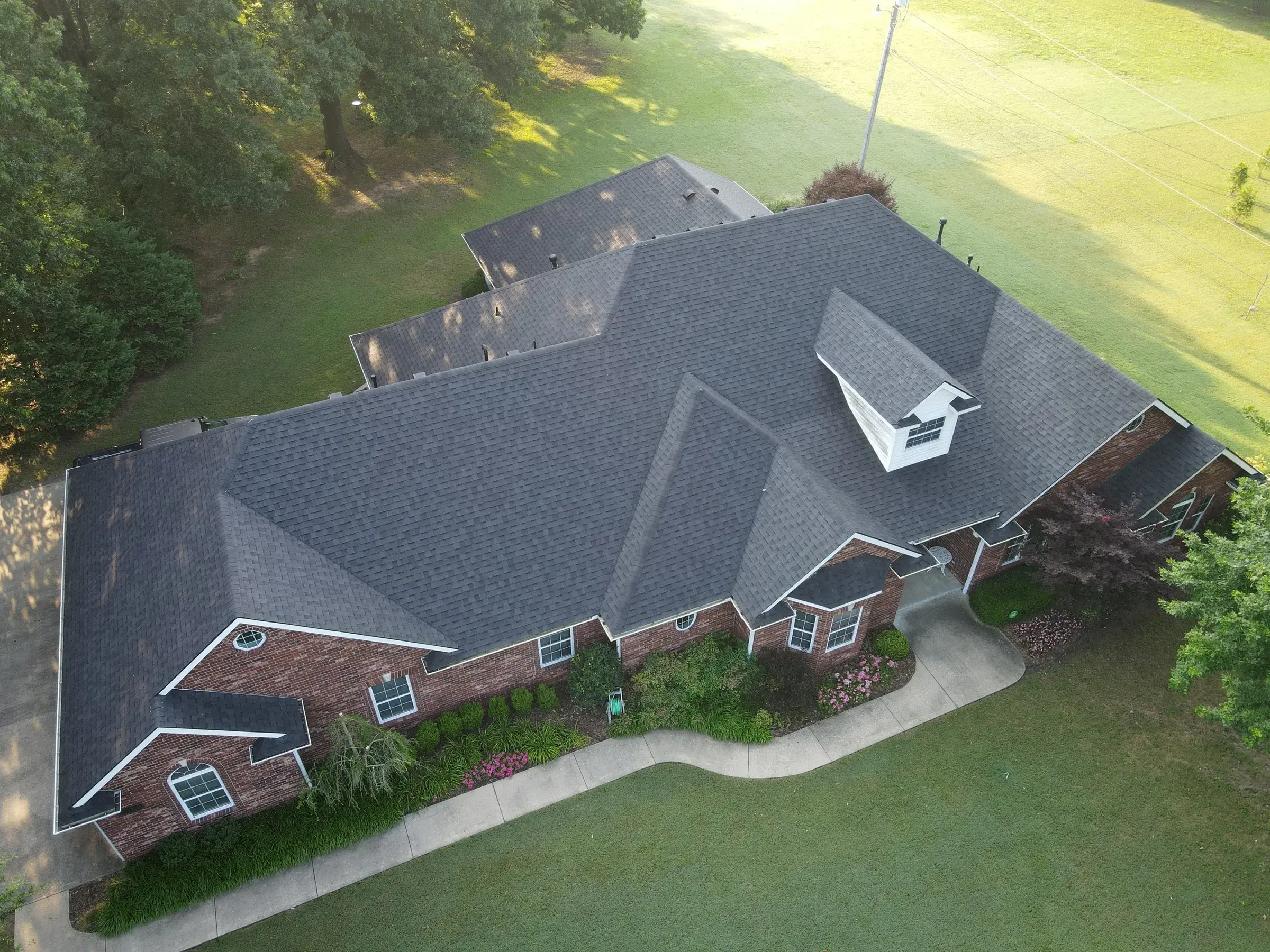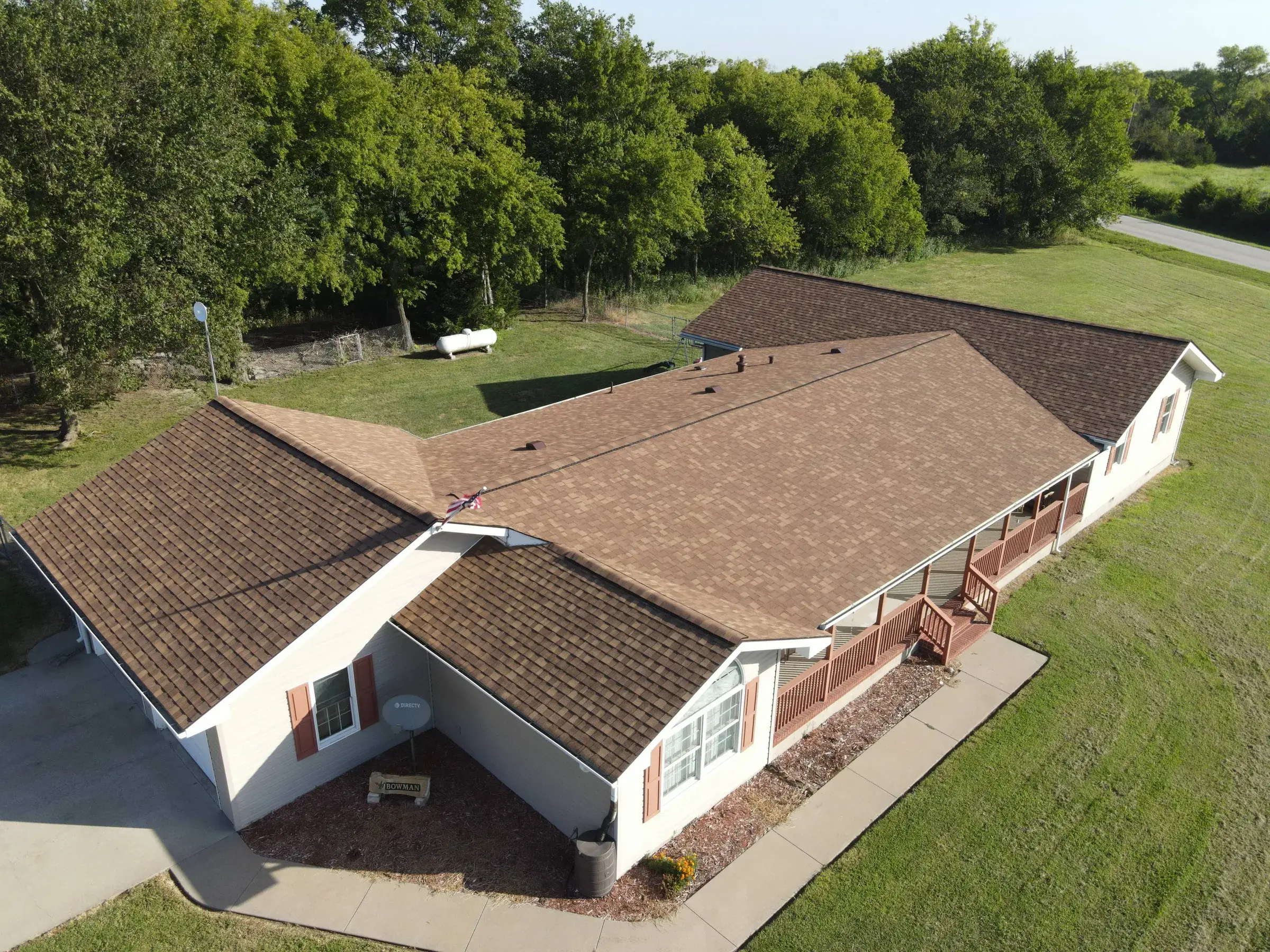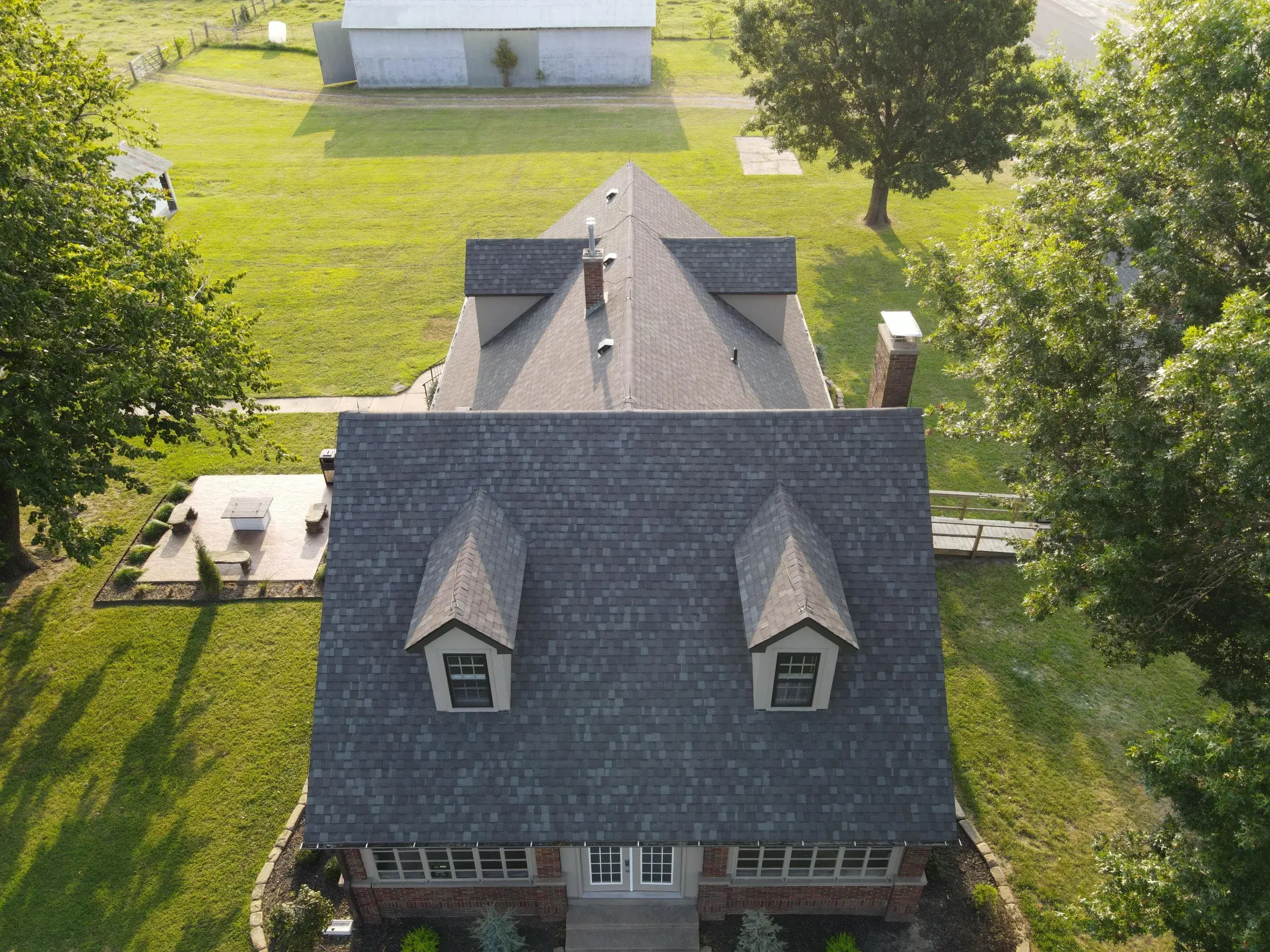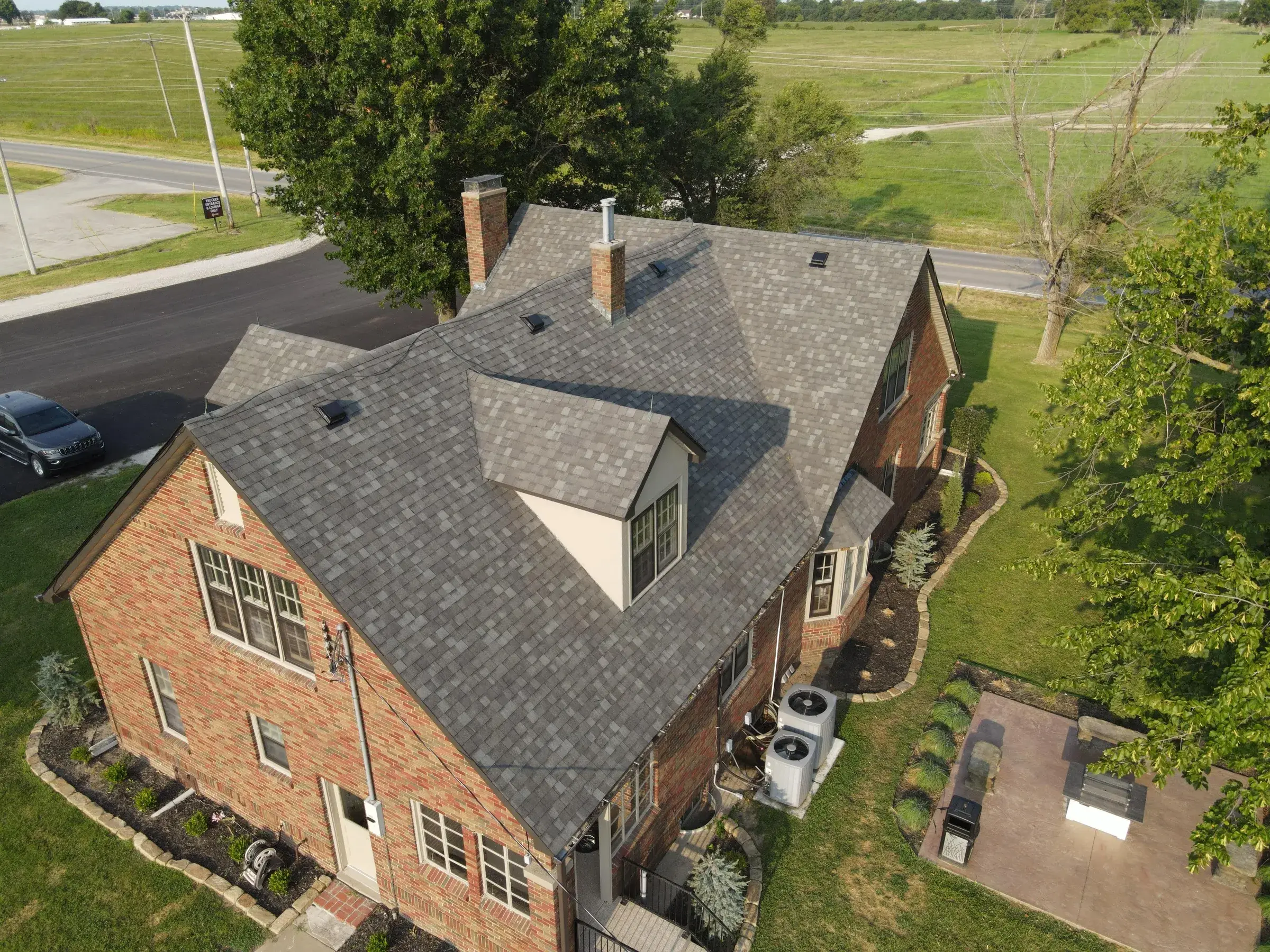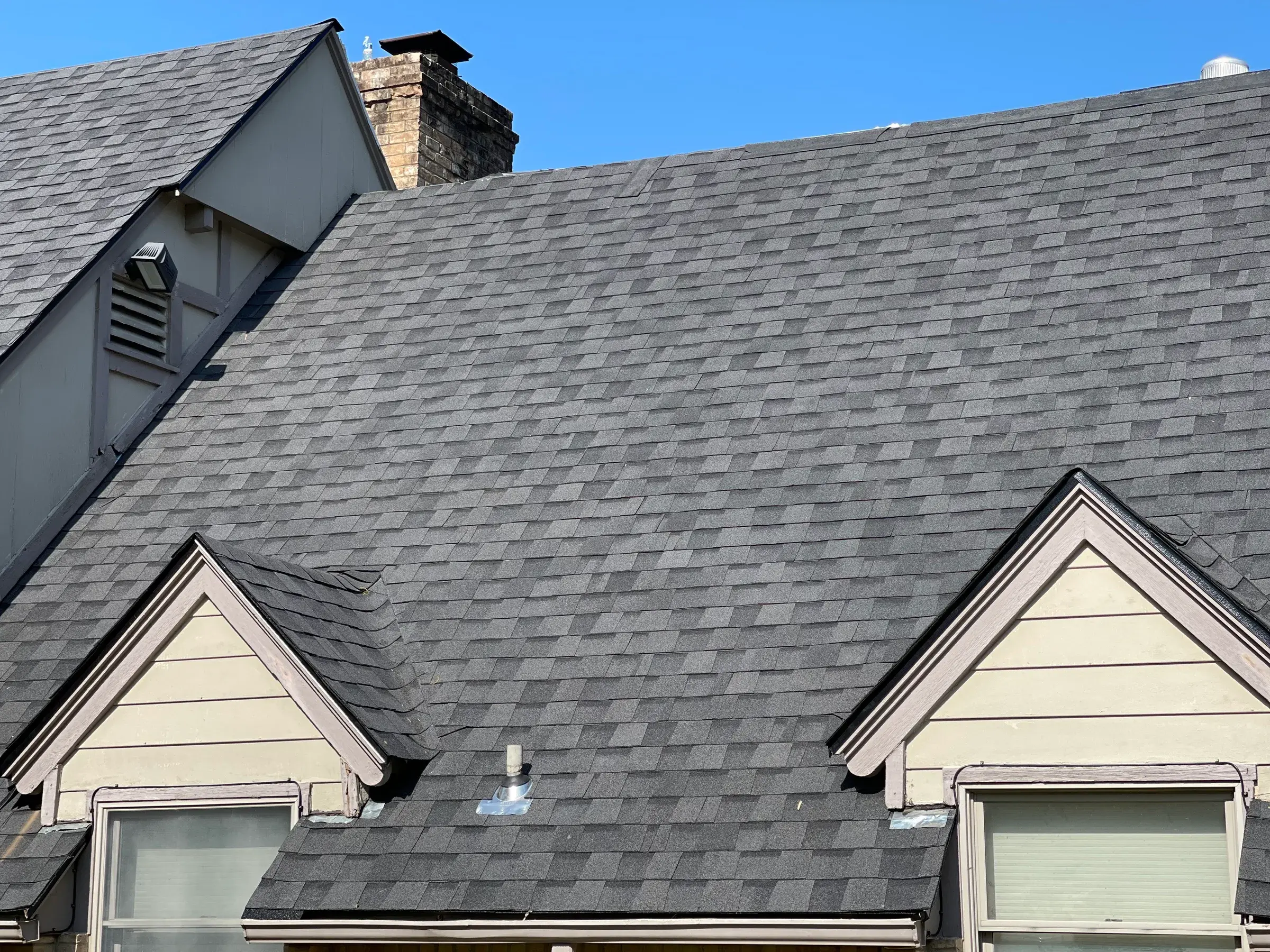
Gutter size is calculated from the roof's drainage area, a pitch adjustment factor, and local rainfall intensity — not from the house's size. A 6-inch K-style gutter carries substantially more water than a 5-inch, but if gutters overflow, the more common fix is adding downspouts rather than enlarging the trough, since downspout capacity is usually the bottleneck.
What gutters are actually sized for: drainage area, pitch factor, and rainfall intensity
A gutter doesn't care how big your house is. It cares about three things: how much roof drains into that one particular run, how steep that roof is, and how hard it rains here. Get those three numbers and the size mostly answers itself.
Drainage area is not the square footage on your tax card. It's the footprint — the flat, plan-view area — of only the roof planes that feed one gutter section. A gutter section runs from a high point to a downspout. If a 40-foot gutter has its high point in the middle and drops at both ends, that's two sections, and each one only carries half the water. If the same 40-foot gutter slopes one direction to a single downspout, one section carries all of it. Same house, same gutter, double the load.
Then you adjust for pitch. A steep roof doesn't catch more rain falling straight down, but rain here rarely falls straight down — wind drives it into the slope. The Architectural Sheet Metal Manual published by SMACNA (the Sheet Metal and Air Conditioning Contractors' National Association) handles this with a multiplier applied to the footprint area.
| Roof pitch | Multiply the footprint area by |
|---|---|
| Level to 3/12 | 1.00 |
| 4/12 to 5/12 | 1.05 |
| 6/12 to 8/12 | 1.10 |
| 9/12 to 11/12 | 1.20 |
| 12/12 and steeper | 1.30 |
The third number is rainfall intensity, in inches per hour, and it's the one nearly everyone gets wrong. SMACNA's method ties it together simply: peak flow in gallons per minute equals footprint area, times pitch factor, times rainfall intensity, times 0.0104. Run a 700-square-foot roof plane at 6/12 pitch through a 4-inch-per-hour rain and you get about 32 gallons a minute arriving in one gutter. That's three garden hoses running wide open, aimed into a trough five inches across.
5-inch vs. 6-inch K-style: the capacity difference and when the upgrade is warranted
Oklahoma's currently adopted plumbing code is based on the International Plumbing Code, and its roof drainage chapter sizes gutters against the 100-year hourly rainfall rate for your location. For Miami, NOAA Atlas 14 puts that at about 3.5 inches per hour. That single number is why sizing advice written for milder parts of the country doesn't transfer here.
The code's gutter table is written for half-round gutters and states the areas each size can drain at a given rainfall rate and slope. Divide those figures by Miami's 3.5 inches per hour and you get the numbers below. They run conservative for K-style, which holds somewhat more water than a half-round of the same nominal width — the code allows other profiles as long as the cross-sectional area is equivalent.
| Adjusted drainage area for one section | Gutter size at 1/16 in per foot slope | Gutter size at 1/8 in per foot slope | Minimum 3x4 downspouts | Minimum 2x3 downspouts |
|---|---|---|---|---|
| Up to 700 sq ft | 5-inch | 5-inch | 1 | 2 |
| 700 – 1,000 sq ft | 6-inch | 5-inch | 1 | 2 |
| 1,000 – 1,500 sq ft | 7-inch | 6-inch | 2 | 3 |
| 1,500 – 2,200 sq ft | 8-inch, or split the run | 7-inch | 2 | 4 |
| Over 2,200 sq ft | Run the calculation | Run the calculation | Run the calculation | Not recommended |
Read that table twice, because it contains the whole argument. Slope buys you almost as much as size does: at a steeper 1/8-inch-per-foot pitch, a 5-inch gutter handles nearly as much as a 6-inch does at the shallower 1/16. And a 6-inch gutter carries roughly 40% more than a 5-inch — real, but not transformative. It does not turn an undrained roof into a drained one.
So when is 6-inch actually warranted? When a valley dumps two roof planes into one run. When the gutter serves more than about 700 square feet of adjusted area and you can't add a downspout. When the pitch is steep enough that water arrives fast and overshoots a narrow trough. When you're on the wooded east side of Ottawa County and the extra width is really buying debris tolerance, not just capacity. A 6-inch gutter also pairs naturally with 3x4 downspouts, and that pairing — not the extra inch — is usually what fixes the overflow.
Half-round, K-style, and box gutters: profiles and where each belongs
| Profile | Capacity | Appearance | Where it belongs |
|---|---|---|---|
| K-style, 5-inch | The residential baseline | Crown-molding face; the default on most houses here | Simple gable roofs, short runs, open lots with little tree load |
| K-style, 6-inch | Roughly 40% more than 5-inch | Heavier face; needs fascia deep enough to take it | Long runs, valleys, steep pitch, heavy leaf load, or where a second downspout isn't possible |
| Half-round | Less than K-style at the same nominal width | Rounded, traditional | Older and historic homes; copper work; anywhere the smooth interior helps debris keep moving instead of lodging in a corner |
| Box / commercial | Highest; sized case by case | Squared and industrial | Metal buildings, shops, barns, and additions with one large uninterrupted roof plane |
Half-round gets dismissed as the decorative option, but its round interior has no inside corner for sludge to pack into, which is a genuine functional advantage. K-style wins on capacity per inch of width and on price. Box gutters win on volume and lose on everything else, including the fact that when they fail they usually fail inward, over the wall.
Downspouts: 2x3 vs. 3x4, spacing rules, and why one more downspout beats one bigger gutter
Here's the part most homeowners never hear. The trough is rarely the bottleneck. The bottleneck is the hole cut in the bottom of it. Water in a gutter is only two or three inches deep, so it doesn't enter the outlet under pressure — it dribbles over a lip into a small opening. That's why field experience is so much more pessimistic than the plumbing code's leader tables, which assume a full vertical pipe fed by a proper drain. The pipe isn't the limit. The outlet is.
| Downspout | Cross-sectional area | Equivalent round pipe | Rule-of-thumb roof area served | Notes |
|---|---|---|---|---|
| 2 x 3 inch rectangular | 6 sq in | About 2.75 in round | About 600 sq ft | The old default. Clogs first, freezes first, and is the single most common cause of overflow. |
| 3 x 4 inch rectangular | 12 sq in | About 3.9 in round | About 1,200 sq ft | Exactly double the cross-section of a 2x3. Passes most leaves and nearly all shingle granules. |
| 3 inch round | 7.1 sq in | — | About 700 sq ft | Smooth bore; standard with half-round and copper systems. |
| 4 inch round | 12.6 sq in | — | About 1,200 sq ft | Highest common residential capacity; ties cleanly into a buried drain line. |
Those roof-area figures are trade rules of thumb, not code, and they're deliberately conservative for the reason above. Use them as a sanity check, not a calculation. The other rule worth knowing: a downspout roughly every 30 to 40 feet of gutter run, and one at every inside corner where two valleys converge, because that corner sees flow from two roof planes at once.
The practical takeaway is a budget one, and it matters in a market where the median home value is $123,300. Replacing a house's gutters with 6-inch is a whole-house expense. Adding one downspout and upsizing an outlet to 3x4 is an afternoon. If your gutters are clean and still overflow, do the cheap thing first — it fixes the problem more often than the expensive thing does.
Finding your local rainfall intensity figure and using it in the sizing math
Now the uncomfortable part. SMACNA sizes gutters on the 5-minute rainfall intensity, not the hourly one, because a gutter fills in about the time it takes to read this paragraph. Its time of concentration is measured in seconds. For Miami that 5-minute figure is roughly 8 inches per hour at the 10-year storm and roughly 11.5 at the 100-year — more than three times the hourly rate the code uses.
That gap explains something people describe to us constantly: gutters that worked fine for years and then poured over the front edge one afternoon. They weren't clogged and they hadn't shrunk. A cloudburst arrived at 11 inches per hour for four minutes, and no residential gutter on this continent is sized for that. Gutters are not life-safety systems and are not designed to never overflow. They're designed so that in ordinary rain — which is most rain — water leaves the roof and lands somewhere useful.
Gutter slope, hangers, and spikes: the mechanical reasons gutters sag and pull away
A gutter should fall about 1/16 to 1/8 inch per foot toward the outlet — roughly a half inch over a 40-foot run, invisible from the ground. Too little and water sits, breeds mosquitoes, and adds weight. Too much and the gutter looks crooked against the fascia and the outlet end sits low enough to catch drip-line splash.
Water is heavy. A 5-inch gutter running full carries several pounds per foot, and a 40-foot run holds a couple hundred pounds when it's flowing hard. That load has to go somewhere. Old spike-and-ferrule gutters put it into a single nail driven through the front lip into the fascia, and every seasonal swing loosens that nail a little more. Hidden hangers, screwed rather than nailed and spaced every two feet or so, spread the load across the fascia instead of concentrating it at points. If your gutter has a visible line of nail heads across the front, that's the design that's failing, and no amount of cleaning changes it.
Why hangers fail here specifically
The Oklahoma Climatological Survey's 1991–2020 normals put Miami at about 89 nights a year below freezing. That's 89 chances a year for water in a gutter to freeze, expand, and lever against the fasteners. Freeze-thaw is patient and it always wins eventually. And if the downspout freezes solid first — the 2x3 goes first, always — the entire run becomes a beam of ice hanging off your fascia. That's the failure mode we see: not a storm tearing a gutter off, but a winter quietly walking the screws out.
Seamless vs. sectional and aluminum vs. steel vs. copper
Seamless gutter is roll-formed on site from a coil, in one continuous piece per run, with joints only at corners and outlets. Sectional gutter comes in ten-foot lengths joined every ten feet. Every joint is a future leak — not a maybe, a schedule. On a house with 40-foot runs, seamless eliminates three joints per run. That's the whole argument, and it's a good one.
Aluminum is the default: it doesn't rust, it's light, and it's covered by ASTM B209 for sheet and plate. Its weakness is denting, which matters when NOAA and the National Weather Service record 4 to 5 days a year with hail larger than three-quarters of an inch in this area. Aluminum gutters get dimpled. That's cosmetic, not functional, and it is not a reason to replace them. Galvanized steel, under ASTM A653, resists hail better and rusts at the cut ends and seams — which is precisely where water sits. Copper, under ASTM B370, outlasts the roof under it and costs accordingly; it belongs on the kind of house where it's an architectural decision, not a drainage one.
Gutter guards: the honest version
No gutter guard eliminates maintenance. Any product or installer telling you otherwise is selling you the wrong thing. What guards actually do is change the maintenance from scooping wet muck out of a trough to clearing debris off a surface — genuinely better, and a real reduction in frequency, but not zero.
| Type | What it actually stops | What still gets through or fails | Honest verdict |
|---|---|---|---|
| Screen (metal or plastic mesh) | Leaves, twigs, bulk debris | Shingle granules, pine needles, maple seeds; plastic versions get brittle under this region's UV load | The cheapest real improvement. Still needs clearing, especially after hail. |
| Micro-mesh (fine stainless on a frame) | Nearly all solid debris, including granules and needles | Fine mesh blinds over with pollen and shingle fines; surface tension can send a hard downpour straight over the top | Best filtration, highest price, most sensitive to exactly the short violent storms we get. |
| Reverse curve / surface tension | Leaves and most bulk debris | Water sheeting past in a cloudburst; debris packing into the nose slot; many attach under the shingle course | Fine in steady rain, poor in the four-minute deluge that defines rainfall here. |
| Foam inserts | Large leaves | Seeds germinate in the foam; granules embed permanently; UV and freeze-thaw break it down; holds water into a freeze | Cheap, easy, short-lived. The worst possible match for 89 freezing nights a year. |
| Brush / bottle-brush | Leaves that stay on top | Small debris settles into the bristles and stays there; comes out saturated | Easiest to retrofit, hardest to clean. Buys time, not freedom. |
Ottawa County splits cleanly on this, and it's worth knowing which side you're on. The eastern half sits on the Ozark Plains — rockier, wooded, rolling — and those homes fight leaf and needle load, so filtration matters most. The western half is the Neosho Lowlands, flat prairie and farmland, where there's little tree canopy but a long open wind fetch. Out there the debris in your gutter isn't leaves. It's shingle granules and blown grit, and granules go straight through a screen. Choose the guard for what's actually landing on your roof.
Discharge: extensions, splash blocks, and getting water away from the foundation
A perfectly sized gutter that dumps against the wall has accomplished nothing but concentrating the problem. Everything above this section is about moving water to one point. This section is about the point.
The U.S. Department of Energy's Building America guidance is consistent on the fundamentals: discharge water well away from the foundation, and grade the ground to fall away from the house for the first several feet. A splash block alone typically isn't enough — it slows water and drops it a foot from the wall, which is a foot from the wall. Downspout extensions, buried solid drain lines to daylight, or a properly pitched swale all do the real work. Solid pipe, incidentally, not perforated: perforated pipe is for collecting groundwater, and using it as a downspout line means you've built an irrigation system aimed at your own footing.
One local wrinkle. Roughly 13% of Ottawa County's housing sits vacant much of the year — lake places near Grand Lake o' the Cherokees among them. A downspout that came unclipped in April discharges directly against the foundation every storm until October, and nobody is there to see it. If you own a place you don't live in, the discharge points are the single highest-value thing to check on a visit.
Fascia, soffit, and the rot that overflowing gutters cause
Overflow doesn't usually go outward in a tidy sheet. Some of it runs backward, behind the gutter, down the fascia board and into the soffit. Fascia is the vertical board the gutter hangs on; soffit is the horizontal underside of the eave. Both are usually the cheapest wood on the house, and both are where the hangers anchor.
This is the loop that turns a $200 problem into a $4,000 one. Water gets behind the gutter, the fascia softens, the hangers lose their grip, the gutter tilts, more water gets behind it. By the time the gutter is visibly sagging, the board it's screwed to is usually gone. That's why drip edge — the L-shaped metal at the roof edge that directs runoff into the gutter instead of behind it — matters more than gutter size for this particular failure. If water is running down your fascia during rain, the fix is at the roof edge, not in the trough, and it's worth a proper roof inspection before you spend money on gutters that were never the problem.
When cleaning is the fix and when it isn't
Diagnosing overflow from the ground
- Overflows only in the hardest downpours, gutter is clean → capacity or downspout, not cleaning
- Overflows at the same one spot in every rain → sag, wrong slope, or a failed hanger at that point
- Water runs down the back, behind the gutter → drip edge problem at the roof edge, not a gutter size problem
- Downspout gurgles, then the gutter backs up → clog at the outlet or in the leader. This one cleaning fixes.
- Gutter is clean but the downspout stays dry in rain → blocked leader or a collapsed buried line
- Gutter holds dark sandy grit, not leaves → shingle granules. Ask what's happening to the roof.
- Gutter has pulled away from the fascia → hangers or rot; adding capacity won't help
- Ice sits in the gutter all winter → the downspout or the discharge froze first
- Overflows at an inside corner where two valleys meet → concentrated flow; needs a bigger outlet or its own downspout
Read that list honestly and you'll notice something: exactly one line is solved by cleaning. We do gutter cleaning and we'll do yours, but we'd rather tell you the truth about it. If your gutters are full of leaves and the downspout is plugged, cleaning is the whole fix and anyone selling you more than that is overselling. If your gutters are clean and still overflowing, cleaning them again next month will change nothing, and the answer is a downspout, a hanger, a slope correction, or a drip edge — sometimes a roof repair, occasionally a roof replacement if the granule load in the trough is telling you the shingles are done.
One last note on hiring. Oklahoma doesn't license roofing contractors — it registers them, through the Construction Industries Board, and registration for residential work requires liability insurance of at least $500,000. You can check any contractor's registration yourself, free, at verifyroofing.cib.ok.gov. Nobody in this market tells homeowners that, and everybody should. Check ours while you're there.
If you're in Miami, anywhere in Ottawa County, or across the line into Kansas, Missouri or Arkansas and your gutters are overflowing, we'll come look at it and tell you which of the nine things on that checklist it actually is. The inspection and the quote are both free, and if the answer is "add one downspout," that's what we'll say. Call (209) 758-8550.
Questions people ask about this
Do I need 5-inch or 6-inch gutters in Miami, Oklahoma?
It depends on the adjusted drainage area feeding each gutter section, not on your house's total size. Using NOAA Atlas 14's roughly 3.5 inches per hour design rainfall for Miami, a 5-inch gutter at a shallow 1/16-inch-per-foot slope handles about 700 square feet of adjusted area; a 6-inch handles about 1,080. Measure the footprint of only the roof planes draining into that one run, apply the pitch factor, and compare. If you're under 700 square feet per section, 6-inch is buying you debris tolerance, not capacity.
Is it cheaper to add a downspout than to upsize my gutters?
Almost always, and it usually works better too. Going from 5-inch to 6-inch adds roughly 40% capacity to the trough, but the trough is rarely the bottleneck — the outlet is. Adding a downspout or upsizing an existing 2x3 outlet to a 3x4 doubles the drain cross-section at that point and costs a fraction of re-gutting the house. Try the cheap fix first.
Do gutter guards mean I never have to clean my gutters again?
No, and no honest installer will tell you otherwise. Guards change the job from scooping muck out of a trough to clearing debris off a surface, and they genuinely reduce how often you need to do it. But micro-mesh blinds over with pollen and shingle fines, foam grows seedlings, reverse-curve packs at the nose slot, and screens pass granules straight through. Every type needs periodic attention.
Why do my gutters overflow even though they're perfectly clean?
Probably because they're working exactly as designed. SMACNA sizes gutters on 5-minute rainfall intensity because a gutter fills in seconds, and for Miami that figure runs around 8 inches per hour for a 10-year storm and roughly 11.5 for a 100-year — several times the hourly rate the plumbing code sizes against. No residential gutter is built to swallow an 11-inch-per-hour cloudburst. If it only overflows in the worst four minutes of the worst storms, that's normal. If it overflows in ordinary rain, check the downspout and the slope.
Will bigger gutters fix water in my crawlspace?
Not by themselves. Gutters concentrate roof runoff at one point; what happens after that point is what determines whether water reaches your foundation. The Department of Energy's Building America guidance emphasizes discharging well away from the wall and grading the soil to fall away from the house. A splash block drops water a foot from the foundation, which is still a foot from the foundation. Extensions or a solid buried line to daylight do the actual work.