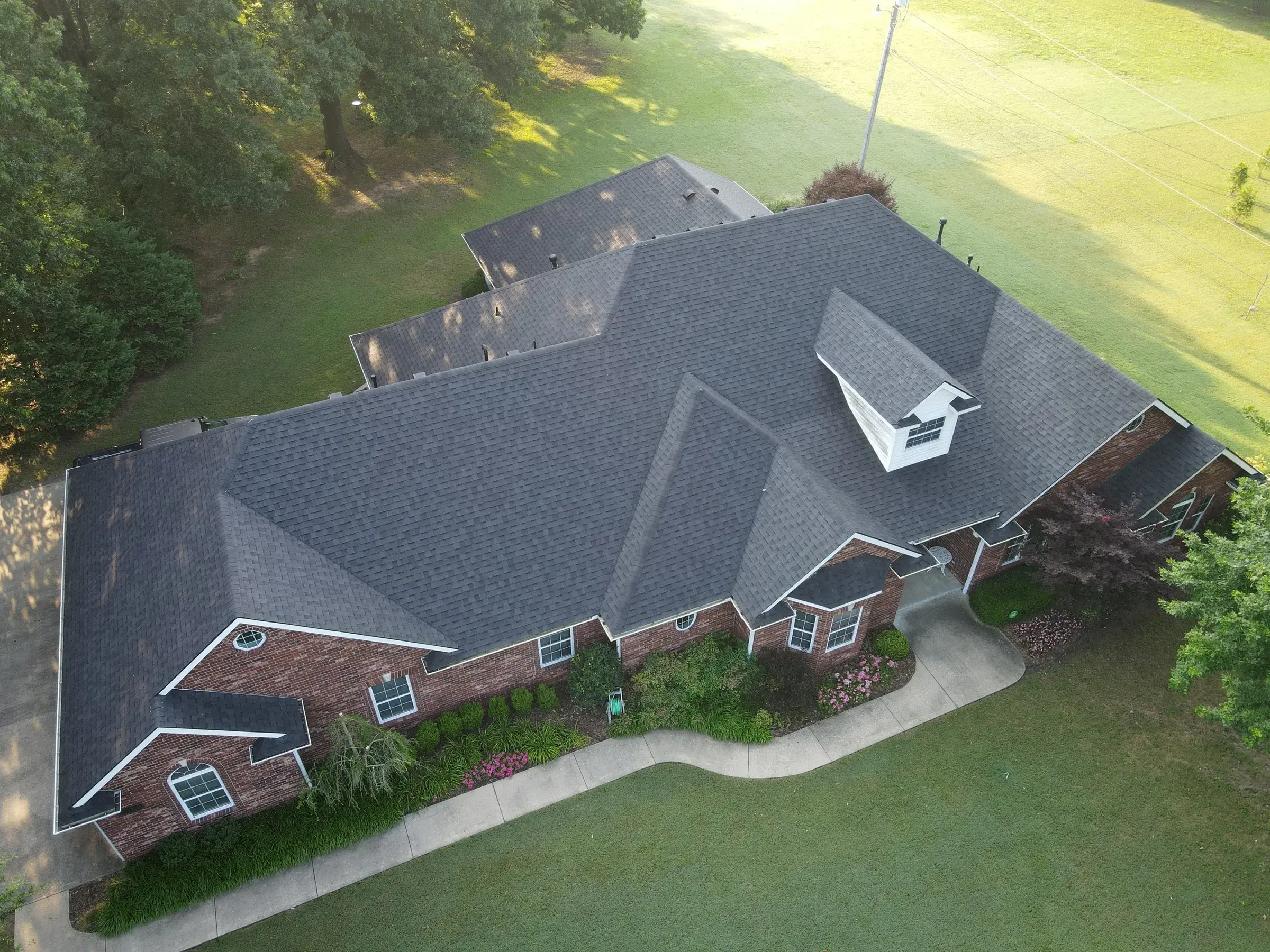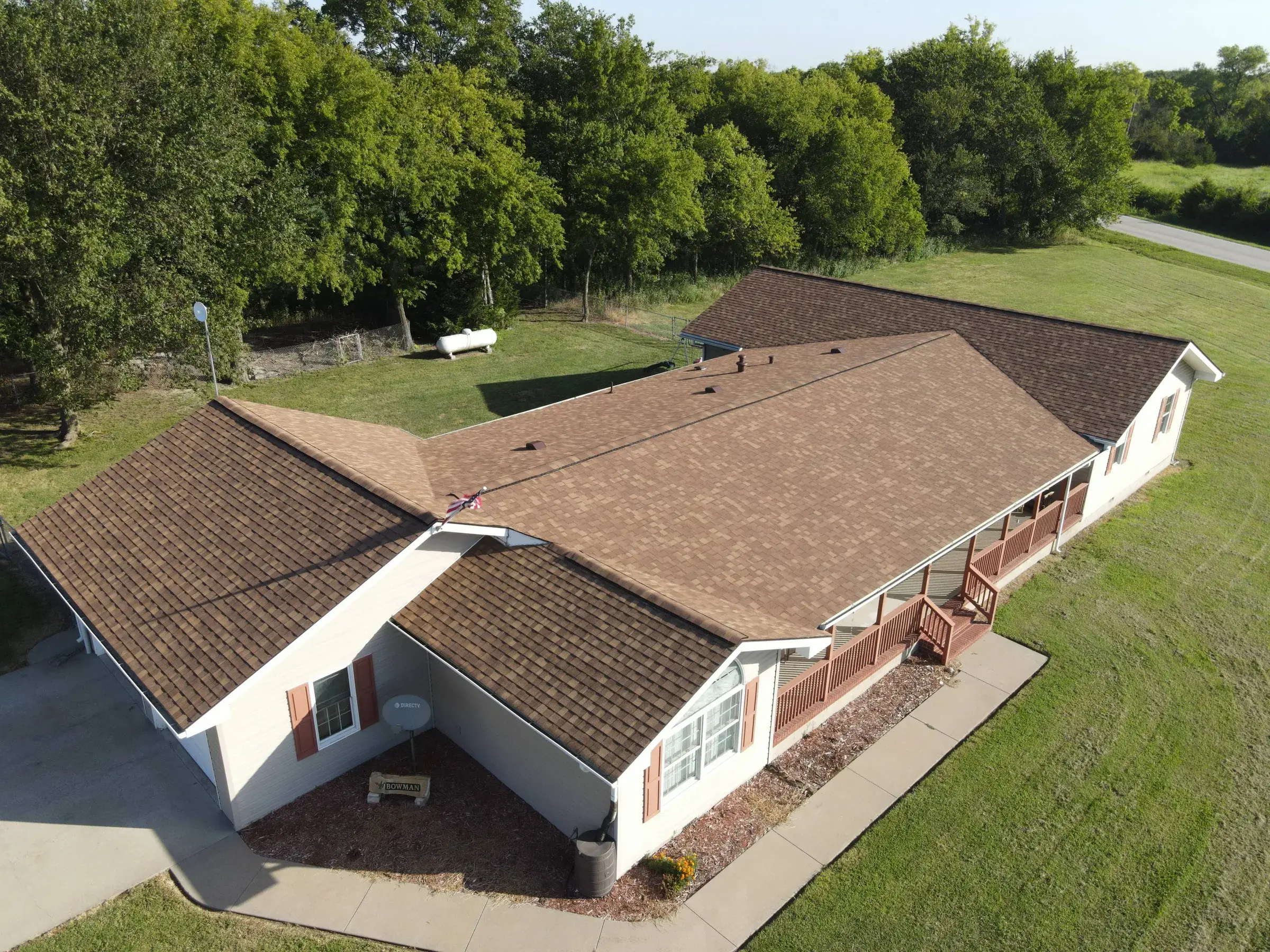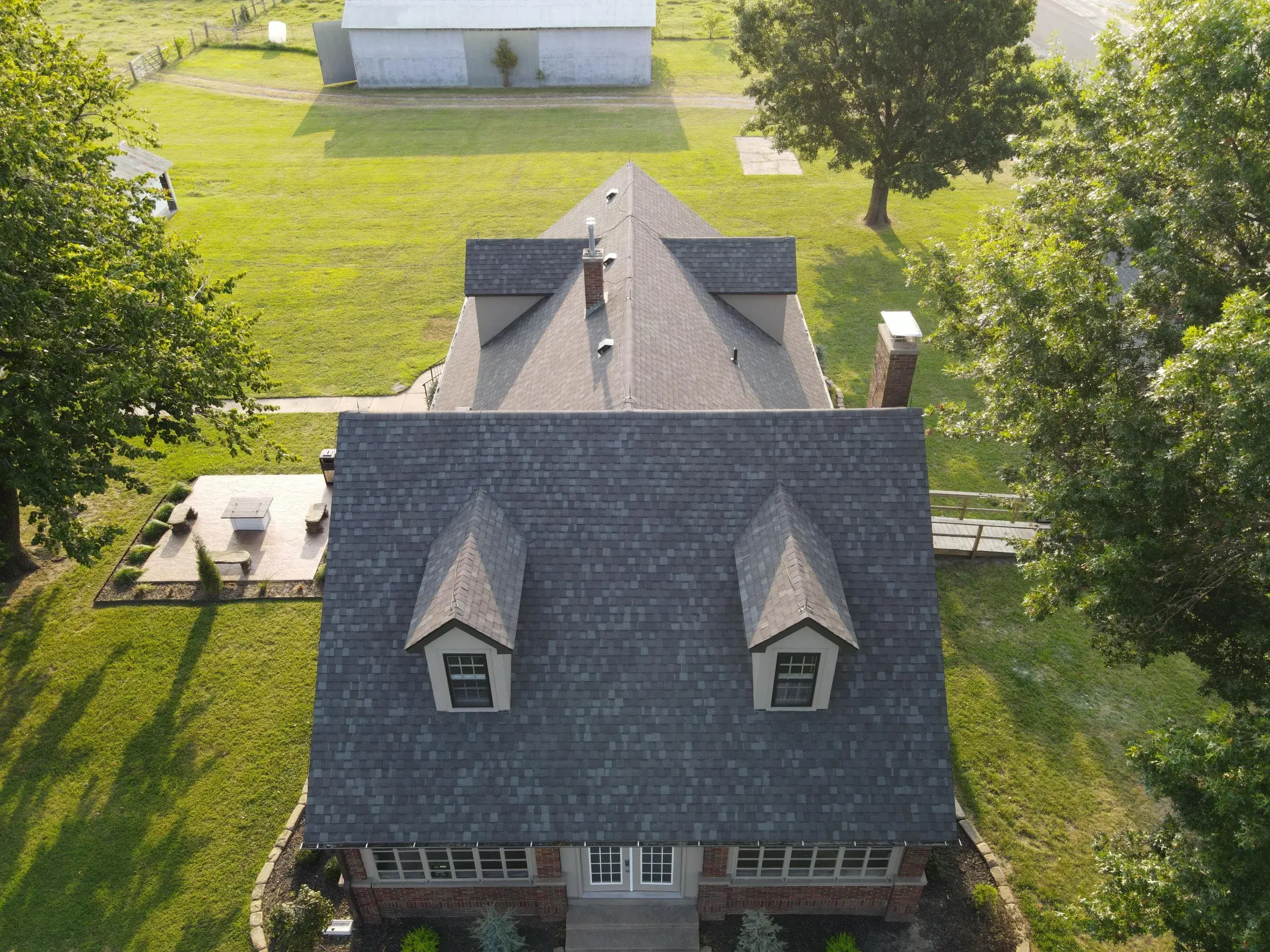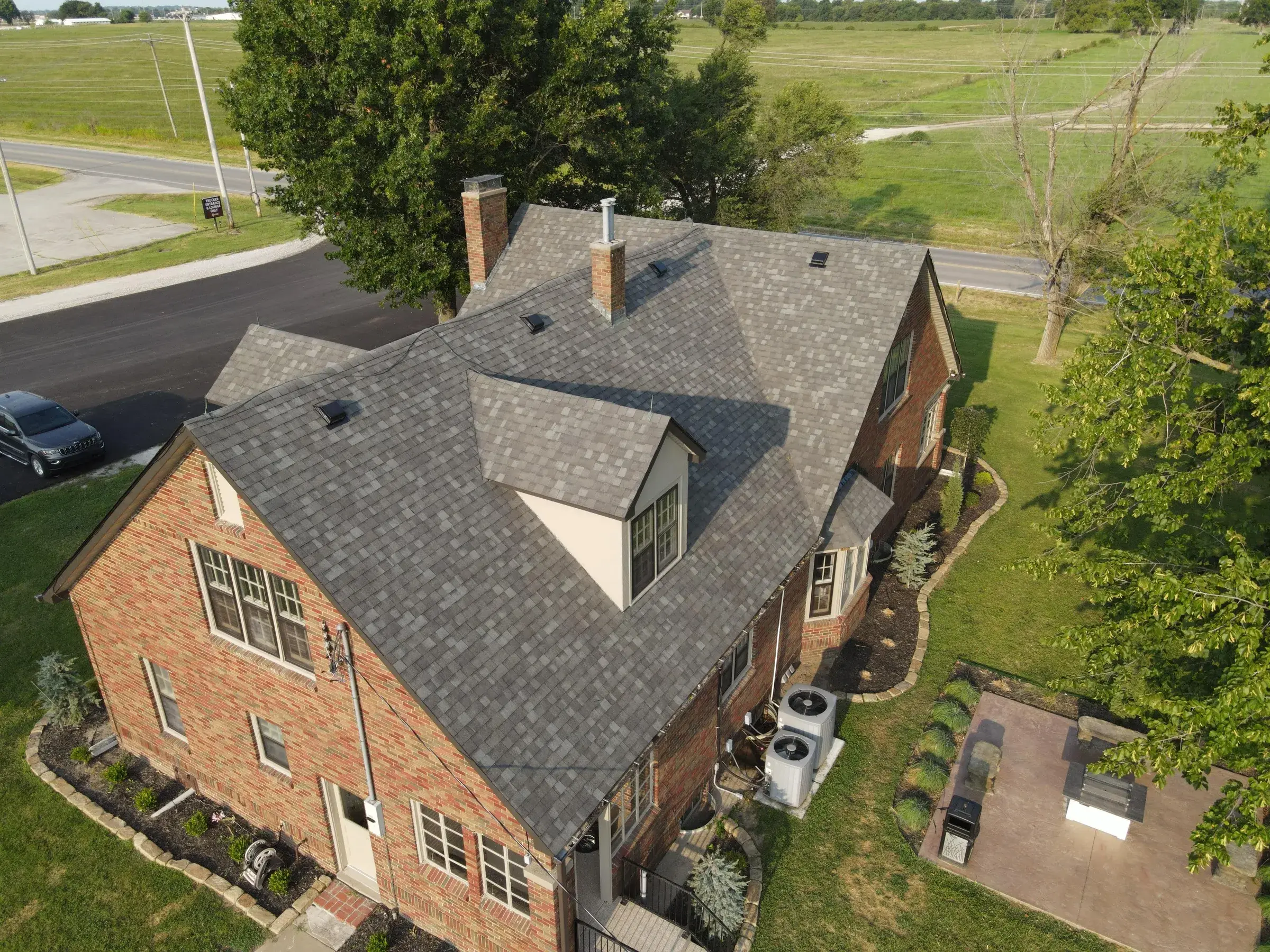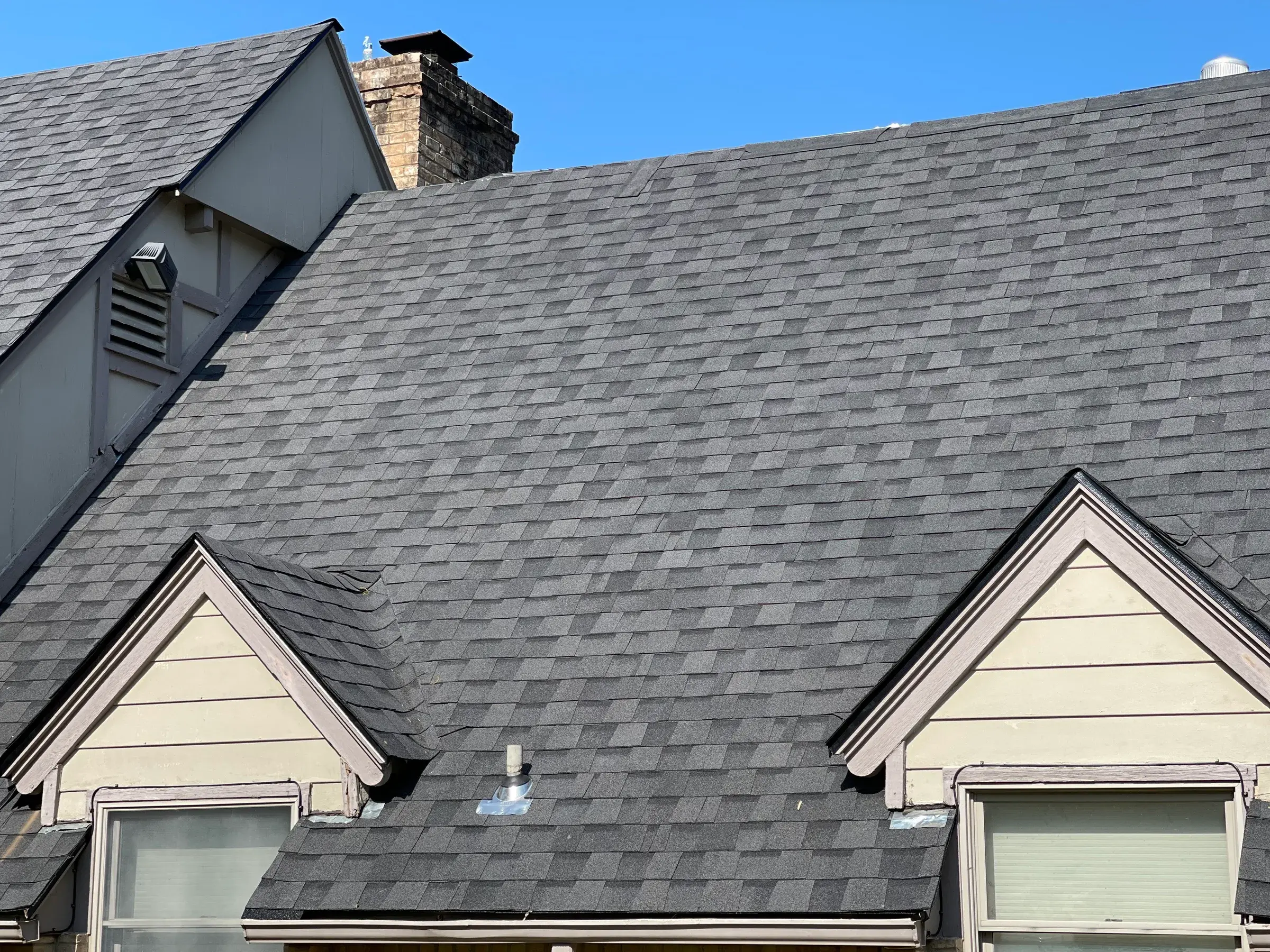
Heat rarely kills a shingle by itself. It accelerates volatile loss, thermal cycling, and granule shedding, which is why attic ventilation and shingle construction matter more than color. Architectural laminated shingles carry more asphalt and higher wind ratings than 3-tab. Reflective shingles lower surface temperature, with performance measured by CRRC-rated solar reflectance.
How heat actually ages an asphalt shingle
An asphalt shingle is three things stacked together. A fiberglass mat gives it strength. Asphalt does the actual waterproofing. Mineral granules — the crushed rock embedded in the top surface — shield the asphalt from sunlight. Heat does not attack those three equally. It works on the asphalt, and the granules are the only thing standing between the asphalt and the sun.
Once you understand that, most shingle marketing sorts itself out. The grades that hold up in a hot climate are the ones carrying more asphalt and holding their granules longer. Everything else is shadow lines.
Volatile loss: the oils leave and don't come back
Asphalt contains light oils that keep it flexible. Heat drives those oils off slowly, over years. What's left behind is harder and more brittle. The Asphalt Roofing Manufacturers Association (ARMA) covers this in its technical bulletins on shingle aging — it is the basic mechanism behind shingles going stiff with age, and it is why a fifteen-year-old roof cracks under your boot on a January morning while a three-year-old roof flexes and stays intact.
Nothing visible happens on any one hot day. It is cumulative. A thicker asphalt layer means more reserve before brittleness reaches the mat, which is the single most useful thing to hold in your head while comparing grades.
Thermal cycling: the number that actually matters here
Miami sits at 778 feet on the Neosho River, and the Oklahoma Climatological Survey's 1991–2020 normals describe a roof that never gets to settle. Fifty-seven days a year above 90°F. Five above 100°F. An August normal daily maximum of 91.5°F. And on the other end, eighty-nine nights a year below freezing. The all-time record high for Miami is 116°F, set in 1954, but the record is not the problem — the swing is.
Every one of those days, the shingle expands as it heats and contracts as it cools. So does the deck under it, at a different rate. Multiply that by thousands of cycles and you get the fatigue that eventually shows up as curled corners, split tabs and popped nails. A shingle in a place with no freezing nights and a shingle in Ottawa County are doing very different amounts of work over the same twenty years.
UV and granule adhesion
Northeast Oklahoma gets roughly 62% of its possible annual sunshine. That is a real UV load, and ultraviolet light breaks asphalt down at the surface. The granules are the sunscreen. When granules shed, the exposed asphalt ages faster, which loosens more granules — a loop that accelerates once it starts.
Practical version: a light scatter of loose granules in the gutter in the first few weeks after installation is normal manufacturing excess. Bald patches at ten years are not. Check the south and west slopes, which take the most sun and always age first. Those are usually the slopes you cannot see from the driveway, which is exactly why nobody looks at them.
3-tab shingles: construction, weight, and where they still make sense
A 3-tab is a single layer of mat, asphalt and granules, cut with two slots so each strip reads as three tabs. Flat profile, uniform, no shadow line. Because it is one layer, it is lighter, thinner and carries less asphalt per square foot — less reserve as the oils leave. It also has exposed tab edges and a single thickness in the wind zone, which is why its tested wind classes tend to sit at the lower end.
That does not make it a bad product. It makes it a specific one. A 3-tab still earns its place on outbuildings and detached garages, on rentals where the math has to work, on manufactured and mobile homes — 12.2% of Ottawa County's 13,701 housing units, per the Census Bureau's 2020–2024 American Community Survey — and on repairs where you are matching an existing 3-tab roof and a laminated shingle simply would not lie flat against it.
It also matters that median household income in Ottawa County is $49,947 and the median home value is $123,300. Budget is a real constraint here, not an excuse, and a well-installed 3-tab beats a premium shingle nailed high every day of the week.
Architectural shingles: what the second layer buys you
An architectural shingle — also sold as laminated or dimensional — is two layers bonded together: a base sheet plus a shaped overlay laminated onto it. Two things follow from that, and only one of them is the reason to buy it.
The first is weight. More layers means more asphalt per square, which is the reserve that volatile loss eats into. The second is stiffness in the exposure zone: doubled thickness where wind wants to lift the tab, and no cut slots to start a tear. That combination is why laminates routinely test into higher wind classes than 3-tabs do.
The shadow line is cosmetic. It happens to be useful — a dimensional profile hides a wavy deck that a flat 3-tab would telegraph across the whole slope — but the weight is what is doing the structural work. If someone sells you an architectural shingle on looks alone, they are selling you the wrong half of the product.
Premium and designer laminates: real differences vs. appearance upgrades
This is where the marketing gets slippery, because two very different products share the word 'premium'.
Some premium laminates are genuinely more shingle. Heavier, thicker, more asphalt, sometimes a wider nailing zone that gives the installer more room to hit right, and sometimes SBS-modified asphalt. SBS — styrene-butadiene-styrene, a rubber compound blended into the asphalt — keeps the shingle flexible at low temperature and lets it absorb an impact rather than fracture. In a market with eighty-nine freezing nights and four to five hail days a year, that is not a gimmick.
Other 'designer' products are the same laminate construction with a different cut, a deeper shadow and a slate or shake impression, priced as performance. Nothing wrong with buying looks if that is what you want. Just know which one you are paying for. Weight per square and impact rating tell you apart; the product name does not.
| Grade | Construction | Approx. weight per square | Wind rating you'll typically see | Look | Relative cost |
|---|---|---|---|---|---|
| 3-tab | One layer: fiberglass mat, asphalt, granules; slotted into three tabs | Roughly 200–240 lb | Often ASTM D3161 Class A or D; some Class F | Flat and uniform; shows deck irregularities | Lowest |
| Architectural (laminated) | Two layers bonded: base sheet plus shaped overlay | Roughly 240–340 lb | Commonly ASTM D3161 Class F and/or ASTM D7158 Class H | Dimensional shadow lines; hides minor deck waves | Middle |
| Premium / designer laminate | Two or more layers, heavier; sometimes SBS-modified asphalt or a wider nailing zone | Roughly 400–480 lb | Usually ASTM D3161 Class F and/or ASTM D7158 Class H | Deep shadow; slate or shake impression | Highest |
| Reflective ('cool') shingle | Same 3-tab or laminate build; granules engineered for higher solar reflectance | Matches its base grade | Matches its base grade | Usually lighter colors; some darker colors use reflective granules | Small premium over the same base grade |
Weights above are typical ranges, not specifications. They vary by manufacturer and product line, and the real number is printed on the data sheet — which is the point of the next few sections.
Reflective and 'cool roof' shingles: reflectance, emittance and CRRC ratings
A reflective shingle is not a different kind of shingle. It is a normal 3-tab or laminate whose granules have been engineered to bounce back more sunlight. The construction underneath is unchanged, so a reflective shingle inherits the weight and wind class of whatever grade it is built on. Buying reflectance does not buy you durability, and vice versa.
The ENERGY STAR roof products criteria set the reference bar for steep-slope roofing at a solar reflectance of at least 0.25 initially and at least 0.15 after three years of weathering. That is a floor, not a target, and it is worth confirming a specific product's current listing rather than trusting a brochure.
What you will not get from us is a savings percentage. Both the Department of Energy and the CRRC frame cooling savings as varying by building, and they are right to. Whether a reflective roof shows up on your bill depends on how deep your attic insulation is, how well the attic breathes, and — this is the big one — whether your air conditioning ducts run through that attic. If the ducts are up there sweating in the heat, attic temperature matters enormously. If they are not, it matters much less. Nothing in Oklahoma's residential code requires any reflectance value on a house, either. This is a choice, not a requirement.
Why ventilation moves more than color does
A dark shingle in full sun runs hotter at the surface than a light one. That is physics and nobody disputes it. But a shingle is heated from both sides, and the side you can still do something about on a roof you already own is the underside.
Trapped attic air heats the deck. The deck heats the shingle from below. There is no color you can pick that fixes a blocked soffit. Color changes the surface temperature of one layer; ventilation changes the temperature of the whole assembly — deck, mat and the back of the shingle — and it keeps working at night, in winter, and on the north slope where reflectance barely matters.
The current Oklahoma residential code uses the standard attic ventilation ratio: one square foot of net free ventilating area for every 150 square feet of attic floor, reduced to one in 300 where the venting is balanced between intake and exhaust and the other conditions are met. Note the phrase 'net free area.' That is not the size of the hole you cut. It is the open area left after the screen and the louvers, it is smaller than people assume, and it is printed on the vent itself.
The failure we find most often is not a missing ridge vent. It is insulation stuffed forward into the soffit, choking the intake, so the exhaust pulls air from wherever it can get it. Ridge vent paired with a powered attic fan can do the same thing in reverse — the fan finds the ridge easier to draw from than the soffits and short-circuits its own airflow, moving air through eighteen inches of attic instead of all of it. If your shingles are cupping on a roof that is not old enough to cup, look at [ventilation](/services/roof-ventilation-repair) before you look at the shingle. Manufacturers make code-compliant ventilation a condition in their own installation instructions for exactly this reason.
Wind ratings decoded: ASTM D3161 and ASTM D7158
Two standards, two completely different tests, and a data sheet may list one or both. They are not interchangeable, and the classes do not line up.
ASTM D3161 is the fan test. Shingles go on a deck at a set slope in front of a fan for two hours; if nothing lifts, it passes that class. ASTM D7158 is not a fan test at all — it uses wind tunnel measurements of uplift force plus a calculation against design wind speeds, so the classes are expressed as the basic wind speed the shingle is calculated to resist.
| Test method | Class | Wind speed | What it means |
|---|---|---|---|
| ASTM D3161 | Class A | 60 mph | Fan-induced test; the base pass level |
| ASTM D3161 | Class D | 90 mph | Fan-induced test; common on 3-tab products |
| ASTM D3161 | Class F | 110 mph | Fan-induced test; the highest D3161 class |
| ASTM D7158 | Class D | 90 mph | Uplift measurement plus calculation against design wind speed |
| ASTM D7158 | Class G | 120 mph | Same method, higher calculated resistance |
| ASTM D7158 | Class H | 150 mph | Same method; the highest D7158 class |
Two caveats that matter more than the numbers. First, D7158 speeds are three-second gust basic wind speeds calculated under specific assumptions — a stated exposure category and roof heights up to 60 feet. Change the assumptions and the number does not simply transfer to your house. Second, every one of these classes is earned only when the shingle is installed exactly the way it was tested: the specified nailing pattern (often six nails per shingle, not four), nails in the nailing zone and driven flush, and a proper starter strip with its sealant along the eave and the rake.
There is a local wrinkle. The self-seal strip on an asphalt shingle needs sun and warmth to bond. A roof installed in a cold snap may not seal until spring, which is a window where a rated shingle is not yet performing like one. That is what hand-sealing is for, and it is a fair question to ask any contractor working here in December. One more thing: Oklahoma's code adoption does not publish a single statewide design wind speed for you, so if anyone quotes you a legally required mph figure, ask them to show you where it is written.
Reading a shingle data sheet: five specs that matter
Every manufacturer publishes a one-page data sheet for every product, and it is available for free before you sign anything. It is the most useful document in this entire process and almost nobody reads it. Here is what to pull off it.
Five specs to confirm before you approve a quote
- The manufacturing standard: look for ASTM D3462, the material standard for fiberglass-mat asphalt shingles, which includes a minimum tear strength. If a data sheet will not name its standard, that silence is your answer.
- The wind rating with its test method attached — 'ASTM D3161 Class F' or 'ASTM D7158 Class H', never a bare mph number — plus the nailing pattern and starter-strip requirement needed to earn that class.
- Weight per square (per 100 square feet of roof). This is the closest thing to an honest measure of how much asphalt you are actually buying.
- Impact rating, if the product has one: UL 2218 Class 1 through 4, with Class 4 the highest. Understand what it is — a steel ball dropped on a shingle in a lab — and what it is not, which is a promise about hail.
- CRRC-listed solar reflectance and thermal emittance, initial and three-year aged, if heat is what you are solving for. While you are there, check whether the granules are algae-resistant. That matters more on a shaded north slope than most people expect.
The same goes for a 'wind warranty up to 130 mph.' A wind warranty is a contract with conditions; a wind rating is a test result under a named method. The warranty number can be higher than the tested class, and often is. Ask for the ASTM class. 'Designer,' 'extreme,' 'ultra,' 'max' and the color names are all sales language — unregulated, undefined, and not on the data sheet where the real numbers live.
Matching shingle grade to a northeast Oklahoma roof
Start with slope
Asphalt shingles are not permitted below a 2:12 pitch under the residential code, full stop. Between 2:12 and 4:12 they are allowed, but the code requires a doubled underlayment beneath them. Above 4:12, standard single-layer underlayment applies. So if you have a 2:12 porch or a low addition tacked onto a steeper house, shingles are either the wrong material there or the right material with extra work and extra cost. Ask which one your quote assumes, because a bid that ignores the distinction is a leak with a due date.
Worth knowing before you compare bids: Oklahoma amended section R908.3.1.1 of the residential code to require tear-off rather than shingling over the existing roof in defined conditions. If one quote is dramatically cheaper because it is priced as a layover, ask the contractor which condition they are relying on to do that legally. On a [full replacement](/services/roof-replacement), that answer changes the price by thousands and it should be in writing.
Then look at where your house actually sits
[Ottawa County](/locations/ottawa-county) splits down the middle, and the split is genuinely relevant to which shingle you buy. East of [Miami](/locations/miami-ok) you are into the Ozark Plains — rockier, wooded, rolling — and roofs there sit under trees. Shade cuts the UV load, which helps. It also means limbs on the slope, needles packing the valleys, and north faces that stay damp long enough to grow algae. West of town is the Neosho Lowlands: flat prairie and farmland, open fetch, nothing to break the wind, and full sun on every plane of the roof.
Same county, two different orders of priority. West side: buy the wind class and pay attention to the nailing. East side: buy the algae-resistant granules, keep the limbs cut back off the roof, and clean the valleys.
Then budget honestly
The Oklahoma Climatological Survey puts this area at four to five days a year with hail larger than three-quarters of an inch. Hail does not care about your shingle's reflectance. If you are buying once and holding the house, weight and impact rating are where the money does the most work — reflectance is a comfort and operating-cost decision layered on top, not a durability one. And if it is a lake place you see a few weekends a year — roughly 13% of Ottawa County's housing units sit vacant, a good share of them second homes around Grand Lake — lean toward durability over appearance. Nobody is up there noticing a problem in month two.
If you want a second opinion on a shingle spec or a quote you have already been handed, we do free inspections and free written estimates, and we will document what is actually on your roof with a photo report so you are deciding from evidence rather than a sales board. The City of Miami requires a permit for new roofs and re-shingles, and we pull it. And whoever you end up hiring for [asphalt shingle work](/services/asphalt-shingle-roofing) — us or someone else — look them up first at verifyroofing.cib.ok.gov. Oklahoma's Construction Industries Board registers roofing contractors, and registration requires carrying at least $500,000 in liability insurance for residential work. The lookup takes about ten seconds, and it is the best single filter available in this market.
Questions people ask about this
Do light-colored shingles really keep an Oklahoma house cooler?
They lower the roof's surface temperature measurably, and the CRRC's rated solar reflectance is the number that quantifies it. Whether that reaches your electric bill is a different question — it depends on your attic insulation depth, how well the attic breathes, and especially whether your air conditioning ducts run through the attic. We won't quote you a savings percentage, because the Department of Energy and the CRRC both frame those savings as varying by building. Fix blocked soffits before you buy color as an energy strategy.
Is an architectural shingle worth the extra money over a 3-tab?
Usually, and for reasons that have nothing to do with the shadow lines. A laminated shingle carries more asphalt per square — more reserve as heat drives the oils out over the years — and its doubled thickness in the wind zone typically earns a higher tested wind class. Compare the two products' weight per square and their ASTM wind class on the data sheets and the gap is easy to see. A 3-tab still makes sense on outbuildings, rentals, manufactured homes, and repairs that have to match an existing 3-tab roof.
What's the difference between a shingle's wind rating and its wind warranty?
A wind rating is a test result under a named method — ASTM D3161 Class A, D or F from a fan test, or ASTM D7158 Class D, G or H from uplift measurement plus calculation. A wind warranty is a contract with conditions, and the mph figure in it can be higher than any class the shingle actually tested to. Ask for the ASTM class and the test method by name. Both ratings only hold if the shingle is installed with the specified nailing pattern and starter strip.
Will a Class 4 impact-resistant shingle lower my insurance premium in Oklahoma?
It might, but nothing in Oklahoma law requires it — searching the state insurance code for 'UL 2218' or 'impact resistant' turns up nothing. Some carriers offer a credit as their own business decision, with their own documentation requirements. Call your insurer or agent before you buy and ask directly whether they offer one. Your insurer decides that, not your roofer.
Can I have new shingles installed over my existing roof?
Sometimes, but not always. Oklahoma amended section R908.3.1.1 of the residential code to require tear-off rather than shingle-over in defined conditions, so if a bid is priced as a layover, ask which condition it's relying on. A layover also adds weight and traps heat against the new shingles, which works against you in a climate with 57 days a year above 90°F. Either way, the City of Miami requires a permit for new roofs and re-shingles.