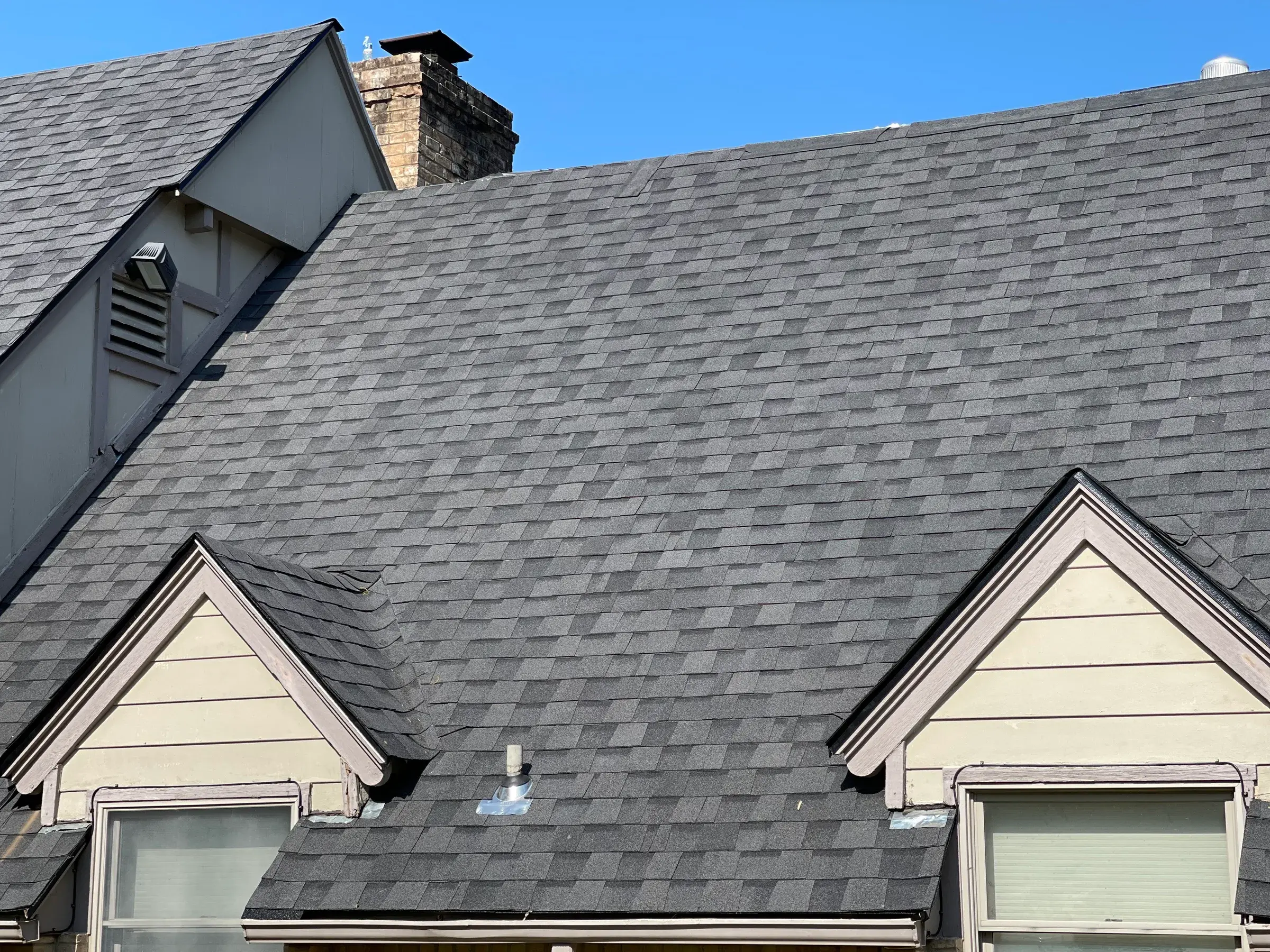
Hail damage on asphalt shingles usually appears as dark, soft bruises where granules were knocked loose and the mat underneath was fractured — not as visible holes. From the ground, check gutters, downspouts, vents, and AC condenser fins for dents first: soft metals dent before shingles bruise, so they are the earliest reliable indicator.
What hail actually does to an asphalt shingle
An asphalt shingle is a layered thing, not a solid one. Hail almost never punches through it. At the sizes that fall in Ottawa County, hail deforms the shingle — and the damage that matters happens inside the layers where you cannot see it.
Three separate problems get lumped together under the phrase "hail damage." They are not the same, and only one of them shortens the life of your roof in a serious way.
Bruising — the one that matters
A bruise is a fracture in the fiberglass mat, the woven structural core buried under the asphalt. Press a bruise with your thumb and it gives. It feels soft, the way a bruise on an apple feels soft. There is usually a dark spot on the surface where granules were knocked loose, but the dark spot is the symptom. The fracture is the injury.
This is why hail damage is found by hand and not by eye. A trained inspector runs a palm across a slope and feels for the give. From the ground, forty feet away, a bruise is invisible. It is invisible from six feet away on the roof, too, on a lot of roofs.
A bruise is not a leak. It is a leak on a delay. Once the mat is fractured, the asphalt above it flexes where it used to be rigid, the remaining granules shed faster, and the bare asphalt starts oxidizing under the roughly 62 percent annual sunshine northeast Oklahoma gets. Then winter arrives. The Oklahoma Climatological Survey's 1991–2020 normals put Miami at 89 nights a year below freezing, and every one of those nights is a chance for water sitting in a fracture to freeze, expand, and pry it wider. A bruise from this spring is a crack in three winters and a stain on your ceiling after that.
Granule loss
The colored granules on a shingle are not decoration. They are the sunscreen. They take the UV hit so the asphalt underneath does not. Hail knocks them loose in a scattered, random pattern — never in lines, never in a path.
Granule loss on its own, without a fractured mat under it, is the mildest form of hail damage. It still costs you service life, because exposed asphalt ages fast. But it is not the same finding as a bruise, and an honest inspector will tell you which one you have.
Cracking
A crack that goes all the way through — often a crescent or a starburst radiating from the impact point — usually takes either a large stone or a shingle that was already brittle. Cold, old, sun-baked asphalt cracks. Warm, newer asphalt dents and rebounds. Same storm, same street, different result.
Anatomy of a hail bruise: what the stone passes through
- Granules. Ceramic-coated mineral, embedded in the surface. The stone drives some of them down into the asphalt and knocks others off entirely. This is the dark spot you can sometimes see.
- Asphalt coating. The waterproofing layer. It compresses under the impact like clay and does not spring back all the way.
- Fiberglass mat. The structural core. This is where the fracture happens. The mat is what holds the shingle's shape and keeps the asphalt from tearing. Once it is broken, the shingle is a patch of waterproofing with no skeleton.
- Back coating and the factory sealant strip. A hard enough hit can break the seal bond between courses, which is a separate problem — an unsealed shingle is a wind problem waiting for the next storm.
- Underlayment. The secondary water barrier. Intact for now, which is why a bruised roof usually does not leak the same week.
- Roof deck. Plywood or OSB. Very large hail can dent decking, and that dent is a finding an inspector will look for from inside the attic.
The soft-metal tell: gutters, downspouts, vents, and AC fins
Here is the single most useful thing a homeowner can know about hail: soft metal dents before a shingle bruises. Thin aluminum, copper, and light-gauge steel yield at less impact energy than it takes to fracture a fiberglass mat. That makes them an early-warning system — and unlike your roof, most of them are at eye level.
Walk your house and look at every soft, exposed metal surface. You are looking for round-ish dimples that were not there before, and for bright, clean spots on dirty metal where the impact scrubbed off the oxidation. Those clean spots are called spatter marks. Spatter is not damage. It is evidence that hail hit here, and how recently.
- Gutter faces and gutter aprons — the metal lip that carries water off the deck edge and into the trough
- Downspouts, especially round ones, and downspout elbows
- Roof vents, turbines, and the caps on furnace and plumbing vents
- The aluminum fins on your air conditioner's outdoor condenser unit — one of the softest targets on the property
- Drip edge and any exposed step flashing (the L-shaped metal that ties a roof slope into a wall)
- Chimney caps and rain collars
- The garage door, the mailbox, and the lid of your grill
Check every side of the house, not just the side you see from the driveway. Hail arrives at an angle with the wind, so damage concentrates on the storm-facing elevations. That plays out differently depending on where in Ottawa County you live. West of Miami, out in the Neosho Lowlands, the ground is flat and open and there is nothing to slow a wind-driven stone. East, in the Ozark Plains, tree cover can shield one slope completely and leave the next one fully exposed. Two sides of the same roof can tell two different stories.
Ground-level checks you can do safely (no ladder required)
Do these in daylight, ideally within a few days of the storm while everything is still fresh. Take photos with your phone as you go — timestamped, wide shot first, then close up. Print this and work through it.
Ground-level hail inspection checklist
- Walk the full perimeter of the house. Do all four sides, not just the front.
- Look at the AC condenser fins from a few feet away, at a low angle. Dented fins look like a combed field.
- Check every downspout for dimples, especially the round ones and the elbows.
- Look at the outward face of the gutter for dents, and at the top edge for clean spatter spots on dirty metal.
- Look up at roof vents, turbine caps, and vent pipe collars with binoculars or your phone's zoom.
- Photograph any dented soft metal next to a coin or a tape measure for scale.
- Check window screens on the storm-facing side for dents, stretched mesh, or small tears.
- Check vinyl or aluminum siding for cracks, chips, or circular dimples — low on the wall means large hail, high on the wall means wind-driven hail.
- Look at the flat top surfaces of your wooden fence caps and deck rails for fresh, pale divots. Pale means new. Weathered gray means old.
- Check the mailbox, the grill lid, and any painted metal patio furniture.
- Look in the gutters and at the bottom of downspout splashblocks for a sudden pile of granules.
- From the ground, scan each roof slope for scattered dark spots with no pattern to them. Random scatter suggests impact. Lines and paths suggest something else.
- Look at the ridge cap and hip lines — they are folded over an edge, so they are the thinnest and most exposed shingles on the roof.
- Check the attic in daylight with the lights off for any new pinpricks of light, and photograph any fresh dents in the deck from underneath.
- Write down the date of the storm and what you remember of the stone size. If you kept a photo of hail on the ground, keep it.
Hail damage on metal, wood shake, and low-slope roofs looks different
Most of Miami's housing is detached single-family — 76.7 percent of the 13,701 units in Ottawa County, per the Census Bureau's 2020–2024 American Community Survey — and another 12.2 percent is mobile or manufactured, where low-slope and metal roofs are common. What hail does to those roofs is not what it does to a laminated asphalt shingle, and the words you use to describe it should change with the material.
| Material | What real hail damage looks like | What fools people | Visible from the ground? |
|---|---|---|---|
| 3-tab asphalt | Dark round bruises with granules driven out; soft to the touch; sometimes a crescent crack. Thin and single-layer, so it bruises at smaller stone sizes than laminated shingle. | Thermal cracking along the tab slots; blisters that pop and leave craters | Sometimes — dark spots may show, but the fracture never does |
| Architectural / laminated asphalt | Same bruising, but harder to see because the color blend hides granule loss. The double layer resists smaller stones. When it fails, the top lamination can separate. | Shadow lines in the color blend that look like dents; normal manufacturing texture | Rarely. This is the material most often called "fine" from the driveway |
| Standing seam or corrugated metal | Round dents on flat pans, dents on the seams, and chipped or fractured paint/coating at the impact. Dents in the pans are frequently cosmetic; a breached coating is not. | Oil canning (the natural waviness of metal panels); dents from a ladder or a tree limb | Yes — metal shows hail more honestly than anything else on the house |
| Wood shake | Splits with sharp, fresh, light-colored edges, usually with an impact mark at one end and no nail hole nearby. Fresh splits look pale against weathered gray. | Natural splitting from age and the 57 days a year above 90°F drying the wood out; splits that run from a nail | Sometimes, if the split is wide |
| Low-slope: TPO, EPDM, modified bitumen | Circular fractures or "stars" in the membrane; on modified bitumen, granule loss and dents in the insulation board below that you feel as soft spots. Damage can be invisible until the membrane is examined closely. | Ponding stains; scuffs from mechanical work near units | No. Low-slope roofs cannot be assessed from ground level at all |
Impact size vs. damage: why small hail can matter and big hail sometimes doesn't
The National Weather Service uses a common-object scale to size hail, and it is worth knowing because it is the vocabulary every inspector and adjuster will use with you:
- Pea — 1/4 inch
- Marble — 1/2 inch
- Penny — 3/4 inch
- Quarter — 1 inch (this is the National Weather Service's severe threshold)
- Golf ball — 1.75 inch
- Tennis ball — 2.5 inch
- Baseball — 2.75 inch
- Softball — 4 inch
The Oklahoma Climatological Survey puts Miami at roughly 4 to 5 days a year with hail larger than 0.75 inch. That is the only hail frequency figure worth quoting for this area, and notice what it does not tell you: it does not tell you whether your roof was damaged. Size is one variable among several.
NOAA's National Severe Storms Laboratory explains where the size comes from — hailstones grow in a thunderstorm's updraft, and a stronger updraft holds a stone aloft longer and grows it bigger. But the damage on your roof depends on more than the stone. It depends on the shingle's age, because asphalt gets brittle as it oxidizes. It depends on temperature, because warm asphalt is pliable and cold asphalt is not. It depends on the angle of impact and on the density of the stone itself, since hail ranges from soft and slushy to solid ice. And it depends on what is behind the shingle: a shingle backed by solid decking survives a hit that would fracture the same shingle spanning a gap.
Which is how one-inch hail fractures the mat on a nineteen-year-old 3-tab roof, while an inch-and-three-quarter stone bounces off a two-year-old laminated shingle on an 85-degree afternoon and leaves nothing but a scuff. "It was only quarter-sized" is not a conclusion. Neither is "it was golf balls, we're definitely getting a new roof."
About impact-resistant shingles and the standards you'll hear quoted
Two standards come up constantly and get mixed up almost as often. UL 2218 is the impact test: a steel ball is dropped from a set height onto the same spot twice, and a Class 4 product survives a 2-inch ball from 20 feet without the back of the shingle cracking. ASTM D3161 is a wind-resistance test. It says nothing about hail. A shingle can pass D3161 and bruise in the first storm.
It is also worth knowing that UL 2218 uses a steel ball, and steel is harder and denser than ice. The Insurance Institute for Business & Home Safety has run impact testing with ice balls instead and found that real-world performance varies a good deal from product to product, even among shingles carrying the same class rating. Class 4 is a useful relative rating, not a guarantee. And in Oklahoma, no law requires your insurer to give you a discount for installing one — if you want to know whether yours offers a premium credit, ask your insurer directly.
Collateral evidence: siding, screens, decking, fence caps, mailboxes
Your roof is the hardest surface on the property to read and the only one you cannot safely reach. So read everything else. The soft targets around a house record the storm, and together they tell you the size, the direction, and roughly the energy of what fell.
- Window and door screens. Aluminum mesh dents and stretches at very low impact energy. A dented screen on the north elevation and a clean one on the south tells you the storm came out of the north.
- Vinyl and aluminum siding. Chips, cracks, and dimples. How high they sit on the wall tells you how much wind was pushing the hail sideways.
- Fence caps and deck rails. The flat, unfinished, upward-facing wood is one of the best records you have. Fresh divots are pale. Old ones have already weathered gray, which is how you separate this storm from the last one.
- Wooden playsets, garden beds, and any exposed lumber.
- Painted metal — mailbox, grill lid, patio furniture, garage door, and the hood and roof of a car left out.
- Landscaping. Shredded leaves and stripped bark under trees are honest witnesses.
- Spatter on any dirty metal or on a wooden deck — clean circular spots where the oxidation or dirt was blasted away.
Photograph all of it. Not because it makes your case, but because it dates the event and shows what fell where. This is the same evidence an inspector reads on the roof, and it is a large part of what an adjuster is checking during a roof inspection when they climb up there.
What is NOT hail damage
More roofs get called "hail damaged" than are hail damaged. Learning the look-alikes is worth as much as learning the real thing, because pointing at a blister and calling it a bruise wastes your time, the inspector's, and the adjuster's — and it makes everything else you say less credible.
| What you're looking at | If it's hail | If it's something else | How to tell |
|---|---|---|---|
| A dark circular spot on a shingle | A bruise: random placement, soft and dented to the touch, mat fractured underneath | A blister: a gas pocket in the asphalt that raised and popped, leaving a small crater with a crisp rim | Blisters have sharp edges and cluster on the hottest, most sun-exposed slopes. Bruises are soft, dented, and scattered everywhere including shaded slopes |
| Granules piled in the gutter | A sudden accumulation in the days right after a storm, matched by fresh bare spots in a random scatter | Normal shedding: a brand-new roof sheds loose factory granules for months; an old roof sheds steadily as the asphalt below gives them up | Timing and rate. A pile that appeared this week is a different fact than a slow trickle you've been sweeping out for years |
| Scuffed or flattened shingle areas | Random. Hail has no route and no preferred destination | Foot traffic: marks that line up along a path — up a valley, over to a vent, around a chimney, along the ridge | Pattern. Hail scatters. Feet make lines that lead somewhere |
| Dents in metal | Roundish, random, on upward-facing surfaces across multiple elevations, sized consistently with each other | Mechanical marks: ladder feet, dropped tools, hammer strikes. Clustered near where someone worked, often crescent-shaped or straight | Location and shape. Damage that stops at the edge of a work zone was made by a person |
| Cracks in the shingle field | A crescent or starburst radiating from a single impact point, in no repeating pattern | A manufacturing or thermal issue: straight lines, uniform, appearing at the same spot on shingle after shingle across the whole roof | Uniformity. If it repeats identically across the field, a factory or the sun did it, not a storm |
Age is the biggest look-alike of them all. A twenty-year-old roof in this climate has lost granules, curled at the edges, and gone brittle without any hail involved — 57 days a year above 90°F and 89 nights below freezing will do that on their own. The line between storm damage and ordinary wear is where most disagreements start, and it is worth understanding before anyone comes to look.
Functional vs. cosmetic damage — the distinction insurers use
This is the split that decides most of what happens next, so it helps to know the words.
Functional damage compromises the roof's ability to shed water or shortens its service life. A fractured mat is functional. Granule loss down to bare asphalt is functional. A punctured membrane, a broken seal bond, a split shake — functional. The roof will not do its job as long as it should have.
Cosmetic damage changes how something looks without changing what it does. Dents in a metal panel where the coating is intact are the classic example. The panel is ugly. The panel is also still watertight, and will be for its full expected life.
Why this matters to you: many policies written across Oklahoma, Kansas, Missouri, and Arkansas now carry a separate wind and hail deductible, and some carry a cosmetic-damage exclusion — often specifically on metal roofs. Those terms are in your declarations page, and they are worth reading before a storm rather than after. Coverage is your insurance carrier's determination under your specific policy, and nothing an inspector or contractor finds on your roof changes that. The Oklahoma Insurance Department is the right place to take questions about what your policy actually says.
When to stop looking and get a professional inspection
Stop when you have finished the checklist. There are two ways it ends, and only one of them is what people expect.
If you found dented soft metal, spatter, dinged screens, or fresh pale divots on the fence caps, you have real evidence that hail hit your house with enough energy to matter. Your roof needs hands on it. From the ground you have gone as far as ground goes.
If you found nothing, that is useful but it is not a conclusion. Soft metals are an early indicator, not a complete one. Gutter guards hide the trough. New gutters have no oxidation for spatter to show against. A tree canopy over the east side of the house — common enough on the Ozark Plains side of the county — can shield the collateral evidence and leave the exposed west slope hammered. "My roof looks fine from the driveway" is the sentence that turns a $700 repair into a deck replacement four winters later.
What an actual inspection involves
Someone gets on each slope. They chalk out a 10-by-10-foot test square on every elevation, count the impacts inside it, and photograph them with a scale in frame. They feel for soft mat. They check the ridge and hip caps, which are the thinnest shingles up there. They read the soft metals and the spatter. They look at the age and general condition of the roof, because that context is what separates hail from wear. They check the attic side of the deck. Then they write down what they found, including the finding that nothing is wrong — which happens, and should be said plainly when it does.
That is what we do on a free inspection: document what is actually on your roof with a photo report, and give you a written estimate for the work we would perform. If you ask us to, we can meet your adjuster on site and walk the same slopes they walk. We will help you understand the process. Your insurer decides coverage under your policy — that part is not ours to promise, and you should be wary of anyone who says otherwise. If the damage turns out to be wind rather than hail, the signs are different enough to be worth reading separately: creased tabs, lifted edges, and missing shingles along the rakes tell a different story than bruising does.
Before you let anyone on your roof
Oklahoma requires roofing contractors to register with the Construction Industries Board, and registration requires at least $500,000 of liability insurance for residential work. You can check any contractor's registration yourself, free, at verifyroofing.cib.ok.gov. It takes about thirty seconds and it is the single best filter against the trucks that show up in Miami the week after a storm and are in Joplin the week after that. Nobody in this market tells homeowners about that tool, which is exactly why you should use it — on us included.
Hail is a normal part of living here — 4 to 5 days a year of it above three-quarters of an inch, according to the Oklahoma Climatological Survey, whether you are in town off Main Street or out on the lowlands west of the river. The roofs that last are the ones where somebody looked after the storm instead of waiting for the ceiling to tell them. If you want a set of eyes on yours, an inspection costs nothing and you get the photos either way.
We are roofing contractors, not public adjusters or insurance attorneys. Coverage decisions are made by your insurer under your policy.
Questions people ask about this
Can I really see hail damage on my roof from the ground?
Usually not — and that is the honest answer. A hail bruise is a fracture in the fiberglass mat inside the shingle, and it is found by touch, not sight. What you can see from the ground is the collateral evidence: dents in gutters, downspouts, roof vents, and AC condenser fins, plus dinged window screens and fresh pale divots on fence caps. Soft metal dents at lower impact energy than it takes to bruise a shingle, so it is your early indicator.
How long after a hailstorm should I have my roof looked at?
Soon, for two reasons. The evidence is most readable while it is fresh — pale divots in wood weather gray, and spatter marks on metal re-oxidize. And most insurance policies require prompt notice of a loss, though the exact requirement is in your policy, not in any general rule. If you suspect hail hit your house, do the ground-level checks in the following days and get hands on the roof rather than waiting to see if it leaks.
My hail was only quarter-sized. Is that too small to matter?
Not necessarily. One inch is the National Weather Service's severe threshold, but stone size is only one variable. Shingle age matters, because asphalt gets brittle as it oxidizes. Temperature matters, because warm asphalt is pliable and cold asphalt cracks. Density of the stone and angle of impact matter too. One-inch hail can fracture the mat on an old, sun-baked 3-tab roof while much larger hail bounces off a newer laminated shingle on a warm afternoon.
Do Class 4 impact-resistant shingles mean my roof won't get hail damage?
No. UL 2218 Class 4 means a product survived a 2-inch steel ball dropped from 20 feet twice on the same spot without the back cracking. Steel is harder and denser than ice, and the Insurance Institute for Business & Home Safety has found that real-world performance varies between products carrying the same rating. It is a good relative rating, not immunity. And Oklahoma does not require insurers to discount for it — ask your insurer whether they offer a credit.
How do I tell hail damage apart from normal wear on an old roof?
Pattern and texture. Hail is random — it has no route and no favorite spot, and a bruise is soft and dented under thumb pressure. Wear is uniform: granule loss across the whole field, curling at the edges, straight thermal cracks that repeat at the same place on shingle after shingle. Foot traffic makes lines that lead somewhere. Blisters have crisp rims and cluster on the hottest slopes. In a climate with 57 days a year above 90°F and 89 nights below freezing, plenty of roofs look rough without any storm involved.