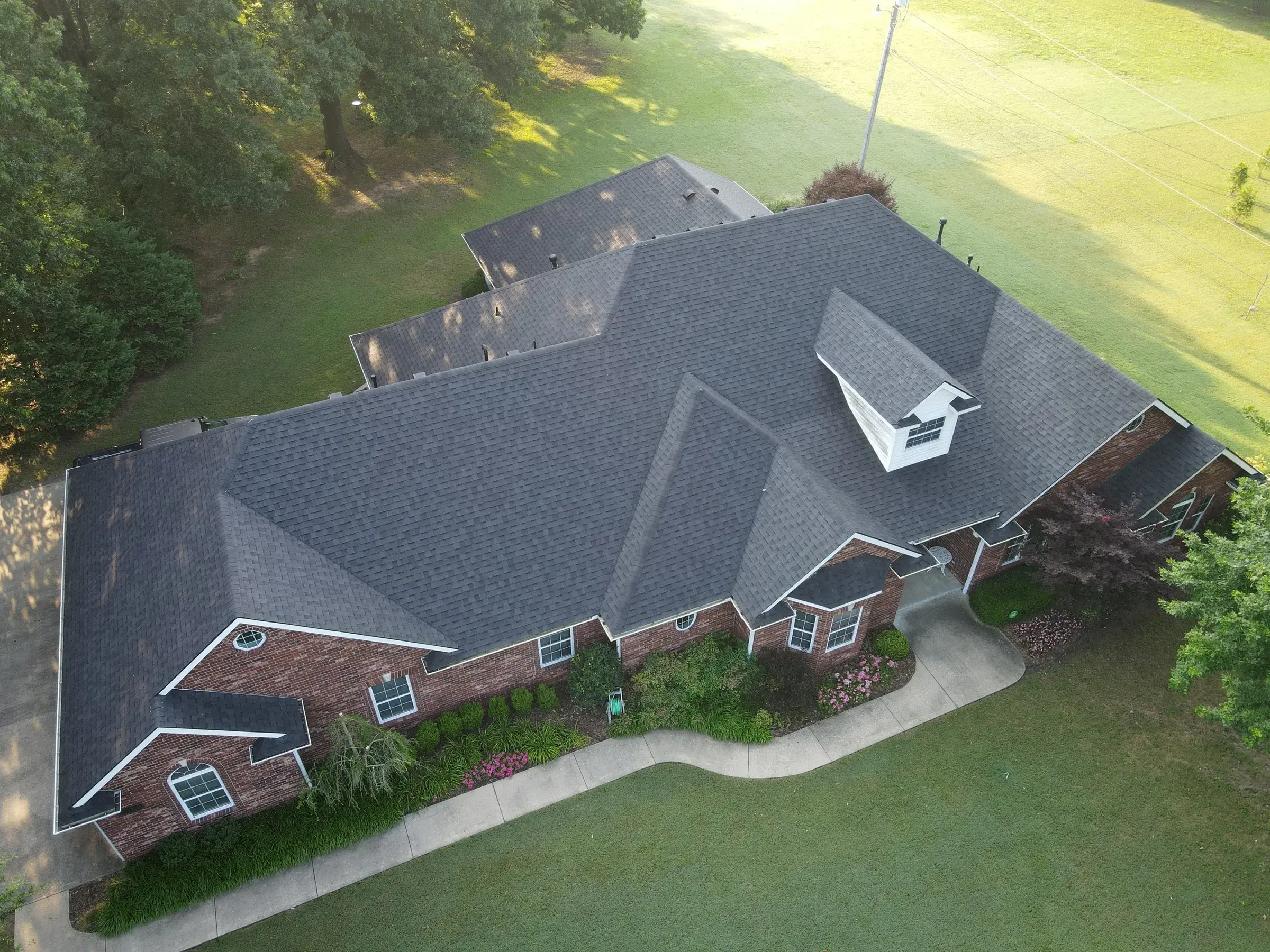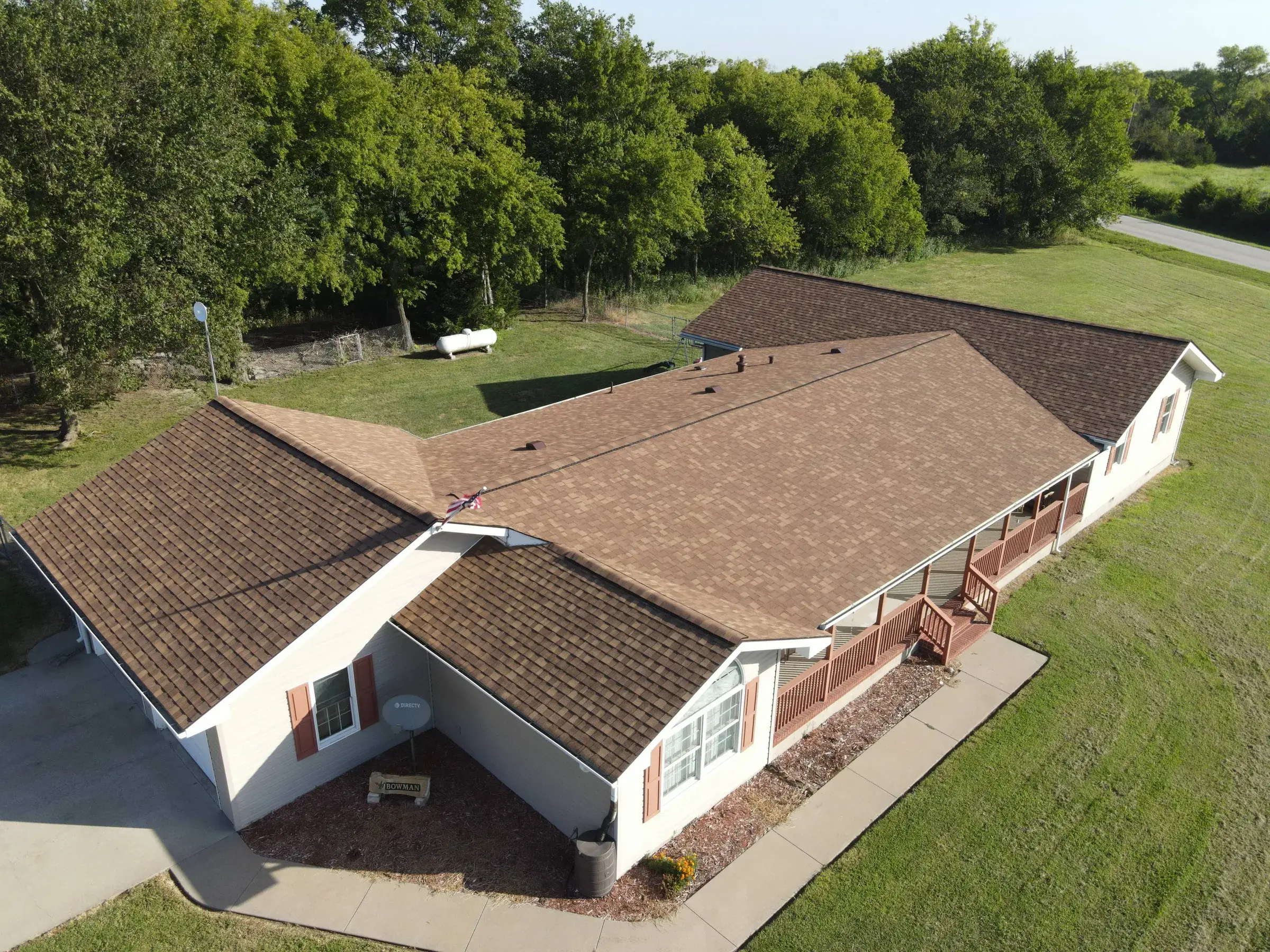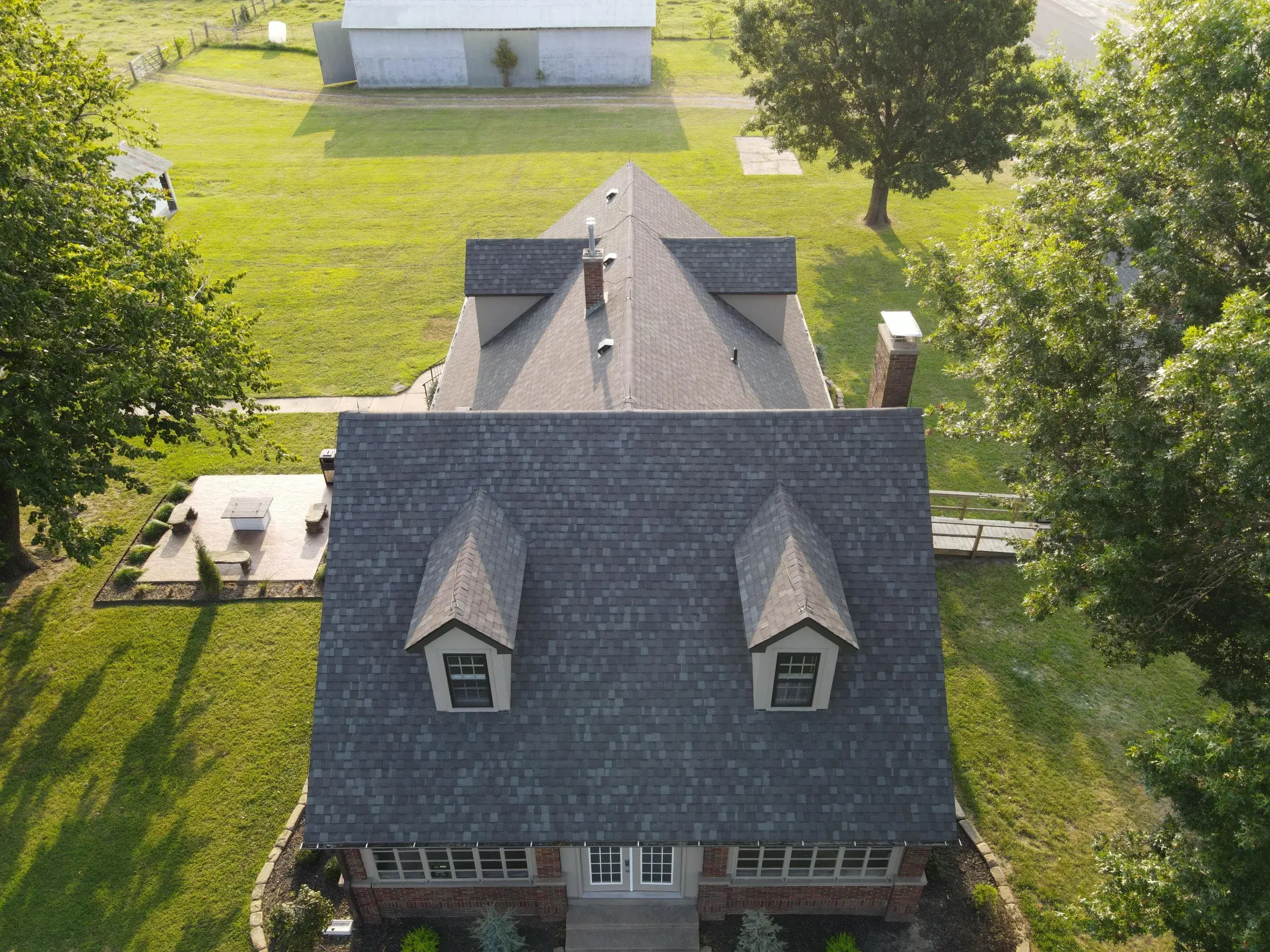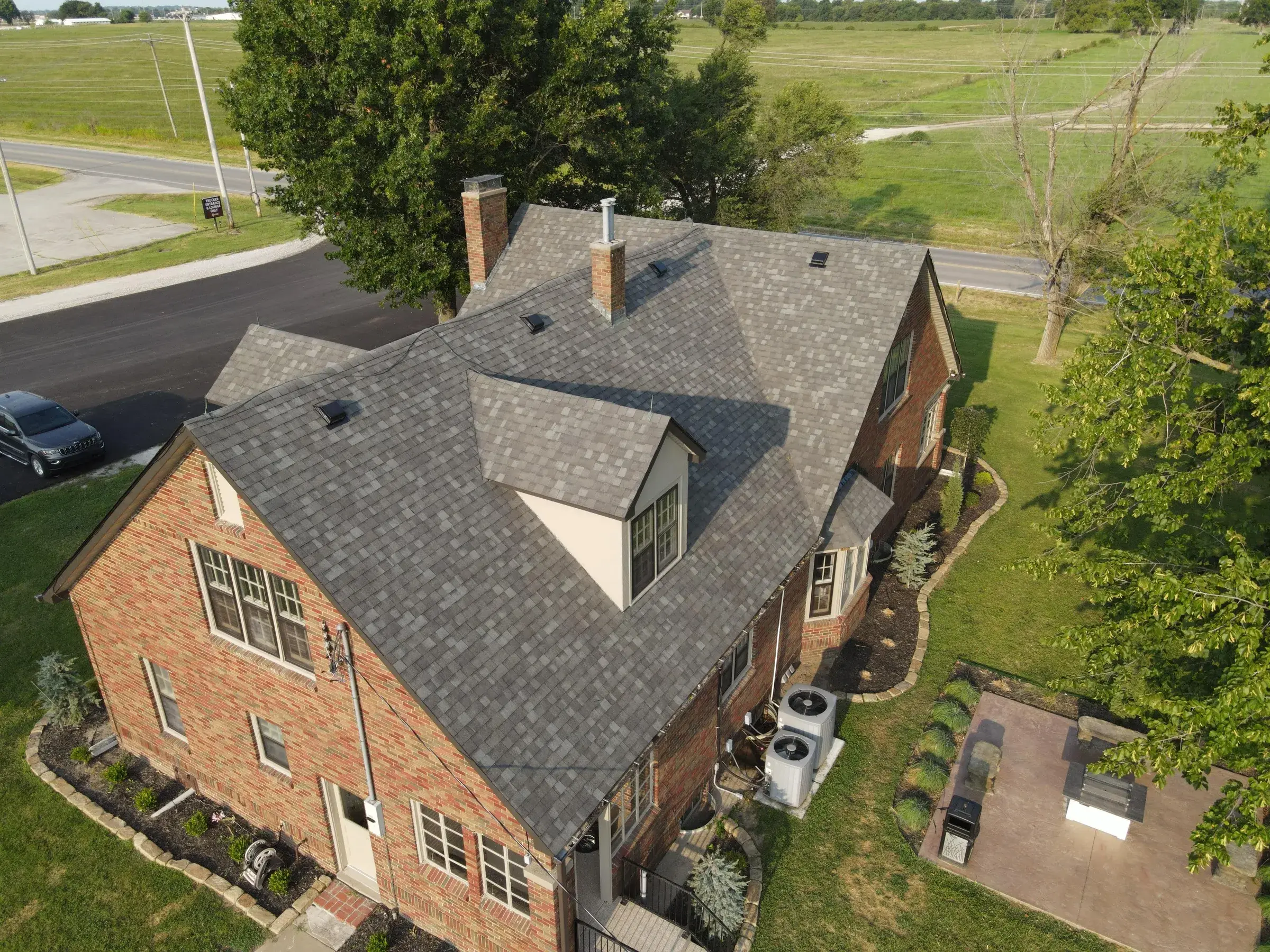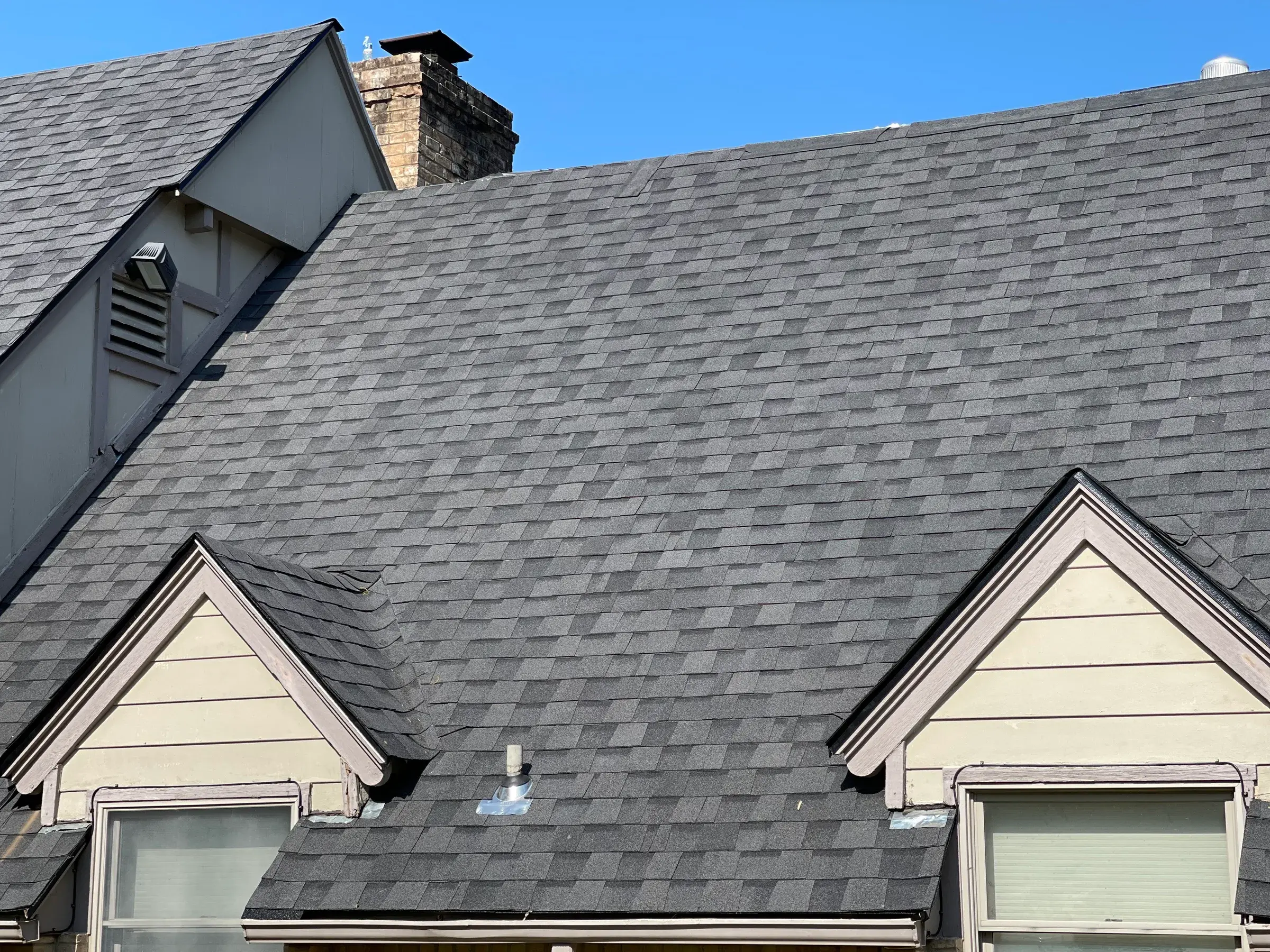
Wind damage most often shows up as creased shingles and broken adhesive seals rather than missing ones. Once wind lifts a shingle past its bending point, the mat is fractured and the seal is gone, even if it lays back down flat. Check ridges, rakes, roof edges, and any attic light or damp decking below.
How wind actually lifts a shingle: uplift, seal-strip failure, and the crease
Wind does not push a roof down. It pulls it up. When air moves fast across a sloped surface, the pressure above that surface drops, and the higher pressure underneath tries to equalize by lifting whatever is in the way. On an asphalt roof, the thing in the way is the bottom edge of a shingle tab.
That tab is held down by two things, not one. The nails hold the top of the shingle. The bottom is held by the seal strip — a band of asphalt adhesive factory-applied under each shingle, meant to melt in the sun and bond to the shingle below it. The nails almost never fail. The seal strip does.
Here is the sequence. Wind gets under a tab. The tab lifts and bends backward. If it bends past the point the fiberglass mat can take, the mat fractures in a line across the shingle, the surface granules crack along that line, and the adhesive bond tears loose. Then the gust passes and the tab lays back down. From the ground it looks like a roof. It is now a flap with a fracture line through it.
Why the seal matters more in Oklahoma than people assume
The Asphalt Roofing Manufacturers Association is clear that shingle seal strips bond thermally — they need sun and warm surface temperatures to activate. Shingles installed in cold weather may not bond at all until the next warm stretch, which is why ARMA and the shingle manufacturers call for hand-sealing in cold conditions. That is not an abstract concern here. The Oklahoma Climatological Survey's 1991–2020 normals put Miami at 89 nights a year below 32°F. A roof laid in January can sit unsealed for weeks, and a February wind event finds it in exactly that state.
| Wind speed | What that number means | What usually fails on an asphalt roof |
|---|---|---|
| Under about 45 mph | Ordinary strong gusts | A properly sealed, sound roof does nothing. Tabs that never sealed, or lost their seal to age, can lift and crease at this range. |
| 58 mph (50 knots) | NOAA's Storm Prediction Center severe thunderstorm wind criterion — the threshold at which a thunderstorm is classified severe | Seal-strip failures along edges and rakes. Loose ridge caps. Gutters and drip edge working loose. Usually nothing on the ground. |
| 65–85 mph | EF0 on the NOAA National Weather Service Enhanced Fujita scale | The EF scale's damage indicators for one- and two-family homes place the threshold of visible damage in this band: some roof covering material lost, gutters and awnings damaged, siding pulled. |
| 86–110 mph | EF1 | Toward the upper part of this band the EF damage indicators describe loss of a significant share of roof covering and uplift of roof decking. Missing shingles become obvious. |
| 111–135 mph | EF2 | Large sections of roof structure removed on the EF damage indicators. This is no longer a subtle inspection question. |
The useful thing about that table is the top half, not the bottom. Everything from EF1 up announces itself. The damage that gets argued about later happens between roughly 50 and 85 mph — a common summer thunderstorm outflow in Ottawa County — and produces almost nothing you can see from the driveway.
Why a roof can be wind-damaged with zero shingles on the ground
This is the single most misunderstood thing about wind. Homeowners walk the yard, find nothing, and conclude the roof is fine. Sometimes an adjuster does the same thing from the ground.
But a broken seal and a missing shingle are two different events at two different wind speeds. The seal breaks first, at a much lower gust, and the nails keep the shingle on the roof. Nothing lands in the grass because nothing left. What you have instead is a shingle that is fastened at the top, fractured across the middle, and no longer stuck down at the bottom.
That roof is watertight in a vertical rain. It is not watertight in the next wind-driven rain, because water now has a path under a tab that no longer closes. And it is measurably weaker in the next storm — an unsealed tab lifts at a lower wind speed than a sealed one, so each event lowers the bar for the one after it.
There is also a mundane reason the yard is empty: debris travels. On the Neosho Lowlands side of Ottawa County — the flat farmland west of Miami — a shingle that does come off can cross two properties before it stops. On the Ozark Plains side east of town, it ends up in a treeline. Absence of evidence in your yard is not evidence.
Edges, rakes, ridges, and corners: where wind loads concentrate
Wind pressure is not spread evenly across a roof. It piles up where the airflow separates: at eaves, at rakes, at corners, and along the ridge. The Insurance Institute for Business and Home Safety has spent years on full-scale wind testing of real roofs, and the consistent finding is that failure starts at the perimeter and works inward. That is precisely why the IBHS FORTIFIED Roof standard leans so hard on a sealed roof deck, properly fastened drip edge, and starter strip at the rakes as well as the eaves — the places wind gets its first grip.
Two terms worth having straight, because they come up in every estimate. The eave is the low horizontal edge where the gutter hangs. The rake is the sloped edge that runs up the gable end of the house. Most homeowners know "eave" and have never heard "rake," and the rake is where wind damage tends to start.
| Zone | What the wind does there | What that looks like from the ground |
|---|---|---|
| Rake (sloped gable edge) | Airflow separates hard at the edge; highest suction on the roof. First place a starter strip or drip edge lets go. | A shingle course that looks slightly wavy or lifted along the gable line. Drip edge standing off the wood. |
| Eave / first two courses | Wind drives up the slope and gets under the bottom edge; starter strip is the only thing sealing it. | Tabs along the gutter line that don't sit flat. Granules in the gutter (also normal in small amounts on an old roof). |
| Corners | Two edge zones meet; suction is highest of anywhere on the structure. | Corner shingles curled, torn, or missing while the rest of the roof looks untouched. |
| Ridge and hip | Air accelerates over the peak; ridge caps are single tabs with the most exposure and the least shelter. | Caps sitting crooked, lifted at one end, or gone entirely — visible in silhouette against the sky. |
| Field (the middle) | Lower suction; shingles are overlapped and shielded by the courses above. | Usually nothing, unless the storm was strong enough that the perimeter already failed. Field damage means it was a real event. |
That pattern is why "only the one side is damaged" is normal and not suspicious. Wind comes from a direction. The windward rake and the ridge take it; the leeward field often does not.
Signs from inside: attic light, damp decking, nail pops, dark sheathing
Your attic is the best diagnostic room in the house, and you can get to it without a ladder against the eave. Go up with a flashlight, turn the flashlight off for a minute, and let your eyes adjust.
Daylight through the decking is the obvious one — but know what is supposed to be there. Light at the ridge vent and at the soffit vents is normal and correct. Light coming through in a spot that is not a vent means a fastener path or a gap that shouldn't exist.
Then look at the wood itself. Fresh water on decking is dark and slightly cool to the touch. Old water leaves a grey or black stain with a distinct tide line around it. Rust on the exposed nail shanks poking through the sheathing means moisture is condensing or entering there. Nail pops — nail heads that have backed out and are standing proud of the shingle above — often show as small raised bumps in the roof surface and a shiny shank in the attic. Wet insulation in a line, rather than a puddle, tends to follow a rafter and points at where the water came in above.
Post-wind-event walkaround — ground and attic only
- Stand back from each elevation of the house and look at the roof in silhouette against the sky. Lifted or crooked ridge caps show up here and nowhere else.
- Walk the gable ends. Look along the rake line for a course that waves, stands off, or shows a shadow line under it.
- Look at the eave line for tabs that don't sit flat against the course below.
- Check the drip edge and gutters for sections pulled away from the fascia, or hangers that have torn out.
- Look at the soffit panels under the eaves — any panel pushed out, dropped, or missing.
- Walk the perimeter of the house looking for shingle pieces, granule piles at downspout outlets, and torn seal-strip fragments.
- Check the yard, fence line, and treeline — including the neighbor's side of it — for shingle debris that traveled.
- Look at the siding, window screens, and any metal (gutters, garage door, HVAC fins) for the same storm's fingerprints.
- In the attic: flashlight off, look for daylight anywhere that is not a ridge or soffit vent.
- In the attic: hand-check the decking for dampness, and look for dark staining, tide lines, rusted nail shanks, and wet insulation following a rafter.
- Photograph everything you find the same day, including a wide shot that shows the house.
- Do not get on the roof. A creased shingle is nearly invisible from below and easy to break further by walking on it.
Wind damage on metal, ridge caps, gutters, fascia, and soffit
Asphalt is not the only thing wind finds. Ridge caps are the most exposed component on the roof — single tabs, sitting on the peak, with air accelerating over them. They fail first and they are the easiest thing to spot from the ground, because a lifted cap breaks the straight line of the ridge against the sky.
On a metal roof, look for different things. Fastener back-out — screws standing proud with the rubber washer no longer compressed — is the common wind-and-thermal-cycling failure, and it lets water in at every one of them. Seam separation and panel ribs lifting at the eave are real damage. Oil canning, that gentle waviness in the flat of a panel, usually is not; it's a manufacturing and expansion characteristic, not a storm event.
Then the edges of the building. The fascia is the flat board at the eave that the gutter screws into. The soffit is the panel underneath the overhang, usually vented. Gutters torn off take fascia with them, and once fascia is loose, the drip edge and the first shingle course lose their anchor. A blown-in soffit panel is worse than it looks: it opens a path for wind to get inside the eave and push up on the deck from below, which is exactly the loading a roof is not built to resist. If a soffit panel is out, that is worth a call, not a shrug.
Wind-driven rain vs. wind damage — two different claim conversations
These get merged constantly, and they should not be, because they are different causes of loss and your insurer will treat them as such.
Wind damage is physical damage to the roof from wind force: a creased shingle, a broken seal, a lifted rake, a missing cap. Wind-driven rain is water pushed horizontally into a building through an opening, a vent, a wall detail, or under a shingle that a previous wind already unsealed. One is a damaged roof. The other is water intrusion, and whether it is covered — and under what part of your policy — depends on your specific policy language and on your insurer's determination. We can tell you what we see on your roof. Your insurer decides coverage under your policy, and we are not going to pretend otherwise.
| Wind damage | Wind-driven rain | Debris impact | |
|---|---|---|---|
| What it is | Force of wind physically damaging roof components | Water pushed horizontally through an opening or an unsealed lap | A limb, branch, or object striking the roof |
| On the roof | Creased shingles, broken seal strips, lifted rakes and caps, torn tabs — often with nothing missing | Usually no new roof damage of its own; it exploits damage or a detail that already existed | Linear gouges, punctures, scraped granules along a line, cracked decking, sometimes a hole |
| Inside the house | Often nothing at all until the next rain | Staining at wall/ceiling junctions, around windows, at the top plate — often away from the roof plane | A defined wet spot directly under the strike point |
| Timing of the evidence | Immediate but nearly invisible; the shingle lays back down | Shows up during the storm and can dry before anyone looks | Immediate and obvious — the limb is usually still there |
| Why it gets missed | Nothing on the ground, roof looks intact from the driveway | Dries, gets blamed on a leak, or gets blamed on condensation | Rarely missed, but the roof damage around the strike often is |
What we do instead is straightforward, and it's the same on every job: we document what we find with a photo report, we give you a written estimate for the work we would actually perform, we can meet your adjuster on site if you want us there, and we'll walk you through how the process generally works so nothing surprises you. That's our lane.
Debris impact and tree limbs: a separate cause of loss
Ottawa County is split down the middle in a way that matters here. East of Miami you are into the Ozark Plains — rockier, rolling, wooded, with mature trees over a lot of roofs. West is the Neosho Lowlands: flat prairie and farmland, very little to slow wind down before it reaches a house. The east side gets limb strikes. The west side gets open wind fetch. Same county, two different failure profiles, and it is worth knowing which one you live on.
Debris damage looks different from everything else. A limb drags, so it leaves a line — scraped granules, a gouge, sometimes a puncture with splintered decking under it. A hail bruise is round, soft to press, and has no directionality at all, which is the main thing that separates the two when you're looking at a photo; the differences between the two are worth understanding before you talk to anyone about your roof, and we cover them in more detail in our guide to [identifying hail damage on a roof](/blog/hail-damage-roof-identification). A wind crease is a straight horizontal fracture across a tab with no material removed. Three causes, three signatures.
One caution about limbs: the strike point is the easy part. The damage that gets missed is what the same limb did on its way down — a scraped course two feet away, a bent gutter, a cracked rafter you can only see from the attic. If a limb came down on your roof, the inspection needs to be wider than the hole.
Older roofs and lost seal integrity: what makes a roof more wind-vulnerable
Asphalt shingles fail by drying out. The asphalt in them holds oils that keep the mat flexible; sun, heat, and time cook those oils off. The Oklahoma Climatological Survey's normals for this area are hard on a roof: 57 days a year above 90°F, five above 100°F, an August daily high normal of 91.5°F, and roughly 62% of possible sunshine annually. Add the 89 freeze nights and you get expansion and contraction on top of UV load.
A brittle shingle creases at a lower wind speed than a flexible one. A seal strip that has gone chalky doesn't re-bond the way a fresh one does. And here is the part homeowners most want to be untrue: once a seal is broken and the mat is creased, that shingle does not come back. It may re-adhere in the next hot spell — the asphalt is still asphalt — but the fracture line through the mat is permanent, and that is where it will tear next time.
This is also where the shingle-over question comes up. Oklahoma amended IRC section R908.3.1.1 to require tear-off rather than roofing over the existing shingles in defined conditions — which is a good thing for wind performance, because a new layer nailed over a wind-loosened old one inherits every problem underneath it. The City of Miami requires a permit for new roofs and re-shingles, and we pull it.
Documenting wind damage before the weather cleans up the evidence
Wind damage has a short evidentiary life. Water dries. Debris gets picked up. The creased tab lays flat and re-adheres in the next 90-degree afternoon, and now it looks like a normal shingle that just happens to have a fracture through it. The clock starts the moment the wind stops.
Do the ground-and-attic walkaround the same day if it's safe to be outside. Photograph wide first — a shot that shows the whole house and identifies the property — then closer. Get the date on the file. Photograph the collateral too: the dented gutter, the torn screen, the siding, the limb in the yard. Collateral damage on things at eye level is often the clearest proof of what the wind did at roof level. Our walkthrough on [documenting storm damage with photos](/blog/documenting-roof-storm-damage-photos) goes through what to shoot and in what order.
If there's an actual opening — a hole, a missing section, water coming in — the priority is stopping the water, not the paperwork. [Emergency roof tarping](/services/emergency-roof-tarping) is a service we provide, and getting a tarp on early limits the interior damage that a second storm would otherwise add to the pile. Photograph before the tarp goes on.
Then have someone look at it properly. A [free roof inspection](/services/roof-inspections) on a wind event is mostly a hands-on seal test and a look at the rakes, ridges, and corners — the things you cannot assess from the driveway. If there is real damage, [storm damage roof repair](/services/storm-damage-roof-repair) is what follows, and if there isn't, you've learned that too and it cost you nothing. We work across Ottawa County and the surrounding area on both sides of the state line — you can see what that covers on our [Ottawa County service page](/locations/ottawa-county-ok).
If you had a hard wind and you're not sure, the honest answer is that you probably can't tell from the ground — and that is not a failure on your part. It's the nature of how wind breaks a roof. Give us a call at (209) 758-8550 and we'll come look.
Questions people ask about this
There are no shingles in my yard. Can my roof still have wind damage?
Yes, and this is the most common version of wind damage. The adhesive seal strip under each shingle fails at a much lower wind speed than the nails do, so the shingle stays on the roof while the bond that holds its bottom edge lets go. The tab often creases — a fracture across the fiberglass mat — and then lays back down looking normal. Nothing lands in the grass, and the roof looks fine from the driveway, but it will leak in the next wind-driven rain.
How much wind does it take to damage an asphalt roof?
Less than most people expect. NOAA's Storm Prediction Center uses 58 mph (50 knots) as the threshold for a severe thunderstorm, and seal-strip failures happen in that range on roofs that are older, brittle, or never sealed properly. The NOAA National Weather Service Enhanced Fujita scale places the threshold of visible damage to one- and two-family homes at around 65 mph. Above roughly 85–90 mph, damage stops being subtle — the EF damage indicators describe significant loss of roof covering and deck uplift.
Should I get on the roof to check for damage myself?
No. A creased shingle is nearly invisible from above anyway, and walking on a wind-loosened roof breaks marginal seals and scuffs granules — you can create damage that wasn't there and complicate your own claim in the process. It's also genuinely dangerous on a wet or storm-loosened surface. Everything a homeowner needs can be checked from the ground and from inside the attic.
Can you handle my insurance claim for me?
No, and in Oklahoma no roofer legally can. Under 36 O.S. §6202 and §6220(E), a contractor who represents an insured's interests on a claim for compensation is acting as a public adjuster, and doing so without a licence is a misdemeanour — a signed authorization does not change that. What we can do is document the damage with a photo report, give you a written estimate for the work we would perform, meet your adjuster on site if you'd like us there, and explain how the process generally works. Your insurer decides coverage under your policy.
Does a creased shingle re-seal itself once the weather warms up?
The adhesive may re-adhere in hot weather — the Asphalt Roofing Manufacturers Association notes that shingle seal strips bond thermally, so heat and sun can re-bond a loose tab. But that does not repair the shingle. The crease is a fracture through the fiberglass mat, and that fracture is permanent. It's a weak line that will tear in the next wind event, at a lower speed than an undamaged shingle would.