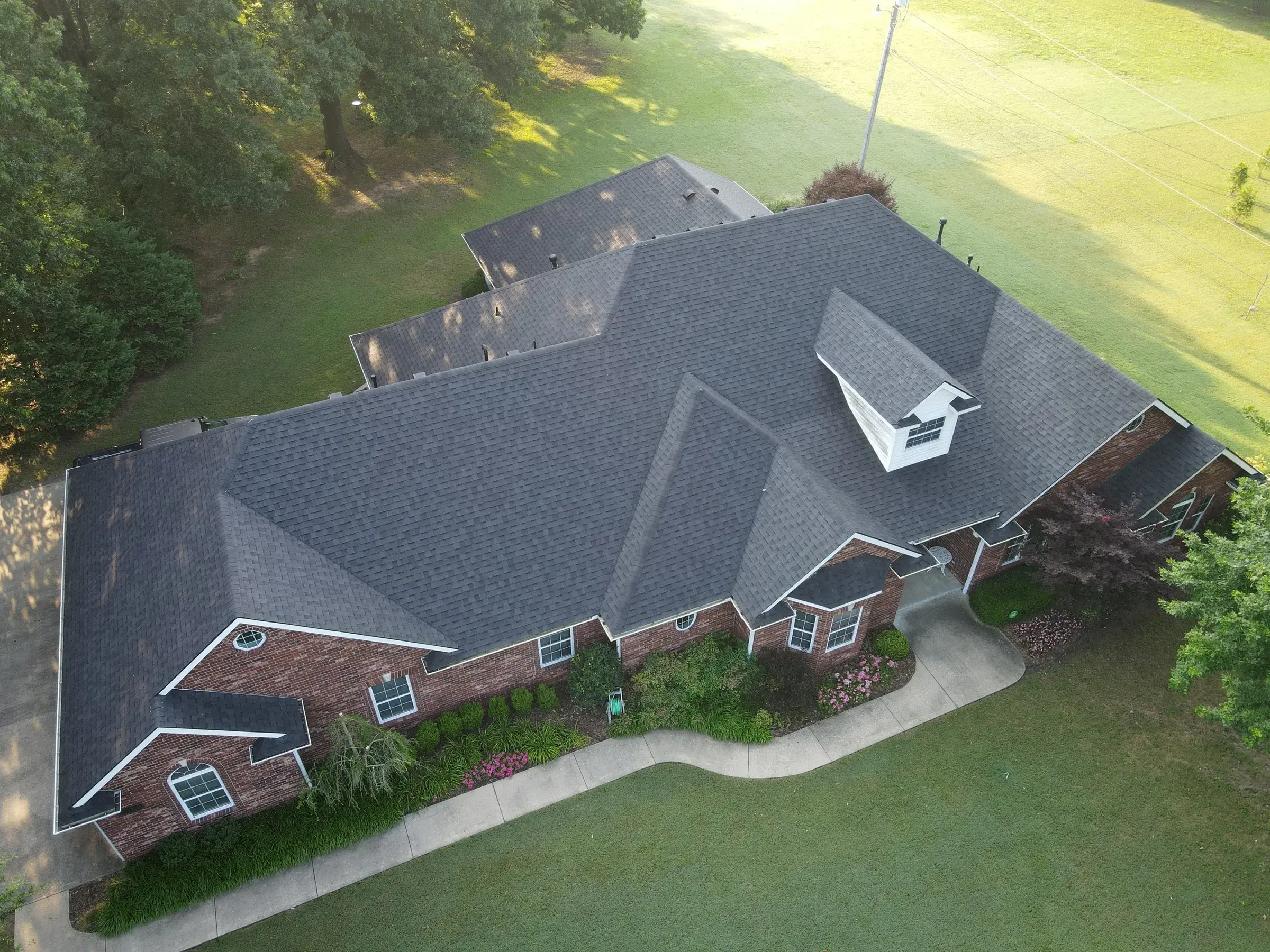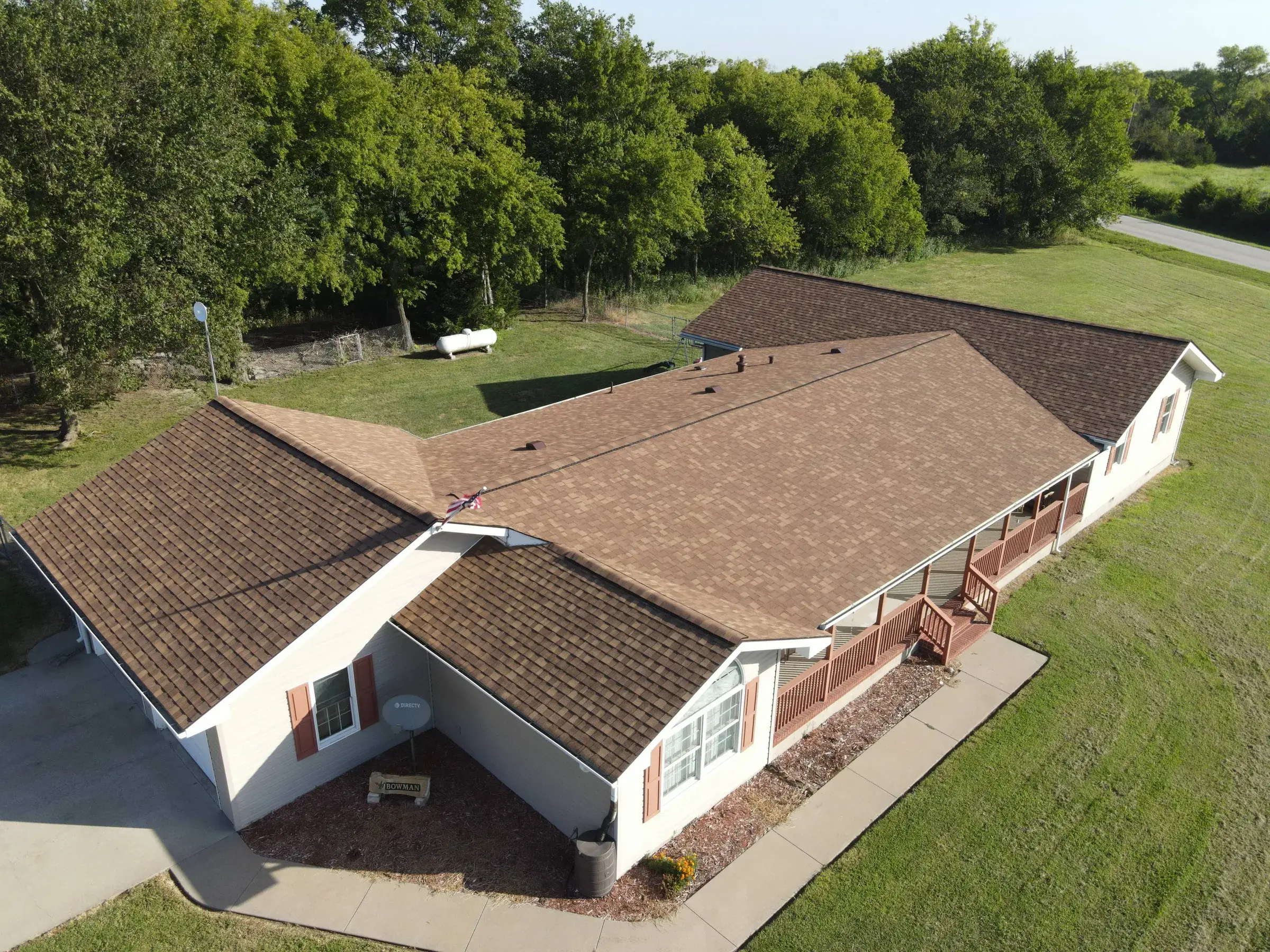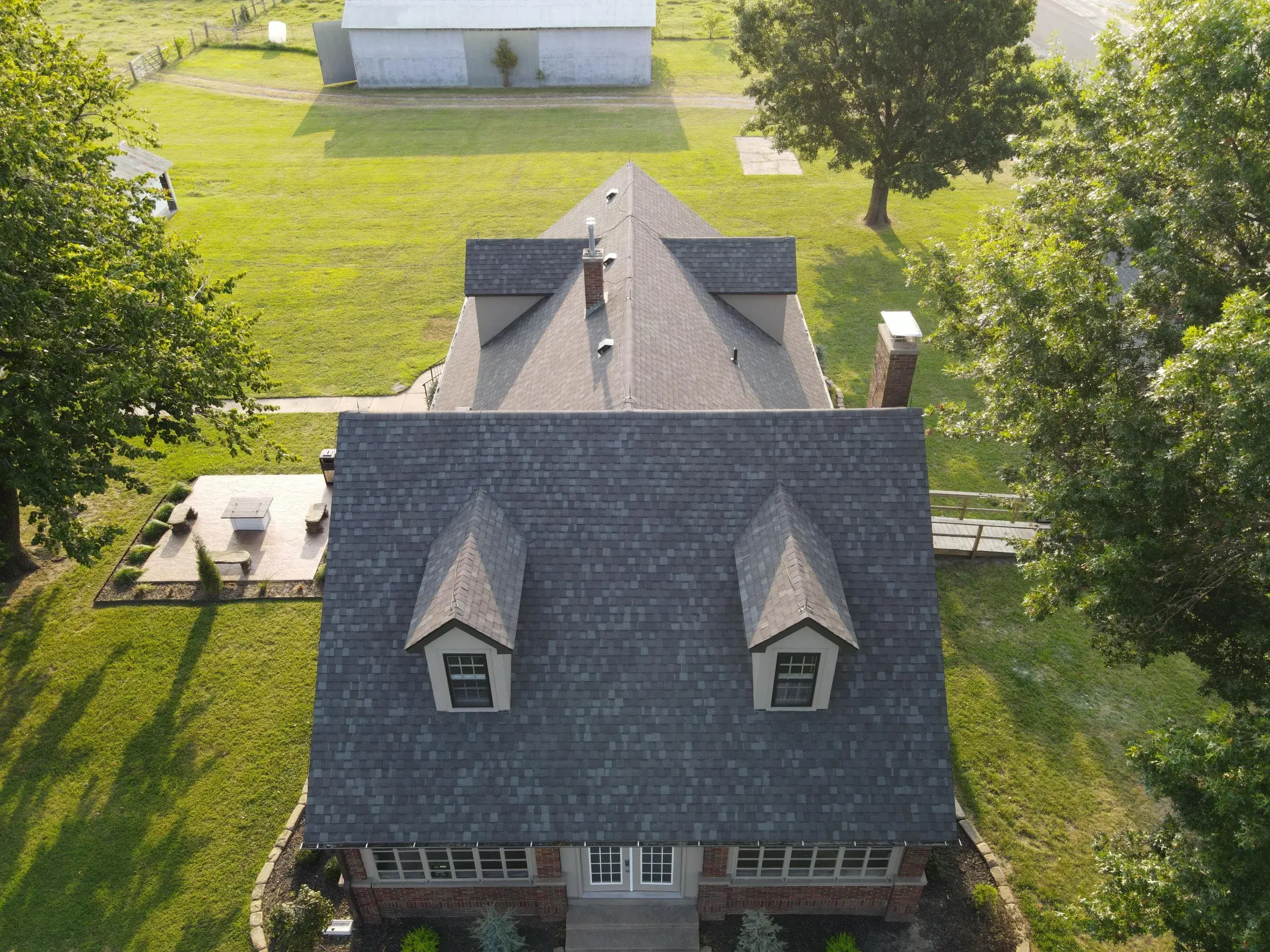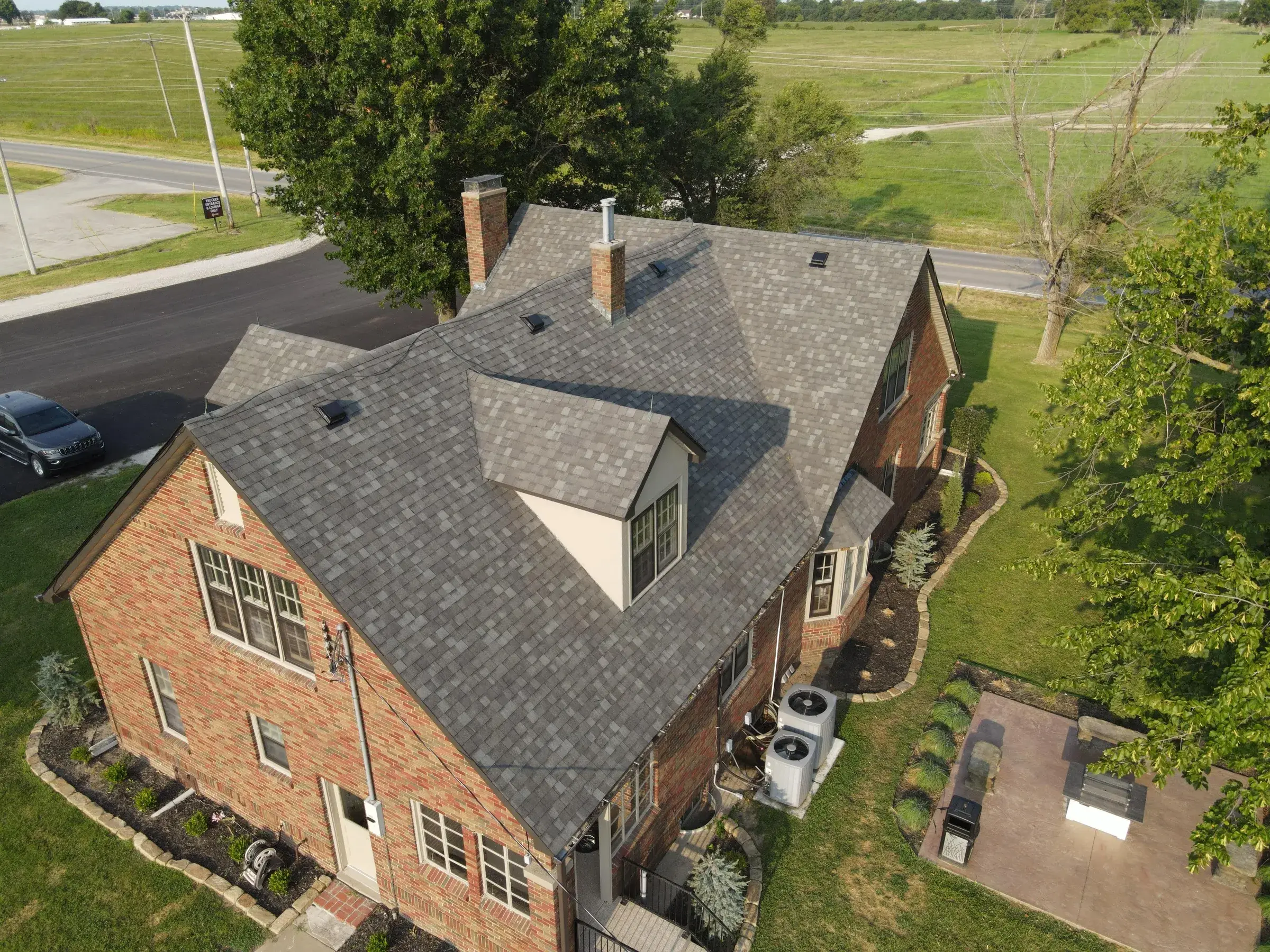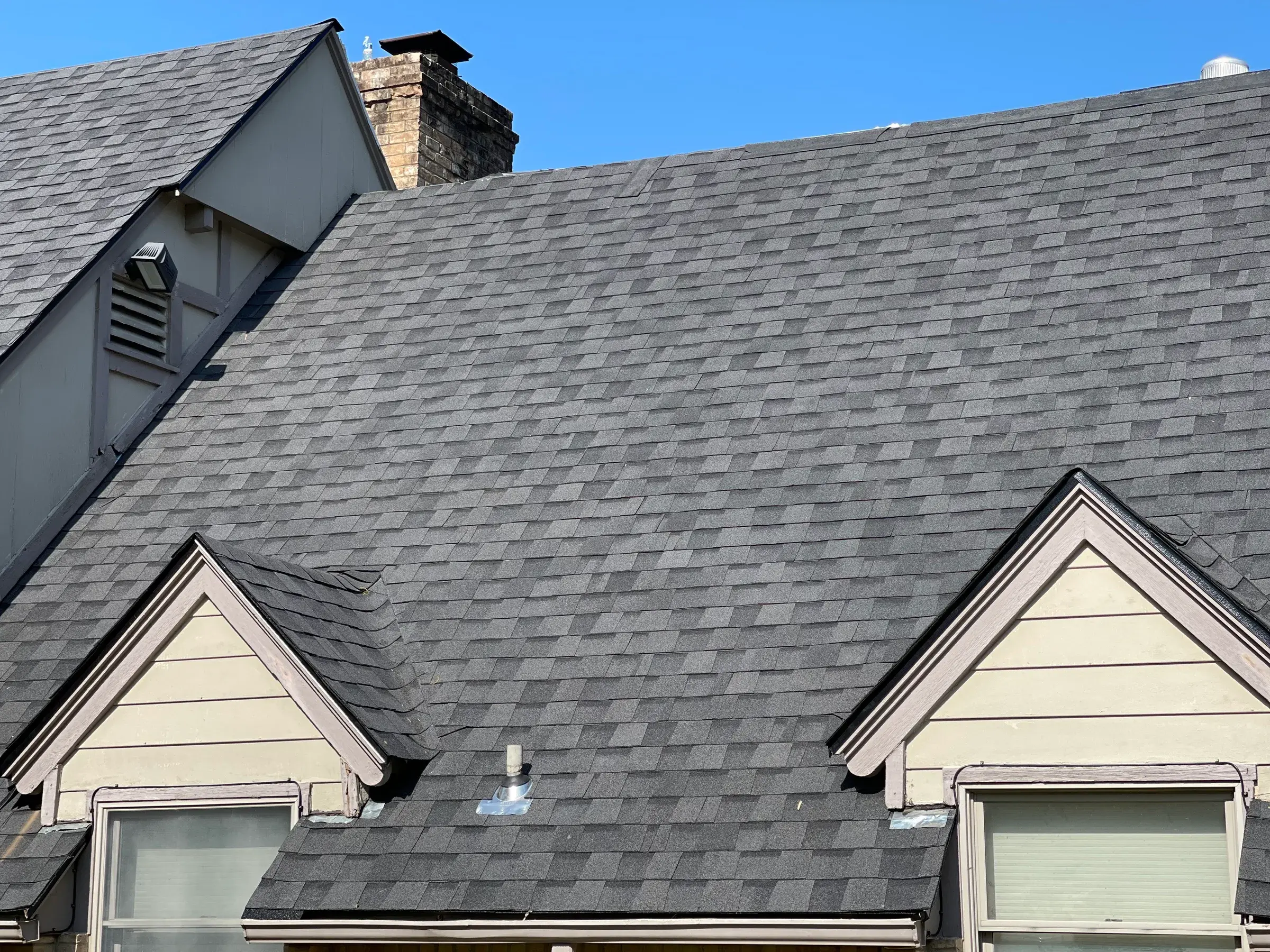
An overlay shingles over the existing roof; a tear-off removes everything down to the deck. Overlay is cheaper because it skips removal and disposal — but it hides deck condition, adds weight, traps heat, and generally shortens the new roof's service life. It is defensible only over a single sound layer on a sound deck.
Overlay, Layover, Re-Cover: Same Thing, Different Words
If you have three quotes on the kitchen table and one is noticeably cheaper, read the scope line before you read the number. There's a good chance it says "re-cover," "layover," "overlay," or "install over existing." All four describe one job: new shingles nailed down on top of the shingles already up there. Nothing comes off. Nothing underneath gets looked at.
A tear-off is the opposite. Everything comes off — shingles, old underlayment, old flashing, thousands of old nails — down to bare wood. The deck gets inspected, bad boards get replaced, and the roof gets rebuilt from the wood up.
The vocabulary does work here. "Re-cover" sounds like maintenance. "Tear-off" sounds like demolition. The International Residential Code (IRC) uses "re-covering" in Section R908 and treats it as the exception rather than the default — a large share of that section is a list of conditions under which you may not do it. That framing is closer to the truth than the sales language is.
Why an Overlay Is Cheaper (It's Not a Discount, It's Omitted Work)
An overlay isn't a better price on the same product. It's a smaller job. Two specific cost centers disappear, and they're both real money.
The first is removal. Stripping a roof is slow, physical labor, and on a typical Miami house it means moving several tons of material off a slope by hand. The second is disposal. Old shingles go in a dumpster and the landfill charges by weight, not by volume. Delete those two lines and the total drops — not because anyone gave you a deal, but because two-thirds of the work on the ground never happens.
Two other things get deleted quietly. You don't get a deck inspection, because you can't inspect wood you never uncover. And you don't get new underlayment across the field, because on a re-cover the old shingle layer becomes the base the new roof sits on. Whatever underlayment is up there stays up there, at whatever age and condition it has reached.
Miami's median home value is $123,300 and the median household income is $49,947 (U.S. Census ACS 2020-2024). The pull toward the cheaper number is not foolish — it's arithmetic. But it's worth knowing exactly which work you're declining. If you're trying to understand where the dollars go in a full replacement, that breakdown is its own conversation.
| Factor | Overlay (re-cover) | Tear-off (full replacement) |
|---|---|---|
| Up-front cost | Lower — removal and disposal are omitted, not discounted | Higher — includes stripping, dumpster, and landfill tipping by weight |
| Deck visibility | None. The wood is never uncovered, so rot, delamination, split boards, and old leak damage stay exactly where they are | Full. Every square foot of decking is exposed and can be replaced before anything goes back on |
| Weight on structure | Roughly doubles the shingle dead load, permanently | Returns the roof to a single layer's dead load |
| Expected service life | Generally shorter than the same shingle on a clean deck — trapped heat and an uneven base both work against it | The shingle's normal service life, assuming correct installation and adequate ventilation |
| Warranty eligibility | Varies by manufacturer and is often restricted or reduced on a re-cover. Must be confirmed in that manufacturer's written installation instructions before the job, not after | Standard eligibility — still subject to those same written instructions |
| Flashing | Frequently reused, or new metal tied in at the higher shingle plane | All new: step flashing, valley metal, pipe boots |
| Resale and disclosure | Layer count is one of the first things a home inspector reports. Buyers, appraisers, and their inspectors ask | One documented layer, a tear-off on record, a permit on file |
What an Overlay Hides: The Deck You Never Get to See
The deck is the wood — plywood, OSB, or on older houses around Ottawa County, 1x6 or 1x8 planks laid across the rafters. Everything else on the roof depends on it. The nails that hold your shingles down don't hold in the shingles. They hold in the deck.
A slow leak doesn't announce itself. Water finds a rafter, runs along it, and shows up on a ceiling twenty feet from the actual entry point — or shows up nowhere at all, for years. Meanwhile the sheathing around that entry point softens. Plank decks cup and split at the seams. OSB swells at the edges and loses its grip on a nail shank.
Northeast Oklahoma is hard on wet wood specifically. The Oklahoma Climatological Survey's 1991-2020 normals put Miami at 89 nights a year below 32°F. That's 89 freeze-thaw cycles working on any moisture sitting in your sheathing, every single winter. Wood that has been through that cycle wet doesn't come back.
Fastener withdrawal resistance is a property of the wood, not of the nail. Drive a nail into softened sheathing and it will hold — right up until the first real wind event asks it to. That's the part an overlay quietly gambles on, and it's the reason the National Roofing Contractors Association's guidance on re-cover evaluation starts by telling you to establish the condition of the existing assembly before deciding. There is no way to establish deck condition from on top of two layers of shingles. That's not a skill gap. It's geometry.
Some of it can be read from the attic side — staining, daylight at the seams, a sag between rafters, a soft spot you can push a thumb into. That's worth doing, and it's part of what a real inspection covers. But an attic check tells you about the underside of the deck, not the top side, and the top side is where the water sat. Knowing what deck damage looks like before you buy a roof is worth an hour of your time.
| Position in the assembly | Overlay (re-cover) | Tear-off |
|---|---|---|
| Top surface | New shingles | New shingles |
| Directly beneath | The old shingle layer — cupped tabs, lost granules, hundreds of old nail heads | New underlayment, lying flat on clean wood |
| Beneath that | The original underlayment, at whatever age and in whatever condition | The deck |
| Beneath that | The deck — never uncovered, never inspected, never repaired | (deck already reached) |
| Fasteners | Longer nails required to pass through two shingle layers and still bite the deck properly | Standard-length nails straight into clean deck |
| Wall and chimney flashing | Often reused, or new step flashing tied in at the raised shingle plane | New step flashing — the L-shaped metal that ties the roof into a wall — plus new valley metal and boots |
Weight: What a Second Layer Adds to Your Structure
Shingles are heavy, and architectural shingles are heavier than the old three-tabs many of these roofs started with. A second layer roughly doubles the shingle dead load on your framing, permanently.
You don't have to guess at the number. Your shingle's weight is published on the manufacturer's data sheet, in pounds per square — a square being 100 square feet of roof. Find that figure, double it, and multiply by the number of squares. That's what you're asking rafters cut decades ago to carry for the rest of their working life. The IRC treats existing structural capacity as a precondition for roof replacement work in Section R908, which is a polite way of saying somebody is supposed to have thought about this.
This lands harder here than in most markets. Miami has 13,701 housing units; 76.7% are detached single-family and 12.2% are mobile or manufactured homes (U.S. Census ACS 2020-2024). Manufactured homes are engineered to a weight budget, and their roof structures are not generic. On a manufactured home, an overlay is a structural question before it's a price question, and the answer has to come from the home's own specifications — not from a rule of thumb.
Dead load is also permanent load. It's there in July and it's there during a wind event, adding to everything else the structure is being asked to handle at the same moment.
Heat: Why a Layered Roof Ages Faster From Underneath
Shingles don't only fail from impact. Most of them die of heat and ultraviolet light, slowly, from the day they go on. Miami's exposure is genuinely high: the Oklahoma Climatological Survey's 1991-2020 normals give 57 days a year above 90°F, 5 days above 100°F, an August daily maximum normal of 91.5°F, and roughly 62% of possible sunshine. Miami's record high is 116°F, set in 1954.
Air temperature isn't shingle temperature, though. A dark roof in full sun runs far hotter than the number on your porch thermometer, and that heat has to go somewhere — down through the deck into your attic, or out through ventilation.
A second shingle layer is an insulator installed in the wrong place. It slows the assembly's ability to shed heat and keeps the sandwich hot longer after the sun moves off. Asphalt loses its volatile oils when it's hot; that loss is what makes an old shingle brittle, chalky, and quick to crack. Two layers simply cook for more hours.
The other half of the equation is airflow: intake at the soffit, exhaust at the ridge, moving continuously. An overlay does nothing to fix a ventilation deficit, and it can make one worse — a new ridge cap set over a ridge vent that wasn't re-cut for the added thickness will choke the exhaust it was supposed to serve. If your attic already runs hot, ventilation is the thing to fix, and burying it under another layer is the opposite of fixing it.
The Layer Limit and Why It Exists in Building Codes
You'll hear "two layers max" repeated as though it were a law of physics. It comes from the IRC's roof re-covering provisions in Section R908, which commonly limit asphalt shingle roofs to no more than two layers. But the exact wording, and the exceptions attached to it, depend on which edition your jurisdiction has adopted and on any amendment sitting on top of it. The Oklahoma Uniform Building Code Commission is the body that adopts code editions for residential construction statewide, and adopted editions change on a schedule.
Here's the part specific to this state, and it's the part that actually decides jobs: Oklahoma has amended IRC Section R908.3.1.1 to require tear-off rather than shingle-over in defined conditions. That amendment narrows what the national text would otherwise permit. So "the IRC allows two layers" is not the end of the discussion in Oklahoma — the state has already had the discussion and moved the line.
Manufacturer instructions are the second controlling document, and people forget it. Under the IRC, roof coverings are installed according to the manufacturer's written installation instructions. If those instructions restrict or exclude re-covering for the shingle you've chosen, that restriction governs — regardless of what the layer count would allow. Which manufacturer, which product, which page: those are answerable questions, and the answer should be in the file before the truck loads.
Telegraphing: Why a Layered Roof Looks Uneven
Telegraphing is the industry word for the shape of what's underneath showing through what's on top. New shingles are flexible, and once summer sun softens them they relax down onto whatever they're lying on. Cupped tabs, humps over old nail heads, the raised outline of a previous patch — all of it reads through the new surface, usually within a season or two.
The Asphalt Roofing Manufacturers Association's technical guidance on shingle re-covering addresses this directly and describes preparation intended to limit it. That preparation helps. It doesn't erase the fact that a re-cover starts life on an irregular plane.
Call it cosmetic if you like, but it's also a sealing problem. Shingles bond to the course below with a factory-applied adhesive strip that activates in the sun. A shingle bridging a hump isn't touching the course below along its full length, so it may not seal along its full length. An unsealed tab is a lever, and wind is happy to pull it. That matters more on the west side of Ottawa County — the Neosho Lowlands, flat prairie farmland with a long open fetch — than it does on a wooded lot on the Ozark Plains side.
When an Overlay Is Actually Defensible
It isn't never. There's a narrow window where a re-cover is a reasonable, honest choice, and pretending otherwise is just a different kind of sales pitch. The window is defined by conditions — and the conditions are cumulative.
Every one of these must be true before an overlay is reasonable
- There is exactly one existing layer of shingles — verified with eyes and a photograph, not assumed from the age of the house
- The existing shingles lie flat: no cupping, no curling, no buckling, no lifted tabs
- There is no active leak and no history of one anywhere on the roof
- The deck can be confirmed sound from the attic side — no daylight at the seams, no staining, no sag between rafters, no soft spots, no delamination
- The framing can carry the added permanent dead load, and that has actually been evaluated against the shingle's published weight rather than waved off
- The roof already has adequate intake and exhaust ventilation, because an overlay will not add any and may reduce what's there
- The specific shingle being installed is one whose manufacturer's written installation instructions permit re-covering, and someone has read that section and can show it to you
- Nothing in the currently adopted Oklahoma residential code, the state's R908.3.1.1 amendment, or a City of Miami requirement prohibits it for your roof — confirmed with the building official, not guessed
- The roof geometry is simple: few valleys, few penetrations, no complicated wall or chimney tie-ins
- The trade-offs — shorter expected life, no deck inspection, permanent added weight, disclosure at resale — are written into the contract you sign
All of them. Not most of them. If any single item fails, the answer is a tear-off, and a contractor who tells you otherwise is telling you what you want to hear. If the trouble is confined to one slope, that's a different question with its own math — a partial replacement is sometimes the honest middle ground where an overlay isn't.
When It Is Never Defensible
- There are already two layers. A third isn't a compromise, it's a code problem and a structural one at the same time.
- The deck is wet, soft, delaminated, or sagging anywhere — you cannot fix wood by covering it.
- The existing shingles are cupped, curled, or buckled. Whatever shape they're in now, your new roof will copy.
- The existing shingles are hail-bruised. More on that below.
- The roof leaks right now. An overlay does not find leaks; it buries them under a second layer of evidence.
- The new shingle's manufacturer instructions prohibit or restrict re-covering. That document wins.
- It's a manufactured or mobile home and nobody has checked the engineered roof load against the added weight.
- The actual problem is a valley, a chimney, or a wall tie-in. Flashing is fixed at the flashing, not from six inches above it.
- The contractor won't put the layer count and the deck condition in writing. That refusal is the answer.
What to Ask If a Contractor Proposes an Overlay
None of these are hostile questions. A contractor proposing a defensible overlay will have every answer ready and will be glad you asked, because it's the difference between a customer who understood the deal and one who calls in four years.
- How many layers are on this roof right now, and how did you determine that? Ask to see the photograph.
- Show me the deck condition. If you can't see it, say so out loud — I'd rather hear "unknown" than a guess.
- Which section of the new shingle's written installation instructions permits a re-cover, and what does it require? Show me the page.
- Have you confirmed with the City of Miami building official that this is permitted for this roof, and are you pulling the permit?
- What is your Oklahoma roofing registration number? Oklahoma's roofing registration act requires that number on a registered contractor's contracts and advertising, and you can check it yourself at verifyroofing.cib.ok.gov. Registration for residential work requires liability insurance of at least $500,000. Oklahoma, Kansas, and Arkansas issue registrations rather than licences, and Missouri has no state roofing licence at all — so "licensed" is a word that means less around here than the registration number does.
- What is the price difference to tear off instead, and what exactly is in that difference — removal, disposal, deck repair allowance, new underlayment, new flashing?
- Will the manufacturer's warranty coverage be identical either way? Where does it say that in writing?
- What is the deck repair allowance, and what happens if the wood turns out to be worse than expected?
Question eight only exists on a tear-off. That's the whole article in one line: on an overlay, there is no answer to it, because there is no moment where anyone looks.
If you're weighing this on a house in Miami or anywhere in Ottawa County, we'll come out and look. We count the layers, photograph what we find, check the deck where it can be checked, and hand you a written estimate for the work we would perform. The inspection and the quote are free. If your roof is genuinely a candidate for an overlay, we'll tell you so. If it isn't, you'll see why in the pictures rather than take our word for it.
Questions people ask about this
Can I put a third layer of shingles on my roof?
No, and it isn't a close call. The IRC's re-covering provisions in Section R908 commonly cap asphalt shingle roofs at two layers, and Oklahoma has amended Section R908.3.1.1 to require tear-off rather than shingle-over in defined conditions on top of that. Beyond the code question, a third layer is a real structural load on framing that was never asked to carry it. Confirm the current requirement with the City of Miami building official — the adopted code edition changes over time.
Will an overlay void my shingle warranty?
It depends entirely on the manufacturer and the specific product, and there is no honest universal answer. Every shingle ships with written installation instructions, and those instructions are the controlling document — some permit re-covering under stated conditions, some restrict coverage, some exclude it. Ask your contractor to show you the exact page for the exact shingle before you sign anything. "It'll be fine" is not a warranty position.
How much cheaper is an overlay than a tear-off?
Nobody can honestly give you a figure without seeing your roof, and any number quoted sight-unseen is a guess. What we can tell you is where the savings come from: removal labor and disposal, which the landfill bills by weight. That's it. Ask any contractor to price both scopes on the same estimate so you can see the actual gap and decide what you're buying with it.
How do I find out how many layers my roof already has?
Look at the rake edge or at the eave above the gutter, where the roof edge is exposed in profile — you can often count courses from the ground with binoculars. A two-layer roof also sits noticeably proud of the drip edge metal. The permit history at Miami City Hall should show any previous re-shingle. Any inspection report should state the layer count with a photograph proving it; if yours doesn't say, it wasn't checked.
Does an overlay make sense on a manufactured home?
Treat it as a structural question first. Manufactured and mobile homes make up 12.2% of Miami's housing units per Census ACS 2020-2024 data, and they're engineered to a specific weight budget rather than to a generic rule of thumb. A second shingle layer roughly doubles that portion of the dead load permanently. Unless someone has checked the added weight against the home's own specifications, the answer is no.