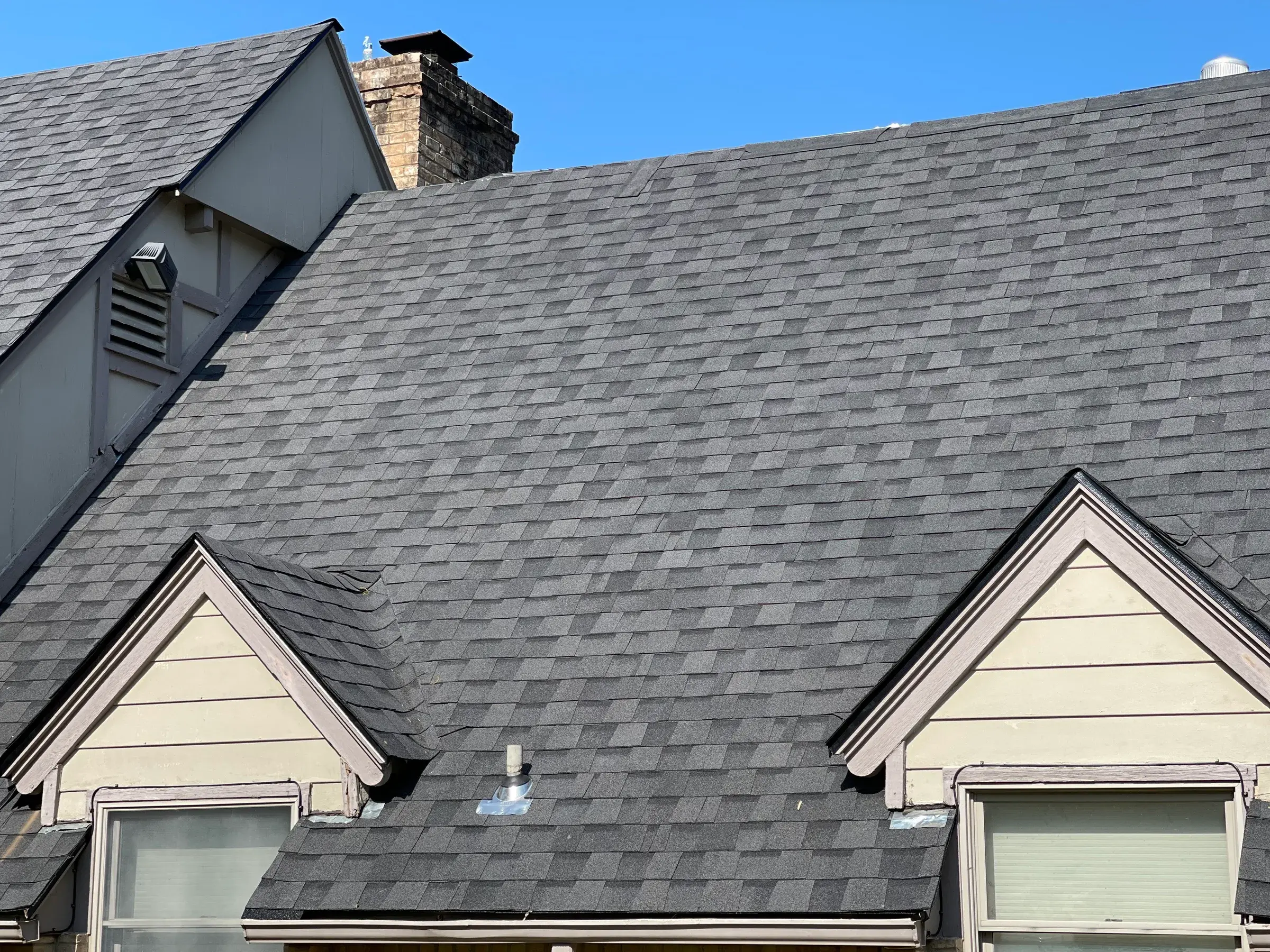
Roof repair cost is driven mostly by mobilization, not material. Getting a crew, ladders, and fall protection to your roof costs the same whether they replace three shingles or thirty, which is why most contractors have a minimum call-out. Diagnosis time, pitch, access, and shingle matching then move the number from there.
Why Repair Pricing Feels Disconnected From the Work
A pipe boot — the rubber or lead collar that seals around a plumbing vent pipe — costs a few dollars at a supply house. The repair costs a great deal more than a few dollars. Homeowners notice that gap and reasonably wonder what they are paying for.
The answer is that you are not buying the boot. You are buying a trained person on a ladder, with fall protection, tools, and the judgment to know why that boot failed and whether anything else on that slope is about to do the same thing. The part is the cheapest thing in the transaction.
This is the opposite of how a roof replacement is priced. A replacement scales with size: more squares, steeper pitch, more tear-off, more decking. Repairs barely scale at all. Three shingles and thirty shingles cost close to the same, because the expensive part happened before anyone touched a shingle. If you want the by-the-square version of the math, that belongs in [roof replacement cost in Oklahoma](/blog/roof-replacement-cost-oklahoma) — this article is about the other kind of number.
Mobilization: The Cost That Exists Before Anyone Touches a Shingle
Mobilization is the trade word for getting everything and everyone to your house, safely, and getting it all home again. It is fixed. It does not care how small your problem is.
A partial list of what happens before the first nail: a truck is loaded and driven to your address; ladders are set and footed; fall protection is rigged; the roof is walked; the work is done; debris is picked up; a magnet is run through the grass for nails; and everything is packed out.
The safety piece is not optional and not padding. OSHA's residential construction standard, 29 CFR 1926.501, requires fall protection for workers exposed to a fall of six feet or more to a lower level. A single-story ranch in Miami with an eight-foot eave clears that line. That means anchors, harnesses, and lifelines get rigged for a fifteen-minute repair exactly the same as for a two-day one. The gear and the time to set it are identical.
The part that is genuinely cheap
Material really is the small line on a repair. The U.S. Bureau of Labor Statistics publishes a Producer Price Index for roofing materials, and it moves — sometimes sharply. On a full replacement, that index matters to your number. On a boot replacement, a swing in shingle pricing is a rounding error against the cost of the ladder being there. We are deliberately not printing an index figure here, because it would be stale by the time you read it. Check the BLS series yourself if you want the current trend.
Minimum Call-Outs and Why They Are Legitimate
Because mobilization is fixed, most roofing contractors set a minimum call-out: a floor price for showing up and doing work, regardless of how little work there is. It is the same logic a plumber or an electrician uses, and it is not a trick.
Here is the thing worth understanding. A minimum is not a penalty for having a small problem — it is a description of what a visit actually costs. If a contractor quotes you a suspiciously low number for a tiny repair, one of a few things is usually true: the diagnosis is not included, the repair is a caulk-and-go that will fail, or they intend to find more work once they are up there.
What you should do with a minimum is use it. If you are paying the floor anyway, get value for it — which is the whole argument for bundling, further down this page.
Diagnosis Time: Finding the Leak Is the Hard Part
Water does not fall straight down through a roof. It enters at a failure, runs along the underside of the decking, follows a rafter, crosses a truss chord, and drips through your ceiling somewhere else entirely. The stain on your drywall tells you almost nothing about where the hole is.
NRCA guidance on leak investigation makes this point plainly: the work is tracing water back to its source, not treating the place where it appears. That tracing is a skill, and it takes time. On a straightforward roof it might take twenty minutes. On a complicated one — multiple planes, a chimney, an addition tied into an original roofline — it can take longer than the repair itself.
This is why an honest repair estimate often cannot be given over the phone. The scope is unknown until the source is found. Anyone who quotes a firm repair price from a photo of your ceiling is guessing, and the guess will be adjusted later. If you are trying to work out how fast you need to move on a leak, [how urgent is a roof leak](/blog/roof-leak-how-urgent-is-it) walks through triage; if you want the source found and photographed with no obligation, our [roof inspections](/services/roof-inspections) are free.
Two Ottawa County wrinkles
Where you are in the county changes what we are looking for. East Ottawa County runs into the Ozark Plains — rockier, wooded, rolling. Those roofs collect tree debris in valleys and behind chimneys, hold shade, and grow moss on north slopes. Debris dams water, and dammed water finds nail holes. West of Miami you are in the Neosho Lowlands: flat, open prairie with a long wind fetch and nothing to slow it down. Those roofs lose shingles at rakes and ridges rather than rotting in the valleys. Same county, different diagnosis.
Pitch, Height, and Access
Three physical facts about your house move a repair price more than the repair itself does.
Pitch is the slope, written as rise over run. A 4:12 roof is walkable. Somewhere around 6:12 most people stop walking comfortably, and the crew starts installing roof jacks and toe boards — temporary planks bolted through the roof — to have somewhere to stand. That is setup time before the work, plus patching the jack holes after.
Height is the second. A two-story or a steep-gabled story-and-a-half means longer ladders, a harder anchor setup, and slower material handling. Access is the third and the one homeowners never think about: if the only place to set a ladder is over a deck rail, a rock bed, a fence line, or a mature shrub, the setup takes longer and sometimes takes two people instead of one.
None of this is negotiable and none of it is the contractor's choice. It is your roof's geometry. But it does explain why the same pipe boot on two houses three streets apart in [Miami](/locations/miami-ok) can price differently.
Matching: Why an Old Shingle Costs More Than a New One
A repair has to blend into a roof that has been weathering for years. That is harder than it sounds, and it is a real cost driver.
Shingle colors are discontinued. Manufacturers change granule blends within the same product name. And your roof has been fading under Oklahoma sun — roughly 62% annual sunshine here, per long-term climate normals — since the day it went on. A brand-new bundle of the identical color code will not match a ten-year-old field. It will be close, or it will not, and finding out which one takes a supply-house trip and a physical comparison on the roof.
Sometimes the fix is to pull matching shingles from a hidden slope — a garage back, a section behind a dormer — and put the new ones there instead, where nobody sees them. That is more labor than just nailing on a new shingle, and it is the right call more often than people expect.
Be wary of any contractor who promises a perfect match sight-unseen. What you want is a contractor who tells you honestly how close it will be before they install it.
| Cost driver | Why it exists | What to ask your contractor |
|---|---|---|
| Mobilization | Truck, crew, ladders, and fall protection required by OSHA 29 CFR 1926.501 above six feet — all fixed regardless of repair size | "Is there a minimum call-out, and what work does it include?" |
| Diagnosis time | Water travels before it drips; the source is rarely above the stain | "Is finding the leak billed separately, or is it part of the repair?" |
| Pitch | Above roughly 6:12, roof jacks and toe boards must be installed before work starts — and patched after | "Does my pitch require staging? Is that in the price?" |
| Height and access | Longer ladders, harder anchoring, and obstructed ladder placement all add setup labor | "Where will you set the ladder, and does anything need moving?" |
| Matching | Discontinued colors, changed granule blends, and years of UV fade mean new shingles rarely match old ones | "Will you show me the match before you install it? Can you pull from a hidden slope?" |
| Unknowns behind the shingles | Rotted decking and failed underlayment are invisible until the roof is opened | "What's the price if you open it and find soft decking? Get that in writing now." |
Repair Categories From Simplest to Most Involved
Not all repairs are the same animal. Here is a rough ladder of complexity, and — more usefully — which ones are a sign that the repair conversation is over.
| Repair type | Complexity | What drives the price | Repairable, or a replacement trigger? |
|---|---|---|---|
| Pipe boot (collar around a plumbing vent) | Low | Almost entirely mobilization; the part is a few dollars | Almost always repairable. If every boot on the roof is cracked, they aged together and the shingles are the same age. |
| A few blown or creased shingles | Low | Mobilization plus matching | Repairable. But creasing across the whole windward slope means the seal strips let go generally — that's a replacement conversation. |
| Step flashing at a wall | Medium | Shingles must come off in sequence and siding often has to be lifted to get at it | Repairable, but not without disturbing the courses above. Rarely a true spot fix. |
| Valley (where two roof planes meet) | Medium to high | Two planes of shingles, a water-critical detail, and twice the matching problem | Repairable. If the valley is failing from age rather than damage, the rest of the roof is the same age. |
| Small deck section (rotted sheathing under the shingles) | High | Diagnosis, tear-back to sound wood, and an extent nobody knows until it's opened | Repairable if isolated. If the rot follows a chronic leak across the plane, you're past repair. |
Flashing deserves a note of its own, because it is the single most misdiagnosed item on this list. Step flashing is the L-shaped metal that ties a roof into a wall, installed one piece per shingle course. It is woven into the roof, not laid on top of it, which is why it cannot be fixed with a tube of sealant — and why people keep trying. If your leak is at a wall, a chimney, or a skylight, read [roof flashing problems explained](/blog/roof-flashing-problems-explained) before you accept a caulk repair.
Bundling: Why Fixing Three Things at Once Costs Less Than Three Visits
This follows directly from everything above. If mobilization is the fixed cost, then three separate visits mean paying the fixed cost three times. One visit that handles three items pays it once.
So the practical move is: when someone is already up there, get the whole roof looked at. Not so a salesman can pad the ticket — so the two boots that are two years from failing get done now rather than in a separate call-out next spring, at another full minimum.
There is a local reason this matters more here than in a mild climate. The Oklahoma Climatological Survey's long-term normals for this area show about 89 nights a year below freezing and four to five days a year with hail larger than three-quarters of an inch. Freeze-thaw works on every small opening in your roof, all winter, every winter. A marginal detail does not stay marginal in Ottawa County. It gets worked on.
When a Repair Isn't Worth Doing
A repair is worth doing when the problem is local and the rest of the roof has real life left. It stops being worth doing when you are spending mobilization money over and over on a roof that is failing generally.
Signals that you are past repair: the same slope leaks in a new place each season; granules are gone across whole planes, not just in the gutter; shingles are brittle enough to crack when lifted rather than flex; creasing shows up across an entire windward face; or matching has become impossible because the product is long discontinued. Any one of those, on its own, is not a verdict. Three of them together usually is.
One planning note if you do cross that line. Oklahoma amended IRC section R908.3.1.1 to require a full tear-off, rather than shingling over the existing roof, in defined conditions — so "just add a layer" is not always on the table here even where it might be elsewhere. And the City of Miami requires a permit for new roofs and re-shingles; we pull it. Ask any contractor whether your scope crosses into permit territory, and ask before the work, not after.
For the full decision framework, [roof repair vs. replacement in Oklahoma](/blog/roof-repair-vs-replacement-oklahoma) is the deeper version of this section, and our [roof replacement](/services/roof-replacement) page covers what that scope involves.
Repairs and Insurance: Why Small Repairs Usually Aren't a Claim
Most single-item roof repairs never touch insurance, and the reason is arithmetic you can do at your own kitchen table.
What we can do is narrower, and we want to be exact about it. We document what we find with a photo report. We provide a written estimate for the work we would perform. If you ask us to, we can meet your adjuster on site and show them what we saw. We will help you understand how the process runs. We do not file, handle, or negotiate claims — under Oklahoma law that is public adjusting, and it requires a license we do not hold. If that boundary is useful to see spelled out, it is on our [insurance claim assistance](/services/insurance-claim-assistance) page.
What Should Be in a Written Repair Estimate
A repair estimate is a small document, which is exactly why so many of them are bad. A verbal number and a handshake is not an estimate. Here is what should be on the paper before you agree to anything.
Your written repair estimate should contain all of this
- The contractor's Oklahoma roofing contractor registration number — 59 O.S. § 1151.17(C) requires it, and you can verify it yourself for free at verifyroofing.cib.ok.gov
- The specific defect identified, described in words, not just "repair roof"
- Photos of the actual failure on your actual roof — not stock images, not a generic example
- Exactly what will be replaced or reworked, item by item, with quantities
- Whether diagnosis time is included in the price or billed separately
- What happens if rotted decking is found once the roof is opened, and at what price
- How matching will be handled, and whether shingles will be pulled from a hidden slope
- Whether a permit is required for the scope, and who is pulling it
- Cleanup, including a magnet sweep for nails
- Total price, with the payment terms and the cancellation rights required under 59 O.S. § 1151.21
- A start window and an approximate duration
One more verification step that costs you nothing and takes about a minute. The Oklahoma Construction Industries Board runs a public lookup at verifyroofing.cib.ok.gov. You type in a company and it tells you whether they are registered. Registration in Oklahoma requires liability insurance of at least $500,000 for residential work — so a valid registration is not a quality rating, but the absence of one tells you something real. Almost nobody in this market explains that tool exists. Use it on us, and use it on the next three trucks that knock on your door after a hailstorm.
If you have a specific problem — a boot, a wall detail, a few shingles off the ridge — we will come look at it, photograph what we find, and put a written number on paper for you. The inspection and the quote are free. That is our [roof repair](/services/roof-repair) work, and it is the same process whether the answer turns out to be a two-hour fix or a conversation about the whole roof.
Questions people ask about this
Why does a contractor charge so much to replace one pipe boot?
Because you are not paying for the boot, which costs a few dollars. You are paying for mobilization — the truck, the crew, the ladders, and the fall protection that OSHA's residential standard (29 CFR 1926.501) requires above six feet. That cost is identical whether the crew replaces one boot or ten, which is why most contractors set a minimum call-out. The most economical thing you can do with a minimum is bundle other small items into the same visit.
Can you give me a repair price over the phone?
Usually not an honest one. On a leak, the scope isn't known until the source is found, and water travels along decking and rafters before it drips — the stain on your ceiling is rarely under the hole. Anyone who quotes a firm repair price from a photo of your ceiling is guessing and will revise it later. We inspect for free, photograph what we find, and then put a written number on paper.
Should I file an insurance claim for a small roof repair?
That's a decision only you can make, using your own policy — and we're not permitted to make it for you. Pull your declarations page and find your wind and hail deductible; many Oklahoma policies use a percentage of dwelling value rather than a flat amount, so it may be larger than you expect. If the repair costs at or below that number, a claim would pay nothing. The Oklahoma Insurance Department publishes consumer guidance and answers policyholder questions directly.
A contractor offered to cover my deductible. Is that a good deal?
It's an unlawful one. Under 59 O.S. § 1151.30, an Oklahoma roofing contractor may not advertise or promise to pay, waive, rebate, or offset any part of your deductible, or offer you anything of value in exchange for a service — including yard-sign or referral credits on insurance work. The provision was amended effective November 1, 2025 by HB 1257, and violations carry a misdemeanor and fines of up to $500 per violation. Treat the offer as a warning about everything else that contractor will tell you.
Will my repair match the rest of my roof?
Close, often. Perfect, rarely. Shingle colors get discontinued, manufacturers change granule blends within the same product name, and your roof has been fading under roughly 62% annual sunshine since it went on — a new bundle of the identical color code won't match a ten-year-old field. Sometimes the better answer is pulling matching shingles from a hidden slope, like a garage back, and putting the new ones there. Ask to see the match before it's installed.