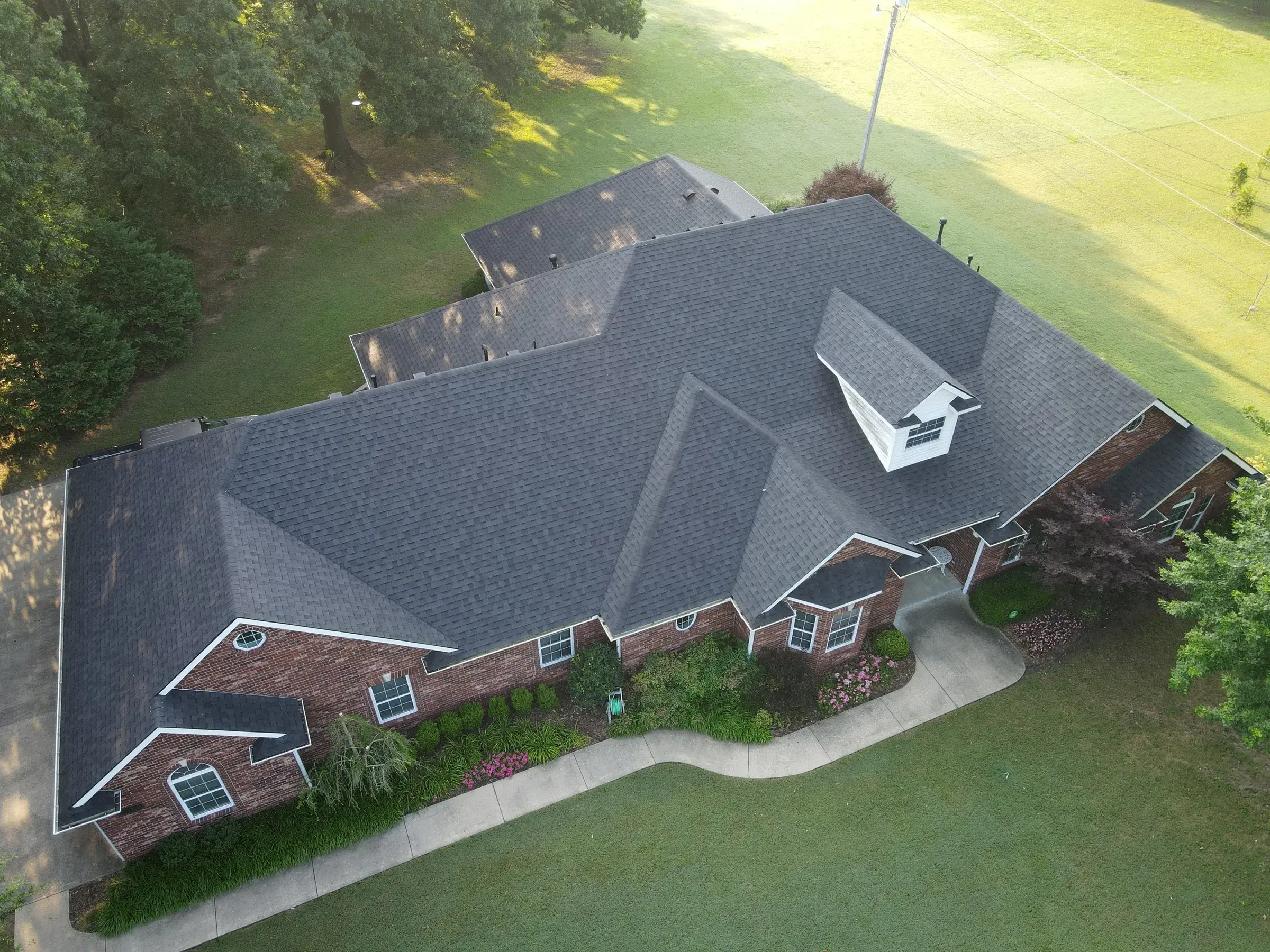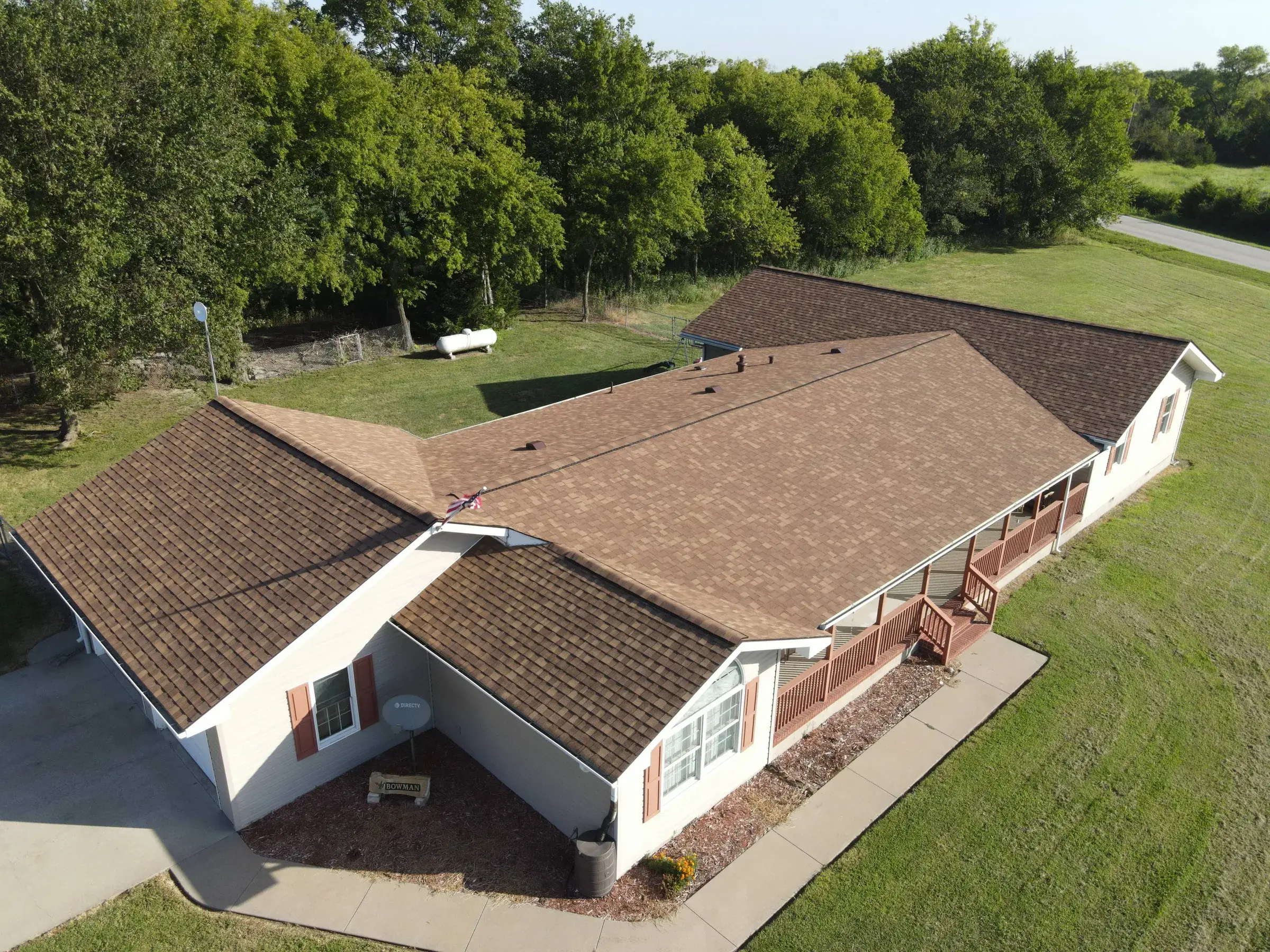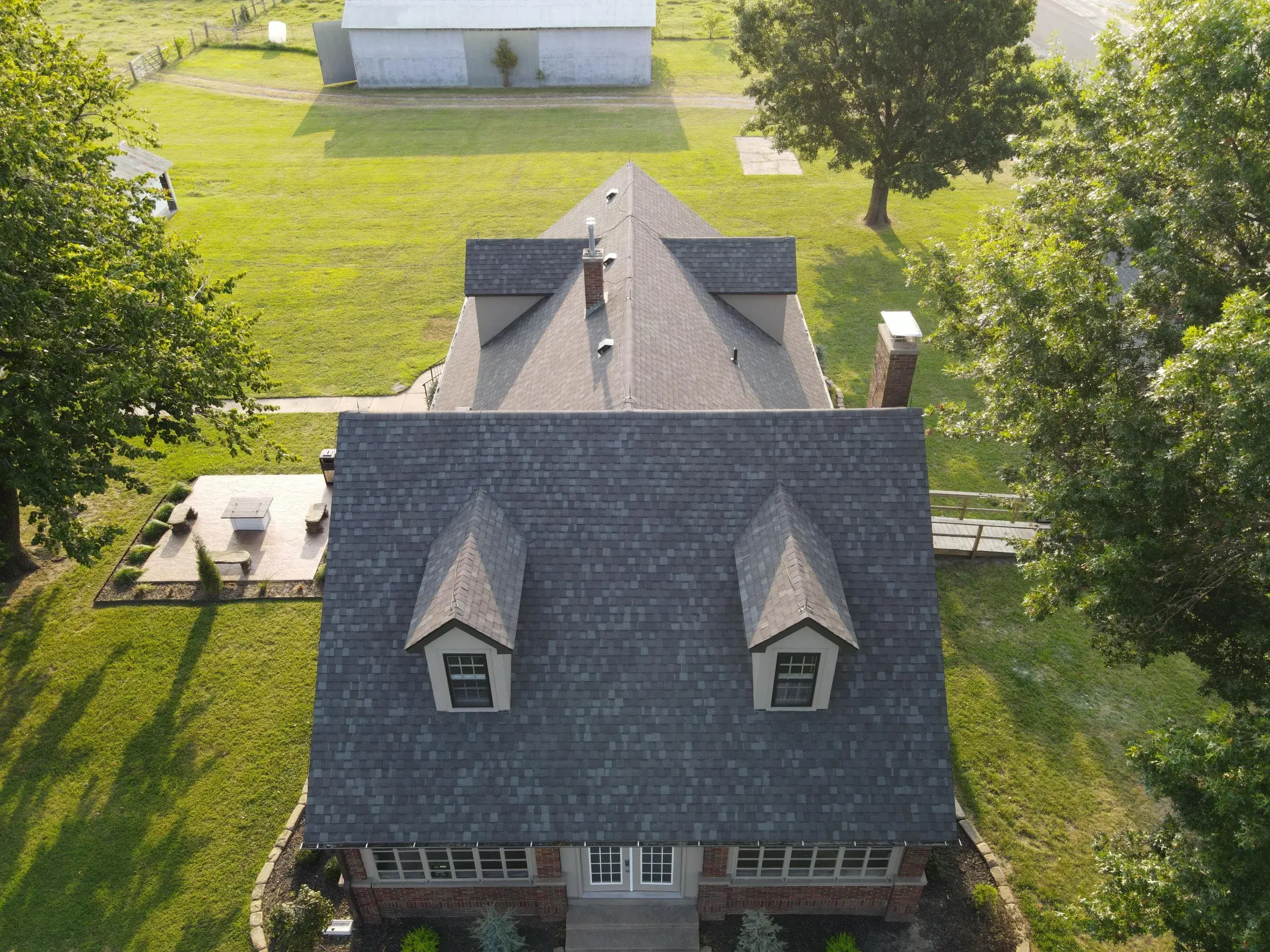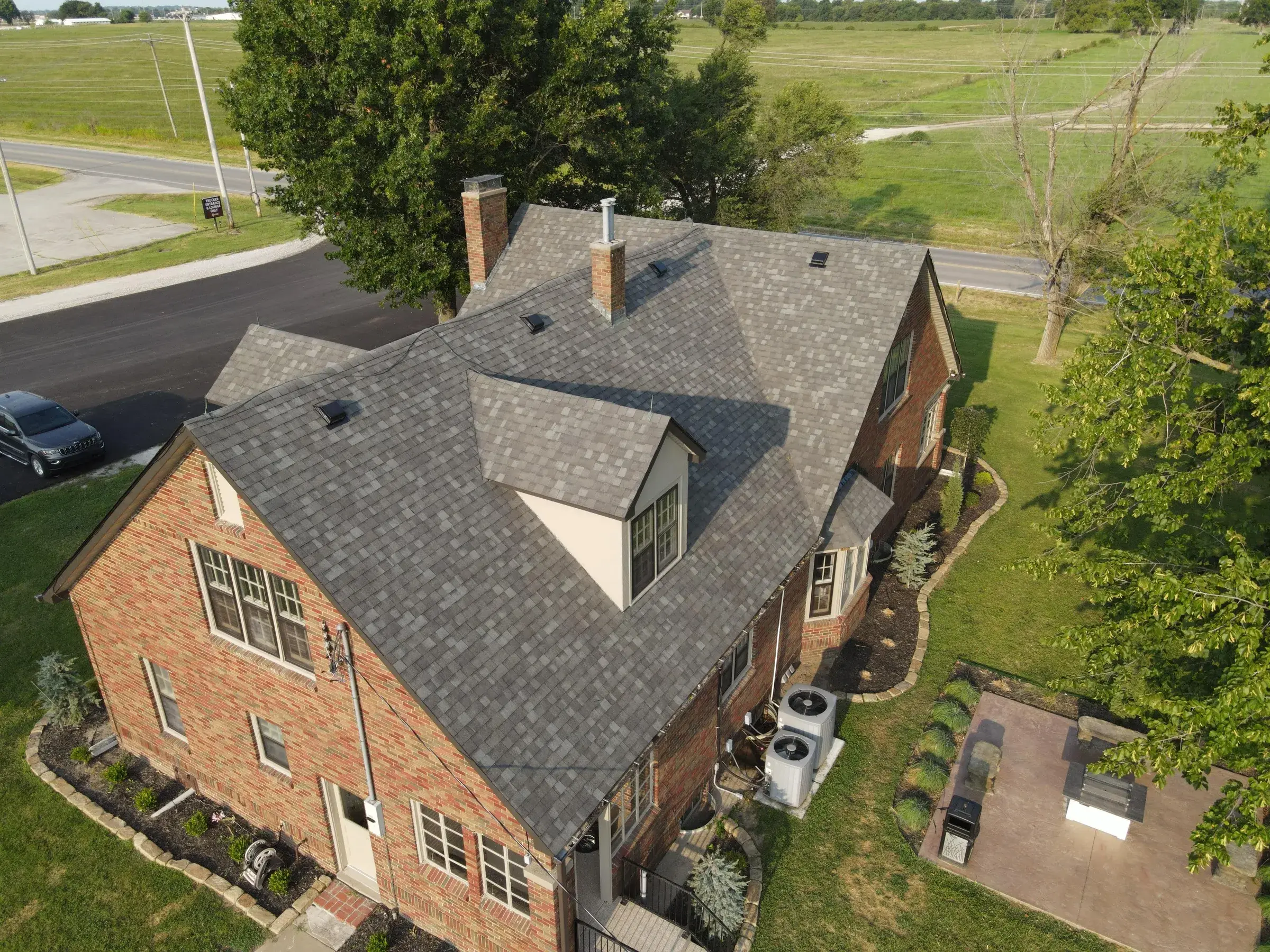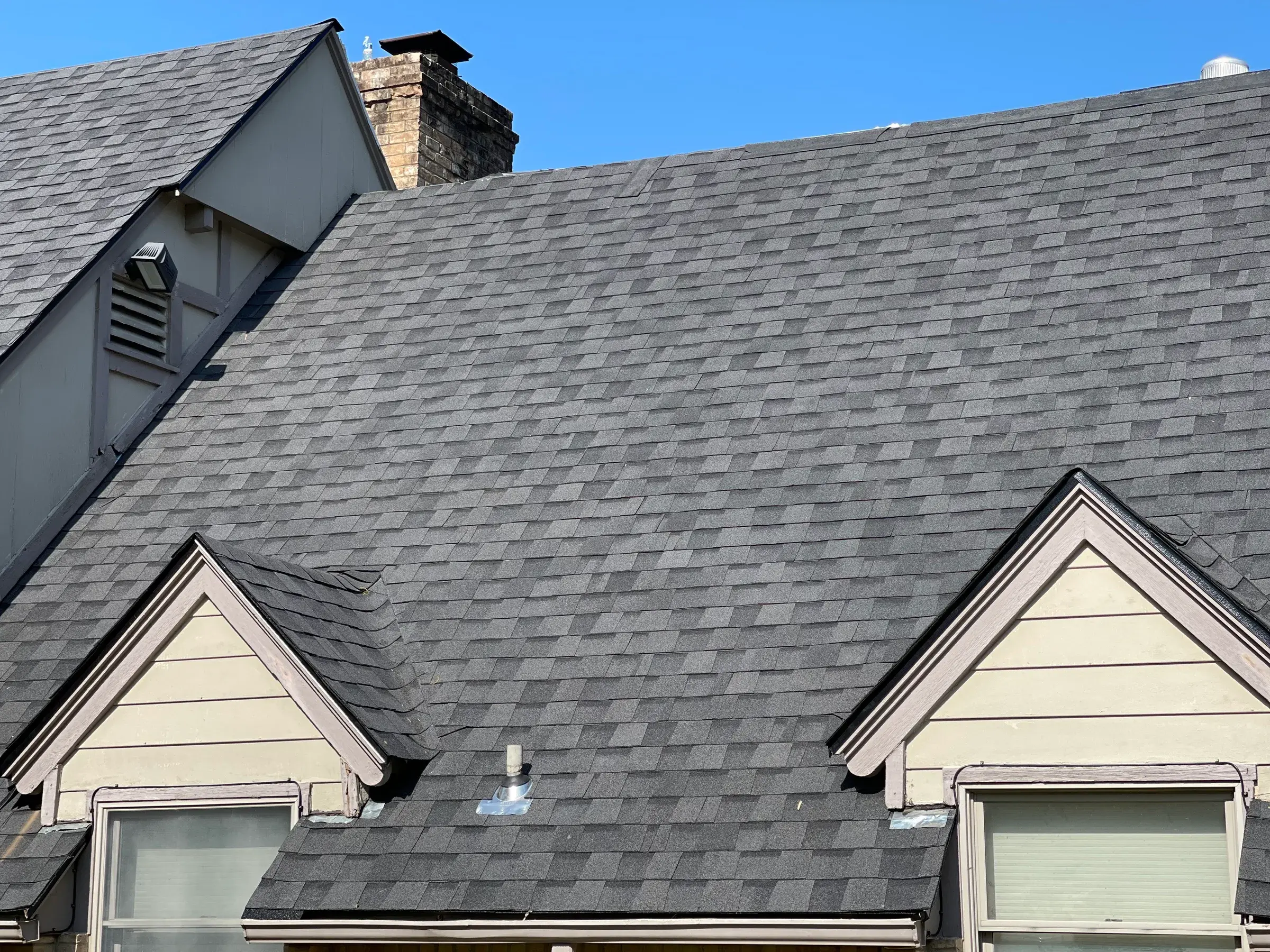
Underlayment is the secondary water barrier installed over the roof deck and beneath the covering. Asphalt-saturated felt (15# or 30#) is the traditional option; synthetic sheets are lighter, stronger in tear resistance, and tolerate longer UV exposure. Both are code-required on most roofs. The upgrade matters most where wind lifts shingles or water backs up.
What underlayment is actually for: the secondary water barrier concept
Your shingles are the roof. Underlayment is the layer underneath them, and its job description is narrow: catch the water that gets past the covering and route it back out to the eave. The Asphalt Roofing Manufacturers Association, in its technical guidance on underlayments, describes it as a secondary water barrier. Secondary is the operative word. It was never designed to be the roof. It was designed to buy the deck time.
Time for what, exactly? For the hour after a gust folds back a tab. For the afternoon a shingle is gone and nobody is home. For the night water backs up a valley and runs uphill under the courses. Northeast Oklahoma hands underlayment plenty of chances to do that job. The Oklahoma Climatological Survey counts four to five days a year in this part of the state with hail larger than three-quarters of an inch, and hail rarely shows up without the wind that comes with it.
Here is the part most homeowners never hear: you cannot see your underlayment. A roof inspection reads the covering — granule loss, bruising, lifted tabs, failed seal strips — and reads the symptoms from inside the attic. The layer beneath the shingles stays invisible until a tear-off. Which means the only day you get to choose it is the day you are buying a roof replacement or a new roof installation, on a page of a proposal you probably skimmed.
Asphalt-saturated felt: 15# vs. 30#, weight, and how it behaves when wet
Felt is an organic mat — traditionally cellulose — saturated with asphalt. It is the oldest option still in wide use, and it works. Two ASTM standards govern it, and they are not the same standard.
ASTM D226 covers asphalt-saturated organic felt used in roofing and waterproofing. It defines Type I, known in the trade as No. 15, and Type II, No. 30. ASTM D4869 covers asphalt-saturated organic felt underlayment made specifically for steep-slope roofing, defines four types, and adds a liquid-water-transmission requirement that D226 does not have. The two standards do not require the same mass. That is why two rolls both labeled "15-pound" can feel meaningfully different in your hands.
Behavior matters more than the number. Felt takes on water. Get it wet before the shingles go on and it swells, wrinkles, and telegraphs those wrinkles up through the finished courses as ripples you will see from the driveway for the rest of the roof's life. Leave it in the sun and it dries out and turns brittle. And at the fastener it tears — an asphalt-soaked organic mat has no reinforcing scrim holding it together, so under wind load a nail head becomes a slot, and the slot becomes a flag of loose felt.
No. 30 felt is heavier, stiffer, and more forgiving of all three problems than No. 15. It is also still felt. If you are comparing a No. 15 quote against a No. 30 quote, the upgrade is real but modest, and it does not change the failure mode — only how long it takes to arrive.
Synthetic underlayment: polypropylene/polyethylene sheets, tear strength, and walkability
Synthetics are woven or spunbond polypropylene or polyethylene, usually with a coating. ASTM D8257 is the specification covering mechanically attached polymeric roof underlayment for steep-slope roofing. If a quote says "synthetic" and names no standard, D8257 is the question to ask. The category is not tightly policed, and there are thin sheets on the market that meet nothing in particular.
The differences you can feel: a roll weighs a fraction of felt per square and covers far more area, which means fewer laps across the deck. It does not absorb water, so it does not wrinkle when the dry-in gets rained on. The woven scrim gives it tear resistance felt cannot match — the practical version of that sentence is that nails do not pull through as readily under uplift. And most synthetics have a surface texture engineered to be walked on. Felt gets slick when it is damp or dusty. On a 6:12 in July, that difference is not academic.
What synthetic does not do: it does not prevent leaks. It is still a secondary barrier sitting under a covering that does the real work. It is not a waterproofing membrane, and no field underlayment substitutes for flashing that is detailed correctly. Anyone selling you synthetic as leak protection is selling the wrong thing for the wrong reason.
Self-adhered vs. mechanically fastened: where each belongs
There is a third category. A self-adhered sheet — polymer-modified bitumen with an adhesive back, covered by ASTM D1970 — has one property the other two lack: it seals around the fastener that goes through it. Drive a nail through mechanically fastened felt or synthetic and you have a hole with a nail in it. Drive it through a D1970 membrane and the compound closes around the shank.
That property is why self-adhered material belongs where water is likely to stand, back up, or get pushed uphill: eaves, valleys, around penetrations, at low-slope transitions, and where a roof plane dies into a wall. It is also why it is usually not a whole-roof answer. It costs the most per square, it is impermeable, and running it across an entire deck raises the drying question we get to two sections from here. Where a self-adhered ice barrier earns its place on a northeast Oklahoma roof, and how far up the slope it needs to run, is a separate conversation from the field underlayment covered here.
| Product | Nominal weight per square | Tear strength | UV exposure limit | Permeability | Relative material cost |
|---|---|---|---|---|---|
| 15# felt (ASTM D226 Type I / D4869 Type I) | Named for roughly 15 lb per square; actual roll mass depends on which standard it meets — read the label | Lowest. No reinforcing scrim; tears at nail heads under wind | Shortest of the four. Varies by product — the data sheet governs | Vapor-permeable, but absorbs liquid water and wrinkles | Lowest |
| 30# felt (ASTM D226 Type II) | Roughly double No. 15; again, label over name | Better than No. 15, same failure mode | Short. Varies by product — check the data sheet | Permeable; absorbs less than No. 15, still buckles when wet | Low |
| Synthetic (ASTM D8257) | A fraction of felt per square; one roll covers several squares | Highest of the mechanically fastened options; the scrim resists nail pull-through | Longest published windows of the three fastened types; published per product — check the data sheet | Varies by design, from near-impermeable to engineered breathable. Stated in perms on the data sheet | Higher per square, but a small share of total job cost |
| Self-adhered (ASTM D1970) | Heaviest per square | High — but the property that matters is self-sealing around fasteners | Varies widely by product; some of the shortest windows in the category. Data sheet governs | Impermeable by design — a vapor barrier. Placement matters | Highest |
UV exposure limits: how long each product can sit exposed before it's compromised
Every underlayment carries a published limit on how long it may be left exposed to sunlight before the covering goes on. There is no universal number. It varies by product, and it is printed on that product's data sheet. What is consistent is the ordering: felt's window is measured in a small number of days, while many synthetics publish windows measured in months. Ranges belong to products, not to categories, so ask for the sheet.
This matters more here than the generic language on a data sheet suggests. The Oklahoma Climatological Survey's 1991–2020 normals put Miami at 57 days a year above 90°F, with an August daily maximum normal of 91.5°F, under roughly 62% of possible annual sunshine. Deck surface temperature runs far above air temperature. A felt dry-in that sits through a July week in Ottawa County is not the same event as a felt dry-in that sits through a July week in Michigan.
Failure looks like this: the asphalt's volatile fraction bakes off, the mat dries and shrinks, the sheet curls at the laps and splits at the fasteners. The clock starts the day it is installed, not the day someone notices. If your job could pause between tear-off and shingles — a material delay, a weather window, a busy stretch after a hail event — the underlayment on your deck is what pays for that delay. Ask what the plan is if the roof has to sit.
Code minimums vs. good practice: what's required and what's worth upgrading
Underlayment is not optional. The residential code requires it under asphalt shingles, and the application rule in the steep-slope roofing chapter — Section R905.1.1, with the shingle-specific provisions in R905.2 — sets the layer count by slope: one layer at 4:12 and steeper, two lapped layers on shallower slopes down to the 2:12 minimum for shingles. Oklahoma is in the middle of moving to a newer code edition, so confirm the section numbers against the edition in force the day your permit is issued, and treat the current Oklahoma residential code as the authority rather than any article, including this one.
Two Oklahoma-specific facts are worth carrying into a quote conversation. First, Oklahoma amended the code's re-covering provision, IRC R908.3.1.1, to require tear-off rather than shingling over the existing roof under defined conditions. Second, the City of Miami requires a permit for a new roof and for a re-shingle. We pull it.
Good practice runs past the minimum. The NRCA Roofing Manual: Steep-Slope Roof Systems recommends enhanced underlayment treatment in conditions where a code minimum leaves the assembly thin — shallow slopes, valleys, long eaves, details where water backs up. Ottawa County gives you both arguments at once. The east half is Ozark Plains: rockier, wooded, shaded roofs that hold damp and debris longer. The west half is Neosho Lowlands — flat, open, with a long wind fetch and nothing to slow it down. Same county, two different reasons to spend more on the layer nobody sees.
How the layers stack at the eave, deck up
- Roof deck — clean, dry, fully fastened, with any soft or delaminated sheathing replaced before anything covers it.
- Eave drip edge — fastened directly to the deck. The code specifies it extend at least 1/4 inch below the sheathing, at least 2 inches back onto the deck, and be fastened at not more than 12 inches on center.
- Self-adhered ice barrier, if the roof is getting one — laid over the eave drip edge flange and running up the slope from the eave.
- Field underlayment — lapped over the top edge of the ice barrier, shingle-fashion, so water always runs onto the next layer down and never behind it.
- Rake drip edge — this one goes over the underlayment, not under it. Eaves and rakes are opposite on purpose: at the eave, water traveling on top of the underlayment has to reach the metal and drop into the gutter; at the rake, wind-driven water on the metal has to be shed onto the underlayment.
- Starter course — a continuous strip with a factory sealant line along the eave edge, bonding the first course down against uplift.
- First full shingle course, with its joints offset from the starter's.
The permeability question and why it matters over an unvented assembly
Permeance is how readily water vapor passes through a sheet, measured in perms. Felt is vapor-permeable — that is the one thing it is quietly good at. Synthetics run the whole range: many are near-impermeable, some are engineered breathable and publish a perm rating. Self-adhered membrane is a vapor barrier, full stop.
Over a normal vented attic — which describes most of the detached single-family houses around Miami, and the Census Bureau's American Community Survey puts detached single-family at 76.7% of Ottawa County's 13,701 housing units — this is mostly a non-issue. Air comes in at the soffit intake and leaves at the ridge, and the deck dries downward into the attic. The underlayment's perm rating is not carrying the assembly.
The problem shows up over an unvented assembly: spray foam applied to the underside of the deck, a cathedral ceiling with no vent channel, a converted room over a garage, a lake-house sunroom that got finished without a vent path. Now there is a vapor retarder below the deck. Put an impermeable sheet above it and the sheathing cannot dry in either direction. It is sandwiched, and it will tell you about it eventually.
Northeast Oklahoma drives vapor hard in both directions across a single year — the Oklahoma Climatological Survey's normals give Miami 89 nights a year below freezing alongside those 57 days above 90°F. If any part of your roof is unvented, that is a specific question to raise before the underlayment is chosen, not after. NRCA's steep-slope guidance treats it as an assembly decision, not a product decision, and that is the right way to think about it.
Fastening: cap nails vs. staples and what the manufacturer's instructions require
This is where a good product gets installed badly. A staple's crown is narrow. It holds the sheet at two small points, and the sheet tears between them. A cap fastener — a nail or staple driven through a roughly one-inch plastic or metal disc — spreads the load across the cap and resists pull-through. On a windy dry-in, that is the whole ballgame. On the open west side of the county, with nothing between a section of field and your roof, it is the difference between a roof that is dried in on Friday and a deck full of shredded plastic on Monday.
The code requires roof coverings to be installed according to the manufacturer's printed installation instructions. That sentence has teeth: it makes the paper inside the roll enforceable. Most synthetic manufacturers require cap fasteners and expressly disallow staples. Those same instructions set the pattern — commonly tighter spacing at the laps and wider spacing in the field, with a tighter pattern still in high-wind conditions — and the printed numbers on your roll override any generic figure you read anywhere else, this article included.
| Fastener or detail | Where it's used | How it behaves | What instructions typically require |
|---|---|---|---|
| Plastic cap nail | The default for synthetic; widely accepted for felt | The roughly 1 in. cap spreads load and resists tearing at the head | Named as the required or preferred fastener by most synthetic manufacturers |
| Metal cap nail | Synthetic and felt; often specified where fire or wind provisions call for it | Same load-spreading as plastic; the cap itself does not degrade in UV | Accepted alongside plastic caps on most products — check the sheet |
| Narrow-crown staple | Legacy felt practice; still turns up on bids | Two small bearing points; the sheet tears crown-to-crown under uplift | Commonly disallowed on synthetics, and using them can put you outside the product's stated terms |
| Smooth-shank roofing nail, no cap | Occasionally used on felt | The head is small enough to pull through hot or wet felt | Rarely the specified underlayment fastener on its own |
| Spacing | All mechanically fastened types | Sparse fastening at the laps is the most common field error | A tighter row at laps, wider in the field, tighter again in high-wind conditions — the printed pattern governs |
Reading a quote: what a properly specified underlayment line item looks like
Two quotes, one roof. One says "15# felt." The other says "synthetic underlayment." Neither has told you enough to compare them. That is the real trouble with underlayment line items — not that one is worse than the other, but that both are vague enough to mean almost anything, including the cheapest thing on the truck that morning.
A properly specified line names the product category, the standard it meets, the layer count and the slope that drives it, the fastener, and the laps. It should also line up with the shingle manufacturer's instructions, since many of them limit which underlayments are acceptable under their asphalt shingles. A mismatch there is a real problem later, and it is a cheap thing to check now.
What your underlayment line item should state
- Product category, spelled out: asphalt-saturated felt, synthetic, or self-adhered — not just "underlayment included."
- The ASTM standard the product meets: D226 or D4869 for felt, D8257 for synthetic, D1970 for self-adhered.
- For felt, the type as well as the pound name: Type I (No. 15) or Type II (No. 30).
- Number of layers and the slope it's based on — one layer at 4:12 and steeper, two below that.
- Head lap and end lap, in inches.
- Fastener type — plastic or metal cap, not staples — plus spacing at the laps and in the field.
- Where self-adhered membrane goes (eaves, valleys, penetrations, low-slope transitions, wall lines) and how far up the slope, in inches.
- Drip edge: material and profile, and which side of the underlayment it lands on at eaves versus rakes.
- Starter course: a manufactured starter strip or field-cut shingles — state which.
- Deck repair: the per-sheet price for replacing bad sheathing, and who decides it's bad.
- The permit: that the contractor pulls the City of Miami permit for the new roof or re-shingle.
- The contractor's Oklahoma Construction Industries Board registration number, so you can check it yourself.
That last line takes about thirty seconds to act on. The Oklahoma Construction Industries Board publishes a public lookup at verifyroofing.cib.ok.gov, and registration for residential roofing work requires liability insurance of at least $500,000. Worth knowing: Oklahoma issues registrations, not licenses. A roofer who tells you they are "licensed and bonded" in this state is using words the state does not use, which tells you something before you get to the underlayment line.
If you are holding two quotes and the underlayment lines don't match, you don't need a third opinion to break the tie — you need each contractor to write down the standard, the fastener and the laps, and then the comparison makes itself. If you'd rather have someone look at the roof first, our inspections and written estimates are free, the estimate names the underlayment by category and standard, and you can reach us at (209) 758-8550.
Questions people ask about this
Is synthetic underlayment worth paying more for than felt?
On most tear-offs, the material cost difference is a small share of the total job, and you get real advantages: far better tear resistance at the fasteners, no wrinkling if the dry-in gets rained on, and a much longer published UV exposure window. It is not magic, though. Synthetic does not prevent leaks and does not make a badly flashed roof watertight. Think of it as a better version of the same secondary barrier, not a different category of protection.
My quote says "30# felt." Is that as good as synthetic?
No. 30 felt is a genuine step up from No. 15 — heavier, stiffer, more forgiving when it gets wet — but it is still an asphalt-saturated organic mat with no reinforcing scrim, so it still tears at nail heads under wind and still has a short exposure window. A No. 30 felt roof installed correctly with cap fasteners and proper laps will outperform a synthetic roof stapled on sloppily. The install detail matters as much as the product line.
How long can my roof sit with just underlayment on it before shingles go on?
That depends entirely on the product, and the number is printed on the manufacturer's data sheet rather than set by any general rule. Felt windows are measured in days; many synthetics publish windows measured in months. What matters locally is that the Oklahoma Climatological Survey puts Miami at 57 days a year above 90°F under roughly 62% of possible sunshine, and deck surfaces run far hotter than air. If there is any chance your job pauses between tear-off and shingles, ask which product is going down and what its published limit is.
Does Oklahoma code require synthetic underlayment?
No. The residential code requires underlayment under asphalt shingles and sets the layer count by slope — one layer at 4:12 and steeper, two on shallower slopes down to the 2:12 minimum — but it does not mandate synthetic over felt. Oklahoma did amend the re-covering provision, IRC R908.3.1.1, to require tear-off rather than shingling over an existing roof under defined conditions, which is what actually determines whether you get new underlayment at all. Confirm section numbers against the code edition in force when your permit is issued.
Can the crew use staples instead of cap nails?
The roll's printed installation instructions decide that, and the code makes those instructions enforceable by requiring roof coverings to be installed according to them. Most synthetic manufacturers require plastic or metal cap fasteners and expressly disallow staples, because a narrow staple crown holds the sheet at two small points and the sheet tears between them under uplift. If a quote does not name the fastener, ask for it in writing before you sign.