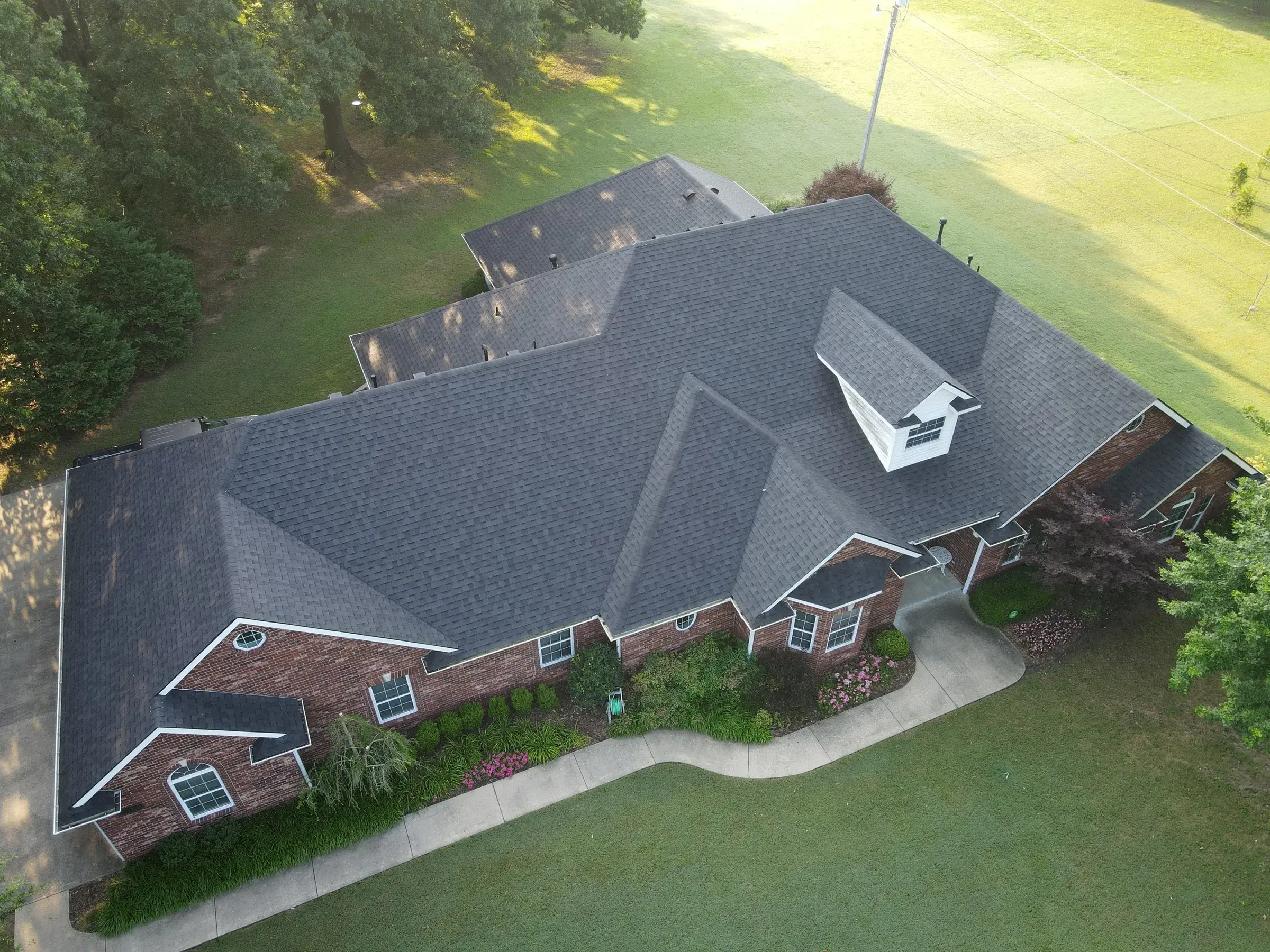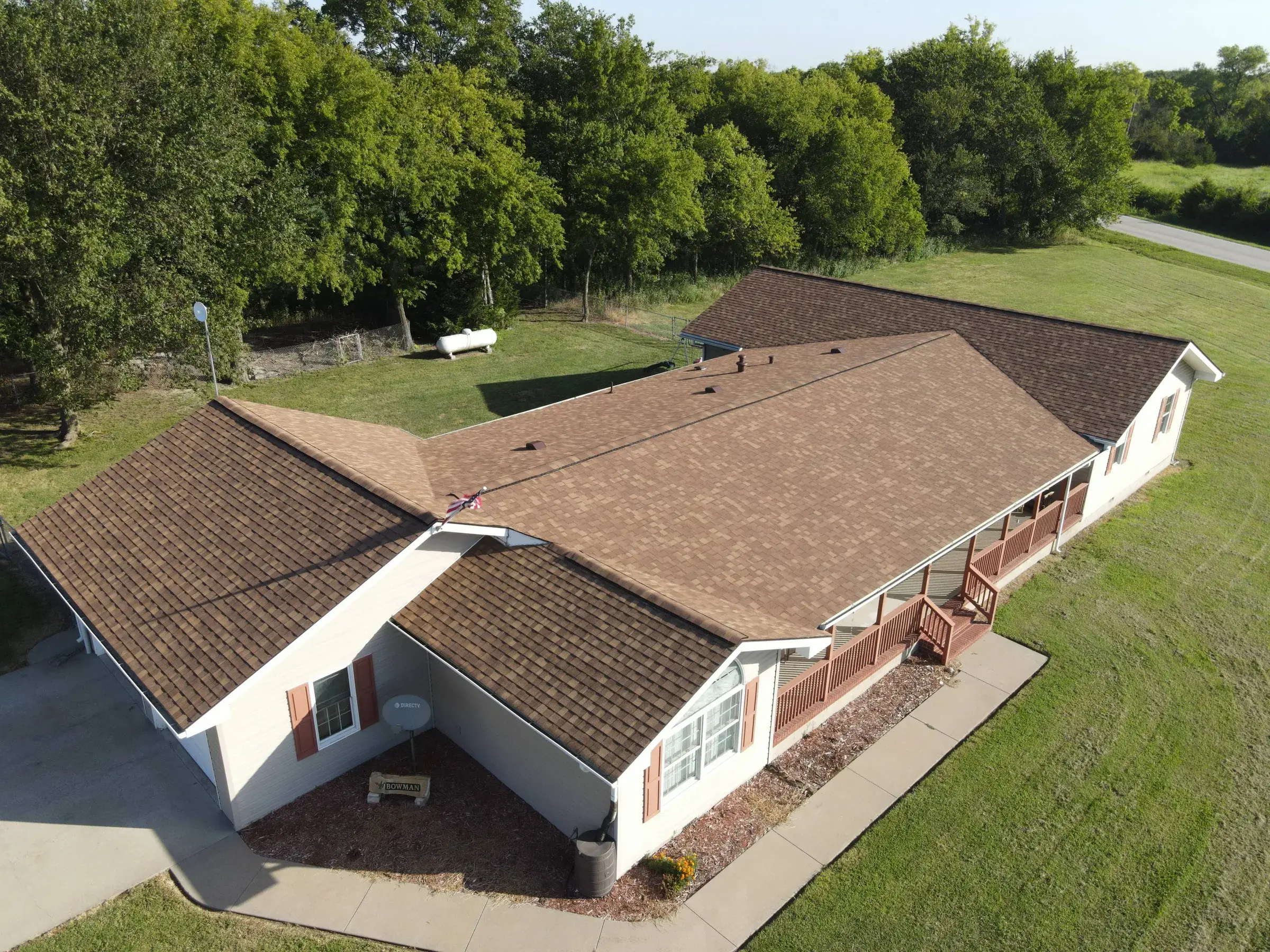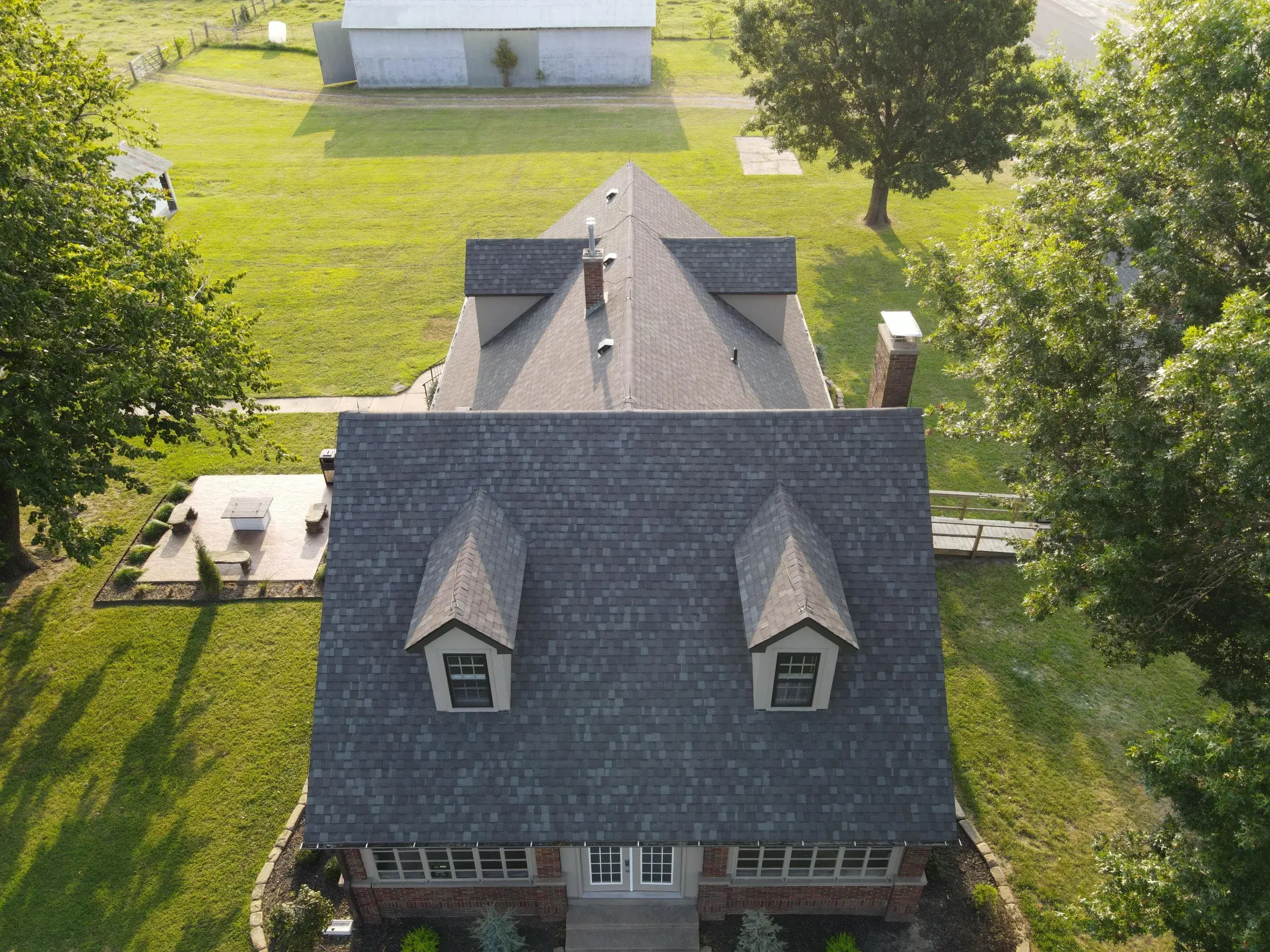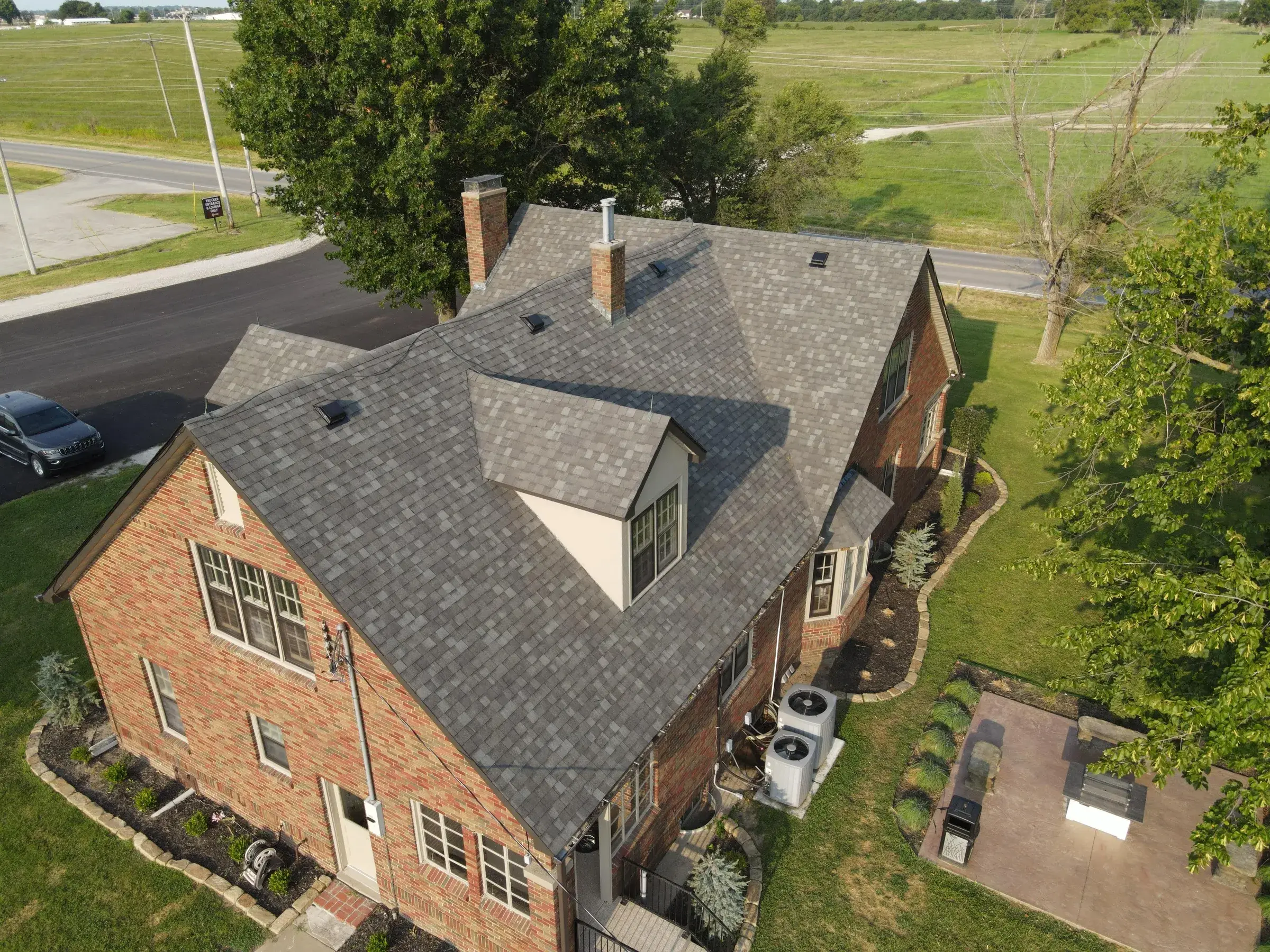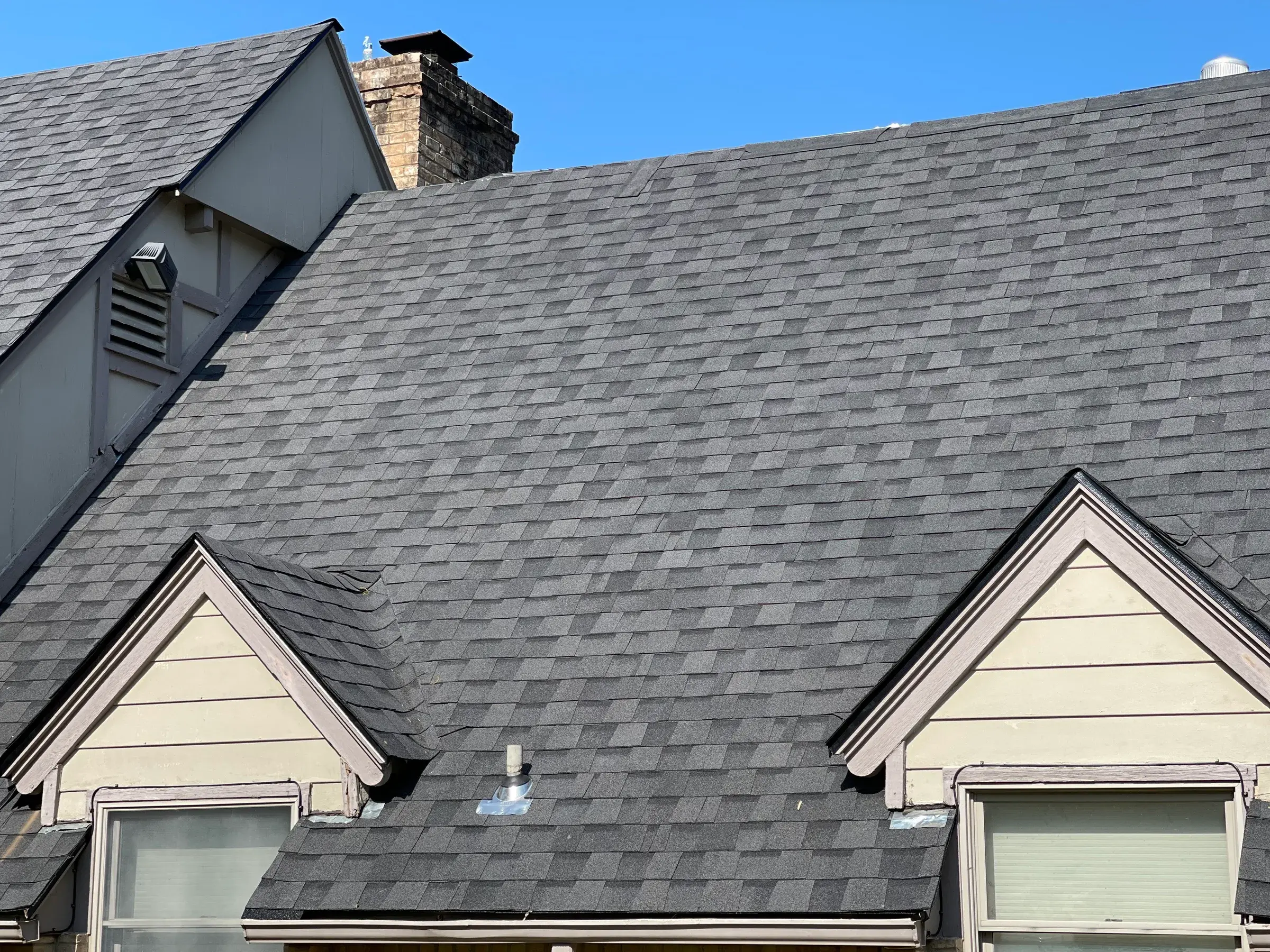
Granules are the shingle's UV armor. Some loss is normal — new roofs shed loose granules for months, and gutters catch them. Trouble looks different: scattered dark circular spots suggest hail bruising, uniform thinning across sun-exposed slopes suggests end-of-life wear, and pin-sized craters suggest blistering. Location and pattern tell you which.
What Granules Actually Do (Hint: It's Not Color)
The granules on your shingles are crushed rock with a ceramic coating fired onto them. During manufacturing they get pressed into a layer of hot asphalt while it's still soft, and they stay there because the asphalt cools around them. They are not paint. They are not a finish. They are a mineral shield.
The Asphalt Roofing Manufacturers Association (ARMA) describes that granule surfacing as the shingle's primary protection against ultraviolet light. Asphalt is an oil-based material, and UV breaks it down. Left bare in the sun, asphalt loses its lighter oils, hardens, shrinks and cracks. The granules absorb and block that UV so the asphalt underneath stays in the shade. They also add fire resistance and take the abrasion from rain, wind-blown grit and foot traffic. Color is the leftover benefit, not the reason they exist.
Here's what's stacked under your feet on a standard fiberglass-mat architectural shingle, top to bottom.
| Layer | What it is | Its job | What happens when granules go |
|---|---|---|---|
| Granules | Ceramic-coated crushed rock, embedded in hot asphalt at the factory | Blocks UV, adds fire resistance, takes abrasion | Nothing above the asphalt to stop sunlight |
| Top asphalt coating | Weathering-grade asphalt | Waterproofs the shingle and holds the granules | Oxidizes, hardens, crazes into fine cracks |
| Fiberglass mat | A thin non-woven glass fiber sheet | The shingle's skeleton — strength and tear resistance | Once exposed, strands show as a bald patch and wick water |
| Back coating and sealant strip | Asphalt plus a heat-activated adhesive line | Bonds each course to the one below so wind can't lift it | Brittle asphalt seals poorly and releases |
| Backsurfacing | Fine sand or talc | Keeps shingles from sticking together in the bundle | Not a performance layer |
That UV load matters more here than most homeowners realize. The Oklahoma Climatological Survey puts northeast Oklahoma at roughly 62 percent of possible annual sunshine, with 57 days a year above 90 degrees, five above 100, and an August daily-high normal of 91.5 degrees in Miami. A dark roof deck in that August sun runs far hotter than the air temperature. The granules are the only thing standing between that and the asphalt.
Cause 1: Normal Break-In Shedding on a New Roof
If your roof is new, some granules in the gutter are supposed to happen.
Not every granule that lands on the asphalt line during manufacturing gets fully embedded. Loose ones ride along in the bundle, survive the install, and then wash off with the first few good rains. ARMA's technical guidance treats this break-in shedding as expected behavior, not a defect. It usually tapers off over the first several months and mostly stops after the first year.
The tell is what the roof looks like, not what the gutter looks like. Break-in shedding is fine, evenly distributed grit with no corresponding bare spot anywhere on the shingle. Look up at the slope from the driveway. If the surface is uniform in color with no dark patches, shiny areas or craters, the grit in your gutter came off the top of the pile, not out of the shingle.
Scale helps too. A dusting of grit at the downspout after a hard rain on a first-year roof is normal. Cups of it every storm on a fifteen-year-old roof is not the same thing at all.
Cause 2: End-of-Life Wear — Uniform Thinning and Exposed Asphalt
This is the slow one, and it's the most common reason an older Ottawa County roof starts filling gutters.
Over years, the asphalt in the shingle loses its volatile oils to heat and UV. As it does, it hardens and shrinks slightly. That shrinkage loosens its grip on every granule it's holding. The granules don't get knocked off — they get let go. Rain, wind and thermal movement then carry them away a few thousand at a time.
Northeast Oklahoma runs this process from both ends. The heat and sunshine drive the drying. Then the Climatological Survey's 89 nights a year below freezing drive the other half: water sits in the granule bed, freezes, expands, and pops granules loose mechanically. Sun in August, freeze-thaw in January, over and over.
What wear thinning looks like from the ground
There's no edge to it. No circles, no craters, no defined marks. The slope just looks thinner and darker than it used to, often shiny or slick-looking where the bare asphalt catches light. Wear shows up worst where the sun is worst, and it typically arrives with company: shingle edges curling up, corners lifting, granule-free strips along the bottom of each course. The NRCA (National Roofing Contractors Association) approach to weathering assessment is to judge the roof as a whole rather than react to one bad shingle, which is a good rule for homeowners too.
If that's the pattern you're seeing and the roof is well into its second decade, the granules are a symptom of age rather than an event. Our piece on [the signs a roof is nearing the end](/blog/signs-your-roof-is-nearing-the-end) walks through what usually shows up alongside it, and [how long roofs actually last in northeast Oklahoma](/blog/how-long-do-roofs-last-northeast-oklahoma) covers what our climate does to the published service life.
Cause 3: Hail Bruising — Circular Impact Marks
Hail removes granules by force instead of by attrition, and it leaves a different signature.
Research from the Insurance Institute for Business & Home Safety (IBHS) on hail impacts to asphalt shingles describes the mechanism: a stone strikes hard enough to knock granules away at the contact point and, in a real bruise, fracture the fiberglass mat underneath. What's left is a dark, roughly circular spot where the asphalt shows through. On the roof it feels soft under a thumb, the way a bruise on an apple gives. That softness is the fractured mat, and it's the part an inspector checks — it is not something to go feel for yourself on a two-story slope.
Two things separate hail from everything else. The pattern is random scatter, not organized by slope or by heat. And it comes with collateral: dents in gutters, downspout faces, roof vents, flashing and AC condenser fins. Soft metal dents when shingles bruise. The Climatological Survey records four to five days a year in this area with hail larger than three-quarters of an inch, so it is a live possibility on any Miami roof — but it looks like hail, or it doesn't.
Cause 4: Blistering — Craters, Not Impacts
Blisters get mistaken for hail constantly, and the difference is worth learning because it changes what you'd actually do about it.
ARMA has a technical bulletin devoted to shingle blistering. The short version: moisture or trapped volatile gas inside the asphalt expands when the shingle gets hot enough, pushing a small bump up under the granule layer. Eventually the bump ruptures. What's left is a tiny crater — pinhead to about pea size — with a sharp rim and no granules in the bottom. It's a pop from the inside, not a strike from the outside.
Heat drives it, which is why the U.S. Department of Energy's guidance on attic ventilation is part of this conversation. An attic that can't move air turns into an oven, the deck bakes, and the shingle bakes with it. Blistering tends to cluster on the hottest, worst-ventilated parts of a roof — a closed-off bonus room over a garage, a low-slope section with no ridge exhaust, a slope with soffit vents that were painted shut or buried in insulation. On a Miami roof running 57 days above 90 every summer, ventilation is not an afterthought.
Blistering that hasn't opened up isn't an emergency. Blistering that has opened up is bare asphalt in dozens of small dots, and it ages the shingle faster from there. The fix worth chasing is usually airflow, not shingles.
How to Tell the Four Apart Without Getting on the Roof
You can get most of the way there from the ground with binoculars, a look in the gutter, and the age of the roof. Here's the sorting table.
| What you see | Likely cause | Where it shows up first | How urgent |
|---|---|---|---|
| Fine even grit in gutters, roof under a year old, slope looks uniform | Break-in shedding | All slopes about equally | Not urgent — watch it taper off |
| Steady grit every rain, slope looks thin and shiny, roof 15+ years | End-of-life wear | South and west slopes | Worth an inspection this season |
| Scattered dark round spots, no pattern, plus dents on gutters and vents | Hail bruising | Whole slope, worse on the storm-facing side | Document it promptly — timing matters to your insurer |
| Dozens of tiny sharp-edged craters, clustered in one area | Blistering | Hottest slope, over poorly vented space | Not an emergency — look at attic ventilation |
| Bare patch with visible glass strands, no granules at all | Advanced wear or a damaged mat | South and west slopes, ridges, valleys | Get eyes on it — that shingle is no longer weatherproof |
| Sudden heavy shedding right after a wind or hail day on a mid-life roof | Impact or wind abrasion | Storm-facing slope, leading edges | Look before the next rain |
| Hail bruise | Blister | Wear thinning | |
|---|---|---|---|
| Shape | Irregular circle, granules knocked clear | Small round crater with a sharp rim | No edge at all — gradual fade |
| Size | Roughly dime to golf ball | Pinhead to pea | The whole slope |
| Distribution | Random scatter | Clustered where it's hottest | Even, follows sun exposure |
| Feel underfoot (inspector's check) | Soft, gives like fruit bruise | Hard, no give | Brittle and stiff |
| Collateral damage | Dents in gutters, vents, flashing, AC fins | None | None |
| Timing | Appears after a specific storm | Builds through hot weather | Creeps up over decades |
| What it points to | Impact assessment | Attic ventilation | Roof age |
What to look for at the downspout and in the gutter
- Check the splash block or the concrete under each downspout for a cone of dark grit — that's the collection point for a whole slope
- Scoop a handful out of the gutter and judge the volume honestly: a teaspoon after a storm is different from a cup
- Look at the grit itself — fresh granules are sharp and colored like your roof; old ones are dull and mixed with dirt
- Note which downspouts have the most. That tells you which slope is losing granules, which is half the diagnosis
- Sight along the gutter for sagging or standing water — granules are rock, and they're heavy
- Run your eye over gutter faces, downspouts, vents, flashing and the AC condenser for dents, which point at hail rather than wear
- Scan each slope with binoculars for dark circles, tiny craters, shiny bare patches or visible glass strands
- Photograph what you find with the date on it, and repeat after the next two or three rains to see if it's trending up or settling down
- Write down the roof's age — a first-year roof and an eighteen-year-old roof shedding the same grit mean opposite things
- Stay on the ground. Nothing on this list requires a ladder, and walking a hot or brittle roof damages granules that were still doing their job
Why the South and West Slopes Always Go First
Wear is never even, and the reason is the sun's track across the sky.
A south-facing slope collects the most sun-hours over a year. A west-facing slope gets hit in the afternoon, when the air temperature is already at its daily peak — that August 91.5-degree normal high in Miami lands on the west slope, not the north one. With around 62 percent annual sunshine on top of that, the south and west slopes of a Miami roof are simply older than the north and east slopes of the same roof, even though they were installed the same week.
This is why a roof can look perfectly fine from the street and be finished around back. If the front of your house faces north, you have been looking at the best-preserved surface on the building for twenty years. Any inspection worth having looks at every slope, and any granule complaint should start with the question of which downspout the grit is coming out of.
Ottawa County adds a wrinkle. The east side of the county is Ozark Plains — rockier, wooded, rolling — so roofs there get tree cover that slows UV damage but traps moisture, drops debris, and encourages moss and algae in the granule bed. The west side is Neosho Lowlands: flat, open prairie with a long wind fetch and nothing shading the roof. Same county, two different aging patterns, and the granule story reads differently in each.
What Granule Loss Does to the Shingle Underneath
Once a patch of asphalt is bare, it starts a chain that doesn't reverse.
UV oxidizes the exposed asphalt. It loses its oils, hardens, shrinks and develops a network of fine cracks. A hard shingle can't flex, and a shingle that can't flex splits when the temperature swings — which it does constantly here, across those 89 freezing nights and 57 hot days. Hardened asphalt also seals poorly, and the sealant strip is what keeps wind from getting under the course above.
That last part is worth sitting with. Shingles are wind-rated to standards like ASTM D7158, and the fiberglass-mat product itself is manufactured to ASTM D3462. Those ratings are measured on new shingles with intact granules and a live sealant line. They are not a promise about what the same shingle does after two decades of Oklahoma sun has cooked the adhesive. Granule loss and wind vulnerability are the same story told at different stages.
When the fiberglass mat itself shows through — a whitish, hair-like patch where the asphalt used to be — that shingle has stopped being weatherproof. The mat wicks water rather than shedding it. And there is no field product that puts granules back. They were embedded in hot asphalt on a factory line; a spray-on coating cannot recreate that. Anyone selling you granule restoration is selling you a paint job. What's actually on the table is [repair of the affected area or replacement of the roof](/blog/roof-repair-vs-replacement-oklahoma), and which one makes sense depends on how much of the roof is involved, not on how alarming the gutter looks. Worth knowing if replacement is the answer: Oklahoma amended IRC R908.3.1.1 so that a tear-off is required rather than shingling over the old roof in defined conditions, and the City of Miami requires a permit for new roofs and re-shingles, which we pull.
What Granule Loss Does to Your Gutters and Downspouts
Granules are rock. They don't dissolve, they don't compost, and they don't flush. They settle.
They collect at the low end of a gutter run and pile up right at the downspout outlet, which is the one spot in the system with no margin. Mixed with the pollen, seed pods and leaf litter that a wooded east-county lot delivers all year, they set into a dense sludge that a hose won't move. Water backs up, overtops the front edge, and lands on the fascia, the soffit and the ground at the foundation. On the east side of the county, where trees hang over roofs, that mixture builds faster than anywhere else.
The weight is a real load. A gutter carrying an inch of packed granule sludge along its length sags, pulls its hangers, and then holds standing water permanently. And on freezing nights — 89 of them a year here — a clogged gutter is where ice forms and stays.
When Granule Loss Means It's Time to Get an Inspection
Granules in the gutter are not a verdict. They are a signal, and the pattern is the message.
There are a few situations where it's worth having someone look. When you can see bare asphalt or glass strands from the ground, the shingle has stopped protecting itself. When the pile at the downspout gets bigger every rain instead of settling down. When the shedding started right after a storm on a roof that was fine the week before — the Climatological Survey's four to five hail days a year mean that's a real possibility around Miami. And when the roof is past its second decade and the south and west slopes look different from the north one.
Equally, there are times to leave it alone. A first-year roof shedding fine grit is doing what it was built to do. A handful of blisters on a hot slope means the conversation is about attic airflow, not shingles. Nobody should replace a roof because a gutter had grit in it once.
How to check out whoever you call
Before anyone climbs on your roof, look them up. The Oklahoma Construction Industries Board publishes a free verification tool at verifyroofing.cib.ok.gov where you can confirm a roofing contractor's registration in about thirty seconds. Registration in Oklahoma requires carrying at least $500,000 in liability insurance for residential work. Almost nobody in this market tells homeowners that tool exists, and after a storm rolls through Ottawa County it's the single most useful thing you can do before signing anything.
We're at 111 S Main St in Miami, on what used to be the Route 66 alignment, and we work across northeast Oklahoma and into Kansas, Missouri and Arkansas from that one office. If the grit in your gutter has you wondering, a [roof inspection](/services/roof-inspections) is free and comes with a photo report of what's actually on each slope — including the slopes you can't see from the driveway. Call (209) 758-8550 and we'll come look at it. If it's normal shedding, we'll tell you that, and you can get on with your weekend.
Questions people ask about this
Is it normal to find granules in the gutter after a new roof is installed?
Yes. Loose granules that never fully embedded in the asphalt during manufacturing wash off over the first several months, and ARMA treats this break-in shedding as expected rather than a defect. The tell is that the roof itself still looks uniform — no bare patches, dark circles or craters. It should taper off noticeably after the first year, and the granules should still be cleaned out of the gutter.
How can I tell hail bruising from blistering without going on the roof?
Look at size, pattern and collateral damage. Hail bruises are dime-to-golfball-sized irregular circles scattered randomly across a slope, and they almost always come with dents in soft metal — gutter faces, downspouts, roof vents, flashing, AC condenser fins. Blisters are much smaller, pinhead to pea-sized craters with a sharp rim, and they cluster on the hottest, worst-ventilated part of the roof with no dented metal anywhere. If soft metals are dented, think impact. If they're clean, think heat.
Can granules be reapplied or restored with a coating?
No. Granules are embedded into hot asphalt on a factory line and held there as it cools — that bond can't be recreated with a field-applied spray or coating. Any product marketed as restoring granules is functionally a paint job over a shingle whose asphalt is already oxidized. What's genuinely on the table is repairing the affected area or replacing the roof, depending on how much of it is involved.
Why is only one side of my roof losing granules?
Almost certainly sun exposure. South-facing slopes collect the most sun-hours over a year and west-facing slopes take the afternoon heat when air temperature peaks — Miami's August daily high normal is 91.5°F per the Oklahoma Climatological Survey, and the area gets roughly 62% of possible annual sunshine. Those slopes age faster than the north and east sides of the same roof. If it's only one slope and it's the storm-facing one, and there are dents on the gutters, that points at hail instead.
Does granule loss mean my roof needs to be replaced?
Not by itself. Granule loss is a signal, not a diagnosis — the pattern and the roof's age determine what it means. Fine even shedding on a first-year roof is normal, blistering points at attic ventilation, and uniform thinning with exposed asphalt on a twenty-year-old roof is a different conversation entirely. The situations worth acting on are visible bare asphalt or fiberglass strands, a pile at the downspout that grows every rain, or shedding that started right after a storm.