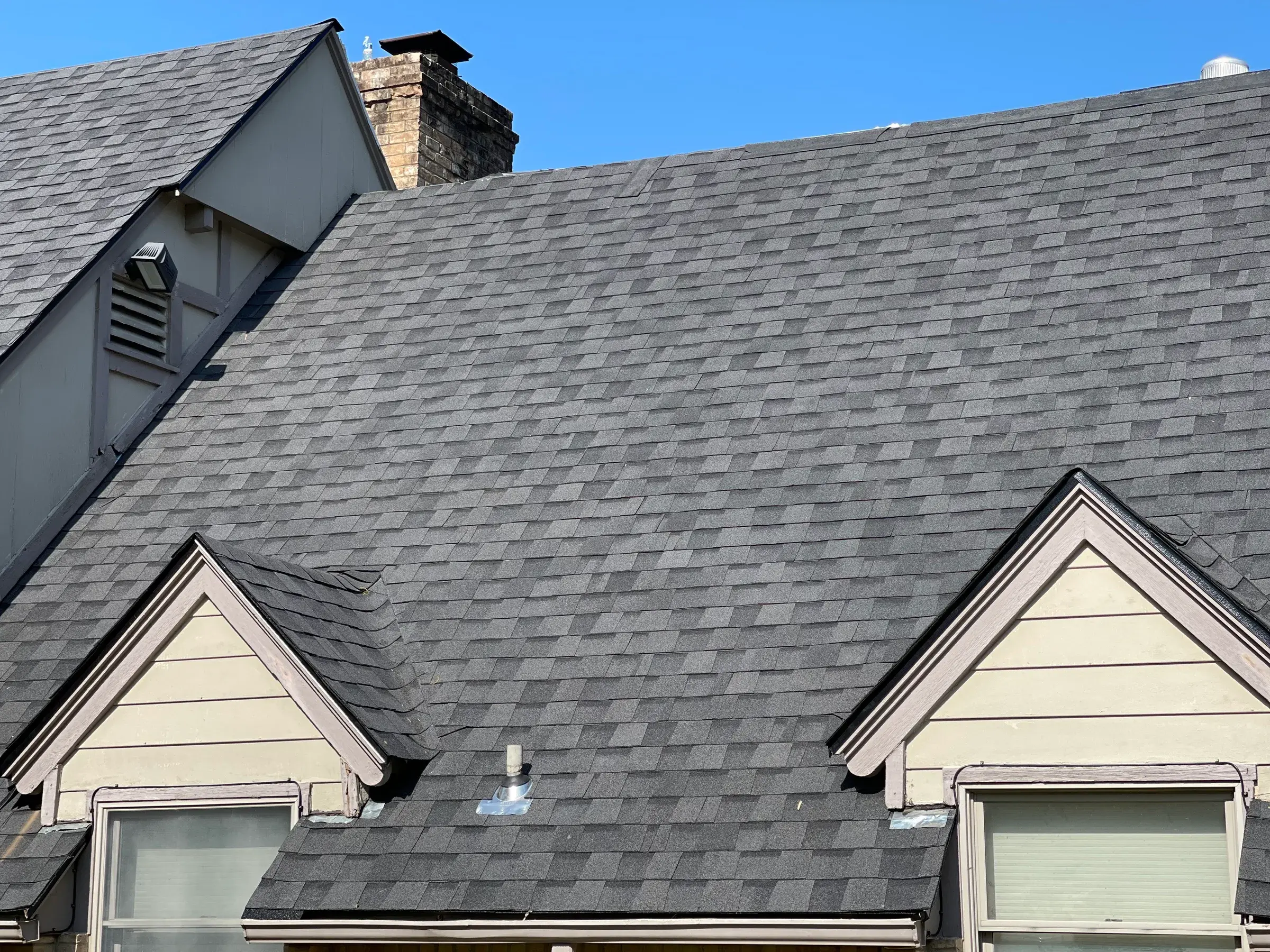
The strongest end-of-life signals are structural and cumulative: curling or cupping shingles across whole slopes, bald patches with exposed asphalt, a visibly sagging roof plane, and repeat repairs in different spots each year. Isolated damage is repairable. Damage appearing everywhere at once means the material itself is finished.
Age Alone Doesn't Decide It — Condition Does
Two roofs installed on the same street in the same month can be five years apart in real condition. One faces south with no shade and bakes. One sits under oaks on the east side of the county and stays damp until noon. Age is a starting point, not a verdict.
What actually ages an asphalt shingle is the slow loss of the volatile oils in the asphalt itself. The Asphalt Roofing Manufacturers Association (ARMA) describes shingle weathering this way: ultraviolet light and heat drive those oils out, the asphalt hardens, the mat shrinks slightly, and the shingle loses the flexibility it had on day one. Everything on this list is a symptom of that one process, or of water finding the gaps it opens up.
Northeast Oklahoma pushes that process hard from both directions. The Oklahoma Climatological Survey's 1991–2020 normals for this area show about 57 days a year above 90°F and roughly 89 nights a year below freezing, with an August daily high normal of 91.5°F. Add roughly 62% annual sunshine and four to five days a year with hail larger than three-quarters of an inch, and you get a shingle that expands, contracts, and takes impact on a schedule. Freeze-thaw is the quiet one — 89 cycles a year works fasteners loose and opens hairline cracks that a milder climate would never produce.
If you want the service-life side of this question — how many years a given material typically gets here — that's covered separately in [how long roofs last in northeast Oklahoma](/blog/how-long-do-roofs-last-northeast-oklahoma). This article is about what your roof is telling you right now, regardless of what the paperwork says its age is.
Sign 1: Curling and Cupping Across Whole Slopes
This is the sign that matters most, and it's the easiest one to see from your driveway. A healthy asphalt shingle lies flat and dead-straight. An old one stops lying flat because the mat has shrunk and the asphalt has stiffened. It can no longer stay where the nails put it.
"Curling" gets used as a catch-all, but the three shapes are different and they point at different problems. Knowing which one you're looking at tells you whether you're seeing age or an installation issue.
| Shape | What it looks like from the ground | Usual driver | What it means |
|---|---|---|---|
| Curling (general) | Shingle edges lift away from the roof plane; the slope looks textured or shaggy instead of smooth | Umbrella term for any upward deformation | Look closer and identify which of the two below it actually is |
| Cupping | Edges turn up, center stays down — the tab is dished, like a shallow bowl | Loss of asphalt oils plus heat; sometimes moisture pushing up from an under-ventilated attic | Late-stage aging. If it's across a whole slope, the material is finished |
| Clawing | Center of the tab lifts or bulges while the corners stay pinned down by nails | Mat shrinkage; sometimes a second layer telegraphing through, or shingles laid over an uneven deck | Aging, but also a flag that something underneath is moving — worth an attic look |
The distinction that decides repair versus replacement isn't the shape. It's the spread. Six curled shingles on one wind-exposed corner is a repair. Curling and cupping across a whole south slope, or on two slopes at once, means every shingle up there has aged the same amount and the ones that look fine today are simply a season or two behind. You cannot repair your way out of that, and anyone who tries is selling you a delay, not a fix.
A curled shingle also stops doing its job before it looks dramatic. Once the edge lifts, wind gets under it, and driven rain gets under it. The shingle below is now the only thing between weather and your deck.
Sign 2: Bald Patches and Exposed Asphalt
The colored granules on a shingle are not decoration. ARMA is direct about this: the granule layer is the shingle's UV shield. The asphalt underneath has no meaningful UV resistance of its own. Strip the granules and the asphalt is exposed directly to sunlight, and at roughly 62% annual sunshine here, that clock runs fast.
From the ground, look for shiny black or dark gray patches where the rest of the slope is uniform in color. Sun hitting the roof at a low angle — early morning or late afternoon — makes them obvious. Slick, wet-looking spots on a dry day are bare asphalt catching the light.
Some granules in your gutters is normal. Every roof sheds loose granules for the first months after installation, and every roof sheds a few for the rest of its life. What isn't normal is a steady accumulation years in, or a visible line of granule wash below every downspout. There's a fuller breakdown of what different amounts and timings actually indicate in [shingle granule loss and what it means](/blog/shingle-granule-loss-what-it-means).
The Insurance Institute for Business & Home Safety (IBHS) has studied how aged shingles perform under impact, and the pattern is consistent: an older, harder shingle that has already lost granule coverage takes hail damage more readily than a new one struck the same way. In a market with four to five hail days a year, granule condition isn't cosmetic — it's the roof's armor.
Sign 3: A Sagging or Wavy Roof Plane
Cross the street. Stand where you can look along the roof from the end, not straight at it. A roof plane should read as a flat surface and the ridge should read as a straight line. Sight down both.
What you're looking for: a dip between rafters, a ridge that bellies down in the middle, a slope that ripples like a slow wave, or a line that's straight on one side of a valley and not the other. Any of these means the problem is below the shingles.
Wavy usually means the decking — the plywood or plank sheathing under the shingles — has taken on moisture and swelled, or has softened enough to deflect between its supports. That's the most common version and it's why a tear-off matters: you cannot assess a deck you can't see. Oklahoma amended the residential code's re-cover provision (IRC R908.3.1.1) to require tear-off rather than shingling over in defined conditions, and this is exactly the reason. A second layer hides the thing you most need to look at. Signs that the deck is the real story are covered in [roof decking damage signs](/blog/roof-decking-damage-signs).
A true structural sag — ridge line bowed, rafters visibly deflected — is a different category. That's not a roofing symptom, that's a framing one, and it doesn't get better.
Sign 4: Exposed or Backed-Out Nail Heads
Every shingle is held by nails that are supposed to be covered by the shingle above. When you can see nail heads sitting on the surface of a slope, something has moved.
Two things cause it here. First, thermal cycling: the roof expands in the afternoon heat and contracts overnight, and with roughly 89 freeze nights a year on top of 57 days above 90°F, that's a lot of movement over a decade. Nails work upward a fraction at a time. Second, a deck that has been wet and dried repeatedly loses its grip on the nail shank — the wood fibers around the nail compress and never fully recover.
From the ground, look for small dark bumps in an otherwise flat course, or short rust streaks running downslope from a point. Rust streaking is the giveaway: a nail can only rust if it's exposed to water, and if it's exposed to water it is also a hole through your roof.
A handful of nail pops is a repair — you're paying for someone to seal a few penetrations. Nail heads showing across a whole slope means the deck's holding power is gone in general, and re-nailing into the same tired wood buys very little.
Sign 5: Cracking and Crazing in the Shingle Mat
Crazing is a fine network of shallow cracks across the surface of a shingle, like the glaze on old pottery. Full cracks are longer splits, often running with or across the length of the tab. Both mean the same thing: the asphalt has hardened past the point where it can absorb movement, so it fractures instead.
There's a simple check, and it's the one that convinces people. On a warm afternoon — when a shingle should be at its most pliable — lift the corner of a tab at the roof edge a half inch. A shingle with life in it flexes. A shingle at end of life makes a small dry crack and snaps. If it snaps in the warmest part of the day, it has no chance of surviving a January night at 20°F when it's stiffest.
Cracking is also the sign that turns hail from a claim question into a certainty. A brittle mat doesn't bruise under impact the way a flexible one does — it fractures. The shingle you'd have argued about after a marginal hail event becomes an obvious hole.
Sign 6: Repeat Repairs in Different Places Each Year
This sign doesn't require a ladder or a roof at all. It requires a folder.
Pull your repair invoices and lay them out by date and location. Two patterns, two very different meanings. If you've paid three times for the same chimney flashing, you have a flashing detail that was never done right — that's a repair problem, and it's fixable. If you've paid three times in three different places — a valley one year, a slope corner the next, a pipe boot after that — the roof is telling you it's failing in general and the leak simply shows up wherever it finds the weakest point that season.
Scattered, moving repairs are among the strongest predictors on this list precisely because they're not a judgment call. You're not interpreting a photo. You're reading your own receipts. The money math usually settles it too: three or four repair visits at a few hundred dollars each, with more coming, against a replacement that resets the whole system. That trade-off is worked through in detail in [roof repair vs. replacement in Oklahoma](/blog/roof-repair-vs-replacement-oklahoma), and there are absolutely roofs where [a targeted repair](/services/roof-repair) is still the right answer.
Sign 7: Daylight or Staining Visible in the Attic
The National Roofing Contractors Association (NRCA) treats interior inspection as part of any real roof condition assessment, not an optional extra. The attic tells you things the shingles won't.
Go up on a bright day. Turn your flashlight off and let your eyes adjust for a full minute. Then look at the underside of the decking.
- Pinpoints of daylight through the deck — holes, not just gaps at the ridge vent
- Dark or gray staining on the plywood, especially in bands following the rafters
- Rusted nail points coming through the deck — condensation, and often a ventilation problem rather than a leak
- Insulation that's matted, compressed, or discolored in patches instead of fluffy and even
- Decking that flexes or feels spongy when you press it with a hand from below
- A musty smell that doesn't clear when the hatch is open
One caution on staining: a stain shows you where water landed, not where it got in. Water runs along rafters and travels feet before it drops. A stain over the bedroom can easily start at a valley on the other side of the ridge. Don't cut a hole in your ceiling based on where the mark is.
Sign 8: Moss, Algae Streaking, and What They Do and Don't Mean
Those black streaks running down a north slope are algae — Gloeocapsa magma. ARMA is unambiguous about it: algae discoloration is cosmetic. It does not eat asphalt, it does not shorten shingle life, and it is not evidence that your roof is failing. Many manufacturers now make algae-resistant shingles with copper-bearing granules specifically because the complaint is about looks.
If someone points at black streaks and quotes you a replacement, they are selling you on the one symptom that means the least. A roof can be streaked and structurally fine. A roof can be spotless white and cooked through.
Moss is a different animal, and geography decides which one you get. Ottawa County splits down the middle: the eastern side is Ozark Plains — rockier, wooded, rolling, and shaded — while the west is Neosho Lowlands, flat and open. On the east side, under a tree canopy where slopes stay damp into the afternoon, moss grows in a mat and holds water directly against the shingle. It also lifts shingle edges as it thickens under them. That's not cosmetic. That's a maintenance issue that will age the roof early if it's left alone.
So: streaks, ignore or clean for appearance. Cushiony green mats plus overhanging limbs, deal with it — and trim the limbs, because the debris that comes off them is the reason the moss is there.
Sign 9: Rising Energy Bills and the Ventilation Connection
This is real but indirect, and it's worth being careful about. A roof does not usually get "less efficient" as it ages. What happens is that the attic system underneath it stops working, and the roof is where you notice.
The U.S. Department of Energy and ENERGY STAR both frame attic ventilation the same way: balanced intake at the eaves and exhaust at the ridge lets an attic shed heat in summer and moisture in winter. When intake gets blocked — insulation stuffed over the soffits, painted-shut vents, a ridge vent that was never cut through properly — the attic turns into a heat trap. Across 57 days a year above 90°F, your air conditioner fights that. There's no honest percentage to put on it; the amount depends entirely on your house, your insulation, and your equipment. What is knowable is the direction, and it's not in your favor.
The winter half matters more for the roof itself. A poorly vented attic collects moisture from inside the house, that moisture condenses on cold decking, and the deck gets wet from the inside. That's how you get rusted nail points and dark plywood with no leak anywhere. It's also why a bad vent setup can age a roof from underneath while the shingles still look presentable. If your attic is stifling in August or damp in January, that's a [ventilation problem](/services/roof-ventilation-repair) worth diagnosing on its own terms — and worth fixing before, not after, new shingles go on.
Treat a rising bill as a prompt to look, not as a sign the roof is done. It is weak evidence on its own and strong evidence when it lines up with attic staining.
Sign 10: Your Neighbors Are All Replacing Theirs
This is the weakest sign on the list, and it's the one used hardest to sell you something. Rank it accordingly.
There's a grain of truth in it. Subdivisions get built in batches, so neighboring roofs often share an install year and a material, and they age on similar schedules. If yours went on at the same time as six others and three of those are being torn off, that's a reason to go look at your own roof. That's all it is — a reason to look.
It is not evidence about your roof, because you don't know why they're replacing. Maybe two of them are selling. Maybe one had a tree limb come through. And maybe a crew is working the street and knocking doors. Neighborhood replacement activity is a fact about the neighborhood, not a diagnosis of your house.
The Oklahoma Insurance Department publishes consumer alerts about exactly this after storm activity, and the advice is worth repeating: be careful with contractors who show up at your door, especially ones offering to get on your roof right now. Three things are worth knowing before you sign anything with anyone in this state.
Ranking the Signs: Which Ones Actually Predict Replacement
Not all ten weigh the same. Here's how they sort, honestly, by how strongly each one predicts that the material itself is done rather than that a spot on it needs work.
| Sign | What it indicates | Predicts replacement | Repairable? |
|---|---|---|---|
| Curling or cupping across whole slopes | The asphalt has hardened and the mat has shrunk everywhere at once | Strong | No — spot repair only delays |
| Repeat repairs in different places each year | The roof is failing in general; leaks find the weakest point each season | Strong | No — you're already paying for it in pieces |
| Sagging or wavy roof plane | Decking has softened or swelled; possibly framing | Strong | Deck sections yes; a wavy whole plane, no |
| Bald patches with exposed asphalt | UV shield is gone; asphalt is degrading directly | Strong if widespread | Isolated patches yes; slope-wide no |
| Cracking or crazing in the mat | Shingles have lost all flexibility and now fracture | Strong if widespread | No |
| Daylight or active staining in the attic | Water is getting through, or the deck is wet from condensation | Moderate to strong | Depends entirely on cause and spread |
| Exposed or backed-out nail heads | Thermal cycling plus a deck losing holding power | Moderate; strong if slope-wide | A few, yes |
| Moss mats on shaded slopes | Moisture held against the shingle; edges being lifted | Weak on its own; a real aging accelerator | Yes — clean it and trim the limbs |
| Rising energy bills | Attic ventilation is likely compromised | Weak alone; moderate with attic staining | Usually a ventilation fix, not a roof |
| Neighbors replacing theirs | The neighborhood shares an install year — or a crew is working the street | Weak | Not a roof condition at all |
Score your own roof
Total up whatever you can confirm. This is a rough sorting tool, not a diagnosis — but it will tell you whether you're in repair territory or replacement territory before anyone gives you a number.
| What you found | Points |
|---|---|
| Curling or cupping on one whole slope or more | 4 |
| Three or more repairs in three or more different spots in the last three years | 4 |
| Ridge or roof plane visibly dips, bellies, or ripples | 4 |
| Bare asphalt patches visible on more than one slope | 3 |
| Shingle snaps instead of flexing on a warm day | 3 |
| Daylight visible through the deck from inside the attic | 3 |
| Curling limited to one corner or one small area | 2 |
| Nail heads visible across a whole slope | 2 |
| Attic decking dark, stained, or spongy | 2 |
| Nail heads visible in a few spots only | 1 |
| Granule accumulation in gutters years after installation | 1 |
| Attic stifling in summer or damp in winter | 1 |
| Moss mats on a shaded slope | 1 |
| Black algae streaking only | 0 |
| Neighbors are replacing theirs | 0 |
0–3: your roof is behaving normally for its age. Keep the gutters clear and look again after the next hail season. 4–7: you have real, localized problems. A repair is probably the right call, and a written assessment tells you which. 8 or more: the pattern is spread across the roof rather than concentrated in one place, and that's what replacement is for. Any single 4-point item on its own is enough to get it looked at properly.
Ground-level self-assessment — no ladder required
Every item here can be done from your yard, your street, or your attic hatch. Do this before you call anyone, so that when someone shows you photos you already know roughly what you're looking at.
What to check from the ground
- Stand across the street and sight along each roof plane end-on — is it flat, or does it dip, ripple, or belly?
- Sight down the ridge line — is it straight from end to end?
- Look at each slope at a low sun angle for shiny dark patches where granules are gone
- Scan for shingle edges lifting or tabs bulging, and note whether it's one corner or the whole slope
- Look for small dark bumps in a course, and for short rust streaks running downslope from a point
- Check gutters and the ground below downspouts for granule accumulation
- Note which slopes have moss mats versus flat black streaking — they mean different things
- Look at the pipe boots and any chimney or wall junction from the ground for gaps or lifted metal
- Go into the attic on a bright day, flashlight off, and look for daylight, staining, rusted nail points, and matted insulation
- Pull your repair invoices — same spot repeatedly, or different spots each year?
- Check whether the attic is stifling in August or damp in winter
- Photograph anything you find, dated, from a fixed spot so you can compare next year
One honest limit on all of this: from the ground you can identify a pattern, but you cannot identify hail bruising. A bruise is a soft spot in the mat where the granules have been driven in — you find it by hand, by feel, and often it's invisible from twenty feet away. That's the one thing on this roof you genuinely can't self-assess.
If your score lands in the middle, or you found something you can't interpret, a [free inspection](/services/roof-inspections) settles it. What that gets you is a photo report of what's actually up there and a written estimate for the work we would perform — nothing more dramatic than that. If it's a repair, we'll say so. If the roof is genuinely at the end and [replacement](/services/roof-replacement) is the answer, the City of Miami requires a permit for new roofs and re-shingles, and we pull it. We work out of one office at 111 S Main St in [Miami](/locations/miami-ok) and across northeast Oklahoma, southeast Kansas, southwest Missouri, and northwest Arkansas.
Questions people ask about this
My roof looks fine from the ground but it's 20 years old. Do I need to replace it?
Not on age alone. Condition decides it, not the calendar — a well-ventilated roof on a shaded slope can outlive a poorly-ventilated one by years. The useful move at 20 years is to look properly rather than to replace preemptively: check the attic for staining and rusted nail points, sight the roof planes for waviness, and see whether a shingle at the roof edge still flexes on a warm afternoon. If nothing on this list turns up, the roof is doing its job.
Are black streaks on my roof a sign it's failing?
No. Those streaks are algae — Gloeocapsa magma — and ARMA is clear that the discoloration is cosmetic. It doesn't consume asphalt or shorten shingle life. Moss is the one to take seriously, because a thick mat holds water against the shingle and lifts its edges. If a contractor quotes you a full replacement based on streaking alone, that tells you something about the contractor rather than about your roof.
How can I tell whether my curling shingles are a repair or a replacement?
Spread is what decides it. Curling confined to one wind-exposed corner or a small area is repairable. Curling or cupping across an entire slope — or on two slopes at once — means every shingle up there has aged the same amount, and the ones that still look flat are just a season or two behind. At that point you're replacing shingles one at a time on a roof that's failing everywhere.
A contractor knocked on my door and said my neighbors are all getting new roofs. Should I let him inspect?
Neighborhood activity is a reason to look at your own roof, not evidence about it — subdivisions get built in batches, so nearby roofs often share an install year. Before letting anyone up there, verify them yourself at verifyroofing.cib.ok.gov, the Construction Industries Board's free public tool. Oklahoma requires roofing contractors to be registered and to display their registration number, and registration requires at least $500,000 in liability insurance for residential work. The Oklahoma Insurance Department publishes consumer alerts about door-to-door solicitation for good reason.
Can I check for hail damage myself?
You can spot the obvious versions — cracked or punctured shingles, dented metal vents and flashing, bare patches. What you can't do from the ground is find bruising, which is a soft spot where an impact drove the granules into the mat without breaking the surface. Bruises are found by hand, by feel, and are often invisible from twenty feet away. That's the reason a hail assessment is worth having someone do properly, especially in an area averaging four to five hail days a year.