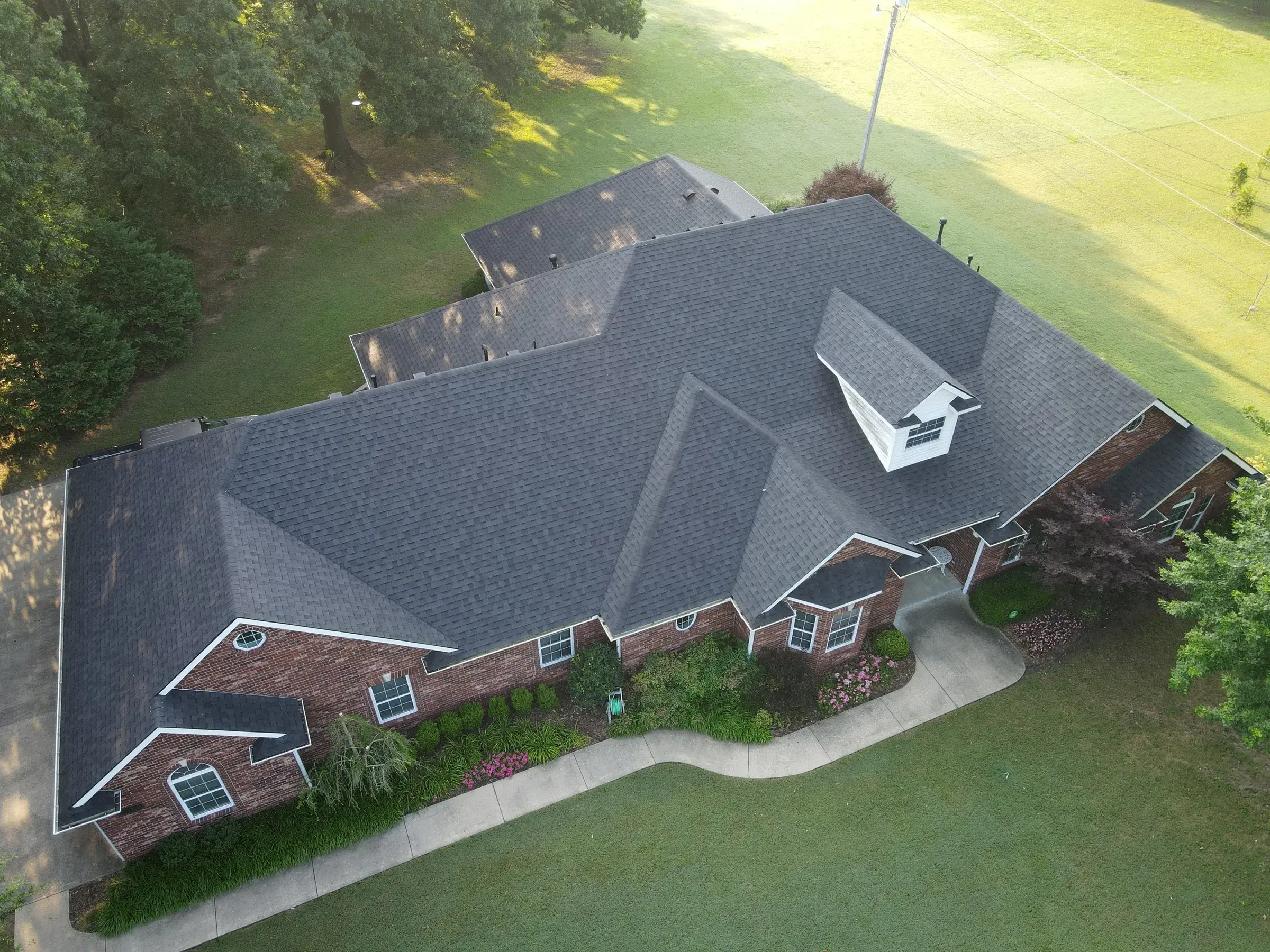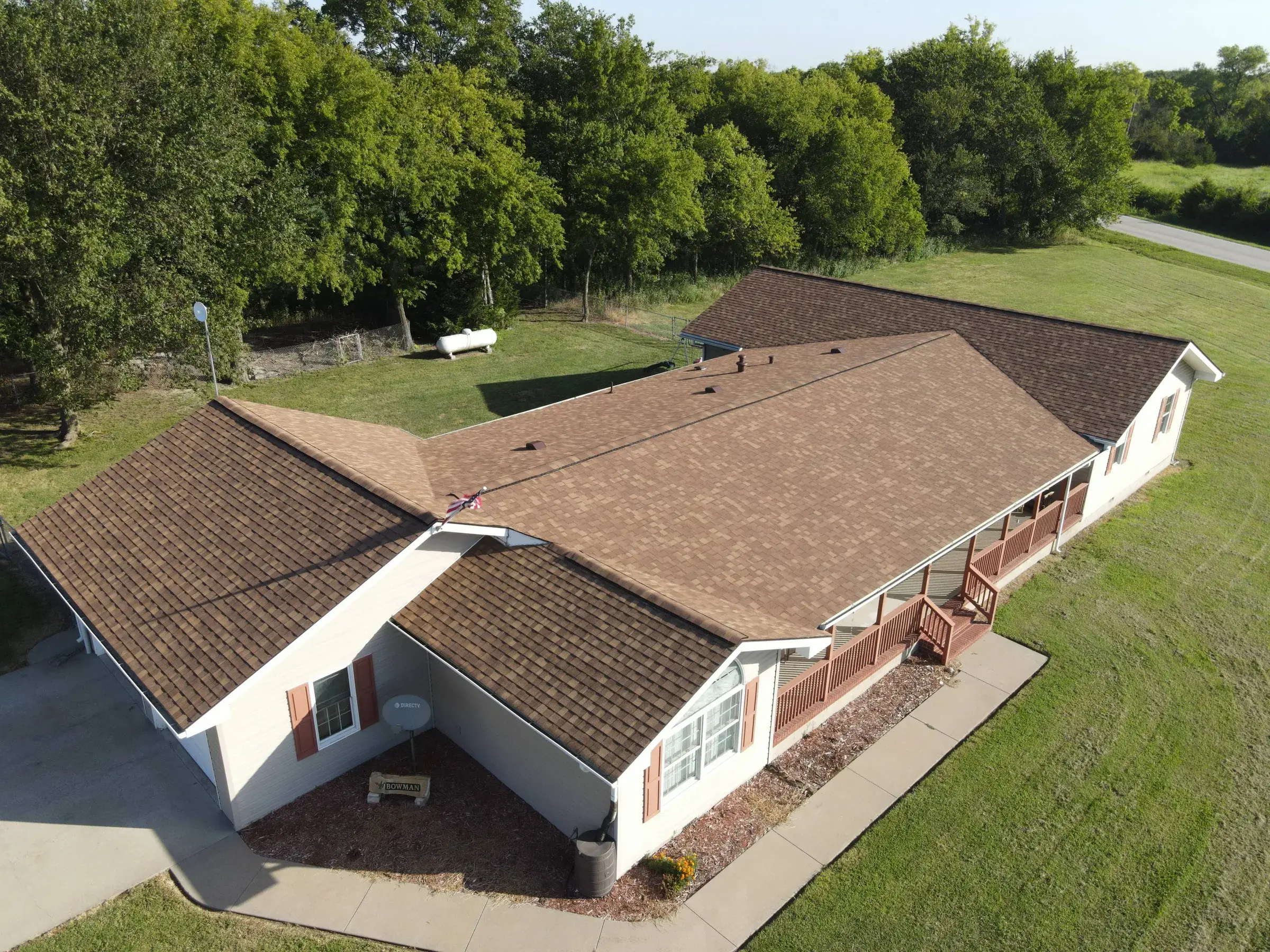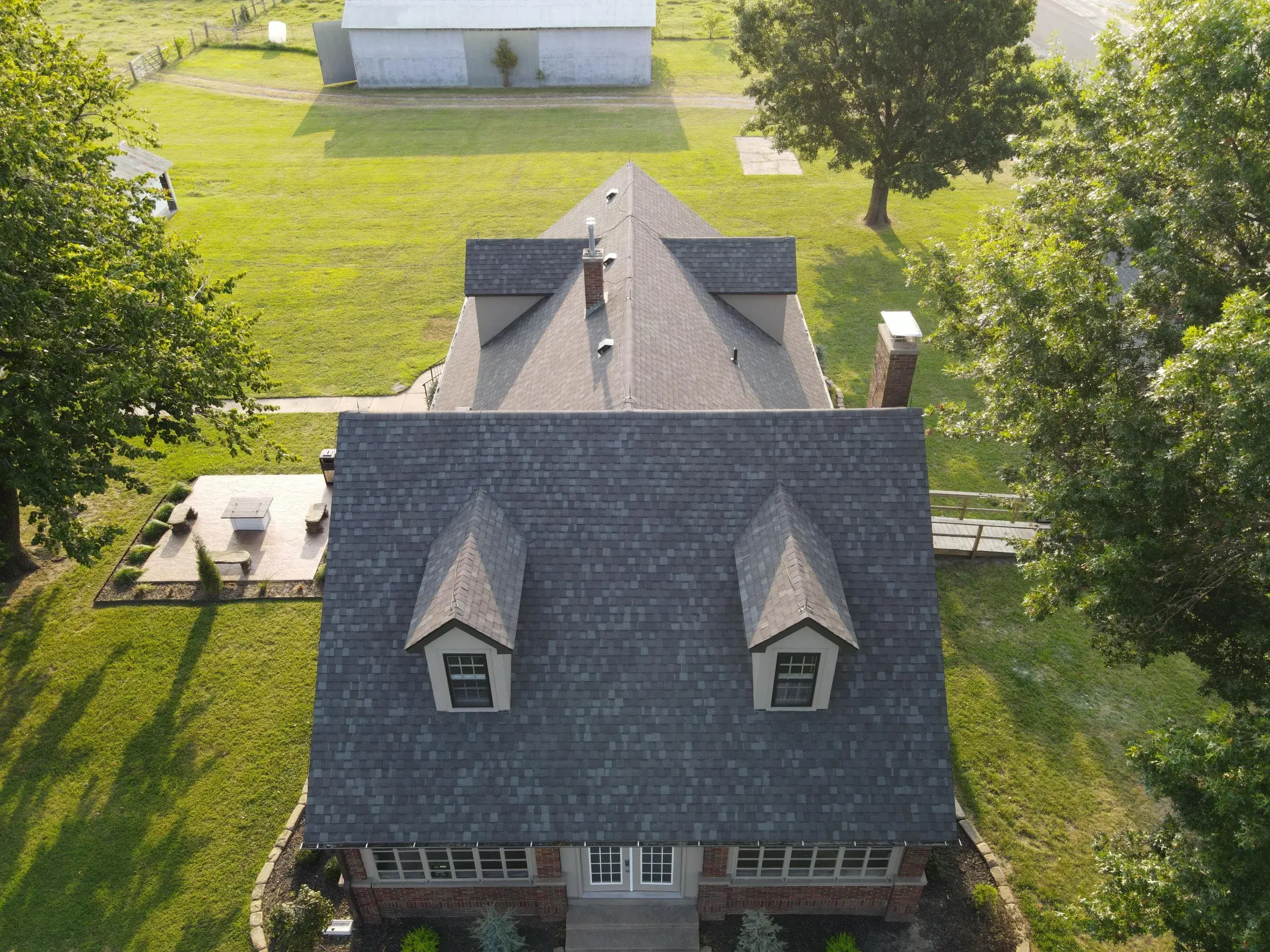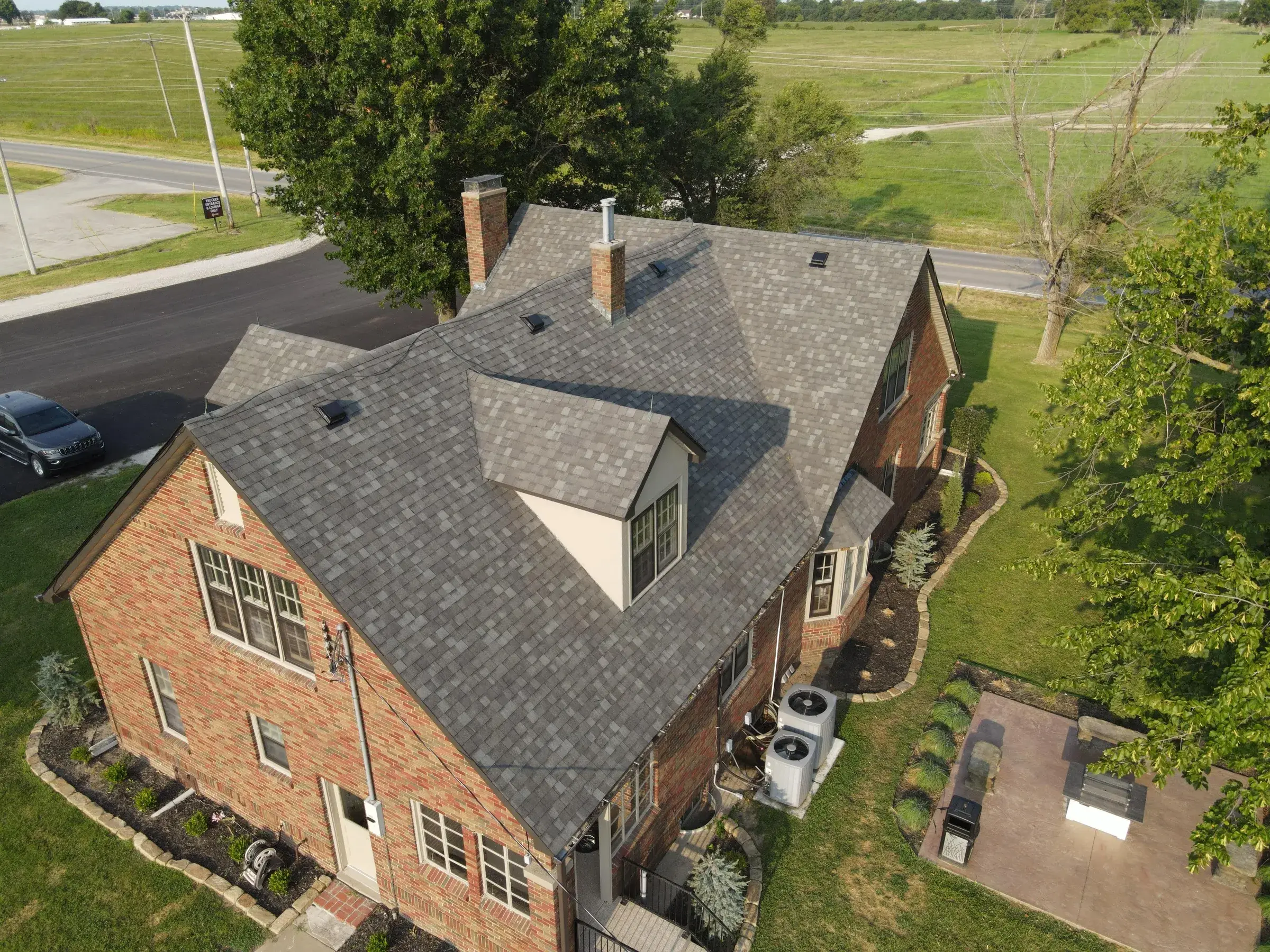
Standing seam panels attach with concealed clips and interlocking seams, letting the metal expand and contract freely with no fasteners penetrating the weather surface. Exposed-fastener panels screw through the panel face into the deck or purlins, sealing at rubber washers that age and require periodic re-fastening. Standing seam costs more; exposed-fastener systems are simpler and cheaper.
The core difference: concealed clips vs. through-fastened panels
Every metal roof answers one question: how does the panel stay on the building? There are only two real answers, and everything else — price, lifespan, maintenance, what it looks like in year twenty — follows from which one you pick.
A standing seam roof holds panels down with clips. The clip is a small metal tab screwed to the deck, hidden under the joint between two panels. The panel legs stand up vertically, fold over the clip head, and lock together. The screws live under the seam, an inch or so above the water plane. Nothing punctures the surface the rain runs across.
An exposed-fastener roof does the opposite. The screw goes straight through the face of the panel, through the deck or the purlin below, and the only thing keeping water out of that hole is a rubber washer squeezed under the screw head. The system works — it has worked on barns and shops for generations — but it works because of the washers, and washers are a wear part.
That is the whole comparison in one sentence: standing seam has no holes in the water surface, and exposed-fastener roofing has thousands of them, each sealed by a piece of rubber sitting in the sun. On a house-sized roof, through-fastened panels are typically screwed at every purlin or deck line across the panel width, and the count runs into the thousands. Every one of them is a small maintenance item with a clock on it.
| Standing seam | Exposed-fastener (through-fastened) | |
|---|---|---|
| Attachment | Concealed clips or a hidden nail flange; seam locks over the fastener | Screws driven through the panel face into deck or purlins |
| Holes in the weather surface | None in the field of the roof (trim and penetrations still flash) | Thousands, each sealed by a rubber washer |
| Slope tolerance | The lowest slope the code allows for metal panels | Needs more slope; lap sealant changes what's permitted |
| Thermal movement | Panels float on clips and move with temperature | Panels are pinned; movement works against the screws |
| Field maintenance | Visual checks; seams and clips are not consumables | Expect at least one full re-fastening cycle in the roof's life |
| Panel replacement | Difficult mid-field — seams interlock | Straightforward; unscrew and swap |
| Relative cost | $$$ | $ |
Seam profiles: snap-lock, mechanically seamed, and nail-strip
"Standing seam" is a category, not a product. Three profiles cover most of what gets installed on homes in this part of Oklahoma, and they are not interchangeable.
Snap-lock
The male leg of one panel snaps over the female leg of the next by hand or with a rubber mallet. No seaming machine. It rides on concealed clips, so it still floats. It is the most common residential standing seam and the least expensive of the three to install.
Mechanically seamed
The panel legs are folded together by a machine that crawls the seam. A single lock is one 90-degree fold. A double lock folds it again, 180 degrees, wrapping the seam tight around itself. The NRCA Roofing Manual's chapter on metal panel roof systems treats mechanically seamed panels as the assembly for low slopes and hard exposures, because the folded seam is far less dependent on gravity than a snapped one.
Nail-strip (fastener flange)
A hybrid. The panel has a flat nailing flange along one edge that gets fastened straight to the deck, and the next panel's seam covers it. The fastener is concealed, but it is not floating — it pins the panel. Nail-strip is cheaper and faster than clipped standing seam, which is why it shows up on a lot of residential quotes, and it is a reasonable system on shorter panel runs. On long runs it gives thermal movement nowhere to go.
| Profile | How the joint closes | Fastener | Movement | Where it fits |
|---|---|---|---|---|
| Snap-lock | Male leg snaps over female leg; friction fit, no machine | Concealed clip | Floats on the clip | Most residential standing seam roofs |
| Mechanical single lock | Seamer folds the legs 90 degrees | Concealed clip | Floats on the clip | Lower slopes, exposed sites, light commercial |
| Mechanical double lock | Seamer folds the legs a second time, 180 degrees | Concealed clip | Floats on the clip | The lowest permitted slopes and the highest uplift demand |
| Nail-strip | Panel's flat flange is nailed to deck; next panel's seam laps over it | Concealed, but fixed | Pinned — panel cannot slide | Shorter panel runs, tighter budgets |
| Through-fastened (R-panel) | Panels overlap at a rib; screw goes through both | Exposed, with washer | Pinned at every screw | Shops, barns, outbuildings, low-cost residential |
Thermal movement: why a 40-foot panel needs somewhere to go
Metal grows when it heats and shrinks when it cools. That is not a defect; it is the material. The design question is whether the roof has been built to let it happen.
Ottawa County gives metal a workout. The Oklahoma Climatological Survey's 1991–2020 normals for this area put roughly 57 days a year above 90°F and 89 nights a year below freezing. The record high in Miami is 116°F, set in 1954; the record low is -28°F, from 2011. That is a 144-degree air-temperature span — and a dark panel in direct sun under our roughly 62% annual sunshine runs well above air temperature. The metal itself sees a wider swing than the thermometer does.
Run the standard steel expansion coefficient the Metal Construction Association publishes in its technical bulletins against a 40-foot panel and a 100-degree temperature swing and you land at roughly a quarter-inch of movement. It sounds trivial. It is not, because it all accumulates at the ends of the panel and it happens twice a day, every day, for decades. Aluminum moves about twice as much as steel for the same swing, which is why aluminum panels get even more attention to floating details.
A clipped standing seam panel handles this by sliding. Floating clips have a two-piece head that lets the panel travel while the base stays screwed down. A pinned system — nail-strip, or anything through-fastened — has no such relief. The movement still happens; it just gets absorbed somewhere else. In a through-fastened roof, "somewhere else" is the screw holes. That is the mechanism behind most of what goes wrong with these roofs, and it is why panel length matters more than most quotes admit.
The washer problem: how exposed fasteners age and what re-screwing involves
The washer under an exposed fastener is usually EPDM rubber. It has three enemies here, and we have all three.
- Ultraviolet light. The washer sits on top, in the sun, for the life of the roof. Rubber gets hard, then it cracks.
- Thermal cycling. Every hot-cold cycle works the panel against the screw shank. Over years, screws back out, tilt, or wallow the hole oversize.
- Installation error. A washer driven too hard squeezes out from under the head and dies early. One driven too soft never seals. There is a correct torque and it is a judgment call thousands of times per roof.
When washers fail, water does not usually pour in. It weeps — a little at a time, into the deck or down a purlin, often for a season or two before anything shows on a ceiling. That is what makes it worth catching on a look-over rather than a leak call.
Re-screwing is the fix, and it is a real project. You back out every screw and replace it with a larger-diameter one that can bite fresh metal in an enlarged hole, with a fresh washer. It is slow, and it is a finite trick: once you have stepped up the screw size, there may not be room to do it again. Plan on a through-fastened roof needing that cycle at least once, and understand that the second cycle is often when the panels come off instead.
Gauge and substrate: 22 vs. 24 vs. 26 gauge, steel vs. aluminum, Galvalume vs. galvanized
Gauge is thickness, and the scale runs backwards: a lower number is thicker metal. The difference between 26 and 24 gauge is not dramatic to the eye and it is dramatic in the hand. Thicker metal resists oil-canning (the visible waviness in the flat of a panel), holds a seam better, and dents less.
Substrate is what's under the paint. Two ASTM standards cover the steel you'll be quoted. ASTM A792 is Galvalume — an aluminum-zinc alloy coating. ASTM A653 is galvanized — a zinc coating. Galvalume generally outperforms galvanized on flat, exposed surfaces, which is why it dominates modern panel stock. Galvanized has an edge in one specific place: cut edges and bends, where zinc's sacrificial behavior protects exposed steel better. Ask which standard the panel meets and which coating weight — the number after the standard is not decoration.
| Option | What it is | Trade-off | Typical use |
|---|---|---|---|
| 26 gauge | The thinnest common panel steel | Cheapest; oil-cans more; dents easier | Exposed-fastener panels on barns, shops, outbuildings |
| 24 gauge | The residential standing seam standard | Meaningfully stiffer than 26 for a modest cost step | Most residential standing seam |
| 22 gauge | Heaviest common panel steel | Costs more and is harder to form | Long runs, high-uplift exposures, some commercial |
| Steel to ASTM A792 (Galvalume) | Aluminum-zinc alloy coated steel | Strong flat-surface corrosion performance; weaker at raw cut edges | The default substrate for most panel systems |
| Steel to ASTM A653 (galvanized) | Zinc-coated steel | Better sacrificial protection at cuts and bends; less durable on flats | Trim, some ag panel, specific details |
| Aluminum | Non-ferrous; will not rust | Costs more; softer, dents easier; moves about twice as much as steel | Rarely necessary inland — a coastal answer to a coastal problem |
One note on aluminum, because it comes up: aluminum's main selling point is that it does not rust in salt air. We are 90 miles northeast of Tulsa, not on a coast. Around Grand Lake o' the Cherokees you are dealing with fresh water, humidity, and tree cover — not salt. Steel is usually the right answer here, and paying the aluminum premium for a problem this market doesn't have is a common way to overspend.
Coatings: PVDF vs. SMP and what each does to chalk, fade, and cost
Paint on a metal roof is not paint the way house paint is paint. It's a coil coating, baked onto the steel at the mill before the panel is ever formed. Two resin families cover essentially the whole market, and they are graded against two AAMA specifications.
PVDF — you'll see it marketed as Kynar 500 or Hylar 5000, which are resin brand names, not roof brands — is tested to AAMA 2605. SMP, silicone-modified polyester, is tested to AAMA 2604. AAMA 2605 sets a tougher threshold for chalk and fade after long-term outdoor exposure than AAMA 2604 does. That is the real difference, and in a market with roughly 62% annual sunshine, it is the difference you will actually see.
Chalking is the white powdery film that develops as the resin breaks down at the surface. Fading is loss of color. Both are driven by UV, and both hit dark and saturated colors — deep reds, blues, blacks — hardest. If you want a dark or vivid color on a roof that faces this much sun, PVDF is worth the step up. If you're roofing a shop in a light neutral, SMP does the job for less.
| PVDF (AAMA 2605) | SMP (AAMA 2604) | |
|---|---|---|
| Resin | Polyvinylidene fluoride (marketed as Kynar 500 / Hylar 5000) | Silicone-modified polyester |
| Chalk and fade | Held to the tougher AAMA threshold; better long-term color hold | Chalks and fades sooner, especially in dark colors |
| Dark and saturated colors | The right choice when color retention matters | Acceptable in light neutrals; risky in deep tones |
| Surface hardness | Softer film; scuffs more readily during handling | Harder film; better scuff and abrasion resistance |
| Typical use | Residential standing seam, visible roofs, architectural work | Exposed-fastener panels, shops, barns, budget-driven work |
| Relative cost | $$ | $ |
Finish warranty terms vary by coating system and by manufacturer, and they are not all the same document. Some cover chalk and fade to defined limits; some cover film integrity only; most have exclusions. Read the written warranty for the specific product you are buying rather than the number on the brochure.
Slope minimums and where each system is code-permitted
Slope is where this decision stops being preference and starts being code. The residential code does not treat metal as one product. It sets separate minimum slopes for metal roof shingles, for standing seam panels, and for lapped, non-soldered seam panels — and it further distinguishes lapped panels with sealant in the laps from those without. The ranking is consistent: standing seam is permitted lowest, lapped panels without lap sealant need the most slope.
The exact fractions belong to the specific code edition Oklahoma has adopted, and Oklahoma is in the middle of an edition change. Rather than quote a number that may be superseded by the time you read this, ask your roofer to show you the requirement in the current Oklahoma residential code for the exact panel you are being sold. The City of Miami requires a permit for new roofs and re-shingles — we pull it — and the permit process is where that gets applied.
Two things worth knowing beyond code. First, manufacturers publish their own slope minimums for their own panels, and those are sometimes stricter than code — install below the manufacturer's minimum and you may have a code-compliant roof with a void warranty. Second, Oklahoma amended IRC section R908.3.1.1 to require a full tear-off rather than a shingle-over in defined conditions. That matters here because "metal right over your old shingles" is one of the most common pitches in this market. Sometimes it's allowed. Sometimes it isn't. Ask which, and ask why.
R-panel and ag-panel on houses, barns, and shops around Ottawa County
Through-fastened panel goes by a lot of names — R-panel, PBR, ag panel, 5V. It is everywhere in this county, and for good reason. Ottawa County has 13,701 housing units, and 12.2% of them are mobile or manufactured homes, a category that frequently gets a metal re-roof or a metal-roofed carport or add-on. Add the shops, barns, and equipment sheds across the western farmland, and exposed-fastener panel is arguably the region's most common metal roof.
It belongs on those buildings. A pole barn has open purlins, no conditioned space below, easy access, and a low bar for cosmetics. If a washer weeps into a barn in year eighteen, nobody's drywall is involved. The system's weaknesses are cheap to live with there.
A house is a different building. It has a deck, insulation, and a ceiling, and the failure mode is slow and hidden rather than visible. The geography inside the county splits here too. East Ottawa County runs into the Ozark Plains — rockier, wooded, rolling — where tree cover means debris in the ribs and shade means slower drying. Debris sitting against a screw head holds moisture on the exact spot you need to stay dry. West, out in the open lowlands, the wind fetch that drives the uplift question also drives the thermal cycling that works screws loose. Neither half of the county is kind to a through-fastened residential roof over a 30-year horizon.
None of that makes exposed-fastener wrong. It makes it a system with a job description. Match it to the building. If you're weighing panel systems for a shop, an outbuilding, or a lake place around Grand Lake, that's a conversation worth having before the quote — the same one we walk through on any [metal roofing](/services/metal-roofing) project, and one that changes shape entirely on a [commercial](/services/commercial-roofing) building with a large low-slope field.
Maintenance expectations over the life of each system
Every roof has a maintenance profile. The honest version of this comparison is that standing seam moves the money to the front and exposed-fastener spreads it out.
A standing seam roof's field is close to maintenance-free. There are no consumable parts in the middle of the roof. What needs eyes on it is the perimeter and the penetrations: trim, sealant at flashings, pipe boots, and the transitions where the panel meets a wall. Pipe boots are rubber and they age like any rubber in this sun. Debris in the pans matters more on the wooded east side of the county than the open west.
An exposed-fastener roof needs a real inspection interval, because the failure is gradual and invisible from the ground. What you're looking for is washer cracking, backed-out or tilted screws, wallowed holes, and sealant at the panel laps. Then, once, you re-screw the whole thing — and once you've stepped up the fastener diameter, you've spent your one upgrade.
Eight questions that make two metal roof quotes actually comparable
- Which exact panel system and profile — snap-lock, mechanical single lock, mechanical double lock, nail-strip, or through-fastened? Get the manufacturer's product name in writing, not just "standing seam."
- What gauge, and what substrate — 26, 24, or 22, and steel to ASTM A792 (Galvalume) or ASTM A653 (galvanized), or aluminum?
- What coating — PVDF to AAMA 2605 or SMP to AAMA 2604 — and what does the written finish warranty for that product actually cover and exclude?
- What clip type and spacing, and does the clip float? A fixed clip and a floating clip look identical on a proposal line item and behave differently for 30 years.
- What uplift test does the assembly hold — UL 580, UL 1897, or ASTM E1592 — at what pressure, over what deck, at what clip spacing?
- What underlayment, and is it rated for the temperature under a metal panel? Standard felt under metal is a shortcut with a cost attached.
- Is the existing roof coming off, and does that comply with Oklahoma's amendment to IRC R908.3.1.1? If a shingle-over is proposed, ask what condition permits it.
- Who pulls the City of Miami permit, and what exactly is in the flashing and trim scope — valleys, sidewalls, chimneys, pipe boots, ridge, and eave?
Cost drivers and how to compare two metal quotes fairly
Two metal quotes on the same house can differ by a factor of two, and the difference is almost never markup. It's the specification. Here is what actually moves the number, roughly in order of impact: panel system (through-fastened at the bottom, mechanically seamed at the top), gauge, coating, roof geometry, and labor for flashing details.
Geometry deserves its own mention. Metal is priced by the panel, and every valley, hip, dormer, and penetration means a cut panel, a custom flashing, and hand labor. A simple gable is the cheapest roof in metal. A complicated cut-up roof is where metal's cost curve gets steep, and where the gap between a careful installer and a fast one shows up first.
The comparison trap is a quote that reads "standing seam metal roof" with a price under it. That single line could describe a 26-gauge SMP nail-strip panel or a 24-gauge PVDF mechanically seamed system on floating clips, and those are different products with different lifespans. The checklist above exists to force both quotes onto the same page. If one contractor answers all eight in writing and the other says the panels are all basically the same, you've learned something the price didn't tell you.
If you're weighing panel systems for a home in Miami, out toward Commerce, or anywhere across [Ottawa County](/locations/ottawa-county), we'll walk the roof, put the options on paper with the gauge, coating, and clip spelled out, and give you a written estimate for the work we would perform. Inspections and quotes are free, and there's no pressure to decide on the spot — bring our numbers to somebody else and compare them line by line. That's what the checklist is for.
Questions people ask about this
Can I put a metal roof directly over my existing shingles in Oklahoma?
Sometimes, but not always, and it is not your contractor's call to make casually. Oklahoma amended IRC section R908.3.1.1 to require a full tear-off rather than a shingle-over under defined conditions, so the answer depends on the state of the existing roof and how many layers are already up there. A shingle-over also hides the deck, which means nobody sees rot, soft spots, or failed sheathing before the metal goes on. Ask specifically which condition permits the shingle-over in your case, and get the answer before the permit is pulled.
Does hail damage a metal roof, and will insurance cover it?
Metal sheds hail far better than asphalt — it rarely punctures — but it dents, and the Oklahoma Climatological Survey records 4 to 5 days a year in this area with hail larger than 0.75 inch. The catch is that many policies covering metal roofs include a cosmetic damage exclusion or endorsement, meaning denting that doesn't affect how the roof performs may not be covered. That is a policy question, not a roofing question. Ask your insurer how they treat cosmetic damage on metal before you commit to the material, because your insurer decides coverage under your policy.
Is nail-strip standing seam as good as a clipped system?
It's a genuine standing seam in appearance — the fastener is concealed — but it is not mechanically the same. The nailing flange pins the panel to the deck, so the panel cannot slide as it heats and cools, while a floating clip lets it travel. On shorter panel runs that limitation matters little and nail-strip is a sensible way to save money. On long runs, thermal movement has to go somewhere, and a pinned panel gives it nowhere. Ask for the panel length before deciding whether the savings are real.
How often does an exposed-fastener roof need to be re-screwed?
There's no honest fixed number — it depends on the quality of the fasteners, how well they were driven at install, and how much sun and thermal cycling the roof takes. What is predictable is that it will need it at least once. The rubber washers harden and crack under UV, and repeated expansion and contraction backs screws out or wallows the holes oversize. Re-screwing means replacing every fastener with a larger diameter one that can bite fresh metal, and because you can only step up the size so far, it's generally a trick you get to use once.
Is aluminum worth the extra cost over steel here?
Usually not. Aluminum's main advantage is that it doesn't rust in salt air, and Ottawa County sits about 90 miles northeast of Tulsa — the water at Grand Lake is fresh, and there's no salt exposure to defend against. Aluminum also costs more, dents more easily because it's softer, and expands roughly twice as much as steel for the same temperature swing, which puts more demand on the floating details. Galvalume steel to ASTM A792 handles this climate well and puts your money into gauge and coating instead.