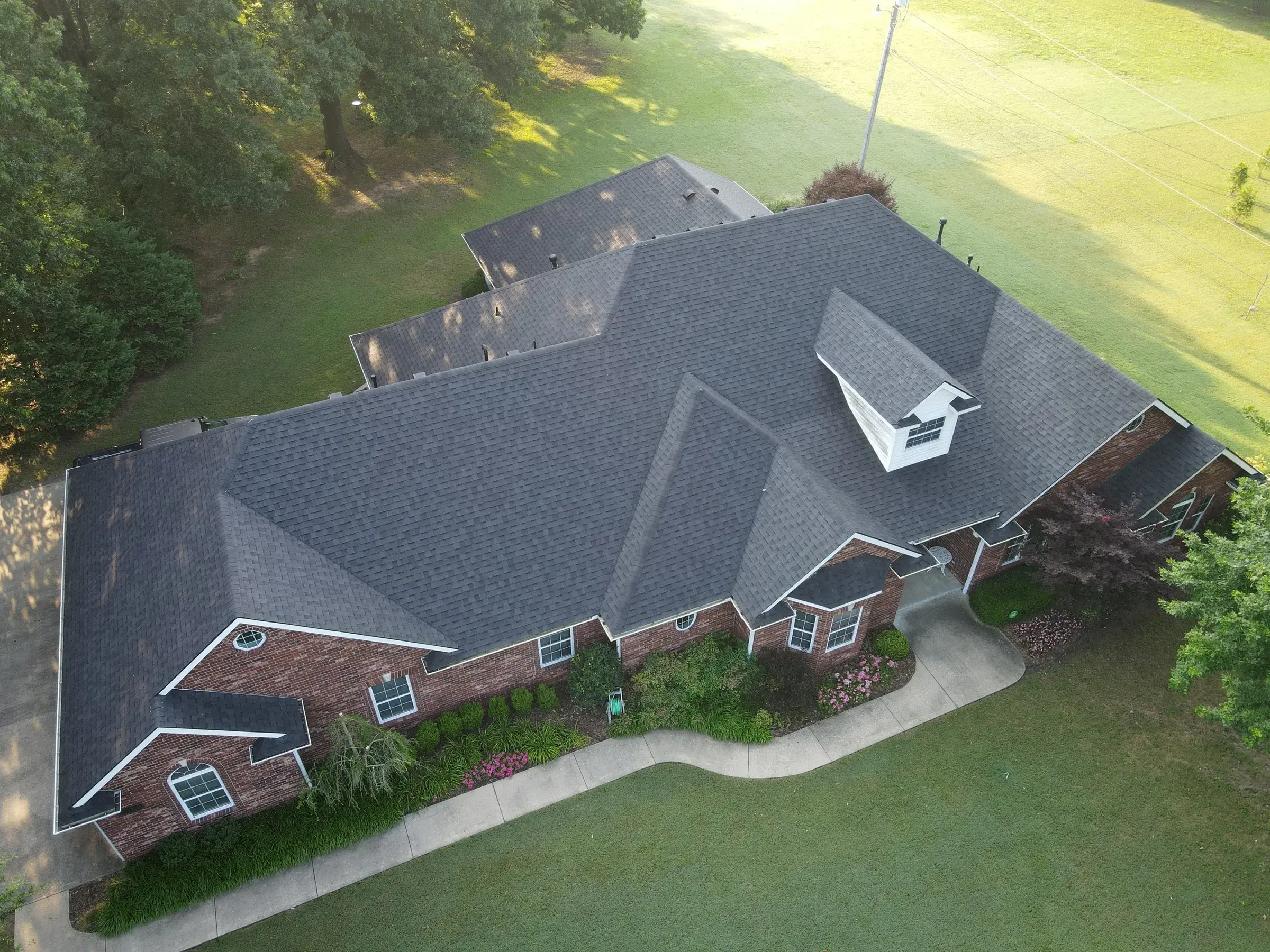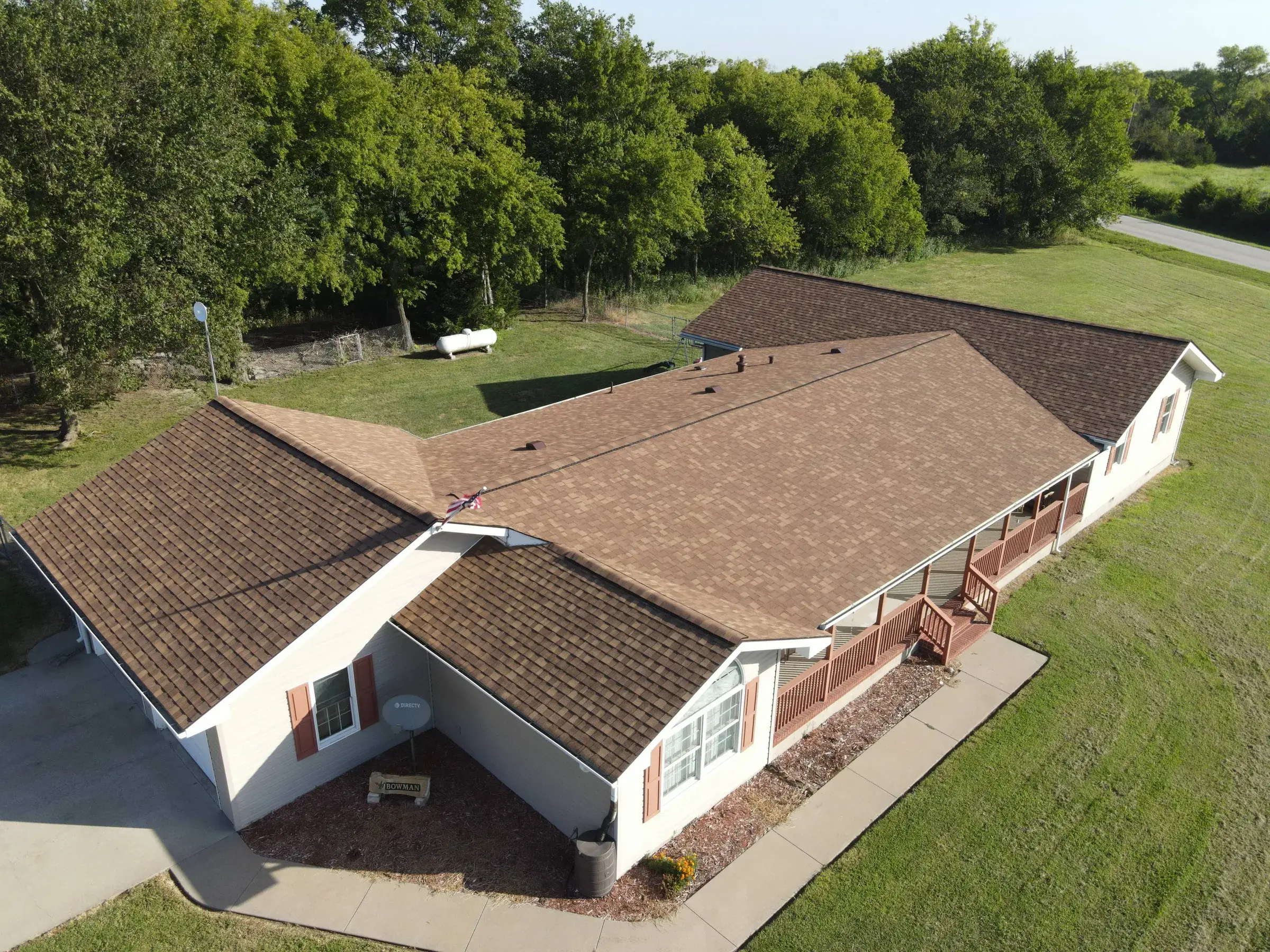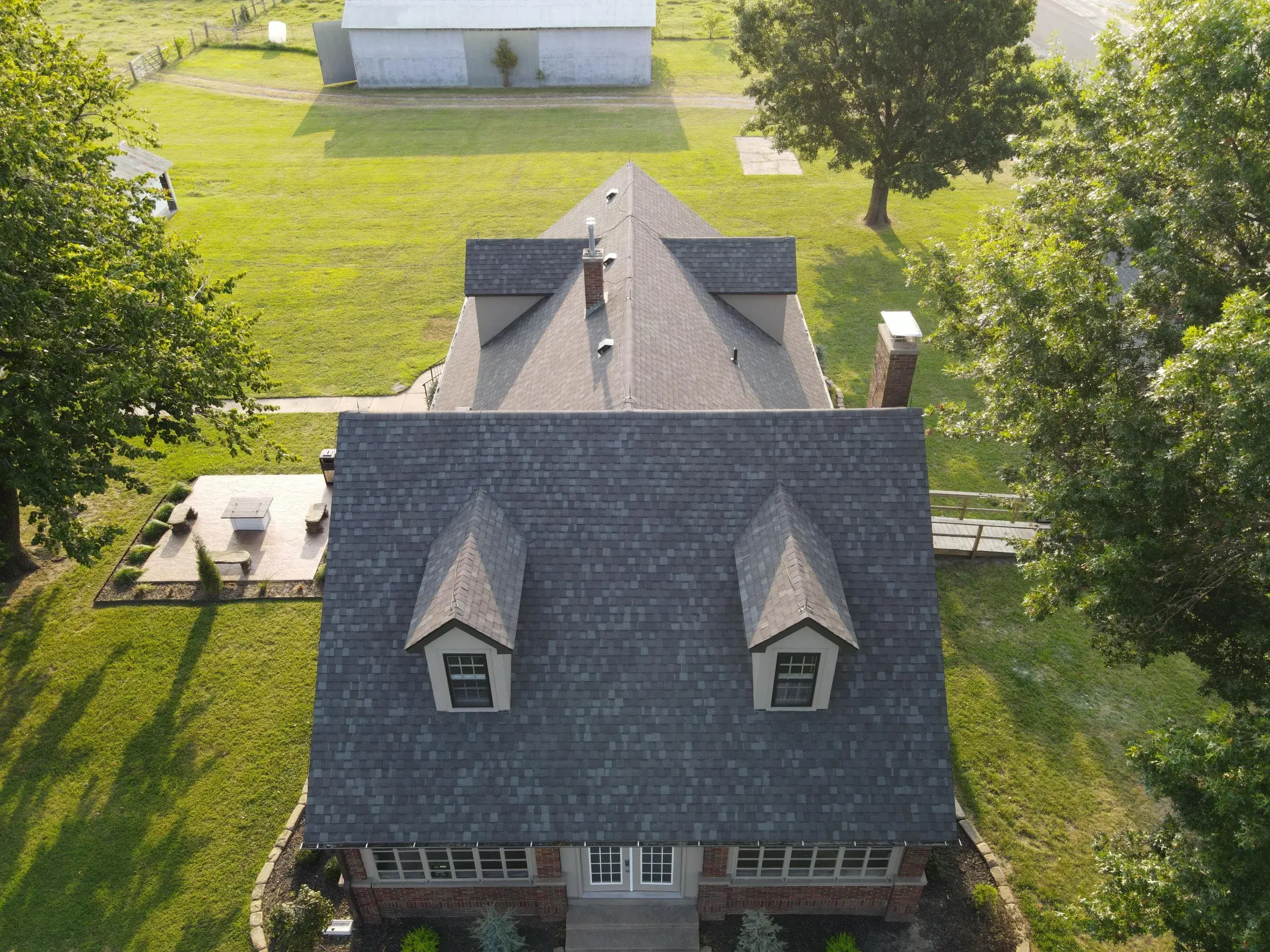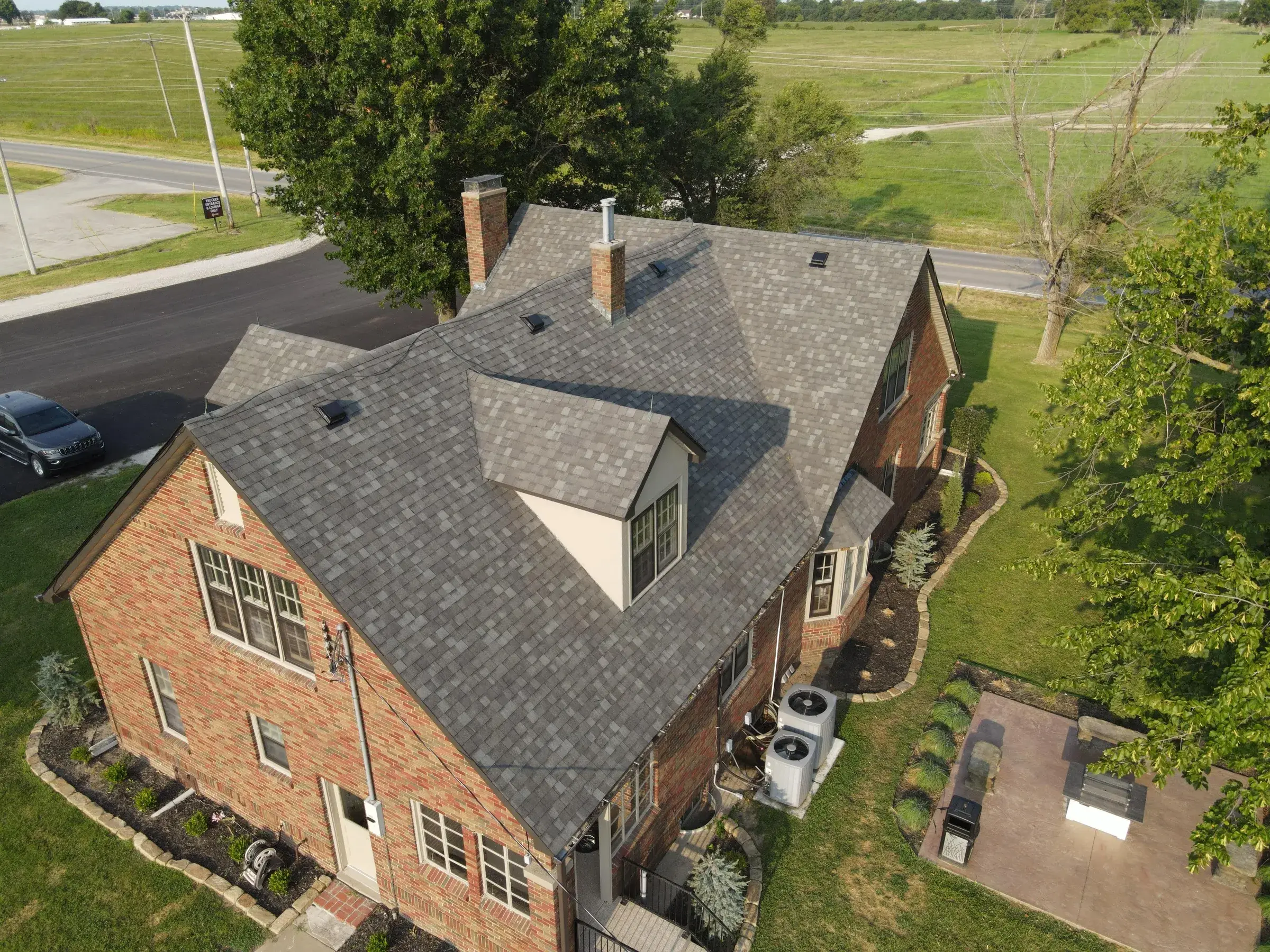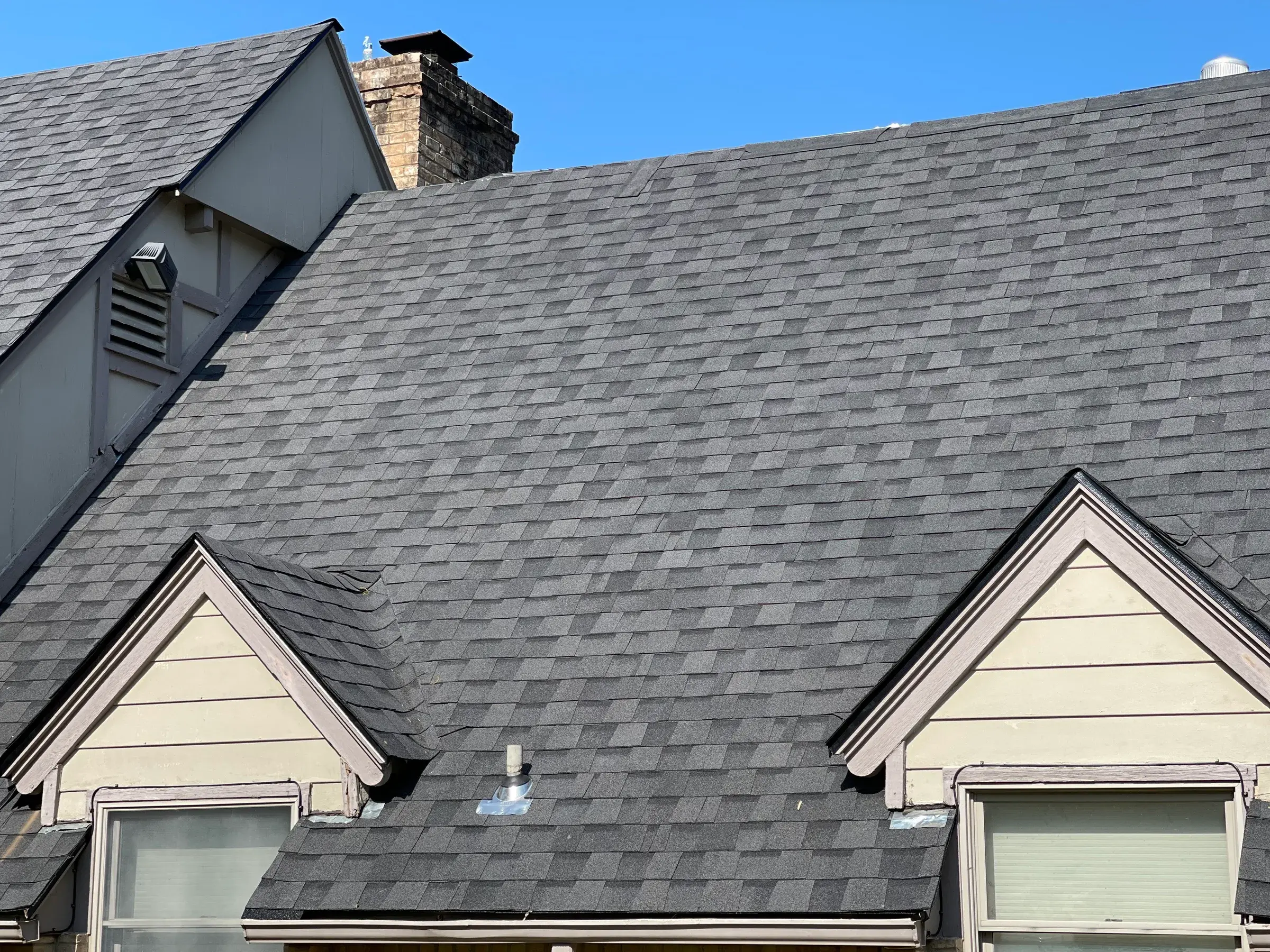
Keep tree limbs at least six to ten feet back from the roof surface where you can. Overhanging branches abrade shingle granules in wind, drop leaves that hold moisture in valleys, feed gutter clogs, and give squirrels and raccoons a bridge to your soffits. Falling limbs during ice storms are the bigger northeast Oklahoma risk.
How much clearance is actually enough — and why "touching the roof" is the wrong threshold
Most homeowners use one test: is the branch touching the roof? If it isn't, they leave it alone. That test fails because it's run on a calm day. Wind moves branches. A limb hanging three feet above the shingles in still air is lying flat on them in a 40 mph gust, sweeping back and forth for the length of the storm.
The working number is six to ten feet of lateral clearance between branch tips and the roof surface. That range comes out of pruning and clearance guidance from the International Society of Arboriculture, and it exists to account for deflection — how far the branch travels when it's loaded with wind, rain, or ice. Six feet is usually enough for a stiff, short-limbed tree. Ten is closer to right for something long and whippy like a silver maple or an elm.
The three zones that matter
| Zone | What it covers | Target | Why it matters |
|---|---|---|---|
| Lateral clearance | Branch tips to the nearest roof edge, wall, or slope — measured on a still day | 6–10 feet | Accounts for deflection. A limb inside this range will contact the roof during a storm even if it never touches in calm weather. |
| Overhead canopy | Foliage directly above the roof plane, at any height | Thin it — you rarely need to remove it | Canopy shades the deck and drops debris. Shade slows drying and feeds moss on north slopes. The fix is selective thinning, not clear-cutting a shade tree you like. |
| Strike zone | A circle around the trunk roughly equal to the tree's height | Know what's inside it | This is where a failed limb or a broken leader lands under ice or wind load. If your roof sits inside it, the tree is a structural question — not a trimming question. |
The strike zone is the one people skip, and it's the one that costs money. A limb does not have to be over your roof to end up on it. A sixty-foot pin oak forty feet from the house has never touched the shingles in its life and can still drop a leader through the deck. Walk the yard and ask which trees are tall enough to reach the house if they let go. That list is short, and it tells you where your real money should go.
Abrasion: what a branch does to granules over a windy season
The colored granules on an asphalt shingle aren't decoration. The Asphalt Roofing Manufacturers Association describes them as the shingle's shield — the layer that keeps ultraviolet light off the asphalt underneath. Strip the granules and the asphalt is exposed. Exposed asphalt dries out, hardens, and cracks. That's the whole failure chain, and it's short.
It matters more here than people assume. The Oklahoma Climatological Survey puts Miami at roughly 62% of possible sunshine over a year, with 57 days above 90°F and August daily highs normally around 91.5°F. That's a real UV and heat load on a black roof. A branch that scrubs a bare patch into your shingle isn't just cosmetic damage — it's opening a hole in the only thing protecting the asphalt from that load.
Abrasion has a signature. Look for a fan-shaped or arc-shaped scuff, wider at one end, following the sweep of the branch. The granules aren't gone in a random scatter — they're gone in a shape. If you see dark asphalt showing through in an arc and there's a limb above it, you've found your answer. You'll usually also find a pile of granules directly below in the gutter.
Where you live in Ottawa County changes the picture. The east side sits on the Ozark Plains — rockier, wooded, rolling, more canopy, more debris. The west side is Neosho Lowlands, flat prairie and farmland with long open wind fetch. East-county homes have more branches close to the roof; west-county homes have fewer trees but the wind hits harder when there is one. Both problems are real. They just need different answers.
Debris in valleys and behind chimneys: the slow moisture problem
A valley is where two roof planes meet — the V-shaped channel that carries water down. It is the busiest square footage on your roof, and it's exactly where leaves collect. Once a valley packs with wet leaf litter, water backs up sideways, gets under the shingle edge, and stays there.
The upslope side of a chimney is the other collector. Water and debris hit the chimney and stop. Well-built chimneys have a cricket — a small peaked structure behind the chimney that splits water around both sides — but a cricket buried in leaves doesn't split anything. It's just a dam with a nice shape.
Now add the freeze cycle. The Oklahoma Climatological Survey counts 89 nights a year below freezing in this area. That's not a deep freeze — that's a repeated freeze. Wet debris in a valley freezes solid overnight and thaws the next afternoon, over and over, and the water it holds gets pushed into every seam it can reach. A dry roof shrugs off cold. A roof with wet packed debris on it does not.
Gutters, downspouts, and the compounding effect of tree cover
Tree cover and gutter trouble aren't two problems. They're the same problem billed twice. Every leaf and twig the canopy drops has one place to go, and it's your gutter.
A clogged gutter overflows at the back edge as often as the front. When it goes over the back, water runs down the fascia — the board the gutter hangs on — and into the soffit. That's how tree cover turns into rotted fascia and a sagging gutter that needs rehanging, not just cleaning. If your trees are close enough to touch the roof, twice a year is a starting point, and our guide to [how often to clean gutters in northeast Oklahoma](/blog/how-often-to-clean-gutters-northeast-oklahoma) works through the timing. If you'd rather not be on a ladder for it, [gutter cleaning](/services/gutter-cleaning) is something we handle.
Two things worth checking that people forget. First, downspouts clog separately from gutters — a gutter can be spotless and the downspout still packed solid at the elbow. Second, silver maple samaras and elm seed actually sprout in a gutter full of decomposed leaf mulch. A small tree growing in your gutter is a sign it's been full for at least a year.
Wildlife bridges: squirrels, raccoons, and soffit damage
An overhanging limb is a road. Squirrels don't climb your siding — they walk across the branch and step off onto the roof edge. Cut the road and you cut most of the traffic. Squirrels are good jumpers, so clearance reduces access rather than eliminating it, but the six-to-ten-foot range makes your roof a much less convenient place to live.
The damage shows up at the edges, not in the field of the roof. Squirrels work at the soffit — the underside panel where the roof overhang meets the wall — and at the gable vent, chewing at any seam that's already loose. Raccoons are heavier and blunter about it. They'll pull up a whole section of drip edge or lever a soffit panel to get into the attic, and they're strong enough to do it in one night.
If you hear something moving in the attic, deal with the animal first and the roof second. Sealing an entry point with a raccoon still inside gets you a worse hole than the one you started with. Once the attic's clear, the entry point needs closing properly — and the limb that got them there needs to go, or you'll do it again next year.
The ice storm factor — why NE Oklahoma tree cover is a structural risk, not just a nuisance
Everything above is maintenance. This part is different. In an ice event, the tree over your house stops being a debris source and becomes a load.
Here's the mechanism, and it's worth understanding because it's counterintuitive. Freezing rain doesn't pile up like snow. It coats — every twig, every branch, on every surface, in a shell. What decides how much ice a tree carries isn't the size of the trunk. It's the total surface area of the crown. A tree with thousands of fine twigs collects far more ice than a tree with a few thick limbs, which is why the delicate-looking ornamental in the front yard is often the one that comes apart first. The National Weather Service office in Tulsa maintains the ice storm climatology for northeast Oklahoma, and it's the right source if you want to understand what this region actually gets — accumulation thresholds, not folklore.
Species matters more than size. Oklahoma Forestry Services and OSU Extension publish guidance on which trees are prone to storm breakage and how to prune for it. Look up what's actually in your yard before you decide what to cut. Weak-wooded, fast-growing species with tight branch unions fail early and predictably; slow, dense hardwoods usually don't. That's a free piece of research that tells you where to spend your trimming budget.
The Insurance Institute for Business & Home Safety includes vegetation management in its guidance for protecting a roof, and the reason is simple: a limb strike is one of the few things that can punch through a deck in a single second. Everything else on your roof degrades over years. This one doesn't. Ice is also why tree cover belongs in the same conversation as the rest of your cold-weather checklist — our notes on [winter roof prep and ice dams](/blog/winter-roof-prep-and-ice-dams-in-northeast-oklahoma) cover the roof side of it.
Trimming safely and when to call an arborist instead of a roofer
Let's be direct about scope: we don't trim trees. We're a roofing contractor. When a limb needs to come off over your house, that's a job for a qualified arborist — specifically an ISA Certified Arborist, a credential from the International Society of Arboriculture that means the person has been tested on pruning standards and tree risk assessment. That's not a formality. Bad pruning cuts create decay pockets that make a tree more likely to fail, not less. You can pay someone to make your tree more dangerous.
Small stuff you can handle from the ground with a pole saw is fine. The line we'd draw: if the cut is above your head, over the roof, or requires you to be on the roof or a ladder to reach it, you're past the point where it's worth it. Our piece on [when to stay off the roof](/blog/roof-safety-for-homeowners-when-to-stay-off-the-roof) goes through the reasoning. A pole saw on a sloped roof is a bad combination — you're pushing upward on an overhead load while standing on a surface designed to shed things.
| Task | Arborist | Roofer | Notes |
|---|---|---|---|
| Judging whether a tree is likely to fail | Yes | No | Tree risk assessment is a defined arborist discipline. We can tell you a limb is over your roof; we can't tell you whether it's sound. |
| Pruning or removing limbs over a roof | Yes | No | We do not trim or remove trees. Rigging a limb down over a roof without damaging the roof is a skill of its own. |
| Removing a fallen limb from a roof | Usually | Sometimes | Depends on weight. Anything that needs rigging is a tree service call. A small branch we can clear while we're up there. |
| Deciding whether the roof deck is compromised | No | Yes | The impact point is often smaller than the damaged area. This is a roof question. |
| Emergency tarping after a puncture | No | Yes | Stopping water is the roofer's job, and it's the first job. |
| Clearing valleys, gutters, and behind the chimney | No | Yes | Routine roof maintenance. |
| Photo documentation and a written repair estimate | No | Yes | For your own records and your carrier's file. |
| Roots, soil heave, or a leaning trunk | Yes | No | Nothing to do with the roof, but it's the same tree. |
After a limb hits: documenting damage and what happens next
If a limb comes down on your roof, the order is: make sure everyone's safe, stop the water, then document. Not the other way around. Water in the attic for two days does more damage than the limb did.
Documentation isn't paperwork — it's the record of what the roof looked like before anyone touched it, and it's gone the moment the limb gets dragged off. Do this from the ground. Do not climb up to get a better picture. [Emergency roof tarping](/services/emergency-roof-tarping) is something we do, and a tarp is what buys you the time to do the rest of this properly.
Post-limb-strike documentation checklist
- Photograph the limb exactly where it landed, before anyone moves it — one wide shot with the tree, the house, and the limb all in frame
- Take ground-level photos from all four sides of the house. Use your phone's zoom, not a ladder
- Photograph the ceilings and walls of every room below the impact, even where the drywall still looks clean
- Check the attic in daylight with a flashlight. Daylight showing through the deck is the clearest evidence of a puncture
- Photograph any wet or matted insulation and note where it sits relative to the impact point
- Preserve the original photo files — don't screenshot or re-crop them. The originals carry the date and time automatically
- Write down the date, time, and the weather while you still remember it clearly
- Keep receipts for anything you buy to prevent further damage: tarps, plastic sheeting, buckets, boards
- Don't dispose of the limb or the broken shingles until your insurer has seen them or told you they don't need to
- Report the loss to your insurance company yourself. You're the policyholder — reporting it is yours to do
- Get a written estimate for the repair work and put it in the file with the photos
On the repair itself: the visible hole is often the smallest part of it. A limb strike transmits force through the deck, and we regularly find cracked sheathing and broken fasteners well outside the impact point. That's why a [roof repair](/services/roof-repair) after a limb strike starts with an assessment of the deck, not just the shingles. If nothing obviously broke but you want to know for sure, a [roof inspection](/services/roof-inspections) is free, and so is the quote that follows it.
One code note worth knowing before anyone tells you they'll just shingle over the damage: Oklahoma amended the residential code (IRC R908.3.1.1) to require tear-off rather than shingle-over in defined conditions. And within the City of Miami, a permit is required for a new roof or a re-shingle. We pull it.
Species notes: what grows around Ottawa County and how each behaves
You don't manage "trees." You manage the specific trees in your yard, and they behave very differently. Ottawa County's east side runs to oak-hickory woodland off the Ozark Plains; the west is open lowland where the trees are mostly planted, mostly around houses, and mostly fast-growing species someone chose for shade in a hurry. Here's what that means on a roof.
| Tree | Debris it drops | Behavior under ice | Clearance priority |
|---|---|---|---|
| Post oak / blackjack oak | Small leathery leaves, acorns, steady twig fall | Strong, dense wood. Holds ice comparatively well; risk is old, long, low limbs | Medium |
| Pin oak | Heavy leaf drop that hangs on well into winter, so it sheds all season | Dense mass of fine twigs collects a lot of ice; lower limbs already droop toward the house | High if it's over the roof |
| Silver maple | Constant twig litter and samaras that sprout in gutters | Classic weak-wooded, fast-growing species — among the first to break | High |
| Bradford / Callery pear | Fine twigs, small hard fruit | Tight, crowded branch unions split at the crotch under load. Frequently fails completely | Highest — usually a removal conversation, not a trimming one |
| Hackberry | Berries that stain and get tracked inside, brittle twig fall | Brittle wood; sheds limbs in wind and worse in ice | High |
| Eastern redcedar | Fine scale litter that mats and packs into valleys | Evergreen surface holds ice and snow all winter instead of dropping it | Medium-high — the litter is the bigger problem, not the strike |
| Cottonwood / sycamore | Big leaves that mat solid, bark plates, seed fluff | Fast-grown wood on very large limbs. When one fails, it's heavy | High — these are deck-puncture limbs |
| Pecan / black walnut | Nuts (impact plus gutter clogs), heavy compound leaves | Known limb-shedders under ice load | High |
Two takeaways from that table. First, the trees most likely to hurt your roof are usually the ones planted closest to it, because fast-growing shade species are what people plant next to houses. Second, the mature native oak at the back of the lot that everyone worries about is often the safest tree you own.
If you're not sure what you've got, Oklahoma Forestry Services and OSU Extension are the right place to identify it and to check its storm record before you spend money on a tree service.
If a limb's already come down, or you want to know what years of branch contact have done to the slope you can't see from the ground, we'll come look. We're at 111 S Main St in [Miami, Oklahoma](/locations/miami-ok), and inspections and quotes are free. Oklahoma requires roofing contractors to register with the Construction Industries Board, and residential registration requires at least $500,000 in liability coverage — you can verify any contractor, including us, at verifyroofing.cib.ok.gov before you let them on your roof. Call (209) 758-8550.
Questions people ask about this
How far back should I trim branches from my roof?
Six to ten feet of lateral clearance between the branch tips and the roof surface, measured on a calm day. The range exists because branches deflect — a limb three feet above the shingles in still air lands on them in a gust. Use the shorter end of the range for stiff, short-limbed trees and the longer end for whippy species like silver maple or elm. Pruning and clearance guidance from the International Society of Arboriculture is the standard reference here.
Do I have to remove the tree, or is trimming enough?
It depends on whether your roof is inside the strike zone — a circle around the trunk roughly equal to the tree's height. If the tree is shorter than its distance from the house, trimming the overhang solves the problem. If it's tall enough to reach the house when a limb fails, trimming reduces the debris but not the structural risk, and that's a conversation for a certified arborist. Species matters too: some trees with tight branch unions are known to split under ice regardless of how well they're pruned.
A limb hit my roof but I don't see a hole. Do I need an inspection?
Probably, yes. The impact point is usually smaller than the damaged area — force travels through the deck, and cracked sheathing or broken fasteners often sit well outside the visible mark. Check your attic in daylight first; light showing through the deck means a puncture. Either way, our inspections and quotes are free, so there's no cost to finding out.
Will my insurance cover a tree limb hitting my roof?
Your insurer decides coverage under your policy — nobody else can tell you what your policy does. What you can control is the record. Photograph the limb where it landed before anyone moves it, document the interior and attic, keep the original photo files, and report the loss to your carrier yourself. We'll document the damage with a photo report and provide a written estimate for the work we'd perform, and we can meet your adjuster on site if you ask. In Oklahoma, a contractor who represents your interests to your insurer for compensation is acting as a public adjuster, which requires a licence we don't hold and don't claim to.
Do you trim trees or remove limbs from my roof?
We don't trim or remove trees — that's a qualified arborist's work, and bad pruning cuts can make a tree more likely to fail. If a small branch is on the roof while we're working, we'll clear it. Anything that needs rigging goes to a tree service. What we do handle is the roof side: emergency tarping to stop water, assessing the deck, clearing valleys and gutters, and the repair itself.