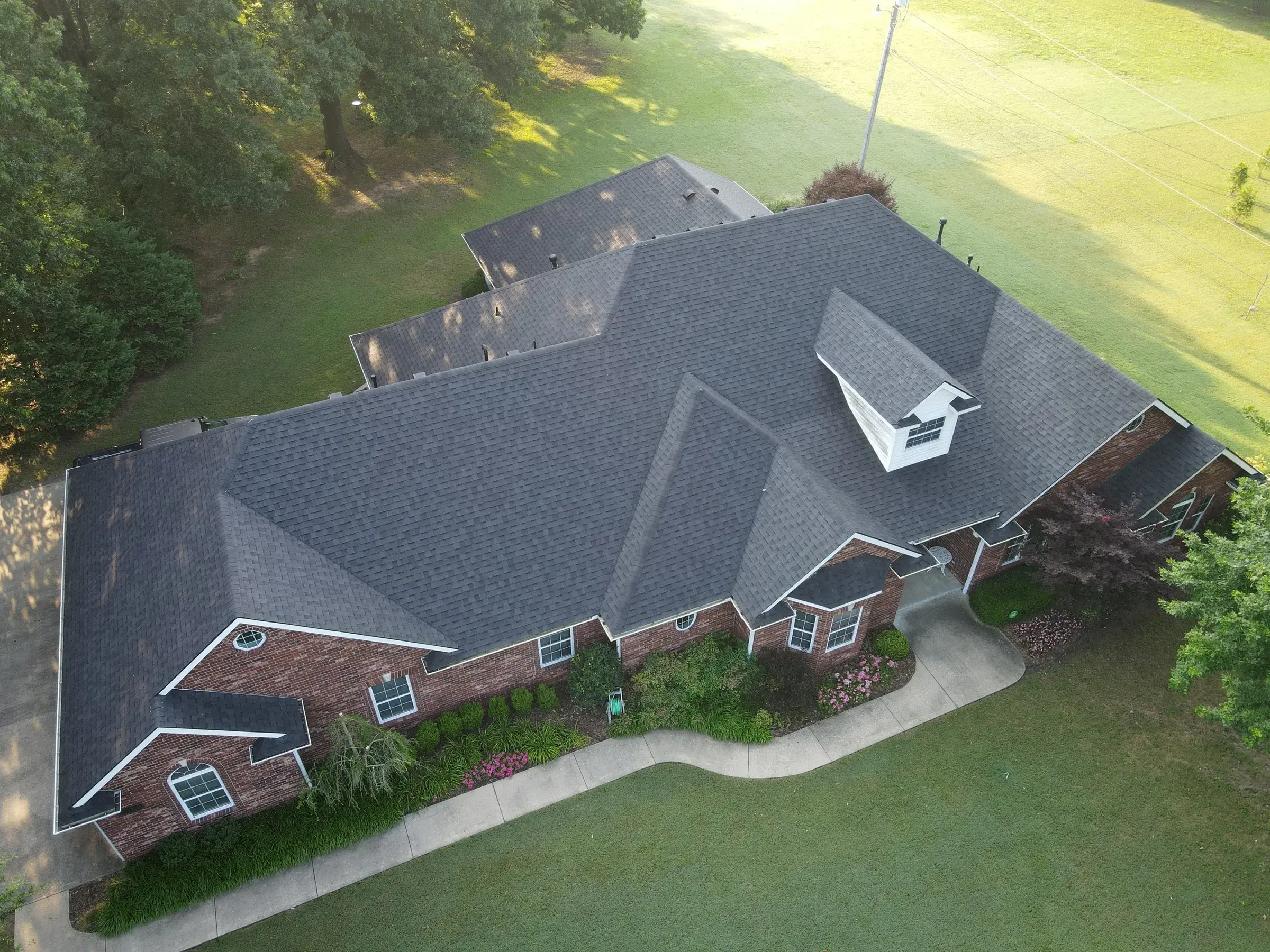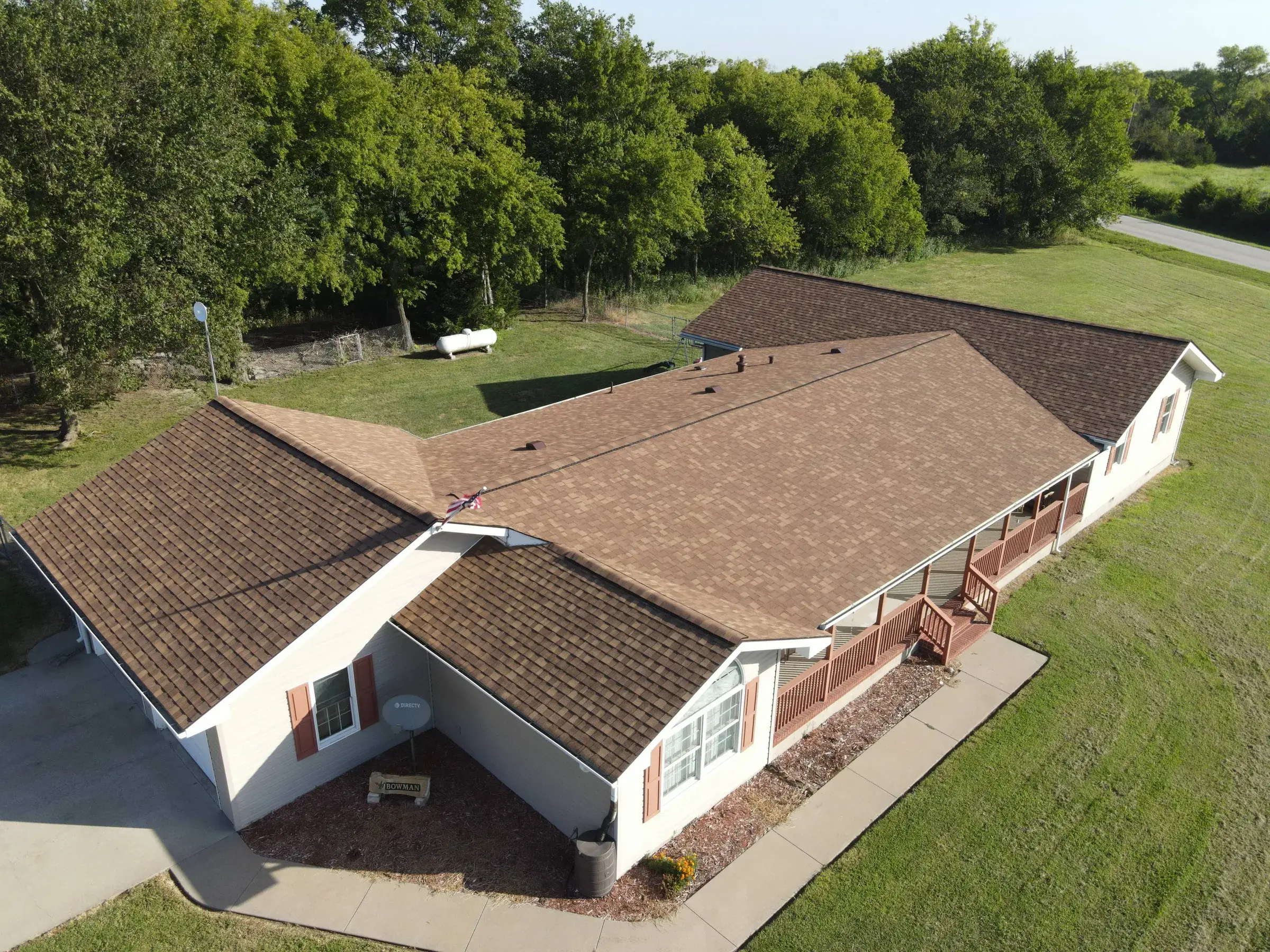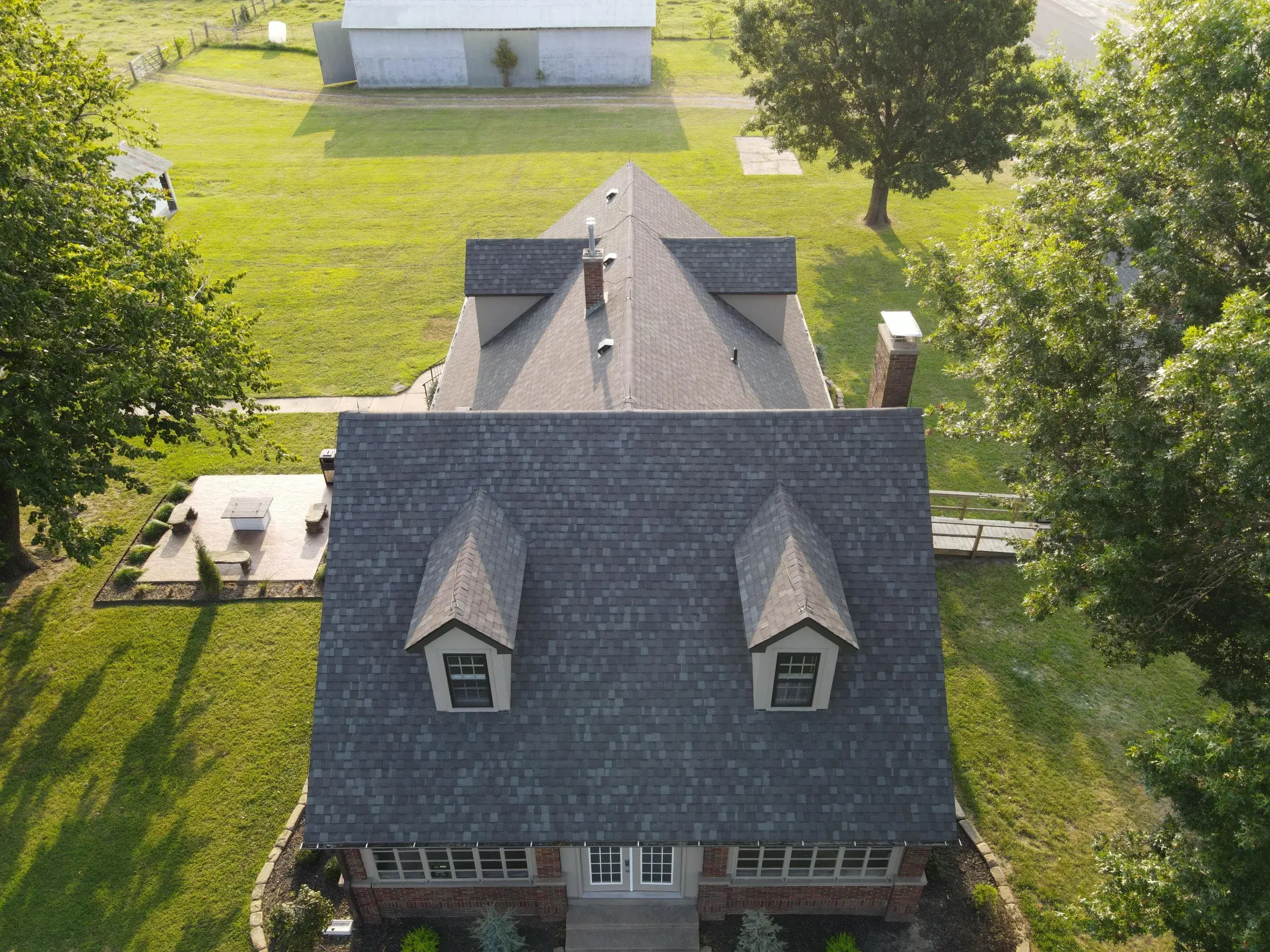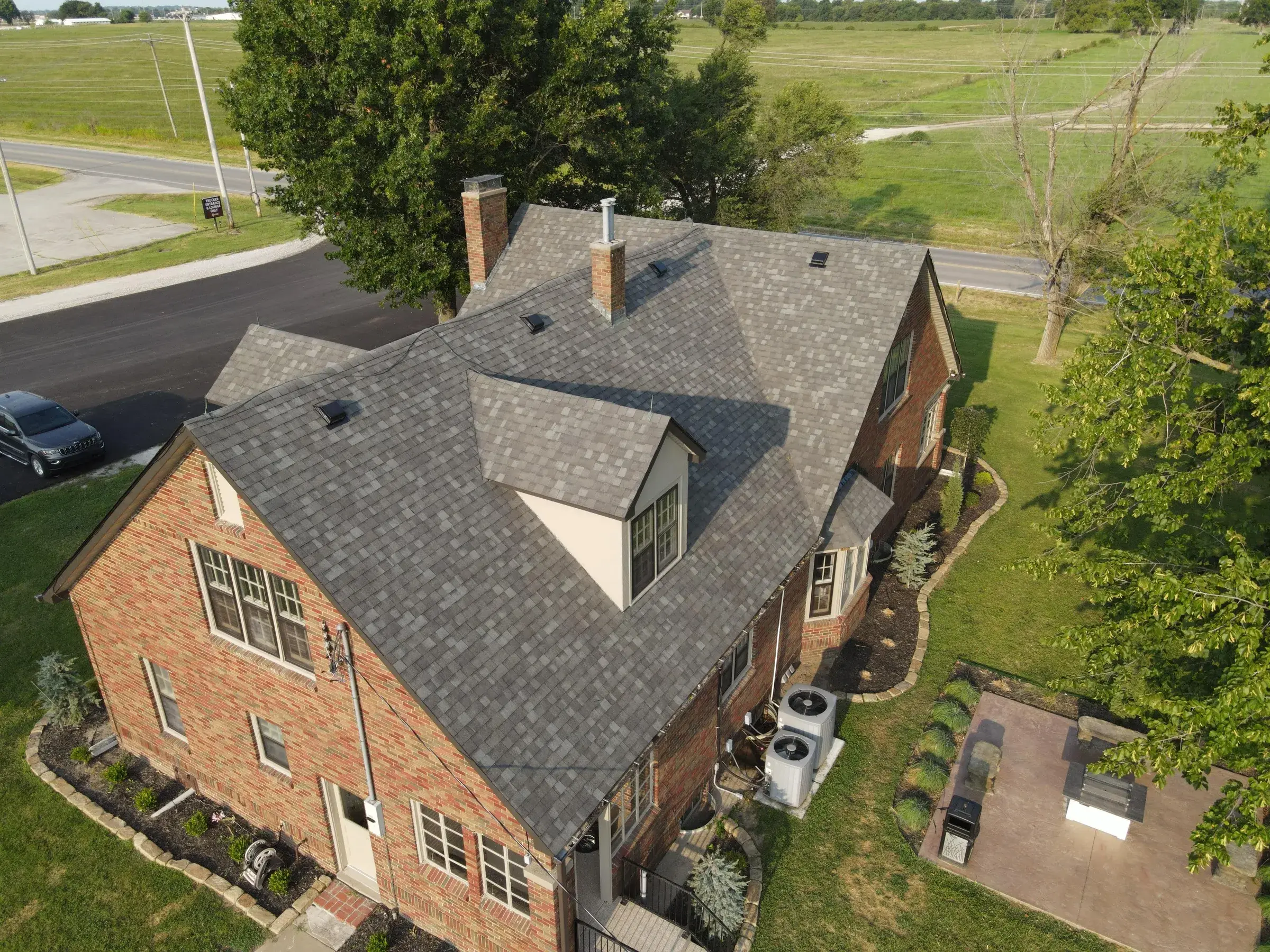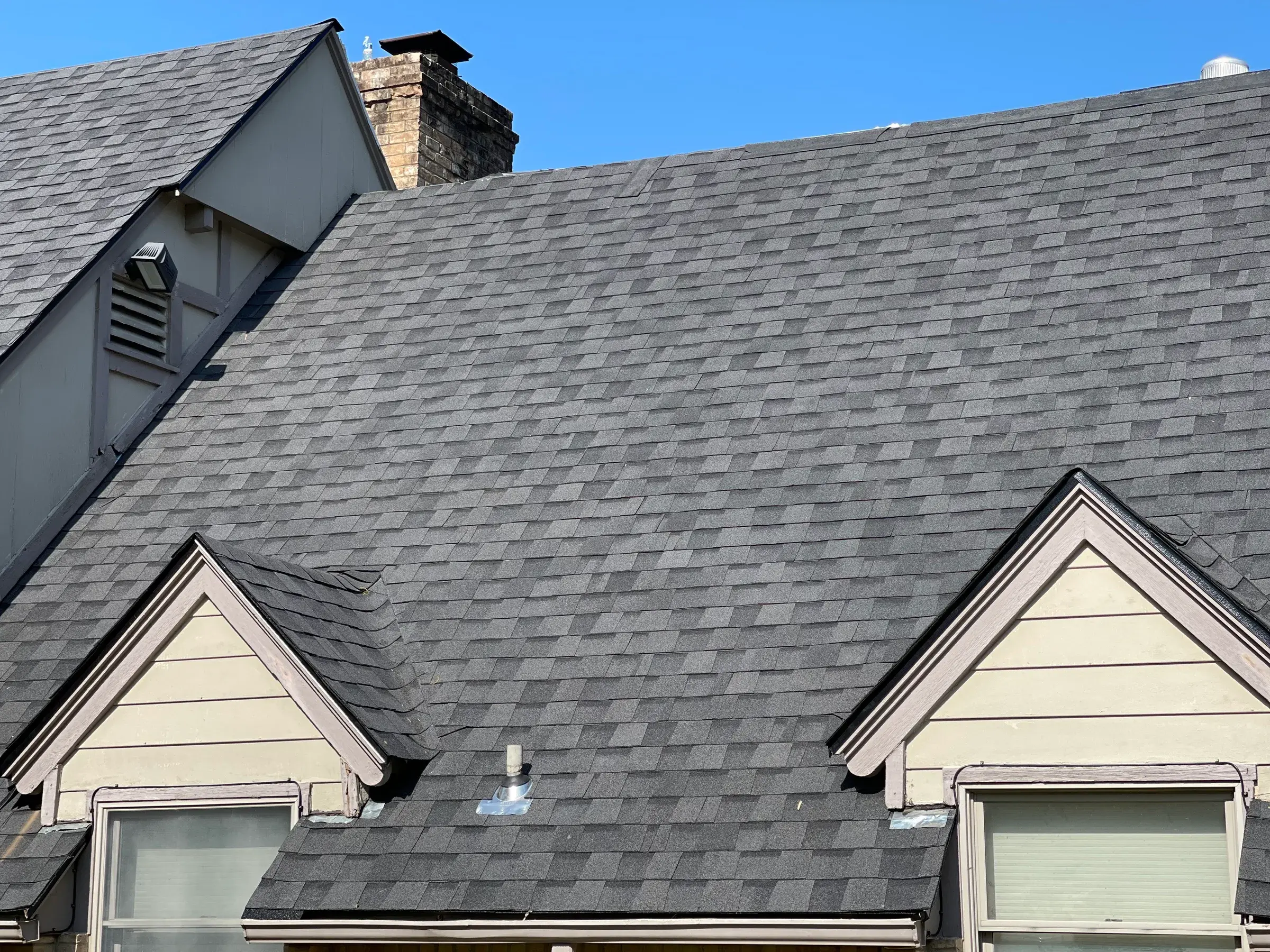
Prepare a northeast Oklahoma roof for winter by clearing gutters completely, verifying attic insulation and ventilation, sealing air leaks from the living space into the attic, and checking pipe boots and flashing while it is still warm enough for sealant to cure. Ice dams here form from heat escaping the attic, not from cold weather alone.
What an ice dam actually is, in one diagram
An ice dam is a ridge of ice at the cold edge of a roof that stops meltwater from draining off. Water pools behind it and sits there. That is the whole problem in one sentence — asphalt shingles are designed to shed water moving downhill, not to hold back standing water. Give water time and depth, and it will travel up under the shingle courses and find the nail holes.
The sequence is always the same, and it happens in this order every time.
| Stage | Where it happens | What's going on | Why it matters |
|---|---|---|---|
| 1. Heat collects | Attic, against the underside of the roof deck | Warm air escaping the living space rises and pools at the peak of the attic, warming the plywood above it | The deck can sit above 32°F while the outdoor air is in the twenties |
| 2. Melt | The upper and middle roof field | Snow or glaze ice melts from underneath, against the warm deck | You can't see it. There's no warning from the ground |
| 3. Refreeze | The eave — the overhang past the exterior wall | There's no heated attic under an overhang, so that deck is at outdoor temperature. The runoff hits it and freezes | A ridge of ice builds along the eave and in the gutter |
| 4. Backup | Behind the ice ridge | Each melt cycle adds water. It pools, sometimes inches deep, and creeps up under the shingle laps | Standing water gets to the nail penetrations. Shingles were never the barrier here |
| 5. Leak | Inside — ceiling near an exterior wall, wall tops, window headers | Water runs down rafters and framing before it drops | The stain shows up several feet from where the water actually got in |
Icicles hanging off the gutter aren't the ice dam. They're the receipt. They tell you meltwater is running off a roof that shouldn't be melting.
Why it's an attic problem, not a weather problem
Two houses on the same street, same storm, same shingles. One grows a foot of ice along the eave and one stays clean. The weather was identical. The difference was inside the attic.
An ice dam requires two temperatures on one roof at the same time: the field above the heated space warmer than 32°F, and the eave colder than 32°F. Cold alone can't do it. Take the heat out of the attic and the whole mechanism stops — the roof stays uniformly cold, the snow just sits there, and it leaves the way it arrived.
The U.S. Department of Energy's guidance on attic air sealing and insulation names the two culprits in that order: air leaking from the house into the attic, then insulation that's too thin or unevenly spread. The Insurance Institute for Business and Home Safety (IBHS) lands in the same place in its winter weather material — air sealing, insulation, and ventilation are the prevention, and everything else is damage control.
Roofers have a name for the goal: a cold roof. You want the deck to be as close to the outdoor temperature as the physics will allow. That sounds backwards to most homeowners, and it's the single most useful idea on this page.
NE Oklahoma's specific pattern: ice storms and freeze-thaw swings, not deep snowpack
Most ice dam advice online is written for Minnesota, where two feet of snow lands in December and stays until March. That is not this market, and copying that advice leads people to the wrong conclusions.
The National Weather Service office in Tulsa, which covers Ottawa County, describes a northeast Oklahoma winter climatology built around freezing rain, sleet, and mixed precipitation events rather than sustained deep snow. Glaze ice is the regional signature. And the Oklahoma Climatological Survey's 1991–2020 normals for the Miami area count 89 nights a year below freezing — with daytime highs that routinely climb back above it. That's not a deep freeze. That's a freeze-thaw machine running most of the winter.
So the local version of this problem looks different. You do not need a snowpack. An inch of crusted snow, or a half-inch glaze layer, sitting on a deck that's being warmed from below is enough to start a dam. Then the afternoon warms up, the ice sheds partway, the night refreezes it, and you get another cycle. The cycles are what do the damage — each one pushes water a little further up under the shingles.
Geography inside the county matters too. East Ottawa County is Ozark Plains — rolling, rocky, heavily wooded. North-facing slopes there stay shaded through short winter days, so ice that melts off the south side hangs on for another day or two on the north, and the tree canopy keeps filling the gutters. West of Miami you're in the Neosho Lowlands: flat, open prairie with real wind fetch. Wind strips snow off the open roof field and redeposits it in valleys, behind chimneys, and against dormers — exactly the spots where a dam has something to build against.
One more local note. Manufactured and mobile homes are 12.2% of Ottawa County's 13,701 housing units. Those roofs have little to no attic depth to work with, so the air sealing and insulation levers below are shorter. The gutter and ventilation checks still apply.
The four prep tasks, in order: gutters, air sealing, insulation, ventilation
The order isn't arbitrary. Do them out of sequence and you pay for work that doesn't help.
1. Gutters and downspouts — clear them completely
A gutter packed with wet leaves freezes into a solid block, and that block is a starter kit for a dam sitting right at the coldest part of the roof. Clear the troughs, then check the downspout throat — that's where the plug usually is. Run water through and watch it come out the bottom. If the yard has hardwoods, this is the job you'll do twice, and it belongs with the rest of your fall roof maintenance work rather than in January. We do this as a standalone service too if the ladder isn't your thing.
2. Air sealing — stop the heat at the ceiling plane
This is the step that actually prevents dams, and it's the one nearly everybody skips. It gets its own section below.
3. Insulation — even depth, and don't smother the intake
Insulation slows heat that's already been sealed against. Applied over unsealed gaps, it just becomes an expensive air filter — you'll see it go grey and dirty where air is moving through it. Walk the attic and look for thin spots, compressed batts, and bare patches near the eaves where somebody stepped. The most common thing we find: insulation shoved out over the top plate and into the soffit, blocking the intake vents completely. Baffles hold it back and keep that channel open.
4. Ventilation — balanced, low intake and high exhaust
Ventilation flushes out whatever heat and moisture make it past the first three steps. It works by moving outdoor air in low at the eaves and out high at the ridge. Here's the quick reference.
| Term | What it means | What goes wrong in the field |
|---|---|---|
| Net free area (NFA) | The actual open square inches of a vent, not the size of the hole it covers | A vent's louvers and screen eat most of its area. Paint over it and the NFA goes to nearly zero |
| 1:150 | The baseline in the International Residential Code's attic ventilation section (R806): 1 sq ft of net free area per 150 sq ft of attic floor | Homeowners measure the vent, not the NFA, and come up short |
| 1:300 | The reduced ratio the code allows with a Class I or II vapor retarder on the warm side, or when 40–60% of the required NFA sits in the upper portion of the attic with the rest at the eaves | People claim the 1:300 credit without meeting either condition |
| Intake | Low, at the soffit or eave | Blocked by insulation, painted shut, or never cut in behind a decorative soffit panel. The most common failure by far |
| Exhaust | High, at or near the ridge | Ridge vent nailed on with no slot cut in the deck underneath it, or a slot too narrow to matter |
| Balance | Intake at least equal to exhaust | An exhaust-heavy attic can't find air at the soffit, so it pulls conditioned air up through the ceiling — heating the deck, which is the exact thing you're trying to stop |
Air sealing is the step people skip — where attic bypasses hide
A bypass is any hole that lets air move from the conditioned house into the attic. They're rarely one big obvious gap. They're a dozen small ones adding up, and they're almost all hidden under insulation.
Two tricks for finding them without a blower door. Look for dirty insulation — grey or dark streaks mean air has been filtering through that spot for years. And on the first hard freeze, go up early in the morning and look at the underside of the deck: frost patterns mark exactly where moist indoor air is arriving.
Attic bypass checklist — walk the attic with this
- Recessed can lights: older non-IC housings leak straight up. Check for an IC-AT rating stamped inside; if it isn't there, use a rated airtight cover and keep insulation clearance per the fixture's listing
- Bath exhaust fans: follow the duct. If it dumps into the attic — or into a soffit, which just re-enters at the intake vent — it needs a dedicated roof or gable cap with a damper
- Kitchen range hood and dryer ducts terminating inside the attic (same fix, same reason)
- Top plates: the gap where interior wall framing meets the ceiling drywall, running the length of every wall. Pull the insulation back and look. This is usually the biggest total leak in the house
- Chimney and flue chases: the gap around the pipe needs sheet metal and a high-temperature sealant rated for it — never spray foam, never fiberglass stuffed in
- Attic hatch or pull-down stairs: weatherstrip the perimeter and build or buy an insulated rigid foam box over it. An uncovered pull-down is a hole in your ceiling
- Plumbing vent stack penetrations through the top plate
- Wiring and ductwork penetrations, including HVAC duct boots seated in the ceiling
- Dropped soffits above kitchen cabinets and bathtub surrounds — these are usually open cavities running right up into the attic
- Knee walls and the transitions where a cathedral ceiling meets a flat attic
One more reason to care: the same air leaks that build ice dams in January are what drive attic moisture and condensation problems the rest of the year — a real issue in the low-lying neighborhoods near the Neosho. Sealing them pays twice.
Pipe boots, flashing, and why sealant work has a temperature deadline
A pipe boot is the rubber collar that seals around a plumbing vent pipe where it comes through the roof. It's the shortest-lived part on most roofs. Miami gets roughly 62% of possible sunshine annually, and that ultraviolet load cooks the rubber until the collar cracks around the pipe. Winter makes it worse in a specific way: warm, humid air rises up the vent stack from the house, hits the cold pipe, and condenses right where the boot has split.
Same inspection pass, check the step flashing — the L-shaped pieces of metal, one per shingle course, that tie a roof plane into a wall or a chimney. Look for pieces that have been face-nailed, tarred over, or replaced with a bead of caulk. Caulk is not flashing. It's a countdown.
Here's the deadline part. Read the spec sheet on almost any asphalt roof cement or polyurethane sealant and you'll find a minimum application temperature — commonly around 40°F, though low-temperature formulations go lower. Below it, the product doesn't cure the way the manufacturer tested it. Shingles have the same constraint: the self-seal adhesive strip needs warmth and sun to bond a new shingle down to the one below. In November you get that. In late January you often don't, and any tab you lift in the cold is a tab that may not re-seal until spring.
Practical version: boot and flashing work is fall work. Once daytime highs stop reaching the fifties, a roof repair becomes a compromise — we'll still make it watertight, but a proper repair done at 60°F outperforms an emergency one done at 30°F, every time.
If you already have a dam: what's safe to do and what damages the roof
There's a dam on the eave right now and this article's prevention advice is useless to you today. Fair enough. Here's the triage version — the goal is to relieve the water and stop making things worse, not to remove the ice.
| Action | Do or don't | Why |
|---|---|---|
| Rake snow off the lower 3–4 feet of roof from the ground, with a plastic-bladed roof rake | Do | Removes the melt supply feeding the dam. Plastic blade only — a metal one shaves granules off the shingles. Stay on the ground |
| Fill a nylon stocking with calcium chloride ice melt and lay it across the dam, perpendicular to the eave | Do — as a stopgap | It melts a drainage channel through the ice so trapped water can escape. Keep it off aluminum and away from plantings below. This buys time; it does not fix anything |
| Relieve a bulging, sagging ceiling with a small hole and a bucket underneath | Do | A controlled drip beats an uncontrolled collapse. That bulge is holding pounds of water |
| Photograph and video everything before you clean up | Do | Your own documentation of the condition, dated, before anything gets moved |
| Chip, hammer, chisel, or pry the ice off | Don't | You will cut shingles and gouge the deck. The damage hides under the ice until spring, and then you have two problems |
| Throw rock salt (sodium chloride) on it | Don't | It corrodes gutters, flashing, and fasteners, and it kills whatever is planted below the eave |
| Use a torch, open flame, or pressure washer | Don't | Fire risk on a wood deck, and thermal shock on cold asphalt cracks it |
| Climb an iced roof or set a ladder against an ice-loaded gutter | Don't | This is the one that actually hurts people. Nothing on the roof is worth it |
Why chipping, salting, and heat cables are last resorts, not fixes
Heat cables — the zig-zag resistance wire you see stapled along eaves — get sold as an ice dam solution. They aren't. A heat cable melts a channel through the ice so water can drain. The dam still forms. You've just given it a drain, and you're paying for electricity every hour it runs. They also fail over time, they're a maintenance item nobody remembers, and installed badly they melt water that refreezes lower down and starts a second dam below the cable. IBHS treats them as a mitigation measure, not a cure, and that's the honest framing.
Ice melt socks are the same category: useful in an emergency, meaningless as a plan. Chipping and salting are worse than useless — they trade a leak now for shingle and metal damage later.
The reason none of these work is that they all address the ice. The ice isn't the problem. The heat under the deck is the problem, and every real fix for it happens in warm weather with the attic hatch open.
Worth mentioning for anyone facing a re-roof: a self-adhering ice barrier membrane at the eaves is a backstop, not a preventer — it keeps backed-up water from reaching the deck, but the dam still forms and the gutters still load. Oklahoma's residential code doesn't mandate one, so it's a decision you make with your roofer rather than a box that gets checked automatically. And a real Oklahoma-specific note: the state amended the code's re-roofing provision (IRC R908.3.1.1) to require a tear-off rather than shingling over an existing roof in defined conditions. If a bid quotes you a layover, ask which condition they think they're in.
Winter leak triage: stop the interior damage, then diagnose in daylight
Water is coming through the ceiling at 9pm in a freeze. Do these in order.
Winter leak: first hour
- Move furniture and electronics out from under it. Plastic sheeting on the floor, buckets under the drips
- If the ceiling is bulging, poke a small relief hole at the low point over a bucket and let it drain
- Kill power to any circuit with a light fixture, fan, or outlet near the water. Water tracks along wiring
- Photograph and video everything — ceiling, walls, contents, and the eave from the ground with a flashlight
- Do not go on the roof. Not tonight, not on ice, not with a ladder against a loaded gutter
- Note the time and the outdoor temperature. A leak that starts during a thaw and stops during a freeze is a dam, near certainly, and that pattern is the diagnosis
Then wait for daylight and a thaw to find the source. The entry point is always uphill of the stain — water rides framing sideways and drops wherever it feels like. Chasing the stain finds you nothing. If the roof needs to be covered before it can be diagnosed and repaired, emergency tarping is something we do, though we'll be straight with you: a tarp does not seal well over ice, and there are nights when the right call is buckets inside and a proper repair once the roof is walkable.
The short version
Ice dams in Ottawa County are made in the attic and revealed at the eave. Clear the gutters. Seal the bypasses. Even out the insulation without burying the soffit intake. Balance the intake and exhaust. Do the boot and flashing work while sealant can still cure. Do all of it before the first freezing rain event, because after that you're managing a problem instead of preventing one.
If you'd rather have someone else walk the attic and the eaves, we do free inspections across Miami and the surrounding towns — Commerce, North Miami, Quapaw, Wyandotte — and the report tells you what we found whether or not you hire us. Call (209) 758-8550. One last thing worth knowing regardless of who you hire: Oklahoma's Construction Industries Board runs a public lookup at verifyroofing.cib.ok.gov where you can check any roofer's registration before you sign anything. Registration requires at least $500,000 in liability coverage for residential work. Use it on us too.
Questions people ask about this
I have icicles on my gutters. Does that mean my roof is bad?
Probably not. Icicles mean meltwater is running off a roof that shouldn't be melting, which points at the attic — air leaking up from the house and warming the deck — rather than at the shingles. The roof covering is usually fine. The fix is air sealing, insulation, and balanced ventilation, all of which happen from inside the attic.
How much snow does it take to get an ice dam in northeast Oklahoma?
Less than most people expect. We don't get the deep, long-lasting snowpack that Northern advice is written around — the NWS Tulsa climatology for this area is built around freezing rain, sleet, and mixed events. An inch of crusted snow or a glaze layer over a warm deck is plenty. What drives the damage here is repetition: the Oklahoma Climatological Survey counts 89 nights a year below freezing around Miami, with highs that climb back above, so you get melt-refreeze cycle after cycle.
Will my insurance cover ice dam damage?
That depends on your specific policy and your insurer's decision, and no contractor can tell you otherwise. Call your agent or carrier first. The Oklahoma Insurance Department publishes consumer guidance on winter water damage claims that's worth reading before you call. What we can do is document the damage with a photo report, provide a written estimate for the work we'd perform, and meet your adjuster on site if you want us there.
Are heat cables worth installing?
As a fix, no. A heat cable melts a drainage channel through the ice — the dam still forms, you pay to run it, and it becomes a maintenance item you'll forget about. IBHS treats cables as mitigation rather than a cure. They can make sense on a stubborn problem spot you genuinely can't reach with air sealing, like a cathedral section with no accessible attic. They should never be plan A.
It's already January. Is it too late to do anything useful this winter?
Half of it is still on the table. Gutter clearing, air sealing, and insulation work all happen from the ground or inside the attic and aren't temperature-limited. What you'll struggle with is anything involving sealant or shingles — most roof cements and sealants list a minimum application temperature on the manufacturer's spec sheet, often around 40°F, and shingle adhesive strips need warmth and sun to bond. Do the attic work now, put the boot and flashing work on the calendar for spring.