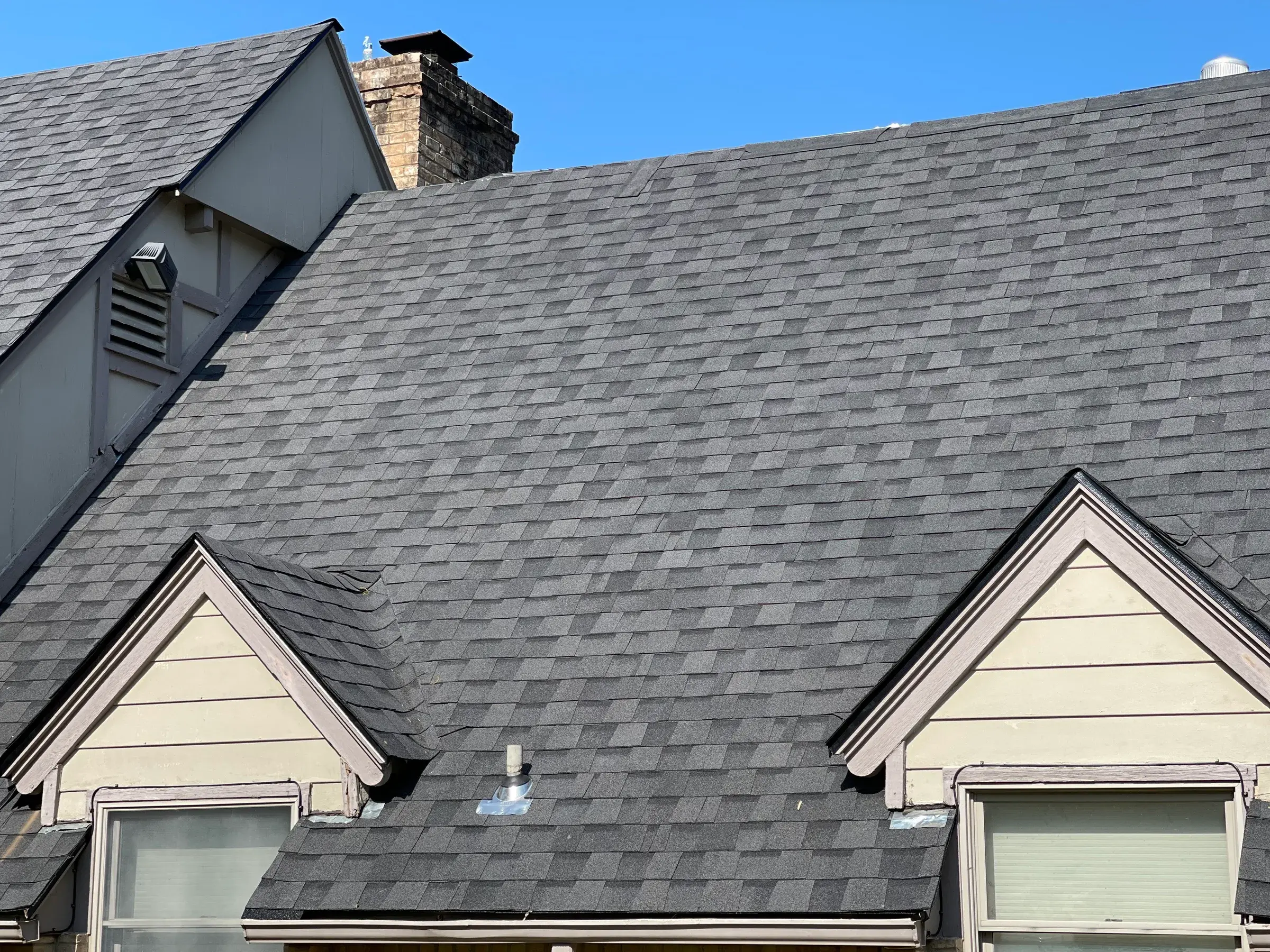
Actual cash value pays replacement cost minus depreciation for your roof's age and wear. Replacement cost value pays the full amount — but typically in two parts: an ACV check up front, then the recoverable depreciation released after the work is completed and documented. The gap between your estimate and your first check is usually that holdback.
The two settlement bases: actual cash value and replacement cost value
Every homeowners policy settles a covered loss on one of two bases. Your declarations page — the summary sheet at the front of the policy — names which one applies. Sometimes it names one basis for the house and a different one for the roof. That second line is the one almost nobody reads until the check arrives.
Actual cash value (ACV) is what your roof was worth the moment before the hail hit. It starts from what a new roof of like kind and quality would cost today, then subtracts value for age and wear. The Insurance Information Institute defines it plainly as replacement cost minus depreciation, and that is exactly the arithmetic an adjuster runs on the estimate.
Replacement cost value (RCV) is what it costs to put the same roof back today, at today's material and labor prices, with no deduction for age. An RCV policy still calculates depreciation. It just doesn't keep it — provided you meet the conditions written into the policy.
Neither basis is a reward or a punishment. They are two different products at two different premiums. The Oklahoma Insurance Department's homeowners consumer guide makes the same point: replacement cost coverage costs more up front and pays more after a loss, and that trade gets made when you buy or renew the policy — not after the storm.
Depreciation explained: how age and remaining life reduce the number
Depreciation is not a judgment that your roof failed. It is an accounting of the service life the roof already used up before the storm arrived. A roof is a consumable. The policy is designed to pay you for the part you hadn't consumed yet.
The usual method is age against expected service life. A shingle roof with a 30-year expected life that is 20 years old has burned through roughly two-thirds of its life, so roughly two-thirds of the replacement cost gets depreciated out. Adjusters apply this line by line — shingles, felt, ridge cap, drip edge, pipe boots — not as one lump percentage. That is why the estimate is eight pages long.
Condition modifies the age. Two roofs installed the same week in Ottawa County can depreciate differently because one bakes in full sun and the other sits under oaks on the east side of the county. The Oklahoma Climatological Survey's 1991–2020 normals for this area describe the wear pretty well: 57 days a year above 90°F, five above 100°F, 89 nights a year below freezing, and roughly 62 percent of possible sunshine. Heat drives off the volatile oils in asphalt. Freeze-thaw cycling works the mat. UV takes the granules. Add the 4 to 5 days a year the Survey records with hail larger than three-quarters of an inch, and a 20-year-old Miami roof has genuinely lived a 20-year life.
So when your adjuster writes "20 years old" on the first page, that single fact is doing more work in the settlement math than the size of the hailstones. Whether the damage is covered at all is a separate question — we walk through that in [does homeowners insurance cover hail damage to a roof](/blog/does-homeowners-insurance-cover-hail-damage-roof). Depreciation only comes into play once coverage is already established.
Recoverable vs. non-recoverable depreciation — the distinction that decides everything
Both kinds of depreciation come out of your first check. They look identical on the first page. They are not remotely the same thing.
| Question | Recoverable depreciation | Non-recoverable depreciation |
|---|---|---|
| Is it withheld from the first check? | Yes | Yes |
| Can you ever get it? | Yes — after the work is completed and documented to the insurer's satisfaction | No. It is gone at settlement. |
| Which policies use it? | Replacement cost (RCV) policies | ACV policies, and RCV policies carrying a roof-specific settlement endorsement |
| What triggers payment? | Proof the work was actually performed — typically a final invoice and completion documentation | Nothing. There is no second payment. |
| Is there a deadline? | Yes. Policies set a window to complete the work and claim it. Yours names the window. | Not applicable |
| What it's called on the claim summary | "Recoverable depreciation" or "holdback" | "Non-recoverable depreciation" or "NR depreciation" |
| Effect on your out-of-pocket | You end up paying your deductible | You pay your deductible plus the entire depreciated amount |
A worked example: same roof, ACV policy vs. RCV policy, side by side
The numbers below are invented for illustration. They are not a quote, not local pricing, and not our cost data — they are round figures chosen to make the arithmetic legible. Your roof, your policy and your carrier's estimate will produce different numbers.
| Line on the estimate | ACV policy | RCV policy |
|---|---|---|
| Replacement cost of the roof | $18,000 | $18,000 |
| Depreciation for age and wear | −$6,000 | −$6,000 |
| Actual cash value | $12,000 | $12,000 |
| Your deductible | −$2,000 | −$2,000 |
| First check from the insurer | $10,000 | $10,000 |
| Status of that $6,000 | Non-recoverable — the claim ends here | Recoverable — held back pending completed work |
| Second check after the work is documented | $0 | $6,000 |
| Total the insurer pays | $10,000 | $16,000 |
| Your out-of-pocket on an $18,000 job | $8,000 | $2,000 — your deductible |
Same roof. Same hail. Same adjuster, same software, same estimate. A $6,000 difference in what you pay, decided entirely by one line on a page you filed away years ago.
Now look at the row that matters most: the first check is identical in both columns. Ten thousand dollars either way. Nothing about that check tells you which policy you have. Homeowners routinely assume the small check means they were shorted, when on an RCV policy it means the process is working exactly as written — and homeowners on an ACV policy routinely assume more money is coming when it isn't. Both mistakes come from the same page.
How the roof payment schedule endorsement changes an RCV policy into something else
Here is the part that catches people who did their homework and bought replacement cost coverage on purpose.
An endorsement is an amendment attached to your policy that changes the base terms. Carriers have increasingly attached roof-specific endorsements that settle roof losses on a sliding scale tied to the roof's age and material, regardless of what the dwelling's settlement basis says. The names vary: roof surfacing payment schedule, roof settlement endorsement, "ACV loss settlement — windstorm or hail losses to roof surfacing." The mechanism is the same. There's a table in the endorsement. It pays a scheduled percentage of replacement cost based on how old the roof is.
The practical effect is that an RCV policy pays your walls, gutters and siding on a replacement cost basis while paying your roof on something much closer to actual cash value, with the depreciation marked non-recoverable. The percentages in those schedules vary by carrier, by material, and by policy year, so no article can tell you what yours says. It is a page in your policy. Go read it.
This is also why the NAIC's work on homeowners policy settlement provisions treats roof surfacing as its own topic rather than lumping it in with the structure. The roof can and often does settle on different terms than the house it sits on.
The tell is easy to spot once you know it: your declarations page says replacement cost, but the claim summary comes back with recoverable depreciation on the gutter and siding lines and non-recoverable depreciation on the roof lines. That's not an error. That's the endorsement doing its job.
Why the first check is an ACV check even on an RCV policy
Replacement cost policies do not prepay. The standard loss settlement language pays actual cash value first, and pays the replacement cost difference only after the damaged property has actually been repaired or replaced. The reason is straightforward: it stops a claim from becoming a cash-out. The policy is built to put the roof back, not to write you a check for a roof you might not install.
So the first check is not a lowball, an opening offer, or an insult. It's the contract executing as drafted. Arguing about the size of the first check on an RCV claim is arguing with a paragraph you agreed to.
The number to compare that check against is not the RCV total on page one. It's the ACV subtotal near the end of the estimate, minus your deductible. If those match, the carrier did what the policy says. If they don't, that's a real question worth asking — and it's a different conversation than a denial. If your claim was declined outright rather than underpaid, [what to do about a denied roof claim in Oklahoma](/blog/denied-roof-insurance-claim-oklahoma) covers that path.
| Step | What happens | Money movement |
|---|---|---|
| 1. Inspection and estimate | The adjuster scopes the damage, writes replacement cost, subtracts depreciation to reach ACV, then subtracts your deductible. | Nothing moves yet. This is paperwork. |
| 2. First check | The insurer pays the ACV amount less your deductible. | ACV − deductible → you, and possibly your mortgage servicer as co-payee. |
| 3. Contract signed | You hire a contractor at a contract price. Your insurer is not a party to that contract and does not set the price. | Nothing moves. |
| 4. Work performed | Tear-off, deck inspection and repair, new roof, permit finaled. | You pay the contractor per your contract terms. |
| 5. Completion package submitted | Final invoice, dated photos, permit documentation and any supplement go to the insurer. | Nothing moves yet. |
| 6. Depreciation released | The insurer pays the recoverable holdback, subject to policy limits and what was actually spent. | Holdback → you, and possibly through escrow again. |
| 7. Reconciliation | The contract is paid in full. | Your deductible always comes out of your pocket. Never the insurer's. Never the contractor's. |
Releasing depreciation: what you must do and by when
Depreciation is released by evidence, not by asking nicely. The insurer needs to see that the roof it depreciated was actually replaced, and that what got installed matches what got paid for.
There is a clock. Policies set a window from the date of loss to complete the work and claim the recoverable amount. Miss it and recoverable depreciation quietly becomes non-recoverable. That window is named in your policy, and it's the single best reason not to spend four months collecting bids.
On our side, the role is narrow and specific: we document the damage with a photo report, we provide a written estimate for the work we would perform, and when the job is done we provide a completed-work invoice with photographs and permit documentation you can submit. We can meet your adjuster on the roof if you ask us to. What we don't do is file, negotiate, or press your claim for you — under 36 O.S. §6202 and §6220, a contractor who represents an insured's interests for compensation is acting as a public adjuster, and doing that without a license is a misdemeanour in Oklahoma. A signed authorisation doesn't cure it. Your insurer decides coverage under your policy. Our [insurance claim assistance](/services/insurance-claim-assistance) page spells out exactly where that line sits.
What to submit to release depreciation
- Your claim number and date of loss on every single document
- A final invoice from the contractor showing the completed scope and the actual contract price
- Proof of payment, or the payment schedule showing what you have paid and what remains
- Dated photographs of the finished roof — and of the bare deck once the old roof came off
- The City of Miami re-roof permit (or your own municipality's), showing the job was permitted and finaled
- Documentation of anything found after tear-off that changed the scope — rotten decking, a second layer, missing drip edge — with photos, submitted as a supplement for your insurer to review
- Material documentation: product, colour and the manufacturer's specification sheet, if a like-kind-and-quality question comes up
- A copy of the signed contract, if your carrier asks for it
- Written confirmation from your adjuster of anything else they require — requirements genuinely vary carrier to carrier
If you want the whole sequence from first phone call to final check laid out in order, we've written it up separately in [the Oklahoma roof insurance claim process](/blog/oklahoma-roof-insurance-claim-process).
Your deductible and the mortgage company: where the rest of the money goes
Your deductible is your money. It does not get waived, discounted, absorbed, rebated, credited, or creatively worked around. Under 59 O.S. §1151.30, it is unlawful in Oklahoma for a contractor to advertise or promise to pay any part of an insurance deductible, directly or indirectly. The same statute bars offering an insured anything of value in exchange for a service — which sweeps in yard-sign credits, referral bonuses, and paid reviews on insurance jobs. The legislature amended it again effective 1 November 2025 under HB 1257.
Check the deductible line on your declarations page for one specific thing: whether wind and hail carry a separate percentage deductible instead of the flat dollar amount you're used to. A percentage deductible is calculated against your dwelling coverage limit, not your home's market value, and it is often several times larger than the all-peril deductible sitting one line above it. Do that multiplication now, on a quiet afternoon, rather than the week after a storm.
If you carry a mortgage, the check will very likely name both you and your servicer. The Consumer Financial Protection Bureau describes how servicers handle insurance proceeds: they endorse the check, hold the funds, and release them in draws as work progresses, frequently requiring their own inspection before the final release. Call your servicer's loss draft department the day the check lands. Ask four things — how to endorse and return it, what the draw schedule is, whether an inspection is required and when, and whether the depreciation release runs through the same process. That call is what separates a job that starts in two weeks from one that starts in two months.
One more Oklahoma-specific point. Under 36 O.S. §1230, Oklahoma voids the assignment of insurance benefits. No contractor here can take an assignment and bill your insurer directly, whatever the door-knocker's clipboard says. The money runs through you. Worth knowing if you own property on both sides of the state line: Kansas permits contractor assignment subject to conditions, so a house in Baxter Springs and a house in Miami are not under the same rules.
Overhead and profit, sales tax, and other line items people miss
Once you've found the depreciation lines, keep reading. Several other lines move the total, and they're easy to skim past.
Overhead and profit (O&P)
General contractor overhead and profit usually appear as two separate percentage lines near the bottom of the estimate. They compensate the coordination of multiple trades on a job complex enough to need it. Whether O&P applies to your loss is your carrier's determination under your policy language. The thing to check is mechanical: if O&P appears in the replacement cost column, confirm it also appears in the actual cash value column. Its absence from one side changes the size of your first check.
Sales tax and permit fees
Oklahoma taxes roofing materials, and that tax belongs on the estimate as its own line — in both columns. The City of Miami requires a permit for new roofs and re-shingles. We pull it on the jobs we do. If there's no permit line on an estimate, that's a missing line item, not a contractor doing you a favour.
Tear-off versus shingle-over
Oklahoma amended section R908.3.1.1 of the residential code to require tear-off rather than laying new shingles over old in defined conditions. This is the most useful code fact in the state for a claim conversation. If an estimate priced a layover and the current Oklahoma residential code requires a tear-off on your roof, that is a scope discrepancy supported by a published code section — documentation, not argument. It's also why our [roof replacement](/services/roof-replacement) scope always starts at the deck.
Ordinance or law, labour depreciation, and supplements
Ordinance or law coverage pays to bring a repair up to current code and carries its own separate limit. Some policies include a modest amount, some don't include it at all. It's on the declarations page. Separately, some carriers depreciate labour as well as materials and some depreciate only materials — this materially changes the ACV number, and it shows line by line on the estimate. And when the old roof comes off, the deck is visible for the first time: bad sheathing, a hidden second layer, flashing that was never installed right. Those get photographed and submitted as a supplement, and your insurer decides whether they're covered.
While you're on the phone with your insurer, ask one forward-looking question: whether they offer a premium credit for impact-resistant Class 4 shingles. Oklahoma does not require carriers to offer one, so the answer varies by company. Only your insurer can tell you what, if anything, is available on your policy.
How to check which basis applies to your roof before a storm ever comes
This takes fifteen minutes on a calm Saturday and it is worth more than anything else in this article. Do it before hail season, not during it.
- Pull your declarations page — the front summary, not the 60-page policy booklet. Your agent will email it same-day if you can't find it.
- Find the loss settlement provision for Coverage A (the dwelling). Look for the words "replacement cost" or "actual cash value."
- Now hunt specifically for a roof line or roof endorsement. Names to watch for: roof surfacing payment schedule, roof settlement endorsement, or ACV loss settlement for windstorm or hail losses to roof surfacing. If one exists, your roof is on different terms than the rest of your house.
- Find the wind and hail deductible. Confirm whether it's a flat dollar figure or a percentage of the dwelling limit. If it's a percentage, do the multiplication and write the real number in the margin.
- Find the deadline for completing work and claiming recoverable depreciation.
- Check whether ordinance or law coverage exists and what its limit is.
- Email your agent and ask them to confirm in writing what basis the roof settles on, and what it would cost to change it at renewal. Agents field this question constantly. It is not an imposition.
- Ask your insurer whether a Class 4 impact-resistant shingle credit is available on your policy.
Glossary of the terms on your claim paperwork
| Term | What it means on your paperwork |
|---|---|
| ACV (actual cash value) | Replacement cost minus depreciation. What the roof was worth the instant before the loss. |
| RCV (replacement cost value) | What it costs to put the same roof back today, with no deduction for age. |
| Depreciation | Value subtracted for the service life the roof had already used up. Calculated from age, expected life, and condition. |
| Recoverable depreciation (holdback) | Depreciation withheld from the first check that the insurer will pay after the work is completed and documented in time. |
| Non-recoverable depreciation | Depreciation withheld permanently. No second check exists. |
| Roof payment schedule | An endorsement that settles roof losses on a percentage scale tied to the roof's age and material, regardless of the policy's general settlement basis. |
| O&P (overhead and profit) | Two percentage lines for general contractor coordination. Check whether they appear in the ACV column as well as the RCV column. |
| Mortgagee endorsement | The provision naming your lender as a payee on claim checks. It's why the servicer's loss draft department controls the money. |
| Supplement | A documented request to add scope the adjuster couldn't see until the old roof was off — bad decking, a hidden layer, missing flashing. |
If you're not sure whether the storm did anything to your roof in the first place, that's the easier question to answer. We'll come out for a free inspection, and you'll get a photo report of what's actually up there and a written estimate for the work we'd perform — yours to keep, use, or ignore. There's no obligation attached to either. You can [book an inspection](/services/roof-inspections) whenever it suits you, and verify our Construction Industries Board registration at verifyroofing.cib.ok.gov before we ever set a ladder against your house.
We are roofing contractors, not public adjusters or insurance attorneys. Coverage decisions are made by your insurer under your policy.
Questions people ask about this
Why is my insurance check so much smaller than the estimate?
Almost always because depreciation was withheld. The estimate shows replacement cost, but the check pays actual cash value — replacement cost minus depreciation — and then your deductible comes off that. On a replacement cost policy, the withheld depreciation is recoverable and gets paid after the work is completed and documented. On an actual cash value policy, or an RCV policy carrying a roof payment schedule endorsement, that money is non-recoverable and no second check is coming. The word in front of "depreciation" on your claim summary tells you which situation you're in.
How do I know if my depreciation is recoverable or not?
Look at your adjuster's claim summary — it will read "recoverable depreciation" or "non-recoverable depreciation," sometimes abbreviated as NR. If it isn't clear, ask your adjuster to confirm it in writing before you commit to a scope of work. Also check your declarations page for a roof-specific endorsement, because an RCV policy can still settle the roof on a non-recoverable basis while paying the siding and gutters at full replacement cost.
Can Absolute Royalty Roofing get my depreciation released for me?
No, and no roofer in Oklahoma should tell you otherwise. Under 36 O.S. §6202 and §6220, a contractor who represents an insured's interests to their carrier for compensation is acting as a public adjuster, and doing that without a license is a misdemeanour — a signed authorisation doesn't change that. What we can do is document the damage with a photo report, provide a written estimate for the work we'd perform, and hand you a completed-work invoice with photos and permit documentation for you to submit. We can also meet your adjuster on the roof if you ask. Your insurer decides coverage under your policy.
Is there a deadline to claim recoverable depreciation?
Yes, and it's set by your policy, not by state law or by your contractor. Policies specify a window from the date of loss to complete the repairs and claim the recoverable amount. Miss it and recoverable depreciation effectively becomes non-recoverable. Find that window on your policy before you start collecting bids — it's the main reason a long shopping process can cost you real money.
A contractor offered to cover my deductible if I sign today. Is that allowed in Oklahoma?
No. Under 59 O.S. §1151.30, it is unlawful for a contractor to advertise or promise to pay any part of an insurance deductible, directly or indirectly, and the statute also bars offering an insured anything of value in exchange for a service — which covers yard-sign credits, referral payments, and paid reviews on insurance jobs. It was amended again effective 1 November 2025 under HB 1257. Beyond the legality, the money usually comes from an inflated invoice sent to your insurer with your name on it. You can check any Oklahoma roofer's registration status free at verifyroofing.cib.ok.gov.