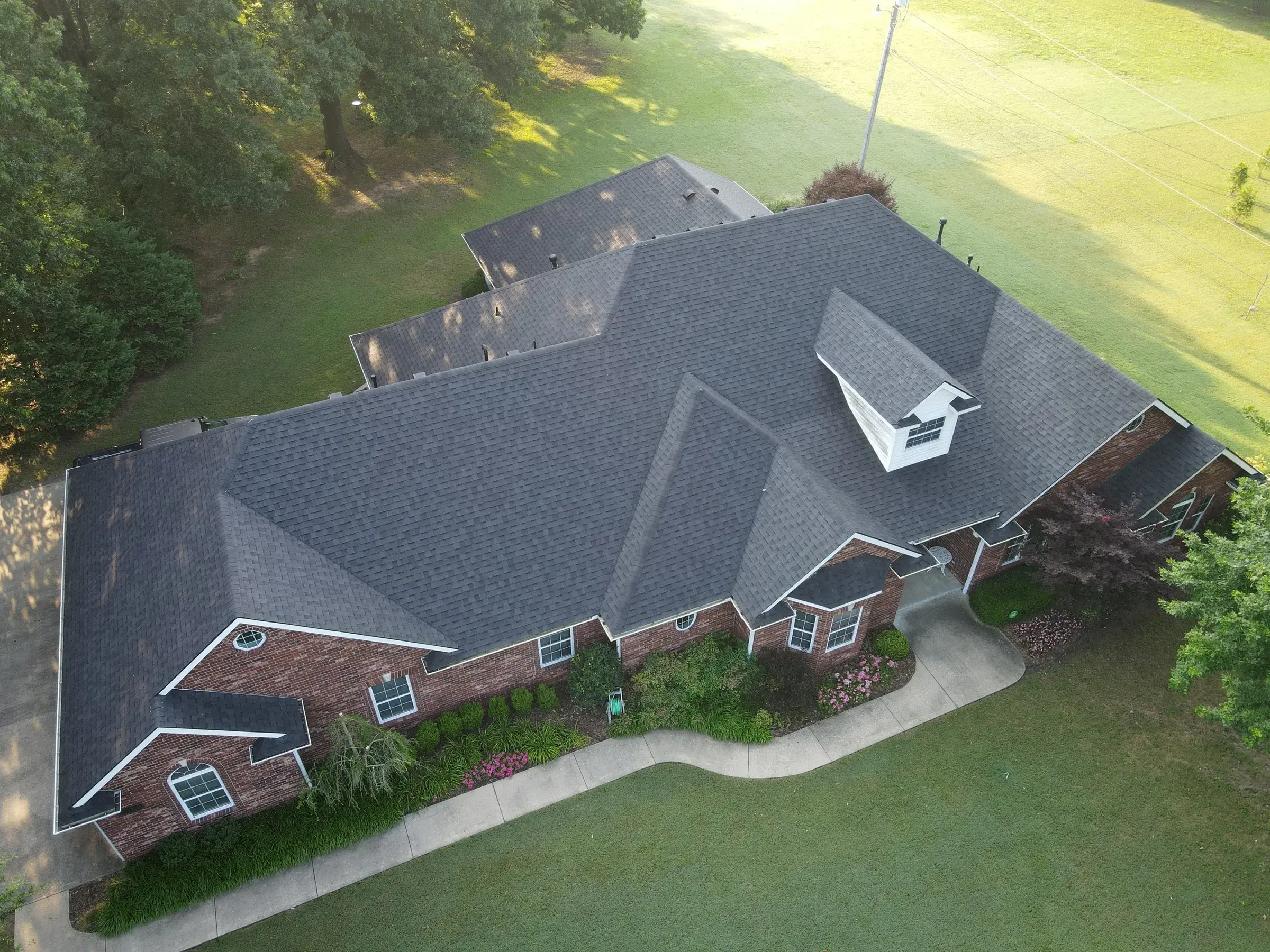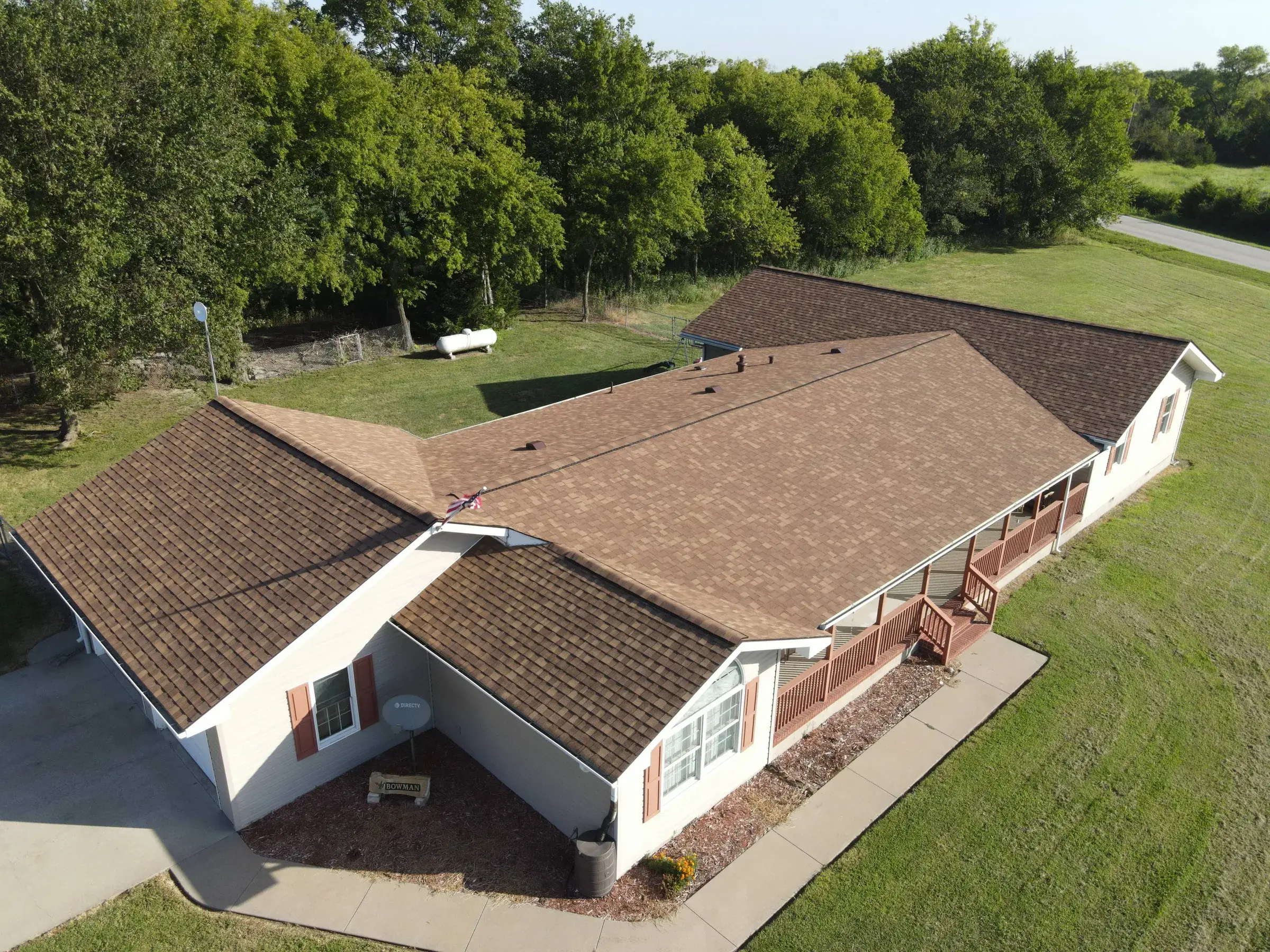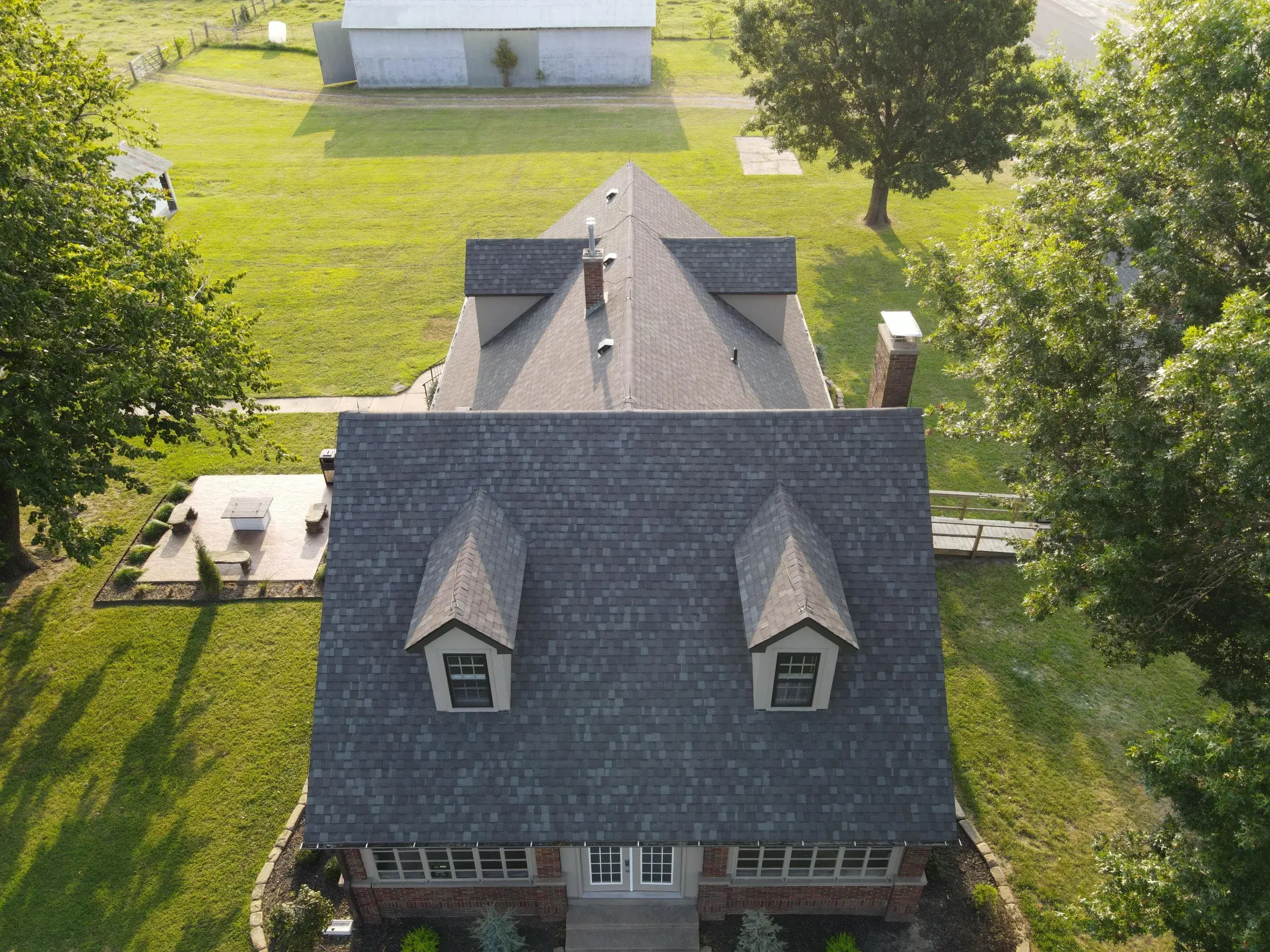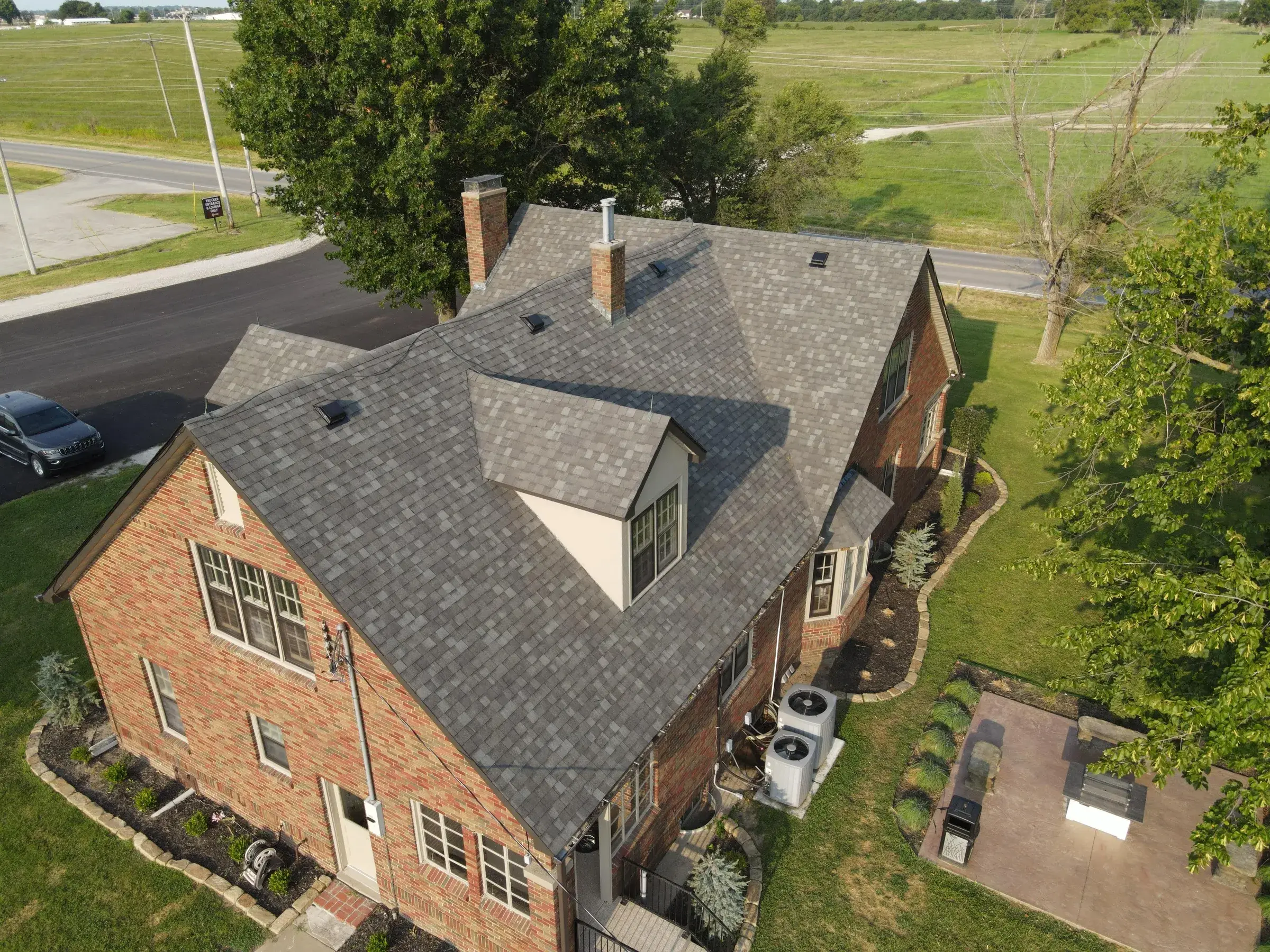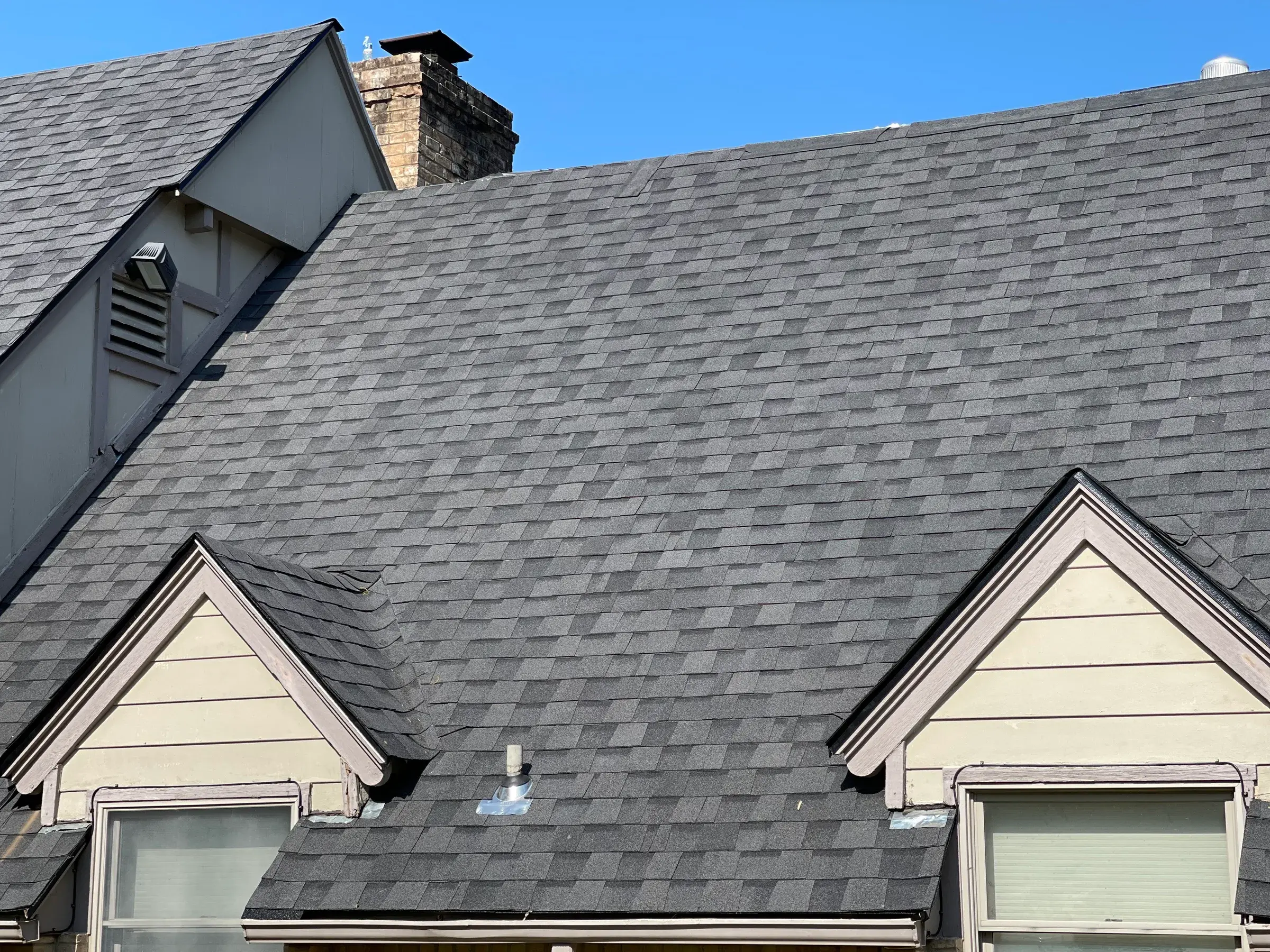
Adjusters are answering three questions: what caused the damage, is it functional rather than cosmetic, and how widespread is it. They typically mark test squares on each slope, count qualifying hits, check directionality against the storm, and compare the roof against wear-and-tear indicators before deciding between repair and replacement.
The three questions every adjuster is answering
An adjuster is not on your roof to decide whether it looks bad. Looks are not a peril. A roof can look rough and still be denied, and a roof that looks fine from the driveway can be totaled. The visit is narrower than most homeowners expect, and once you know its shape, most of what happens up there stops feeling arbitrary.
- What caused this? The policy pays for damage from a covered cause of loss — hail, wind, a falling limb. It does not pay for a roof getting old.
- Is the damage functional? Functional means the shingle's ability to shed water or reach its service life has been affected. Cosmetic means it looks different but still works.
- How much of the roof is affected? One slope or four. A dozen shingles or the whole field. This is the question that decides repair versus replacement.
All three have to land. A roof can have obvious hail bruising and still be scoped as a repair, because only one slope took it. A roof can have marks on every slope and still be denied, because the adjuster attributed those marks to weathering rather than to the storm you filed on. Homeowners tend to argue about the third question when the decision was actually made on the first.
The Insurance Information Institute describes the role plainly: the adjuster investigates the claim and estimates the loss on behalf of the insurance company. That is not a hostile relationship. It is an accurate one. The adjuster is applying your policy's language to what is physically on your roof. Knowing that changes how you prepare — you show up with evidence instead of an argument. If you want the logistics of the visit itself, we cover that in our piece on <a href="/blog/roof-insurance-adjuster-meeting">meeting your roof insurance adjuster</a>.
Test squares and hit counts: how damage density gets measured
A test square is exactly what it sounds like. It is a 10-foot by 10-foot area — 100 square feet — chalked onto a roof slope. That 100 square feet is also one "square" of roofing, the unit the whole industry prices in. The adjuster counts qualifying impact marks inside that box and treats the result as a sample of the entire slope.
The method comes out of the engineering literature. Haag Engineering's published guidance on hail damage assessment is the most widely used reference in the field for this approach: mark representative squares, count only the impacts that actually fractured the shingle mat, and evaluate density slope by slope rather than roof-wide. Many carriers train to some version of it. Not all do, and the specific numbers move.
| Slope | Area sampled | Qualifying hits counted | How that pattern is commonly read |
|---|---|---|---|
| North-facing | 10 ft × 10 ft (100 sq ft = 1 square) | 11 | Dense and directional — consistent with a storm driving hail out of the north |
| West-facing | 10 ft × 10 ft | 9 | Damage present at similar density; same exposure to the storm's wind |
| South-facing | 10 ft × 10 ft | 1 | Essentially clean — the sheltered side of the same event |
| East-facing | 10 ft × 10 ft | 0 | Essentially clean — supports a directional cause rather than age |
| Whole roof (30 squares) | 4 squares actually sampled | Scaled from the samples | Sampling is extended to the slope, not counted shingle by shingle — which is why square placement matters |
Thresholds vary by carrier and by adjuster. Somewhere in the range of eight to ten qualifying hits per 100-square-foot square is a common convention for calling a slope damaged, but it is a convention — not a rule, not a law, and not something any contractor can promise your carrier will use. Some files turn on fewer hits with strong corroboration. Some carriers require the pattern to repeat across multiple squares on the same slope.
Notice what sampling does and does not do. On a 30-square roof, nobody is inspecting 3,000 square feet of shingle. Four 100-square-foot samples get read and extended. That is why placement is worth watching. A square chalked over a shaded, mossy patch under the trees will read differently from one chalked mid-field in the open. You are allowed to ask why a square was placed where it was placed.
Directionality: why hits on one slope and not another matters
Hail does not fall straight down in a thunderstorm. It is driven sideways by the storm's wind. NOAA's National Severe Storms Laboratory explains hail's impact energy as a product of stone size and fall speed — larger stones fall faster and hit harder — and the storm's wind adds a horizontal push to all of it. The result on a roof is lopsided by nature. Directional damage is what a real hail event looks like.
So an adjuster who finds heavy bruising on the north and west and almost nothing on the south and east is looking at a pattern that fits a storm. An adjuster who finds marks evenly scattered across all four slopes at the same density is looking at something else — usually manufacturing blisters, foot traffic, or ordinary weathering. Uniformity is the tell for age. Lopsidedness is the tell for weather.
Where the house sits changes the picture, and Ottawa County is split right down the middle. East of Miami is Ozark Plains country — rockier, wooded, rolling. West is the Neosho Lowlands, flat prairie and farmland. A house on the open west side has nothing between it and the wind, so directional patterns tend to come out clean and obvious. A house tucked under a canopy on the east side may have one slope shielded by trees and another fully exposed, which can make a genuine storm read as patchy. If your roof has an odd shadow of damage, the trees around it are part of the explanation.
Adjusters also check soft metals as a control. Gutter faces, downspouts, aluminum fascia, drip edge, roof vents, turbine caps, the fins on your AC condenser, even a mailbox. Soft metals dent easily and they do not age into dents. If the storm-facing soft metals are spattered and the sheltered ones are clean, that corroborates the roof. If nothing on the entire property carries a mark, a slope full of dark spots is a much harder sell — and it should be.
Cause of loss: hail, wind, debris, mechanical, or age — and why they must separate them
Miami gets hail regularly. The Oklahoma Climatological Survey's 1991–2020 normals put this area at roughly four to five days a year with hail larger than three-quarters of an inch. Over a 20-year roof, that is a lot of chances. Add wind, add limbs, add whatever a previous roofer's boots did around the vents, and a single roof can carry marks from half a dozen unrelated causes. Sorting those apart is most of the job.
- Hail: a random spatter pattern with no rhythm to it, granule loss with a fractured mat underneath, a spot that gives slightly under a thumb, matching spatter on nearby soft metals, and concentration on storm-facing slopes.
- Wind: creased or folded tabs, broken seal strips, shingles missing outright, damage starting at rakes, eaves and ridges where uplift pressure is highest — not scattered across the middle of a slope.
- Debris: gouges, scrapes and punctures that have a direction to them. A limb drags; a hailstone drops. Common on the wooded east side of the county after a windy night.
- Mechanical: crushed granules in a boot-shaped path, damage clustered around a satellite dish or a vent somebody serviced, marks that stop where the walkable route stopped.
- Age and manufacture: blisters (small round pops with no mat fracture beneath), thermal cracking, curled edges, and uniform granule loss down the drainage paths — present on every slope equally and worst where the sun sits longest.
Separating causes is not bureaucratic fussiness. Your policy attaches to a date of loss and a deductible. Damage from a covered wind event two weeks ago is a claim. Blistering baked in over years of heat — the Oklahoma Climatological Survey counts 57 days a year above 90°F here, with an August normal daily high of 91.5°F — is not, no matter how bad it looks. Our article on <a href="/blog/hail-damage-vs-wear-and-tear">hail damage versus wear and tear</a> goes further into that line, and <a href="/blog/hail-damage-roof-identification">identifying hail damage</a> covers what a bruise looks like up close.
Functional vs. cosmetic damage, and the line between them
This is where most honest disagreements live. Inside an asphalt shingle is a fiberglass mat — the structural layer the asphalt and granules are built around. A hail bruise is a fracture of that mat. It usually shows as a dark, granule-free spot that gives a little under thumb pressure, like a bruise on fruit. Granules gone with the mat still intact underneath is a different thing. It looks bad and it is not, by most carriers' reading, functional damage.
Age complicates it. IBHS research on roof performance has documented that weathered shingles respond to impact differently than new ones — asphalt stiffens as it ages, and a hardened shingle can fracture at an impact energy a newer one would have absorbed. That cuts both ways in a claim file. It is a reason your 16-year-old roof genuinely bruised in a storm your neighbor's new roof shrugged off, and it is also a reason the adjuster looks hard at whether age, not the storm, did the work.
| Indicator | Commonly read as functional | Commonly read as cosmetic |
|---|---|---|
| Asphalt shingle impact | Mat fractured beneath the granule loss; the spot gives under thumb pressure; asphalt exposed | Granule scuffing or a shiny spot with the mat sound underneath |
| Ridge and hip caps | A fracture through the cap at the fold — the highest-stress line on the roof | Surface abrasion or granule loss on the cap face |
| Wind on shingles | Seal strip broken, tab creased or folded back, shingle gone | A tab that looks lifted but is still sealed and lays back flat |
| Metal panels, vents, flashing | Punctured, split seam, or a dent that breaks the coating or holds water | A dent that does not breach the coating and does not change how water leaves |
| Gutters and downspouts | Dents that pull the gutter out of pitch or split a seam so it leaks | Dents on the gutter face that still drains normally |
| Skylights and vent housings | Cracked lens, split housing, damaged flashing at the curb | Scratches or scuffs on the frame |
Read your declarations page before anyone climbs the roof. Some policies carry a cosmetic damage exclusion, most often aimed at metal roofing. Many carry a separate wind and hail deductible written as a percentage of the dwelling coverage rather than a flat dollar figure, which changes the math on whether filing makes sense at all. Both live in your own paperwork. Your insurer decides coverage under your policy, and reading it first is the cheapest thing you can do all week.
Repair vs. replace: slope counts, matching, and discontinued materials
Once cause and function are settled, the scope question is arithmetic plus judgment. How many slopes qualified, can the damaged components be repaired in place, and can the repair be made to blend and function. A roof does not get replaced because it is old. It gets replaced when repairing the covered damage is not a real option.
| Factor | Points toward repair | Points toward replacement |
|---|---|---|
| Hit density in test squares | Below the carrier's threshold on most slopes | At or above the threshold on multiple slopes |
| Slopes affected | One slope, localized area | Several slopes, especially the storm-facing ones |
| Where the damage sits | Isolated flashing, a few field shingles | Field, ridge, hips and penetrations all hit |
| Matching material | Same brand, line, profile and color still available | Line discontinued, or existing shingles weathered past any reasonable match |
| Existing layers and deck | Single layer over sound decking | Conditions where Oklahoma's amended code requires a full tear-off rather than a shingle-over |
| Roof age and condition | Newer roof, otherwise sound and sealing | Aged, brittle shingles where new repairs will not seal to the old ones |
| Corroborating evidence | Little to no soft-metal spatter | Directional spatter across soft metals, screens and trim |
The code detail is worth knowing because it can decide a scope. Oklahoma amended the residential code's reroofing section — IRC R908.3.1.1 — to require a tear-off rather than a shingle-over in defined conditions. If a roof legally cannot be layered over, then the cheap version of a repair is off the table before anyone argues about it. The current Oklahoma residential code governs, and the City of Miami requires a permit for new roofs and re-shingles. We pull it.
Matching is the other pressure point, and shingle lines get discontinued constantly. If yours is gone, a repair leaves a patch that will never blend — different color, sometimes a different profile height. Policies handle matching differently and your insurer decides how yours reads. What you can do is nail down the facts: brand, line, color, and whether a supplier can still source it. Establishing that is part of what a real <a href="/services/roof-inspections">roof inspection</a> should document, and it is the difference between a scope conversation and a guess. If the answer does come back as a full <a href="/services/roof-replacement">roof replacement</a>, those documented facts are what the estimate is built on.
Age, prior claims, and pre-existing conditions in the file
Age shows up twice, and the second one surprises people. First, it factors into whether the damage is storm-caused or wear. Second, and separately, it can drive what the claim pays even after approval. Many policies on older roofs are written on actual cash value for the roof, or carry a roof payment schedule that depreciates by age and material. An approved claim on a 19-year-old three-tab under an ACV policy is still an approved claim — it just may not pay much after depreciation and the deductible. Approval and payment are two different events.
Carriers keep claim history, and it travels. If a roof was paid for after a prior storm and never actually replaced, that tends to surface. If two different dates of loss get claimed for the same slope, that surfaces too. Pre-existing conditions get photographed and noted the same way: an unrepaired ridge, a soft spot in the decking, an old repair done in mismatched shingles, a plumbing boot that cracked three summers ago. Noted usually means subtracted.
None of that is a reason to skip filing. It is a reason to know what you are holding before you do. Our walkthrough of the <a href="/blog/oklahoma-roof-insurance-claim-process">Oklahoma roof insurance claim process</a> lays out the sequence and where each decision gets made.
Interior and collateral damage as corroboration
The roof is not the only evidence on the property. Adjusters read the whole site, because a hailstorm big enough to fracture shingle mats leaves a trail everywhere else. Collateral damage is what turns a debatable slope into a documented event — and most of it sits at eye level where you can photograph it yourself before anyone arrives.
Collateral evidence worth pointing out (and photographing)
- Soft metals: gutter faces, downspouts, aluminum fascia, drip edge, roof vents, turbine caps, AC condenser fins
- Window screens and window wrap on the storm-facing elevation
- Deck boards, wood fence rails and painted trim showing fresh, bright spatter marks
- Grill lids, mailboxes, garage door panels — any painted metal that was outside that day
- Ceiling stains, especially near penetrations: bath fans, plumbing boots, chimneys, skylights
- In the attic: daylight at nail holes, wet or stained sheathing, damp insulation, water tracks on rafters
- Fresh granule piles at the bottom of downspouts or in the splash blocks
Interior water is corroboration, not the claim itself. A ceiling stain proves the roof let water in. It does not prove hail did it — a stain can just as easily trace to a failed pipe boot that nobody caused. Adjusters read the interior and the roof together, and a stain directly under a bruised, fractured slope carries far more weight than a stain on its own.
What the adjuster is NOT there to do
A lot of frustration comes from expecting the wrong job from the visit. Here is what the role generally does not include.
- Not there to write you a roofing estimate. A scope of loss is what the carrier will pay to restore covered damage, priced from their estimating software. It is not a construction plan and it is not a bid.
- Not there to recommend a contractor. Some carriers have preferred programs; the choice of who works on your house is still yours.
- Not there to decide on the spot. Field adjusters typically document and submit; the file often gets reviewed by someone you will never meet.
- Not there to negotiate. Field authority is usually limited, and pressure applied on a roof mostly buys a tense afternoon.
- Not your advocate and not your adversary. The adjuster works for the carrier, applying your policy.
Where honest disagreements come from — and how supplements and appraisal address them
Two competent people can walk the same roof and reach different numbers without either of them lying. The usual friction points are narrow and specific: where the test squares were chalked, whether a given mark fractured the mat or only stripped granules, whether the damage belongs to the date of loss you filed on or an older one, whether a component can be repaired in place, and whether the scope accounts for what the job actually requires. Those are technical disagreements. They respond to photographs and measurements, not volume.
A supplement is a request to add to the scope after it has been written — usually because something was not visible when it was. A second layer found at tear-off. Rotted decking under an intact shingle. A ridge vent, a drip edge, code-required items the original scope missed. A contractor supplements over its own scope of work: the documented cost of what it is actually building. That is a document about the work, not an argument about your coverage.
When the disagreement is about the amount of the loss rather than whether it is covered at all, most policies contain an appraisal clause. Each side names an appraiser, the two appraisers select an umpire, and the resulting decision is binding on the amount. The Oklahoma Insurance Department publishes consumer guidance on appraisal and dispute resolution and accepts complaints from policyholders. Appraisal is not the tool for a coverage fight — if the carrier says the peril is not covered, that is a coverage dispute and a different road entirely.
| Term | What it means on a roof claim |
|---|---|
| Scope of loss | The carrier's written list of what it will pay to repair or replace, line by line, with quantities and prices. Not a contractor's bid. |
| Test square | A 10 ft × 10 ft (100 sq ft) area chalked on a slope. Qualifying impacts inside it are counted and treated as a sample of the whole slope. |
| Directionality | The lopsided pattern real storm damage leaves — heavy on the slopes facing into the storm's wind, light or clean on the sheltered ones. |
| Functional damage | Damage that affects the roof's ability to shed water or reach its service life — a fractured mat, a broken seal, a puncture. |
| Cosmetic damage | Damage you can see that does not affect performance. Some policies exclude it outright, most often on metal. |
| Matching | Whether replacement material can reasonably match what is already there. Discontinued lines and heavy weathering make it impossible, which pushes toward replacement. |
| Supplement | A request to add to the scope after it is written, for work that was not visible or was missed — a second layer, rotted decking, code items. |
| Appraisal | A policy provision for resolving a disagreement about the amount of loss. Two appraisers, one umpire, a binding decision on amount only — not on coverage. |
| ACV / RCV | Actual cash value is replacement cost minus depreciation. Replacement cost value is the full cost to replace. Which one applies to your roof is on your declarations page. |
If a storm has been through and you want a second set of eyes — before you file, or after a scope lands and something in it looks thin — we will inspect the roof at no charge, give you a photo report of what is actually up there, and provide a written estimate for the work we would perform. If you want us on the roof while your adjuster is there, ask and we will be. Your insurer decides coverage under your policy; we document the roof. We are at 111 S Main St in Miami, on the old Route 66 alignment, and the number is (209) 758-8550. Whoever you end up calling, check them first: Oklahoma requires a registered residential roofing contractor to carry at least $500,000 in liability insurance and to show its registration number in its advertising. You can verify any Oklahoma roofer, including us, at verifyroofing.cib.ok.gov.
We are roofing contractors, not public adjusters or insurance attorneys. Coverage decisions are made by your insurer under your policy.
Questions people ask about this
How many hail hits does an adjuster need to find to approve my roof?
There is no legal number. Many carriers work from a convention in the range of eight to ten qualifying hits per 100-square-foot test square before calling a slope damaged, and that convention traces back to published assessment methodology like Haag Engineering's. But thresholds vary by carrier and by adjuster, and no contractor can tell you what yours will use. A qualifying hit also has to fracture the shingle mat — scattered granule loss with sound mat underneath usually does not count toward the total.
Why did the adjuster approve only one slope when the whole roof is the same age?
Because hail is directional. It is driven sideways by the storm's wind, so it strikes the slopes facing into that wind and largely spares the rest — NOAA's National Severe Storms Laboratory describes impact energy as a function of stone size and fall speed, and the wind adds the horizontal push. Damage on one slope and not another is the signature of a real event, not evidence of a sloppy inspection. Uniform marks on all four slopes are more often read as age, blistering, or foot traffic.
My shingles are discontinued. Does that force a full replacement?
It pushes in that direction, but your insurer decides under your policy language. If the exact brand, line, profile and color are no longer available, a repair leaves a patch that will never blend, and matching provisions differ meaningfully from policy to policy. The useful thing you can do is establish the facts — brand, line, color, and whether any supplier can still source it — and get them documented in writing rather than debated on the roof.
Can my roofer deal with the insurance company for me?
Not in Oklahoma. Under 36 O.S. §6202, representing an insured's interests in a claim for compensation is public adjusting, and doing it without a license is a misdemeanor — a signed authorization from you does not change that. A roofer can document the damage with photos, give you a written estimate for the work it would perform, meet your adjuster on site if you ask, and explain the process. If you want someone to represent your interests in the claim itself, Oklahoma licenses public adjusters for that, and that is a separate person from your contractor.
The carrier's number is far below what the work costs. What are my options?
If the disagreement is about the amount of loss rather than whether the damage is covered, most policies contain an appraisal clause: each side names an appraiser, the two select an umpire, and the decision binds on amount. The Oklahoma Insurance Department publishes consumer guidance on appraisal and dispute resolution and accepts policyholder complaints. Separately, a contractor can supplement its own scope of work when something turns up that was not visible in the original estimate — rotted decking, a hidden second layer, code-required items.